

It is the Autumn of 1933. The summer had seen the cinema release of The Private Lives of Henry VIII featuring Charles Laughton, and an out-of-favour politician called Winston Churchill had made a speech warning of the dangers of German re-armament. In Wisbech – an unremarkable town in Cambridgeshire’s Fen country – a criminal case was the headline in the Wisbech Standard. The repercussions of this vaguely comical affair would later bring Wisbech into national focus.

Let the report in the Wisbech Standard tell the tale of these ruthless gangsters and their reign of terror which had the honest Fenland folk cowering in their beds and in fear of their lives.
“For five hours Dr H. C. Meacock (in the chair) and other magistrates sat, on Tuesday, at a special Wisbech Children’s Court listening to the evidence in an amazing series of thefts extending over two months, committed by a gang of young Wisbech schoolboys, five of whom were eventually ordered to be sent to an industrial school.”
Those who read – in an earlier Fully Booked True Crime feature – the sad tale of Horace Dimock, and the tragic events in Wisbech some twenty years earlier, may recall the name of Dr Meacock. It could be said that he had ‘previous’. Wasn’t he the man who, twenty years earlier, was most prominent in the sad case of Dr Dimock and The Wisbech Riots? He was, the very same. One of his fellow magistrates was a certain Mr Savory, seen here on the right of the good doctor.

So, what was the nature of the criminal career of these five lads? Were they emulating the deeds of Clyde Barrow and Bonnie Parker who were in the middle of their legendary crime spree a few thousand miles across the Atlantic? The crimes of The Wisbech Five were rather more mundane:
The defendants were first charged with stealing a purse containing a ten shilling note and 2s 6d in silver from the dwelling house of Annie Ward, at Wisbech, on September 5th.
Annie Ward, of Little Church Street, Wisbech, stated that she left her house at 11.55 am to go to a nearby baker’s establishment. When she returned five minutes later she found her purse missing from the mantelpiece.
Inspector Bush gave evidence of the enquiries he pursued after being informed of the loss, and read statements which he said were made by the defendants when he interviewed them.
The next charge was one of stealing a box of ante-serum for pigs and 5s worth of groceries, the property of Bert Clifton at Wisbech on September 1st.
Bert Clifton, a farmer, of Gedney, said that about 8 o’clock he left his motor car against the Canal railings near the Empire Theatre. In the car were some drums of ante-serum, which he valued at 22s 8d, and 5s worth of groceries. He was away from his car between 8pm and 10.45pm, and on leaving the Theatre he went direct to the car and did not miss the goods until he reached home.
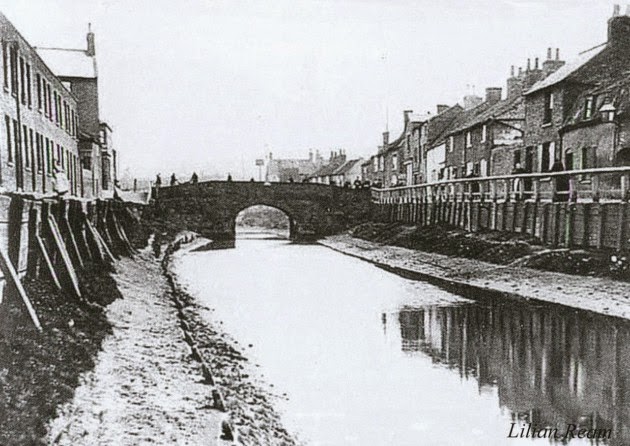
Inspector Bush stated that on September 11th and on subsequent dates he interviewed defendants, one of whom he said took the groceries out of the car and handed them to another of the defendants, who threw them into the canal. Witness added that one of defendants’ parents had rendered every assistance in trying to retrieve the goods from the canal (pictured below)
All the defendants pleaded guilty except one, whose father said that he was in the house at the time of the alleged crime.
The same boys were then charged with stealing a rib of beef and a carton of cream belonging to Susannah Winters, at Wisbech on the same date.
Susannah Winters said that she left her cycle in Clare’s Passage at about 6-40pm. On the handlebars was a basket containing a joint of meat worth 2s 3d, and a carton of cream, which had disappeared when she returned to her cycle at 6.55. Inspector Bush spoke of interviewing defendants, one of whom said that one of the others took the meat home and had it cooked. This was denied by the parent. Mr A R Bennett, headmaster of the Queen’s School and Mr A V Thompson, headmaster of St Peter’s School were present when witness interviewed defendants.
Five of the boys were then charged with stealing cycle lamps at Wisbech on September 8th and 9th, the property of William Callaby, James John Harrop, Kate Rose, and another. Inspector Bush gave evidence in each case.
A charge of stealing two purses and 9d in money, the property of Ivy Irene Hurst, and another, at Wisbech on September 9th was brought against four of the boys. Ivy Irene Hurst said that she went to the Swimming Bath on the date in question, with a friend. After she had left the water, and dressed, she took her shopping bag, which contained her own handbag, inside which was her friends purse, and placed it in her friend’s cubicle. A few minutes later they both went back to the cubicle and found that the purses had been taken from the bag. Witness valued the handbag at 7s 6d. Jean Parlett corroborated the previous witness’s evidence. Inspector Bush said he interviewed defendants, who admitted being there.
Another summons was for stealing half a pound of butter, a box of Aspro tablets and two cycle spanners, at Wisbech on September 9th. Dolly Mary Willimott Barber stated that she left her cycle outside 6, The Crescent at about 6-15pm. On returning at 6-40pm, she found the articles were missing. In his evidence, Inspector Bush said he saw the defendants on September 10th, and one said that they had all shared “the white sweets, which did not taste nice.”
Five of the boys were also charged with stealing a leather handbag containing 2s 7d in money, certain photographs, and one NP match-box, the property of Ivy may Hurst, at Wisbech, on September 1st. Ivy Hurst, of Broad Drove, South Brink, Wisbech, said that at about 9-15am she left her perambulator, in which was her handbag containing the articles, outside Dr Gunson’s House. She visited Dr Gunson’s surgery at 10-10, and when she came out at 11 o’clock the handbag was not there.
Inspector Bush said that when he interviewed defendants one of them said that a boy took the bag out of the perambulator and hid it under some stones near St Peter’s School. All the boys admitted they were there when the theft was committed.
Two of the boys were finally charged with stealing 2s in silver and 4d in copper, the monies of Barbara Joyce Bush, at Wisbech, on September 9th. Barbara Joyce Bush, of the Police Station, Harecroft Road, Wisbech, stated that she left her cycle outside Peark’s shop. On the handlebars was a basket, in which was a small bag containing the money. She was only in the shop about three minutes, but when she came out her bag was missing. Inspector Bush spoke of the previous witness reporting her loss to him, and the subsequent enquiries he made. One of the defendants admitted taking the money and sharing it one of the other boys. They bought some sweets with some of the money.
This hearing took place at Sessions House, a familiar Wisbech landmark.

IN PART TWO
(live on Friday 26th June)
The summing up and sentencing …
The horrors of the Industrial Schools…
The town – and the nation – responds …
The five boys named for the first time ….
The ‘judge’ who had no business being in the court


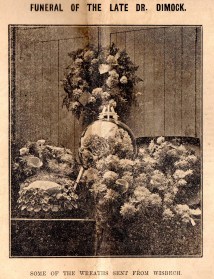 The floral tributes included the following:
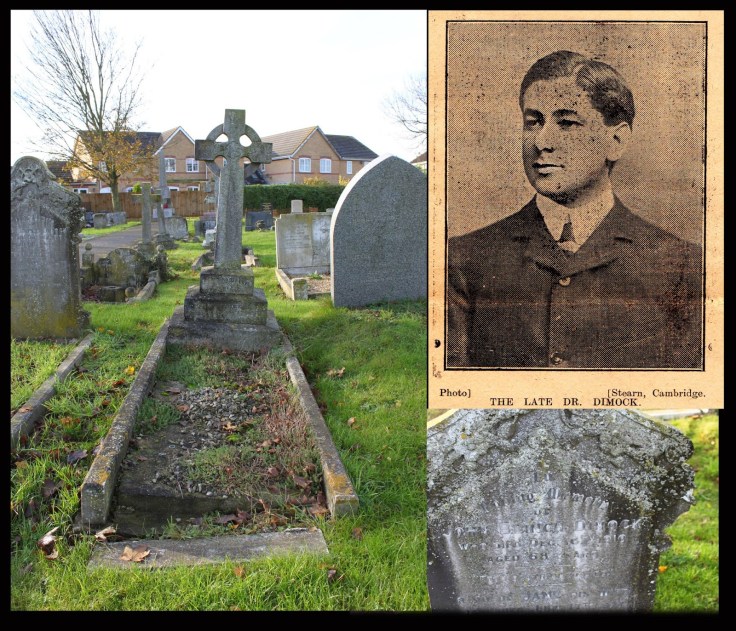
 A century or more later, what do we make of the affair? What happened to the participants who survived? Reading contemporary accounts, it is difficult to believe that Horace Dimock was a totally innocent party. It would have been perfectly possible for him to have won the hearts of his patients, many of them from the poorer side of society, at the same time as conducting a hate campaign against those fellow professionals against whom he bore a grudge. The less lurid of the postcards allegedly sent by Dr Dimock were reproduced in the press, along with detailed evidence by so-called handwriting experts.

 In Wisbech this was a problem
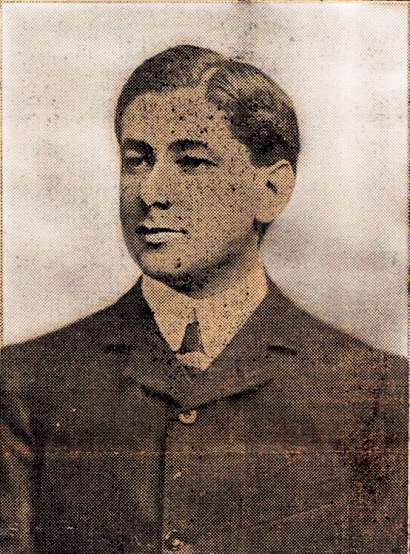 So, the people’s favourite,

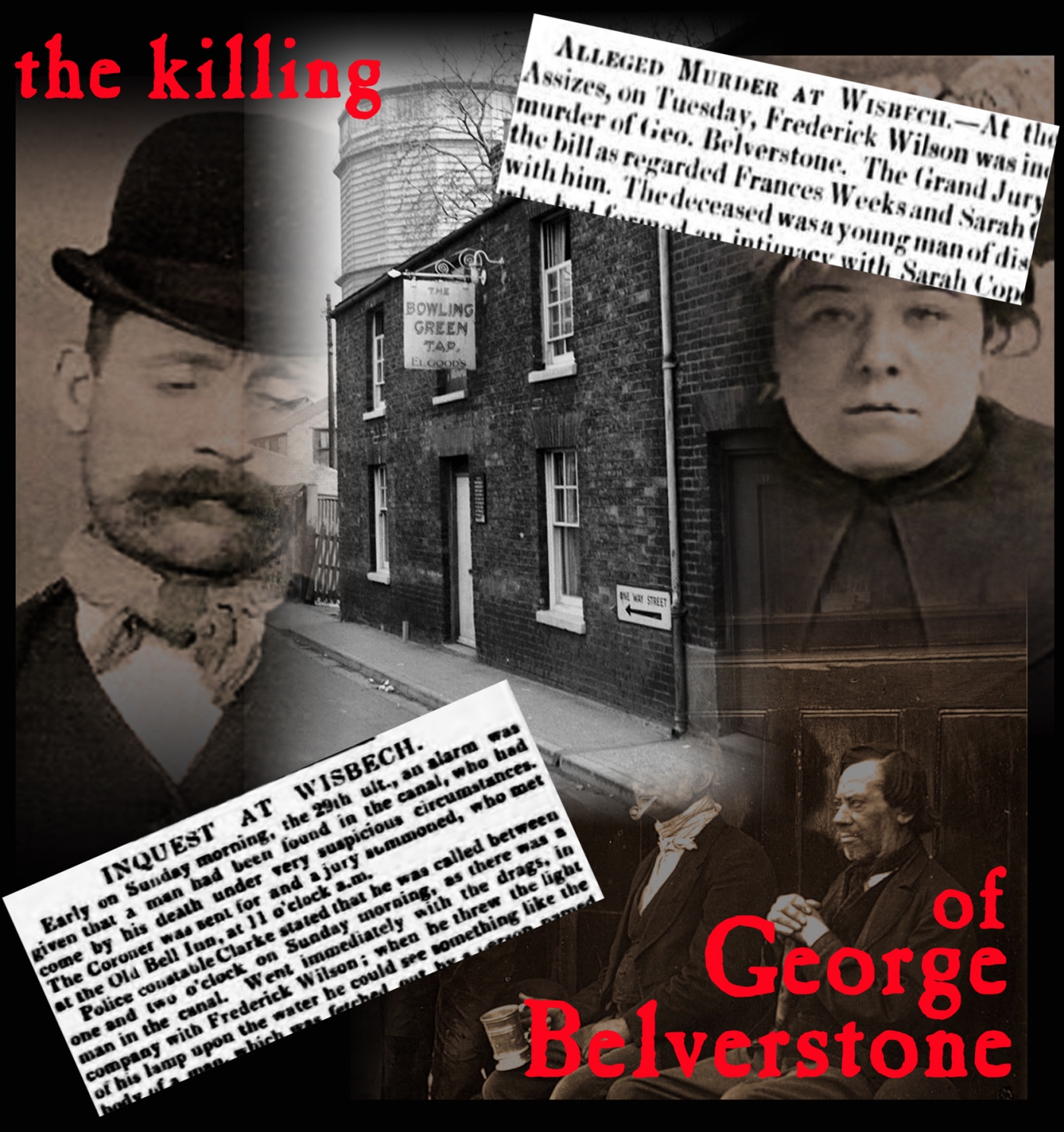

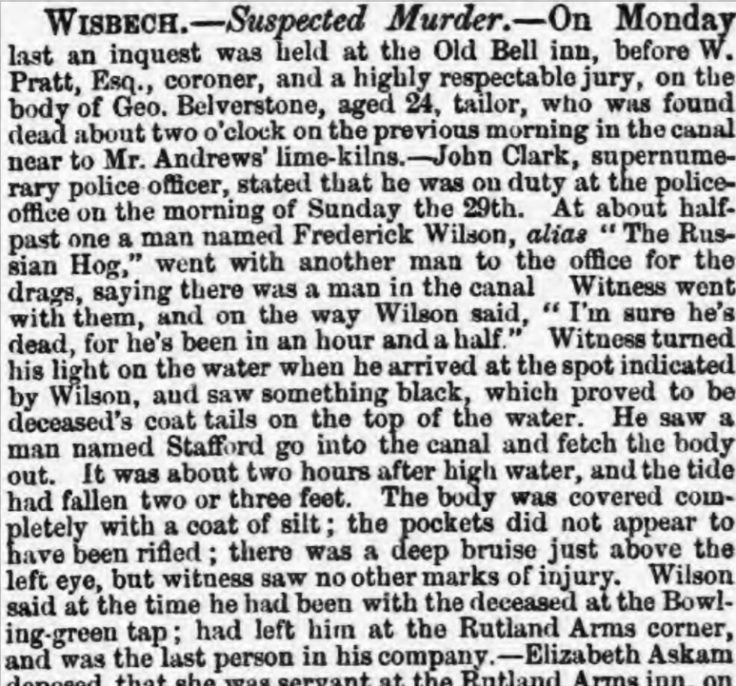

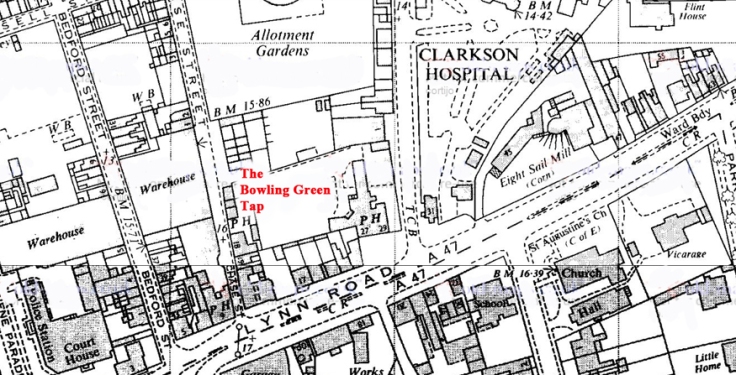
 After an elaborate summing up by Judge James Parke, 1st Baron Wensleydale, (left) the jury retired to consider the precise cause of Belverstone’s death. Not for them days of deliberation, or purdah in some hotel away from the public eye. After a full five minutes, they returned and the foreman stated that George Belverstone had been killed by a blow from Wilson’s fist. The prisoner, at this point, must have had visions of the hangman’s knot swimming before his eyes, but the 1st Baron Wensleydale was minded to differ. Unbelievably, he was of the opinion that although Wilson struck the fatal blow, “the violence was attributed to accident,” and pronounced:


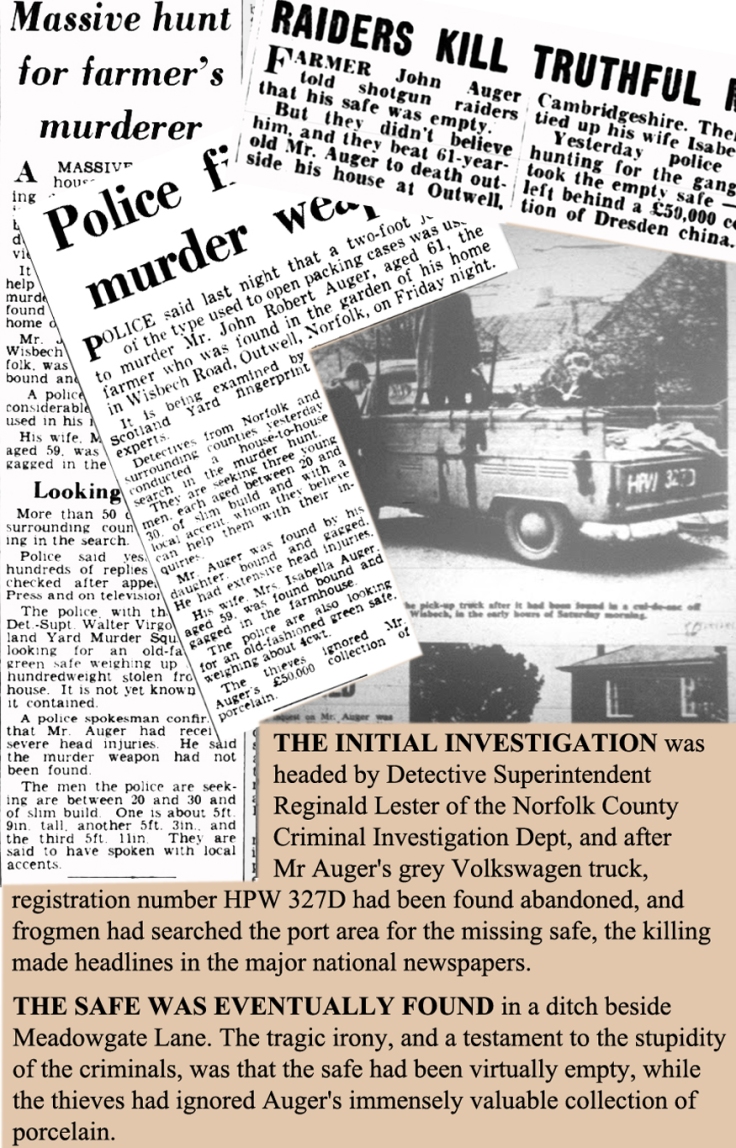

 And yet, and yet. In 1977, Commander Wallace Virgo (left) head of the Serious Crime Squad, was convicted of corruption, and sent to jail . As the ensuing corruption investigations widened, the obscene publications squad was replaced in its entirety with a new group of officers drawn from the uniformed branch, and in all over twenty detectives were dismissed or required to resign. When the cases ultimately came to trial in 1977 the presiding judge Mr Justice Mars-Jones summarised those involved as having engaged in “corruption on a scale which beggars description” Ten years earlier, had the case-hardened and confident London detectives arrived in the relative backwater of the Fens and ‘done a job’ on some local men who were certainly career petty criminals, but not very bright?




 fullybooked2017