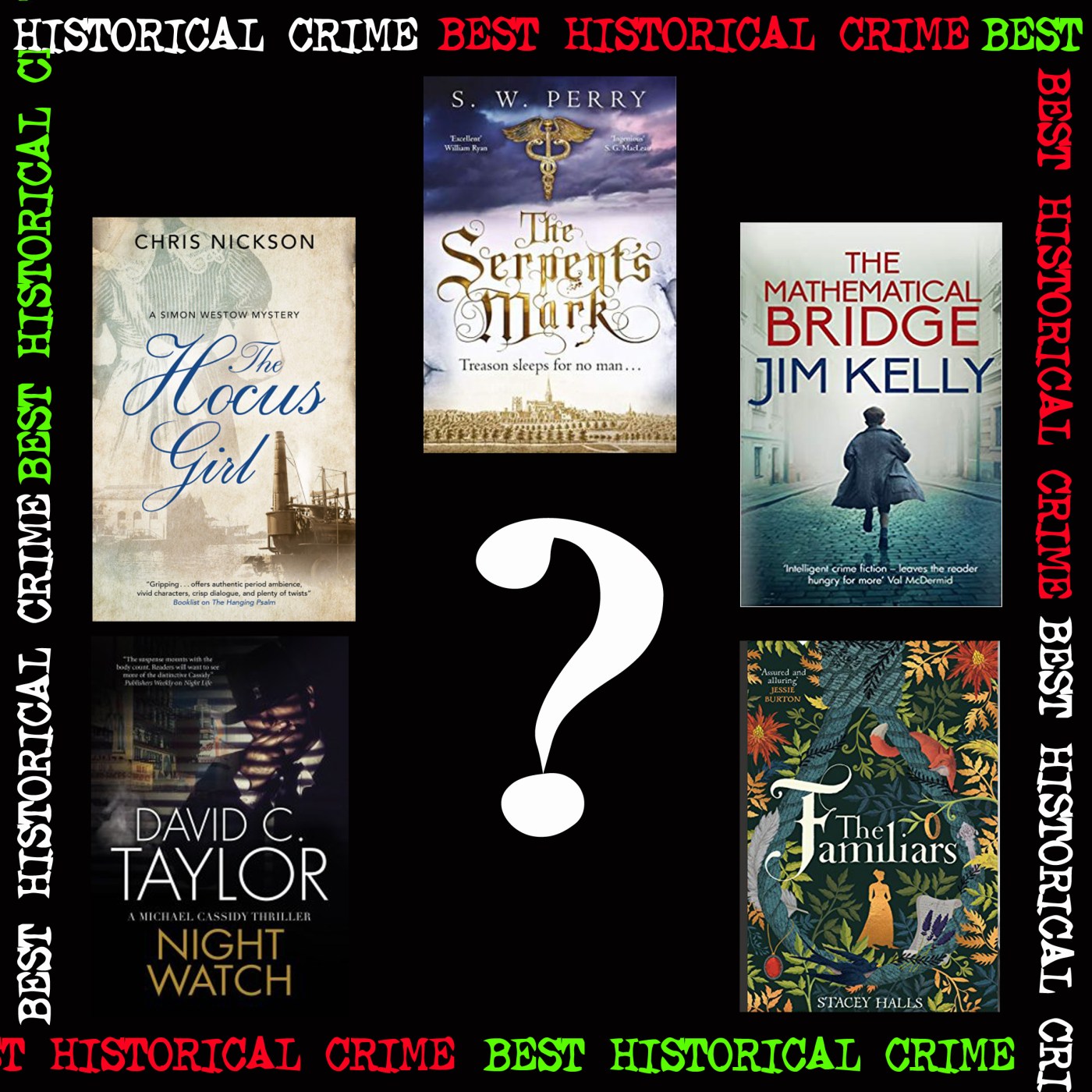

I have always been a fan of historical fiction and, more recently, crime fiction set ‘back in the day’. Sadly, there are those writers whose thirst for period accuracy produces lavish costume drama at the expense of a decent plot and good storytelling. Happily, the five books on my 2019 shortlist don’t fall into that trap – take a look, and if you haven’t read them yet, do so – you won’t be disappointed.
 The Familiars by Stacey Halls was one of the publishing successes of 2019, and rightly so. The evocative visual presentation was matched by superb writing and the conviction of a natural storyteller. The story is not a conventional crime mystery, but involves suspicion, injustice, intrigue, political chicanery and personal bravery. We are in rural Lancashire in the early years of the seventeenth century and young Fleetwood Shuttleworth has been married off to a wealthy landowner. Far away in London, King James is obsessed with a fear of witches and daemons, and those anxious to please His Majesty are falling over themselves to demonstrate their loyalty. Fleetwood’s new home, Gawthorpe Hall, sits under the looming Pendle Hill, and all around the district, harmless old women – and some not so old – are being rounded up as witches. Fleetwood is under pressure from husband Richard to provide a male heir and when, after several miscarriages, she seeks the help of a young peasant midwife, Alice Gray, her actions put her in direct conflict with the King’s men.
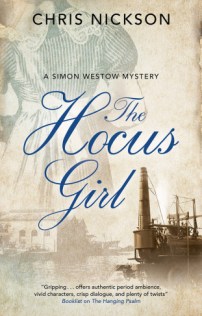 Chris Nickson’s historical novels may be narrow in geographical scope – they are mostly set in Leeds across the centuries – but they are magnificent in their emotional, political and social breadth. In The Hocus Girl, we meet Simon Westow who earns his living as a thieftaker. In America they still have them, after a fashion, but they call them bail skip tracers, or bounty hunters. Leeds in the 1820s had no police force except inept and frequently infirm Parish Constables, and so thieftakers pursued criminals on commission from victims of crime. Westow has a formidable ally in the shape of a teenage girl called Jane. Sexually abused as a youngster, she is ruthless and streetwise, and God help the man who mistakes her for a waif. Westow and Jane have a different kind of fight on their hands here, as they try to prevent a campaigner for social justice being sent to the gallows by political conspirators.
 SW Perry has written an excellent thriller about religious extremism, media manipulation and political treachery. The fact that The Serpent’s Mark is set in Elizabethan London rather than 2019 can only make the reader wonder at how little things have changed. Nicholas Shelby is a physician who, despite his relative youth, has served on the battlefields of Europe and has emerged from a debilitating period of alcoholism caused by the tragic death of his wife and child. With many a real life character – including Robert Cecil and John Evelyn – making an appearance, Shelby becomes involved in a desperate affair which seeks to supplant Queen Elizabeth herself with a hitherto unknown child of Mary Tudor – and return the land of Gloriana to the old faith, Roman Catholicism.
 For all that the era was in my lifetime, the 1950s may just as well be the 1650s given the gulf between then and the modern world. In Nightwatch David C Taylor takes us back to New York in 1954, and we follow a convincingly tough and hard-nosed NYPD cop, Michael Cassidy, who becomes involved in a case which is way, way above his relatively humble pay grade. There were many former Nazis who escaped Nuremburg and had vanished into the ether by 1954 and although many of them were undoubtedly bastards, the sinister folk in American intelligence agencies gave them a lifeline by making sure that they became their bastards. Awkwardly for the CIA, there were also survivors of Hitler’s death camps who had made their way to America, and although they may have been scratching a relatively meagre living, they still had access to information and a burning desire for revenge. Cassidy battles both the indifference of his bosses and the unwanted attention of some very powerful people as he tries to solve a series of murders and make his streets a little less mean.

Click the text image above to link to my review of The Mathematical Bridge.

 t was not until the middle of the nineteenth century that Britain had anything like an organised police force. The Hocus Girl is set well before that time, and even a developing community like Leeds relied largely on local Constables and The Watch – both institutions being badly paid, unsupported and mostly staffed by elderly individuals who would dodder a mile to avoid any form of trouble or confrontation. There were, however, men known as Thieftakers. The title is self-explanatory. They were men who knew how to handle themselves. They were employed privately, and were outside of the rudimentary criminal justice system.
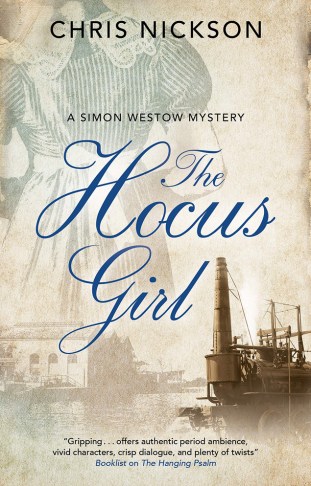 Such a man is Simon Westow. He is paid, cash in hand, to recover stolen goods, by whatever means necessary. His home town of Leeds is changing at an alarming rate as mechanised cloth mills replace the cottage weavers, and send smoke belching into the sky and chemicals into the rivers. We first met Westow in The Hanging Psalm, and there we were also introduced to young woman called Jane. She is a reject, a loner, and she is also prone to what we now call self-harm. She is a girl of the streets, but not in a sexual way; she knows every nook, cranny, and ginnel of the city; as she shrugs herself into her shawl, she can become invisible and anonymous. Her sixth sense for recognising danger and her capacity for violence – usually via a wickedly honed knife – makes her an invaluable ally to Westow. I have spent many enjoyable hours reading the author’s books, and it is my view that Jane is the darkest and most complex character he has created. In many ways The Hocus Girl is all about her.
 he 1820s were a time of great domestic upheaval in Britain. The industrial revolution was in its infancy but was already turning society on its head. The establishment was wary of challenge, and when Davey Ashton, a Leeds man with revolutionary ideas is arrested, Simon Westow – a long time friend – comes to his aid. As Ashton languishes in the filthy cell beneath Leeds Moot Hall, Westow discovers that he is treading new ground – political conspiracy and the work of an agent provocateur.


 fullybooked2017