

Suspected war criminal Hannibal Strauss, a mercenary suspected of war crimes in Libya, Cambodia and elsewhere, is in custody near The Hague awaiting trial before the International *Criminal Court. The wheels of international war crimes justice grind extremely slowly, and as lawyers jostle for position, there is a terrorist outrage in the Netherlands capital. Gunmen open fire on a crowded square, the Grote Markt, killing not only individuals connected with the impending court case, but dozens of random civilians, too. One man involved in the Strauss case, Kon Frankowski, escapes and goes on the run.
*Factual note: the International Criminal Court (ICC) is separate and different from the International Court of Justice (ICJ). The ICJ is part of the United Nations, and investigates countries. The ICC investigates individuals, and is recognised by some – but not all – countries, a notable exception being Russia. Very few people have been convicted and jailed by the ICC, one being Charles Taylor, the former leader of Liberia. A third and unconnected organisation, the International Criminal Tribunal for the Former Yugoslavia, did convict and jail Radovan Karadžić and Ratko Mladić, while Slobodan Milošević died while his trial was in progress.
The mastermind behind the slaughter is an International terrorist known only as The Monk. His organisation has its roots in a pro-Tsarist resistance movement known as the Mladorossi. It has evolved over the decades, but remains a massive threat to international security.
Answering the call to investigate the Grote Markt massacre are Joe Dempsey, and agent with the (fictional) International Security Bureau, and his partner, criminal barrister Michael Devlin. They seem an unlikely pairing, to be honest. Dempsey is Special Forces trained, has killed many men in the course of his job, while Devlin is undoubtedly clever, but I’m not sure what his interlocutory skill brings to the table outside of the interview room. Hey ho, though, it’s a novel, so let’s run with it.
The reason why Frankowski is at the centre of this is that he was money-launderer-in-chief to Hannibal Strauss, and the Hungarian mercenary has entrusted Frankowski with a list of all Russian Mladorossi agents and how they are embedded across the world. This list – in the right/wrong – hands would almost certainly be the end for The Monk and his machinations. Joe Dempsey, however, has a rather delicate personal connection to Frankowski. Frankowski’s wife Maria is the former lover of Dempsey, who reluctantly ended the relationship because of the danger his work would bring to them if they became a family.
While Dempsey and Devlin are on the ground in the Netherlands, Agent Eden Grace – Dempsey’s ISB protégé, is handling things in America, and it is there that Maria Frankowski and her children have gone into hiding, as they have become an pawns in the violent chess game which seeks to find Kon Frankowski and the fatal list.
In all good spy thrillers, we must never take the author’s word that people are who we are told they are, and The Shadow Network is no exception.The Monk is hiding in plain sight, and neither we – nor Dempsey and Devlin – have a clue as to who he really is. This is a thoroughly entertaining thriller with fight scenes so real that just reading them may necessitate a visit to A & E with sympathetic wounds and trauma. It is published by Elliot and Thompson and will available on 15th February. Tony Kent, by the way, is that most unusual of pairings – a criminal barrister and heavyweight boxer. Cross him at your peril!


 Sheen is given the task of re-investigating the Cyprus shootings, with a strong hint that it would suit the contemporary political narrative were the SAS men to be found guilty of unlawful killing. As he turns over the stones, Sheen isn’t surprised to see all kinds of unpleasant creatures scuttling away from the light. He has his own issues, as his own brother was the collateral damage of a terrorist bomb in their childhood street while they were kicking a football about.
 Donnelly has written a brilliant and terrifying novel that should remind people that despite the outward air of calm and reconstruction there is a parallel Belfast – a place where grievances are bone-deep and still burning white hot.



 f fictional coppers need to be idiosyncratic to attract readers, then DI “Harry” Hardeep Singh Virdee ticks all the required boxes and also a good few new ones of his own devising. The Bradford policeman is a Sikh, but has enraged his father and his wider community by doing the unthinkable in marrying a Muslim woman. His brother Ronnie also happens to be a ruthless career criminal.
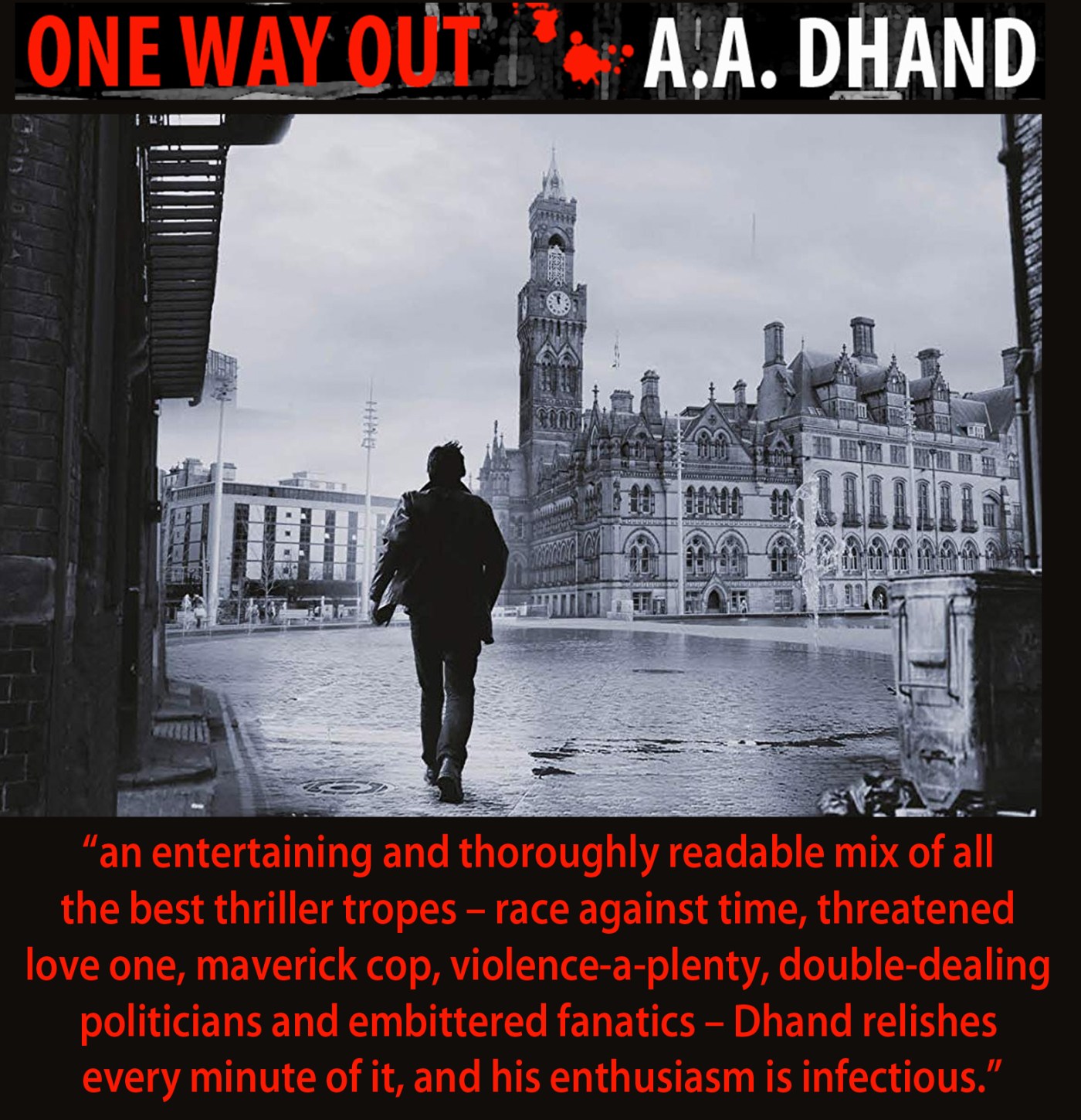
 The latest novel from AA Dhand is a gripping thriller which goes well beyond the constraints of the conventional police procedural. One Way Out begins with a huge bomb going off in the centre of Bradford. Although there has been sufficient warning to minimise civilian casualties, the perpetrators – an extreme right wing group known as The Patriots – have a further trick up their sleeve. It is a Friday, and with all 105 mosques in the Yorkshire city being full of worshippers, the terrorists announce that they have planted a bomb in one of the mosques, and it will be detonated unless the police track down and hand over the members of a notorious Islamic militant group called Almukhtaroon. The Patriots have pre-empted the obvious evacuation of the mosques by stating that if one single worshipper attempts to leave, the bomb will be detonated.
 hat we then have is an entertaining and thoroughly readable mix of all the best thriller tropes – race against time, threatened love one, maverick cop, violence-a-plenty, double-dealing politicians and embittered fanatics – Dhand relishes every minute of it, and his enthusiasm is infectious.
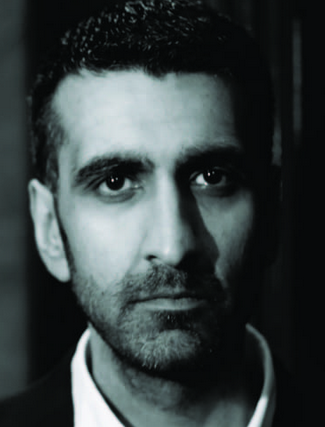 Dhand is a Bradford man, born and bred, and he paints a vivid – if occasionally depressing – picture of the results of racial and religious bigotry. While he is justifiably harsh on right-wing extremism, he doesn’t spare the blushes of the Asian community, whether they are warring Muslim factions or Sikhs with more angry pride in their hearts than compassion. I’m not sure I totally bought into the relationship between Virdee and Tariq Islam, but no matter what the plot, suspension of disbelief is what we fiction readers are good at, otherwise we would spend our days reading history books or browsing the Argos catalogue.
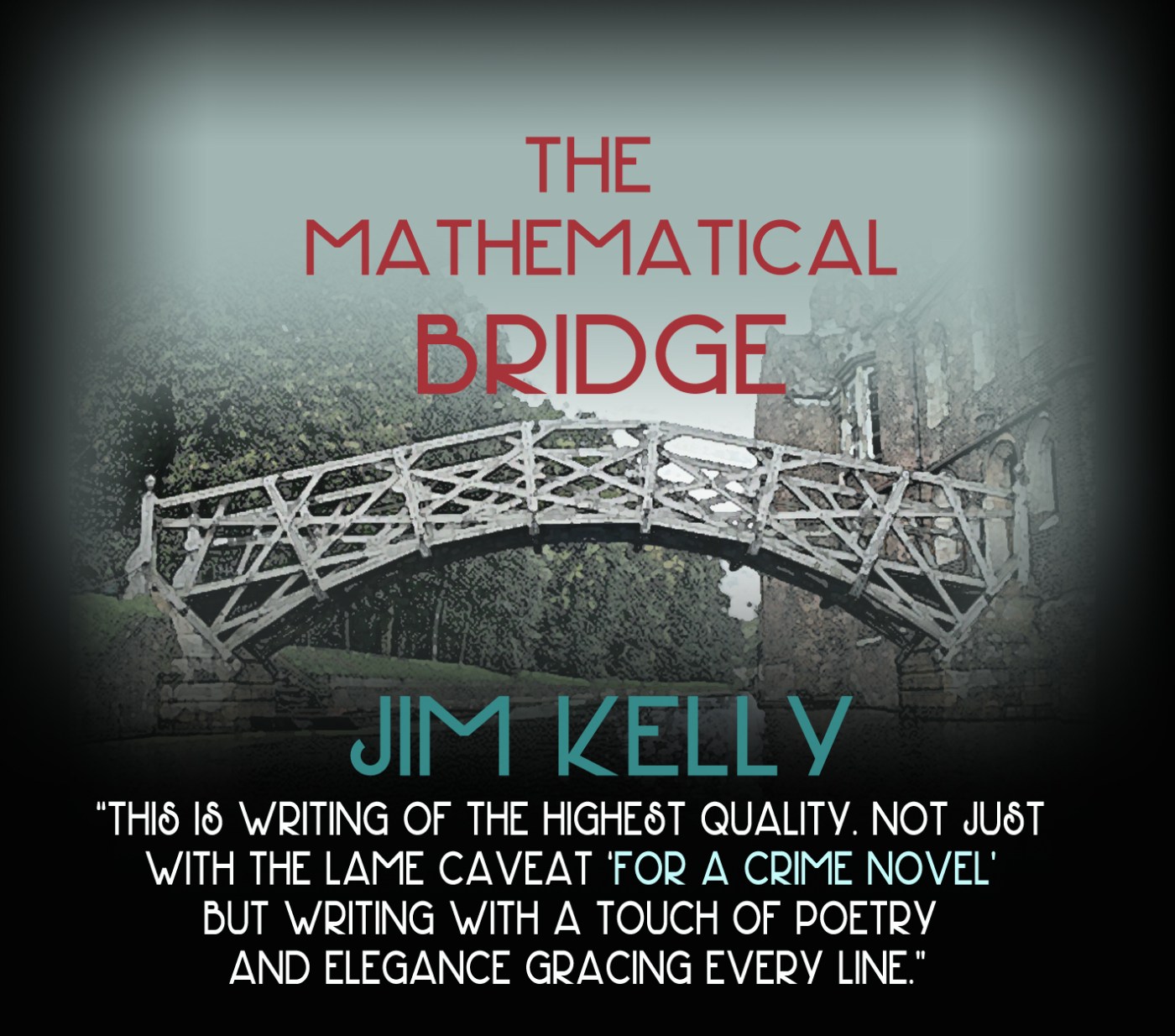

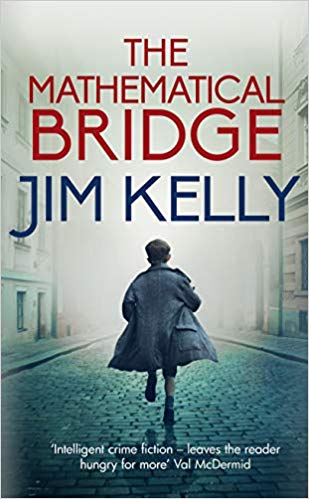 “Begin as you mean to go on” says the old adage, and Jim Kelly sets himself a hard task with the brilliant and evocative first paragraph of The Mathematical Bridge. The beautiful use of language aside, Kelly’s first 126 words convey a wealth of information. A country at war. Midwinter. A city preparing for an attack from the air. A policeman out and about when honest men are abed.
 This is writing of the highest quality. Not just with the lame caveat ‘for a crime novel’ but writing with a touch of poetry and elegance gracing every line. Even when the crime is solved, the perpetrators are behind bars, and the delightfully complex contradictions of the plot have been explained, Kelly (right) still has the emotional energy to give us a last scene which manages to be poignant but, at the same time, life-affirming.


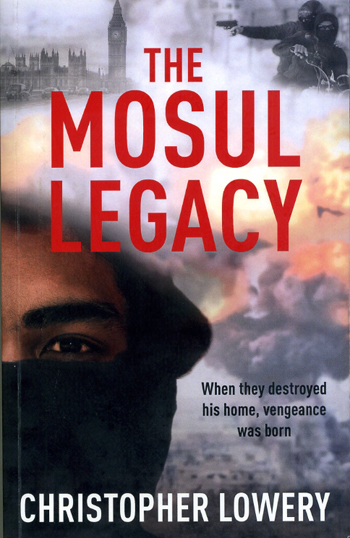 Lowery sets out his narrative stall with those four threads which will eventually weave together to powerful effect. Ibrahim, his puppet strings pulled from afar courtesy of the internet, plans a terrorist bomb attack which goes spectacularly wrong and he goes on the run. A revered and respected fighter, Karl, has to watch in frustration while his ISIL soldiers are outgunned and overwhelmed by coalition forces, and his position is undermined by over-promoted jobsworths in his own organisation. Faqir has finally had enough of living in the shell-torn morgue that Mosul has become, and gathers together his hard-earned savings and is determined to find a better life for his family. Battling German privacy laws which prevent him from publishing photos of his suspect, Kellerman presses on and is determined to bring his man to justice.
 This is a big, sprawling novel – nearly 450 pages – but it is grimly readable. I say ‘grimly’ because it goes behind bland newspaper headlines and ten-second TV news video clips, to reveal the whole Iraq – Syria situation as the ruinous, depressing and insoluble shambles it has become. It would be impossible to write a novel like this with it being political, but I don’t think Lowery (right) allows himself to become partisan. For sure, he pulls no punches in his scathing depiction of the social intolerance of many Muslim communities, and the genocidal fanaticism of ISIL which is as close to mental illness as makes no difference. He is, however, just as clear sighted in his scepticism about the real reasons why America and its allies – most pointedly Britain – became involved in Iraq in the first place.

 Born and educated in the United Kingdom, Marion Leigh (left) has lived in France, Germany, Indonesia, Canada, the USA and, latterly, Spain. She has also spent time in Australia and the Far East, India, Africa, South America and the Caribbean. Her debut novel, The Politician’s Daughter, was the first in a series of adventure thrillers featuring feisty globetrotting Petra Minx of the Royal Canadian Mounted Police. Dead Man’s Legacy followed, but now Petra is in South Africa, accompanying her buddy, Carlo, to his cousin’s wedding. She becomes involved in the hunt for the attacker of two teenage girls in Cape Town and finds among her foes, in no particular order, a wicked step-brother, a phony priest, and a reluctant bride. This is out now, from
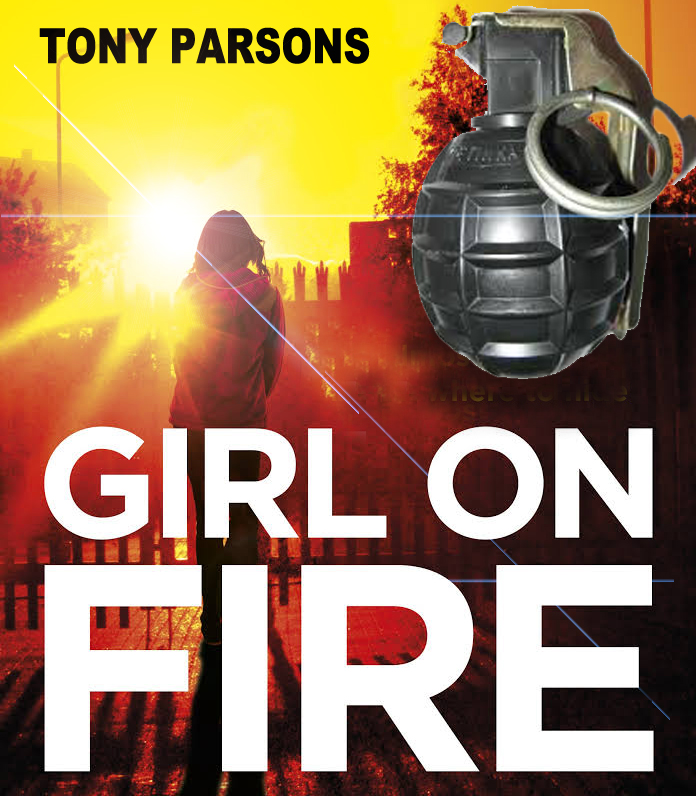
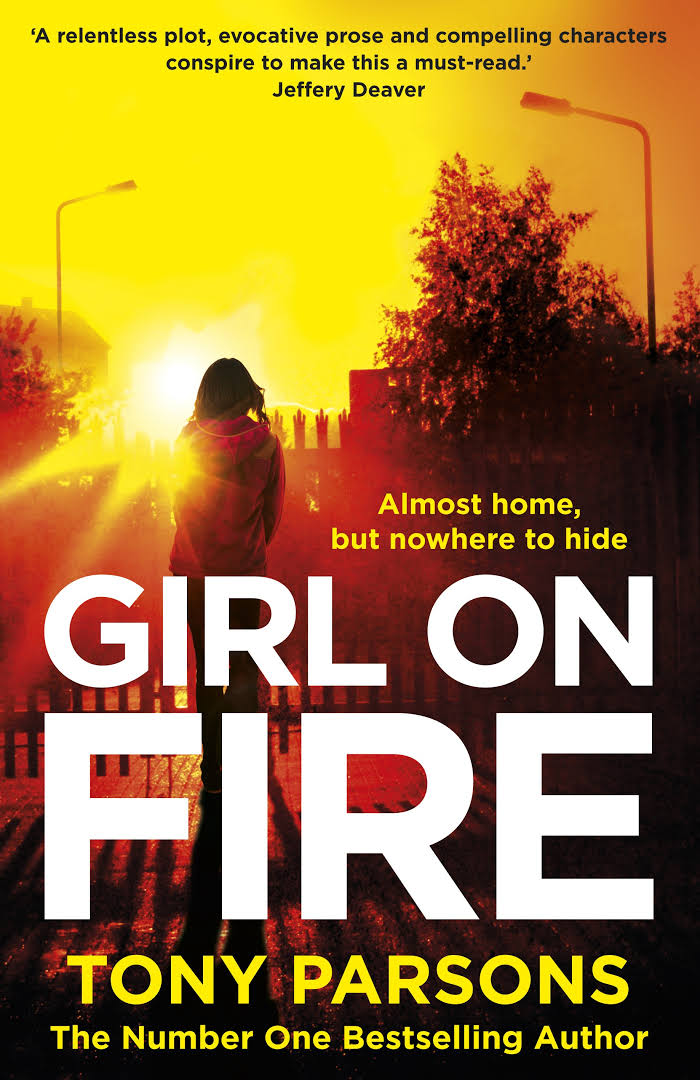 Wolfe survives, and shoulders his way into the hit team which raids a nondescript terraced house in Borodino Street in East London. Their target? To capture two Pakistani brothers who have adapted simple commercially available drones into weapons of terror. Needless to say, the raid does not go according to plan. The lead police officer is shot dead at the outset, by one of the brothers disguised in a niqab. He is eventually shot dead, as is the remaining brother. But there are questions raised about the death of the latter. Was he shot as he was trying to surrender, or was he simply assassinated by a vengeful police marksman? And where are the two ex-Croatian hand grenades which informers say had been sold to the Khan brothers?
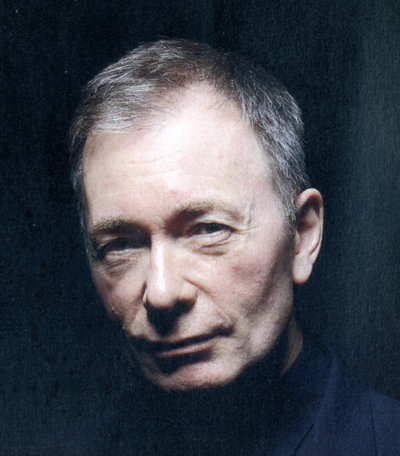 The novel frequently holds you by the hand – no, make that puts you in an arm lock – and takes you to places you would rather not go. Parsons (right) is not someone with a well stocked cupboard full of tea lights, bunches of flowers and anodyne pleas for togetherness. He is not going to link arms with anyone and place these tributes at scenes of murder and carnage. Least of all will he, via Max Wolfe, be tweeting Je Suis Borodino Street any time soon. Some might say that for a humble DC, Max Wolfe certainly seems to get about a bit, but this is an irrelevant criticism, because what he thinks and sees are essential to the story. Wolfe is a a man of deep compassion and perception. Not only is his narrative reliable – it is painfully accurate and candid. Readers have, of course, the option of averting their gaze or thinking about gentle deaths in Cotswold villages, solved by avuncular local bobbies. Those who choose not to turn away from this brutal autopsy of Britain – and specifically London – in 2018 will not, I suggest, feel rejuvenated, life-enhanced or particularly optimistic by the end of this novel. Rather, they will follow the emotional journey of the celebrated wedding guest:
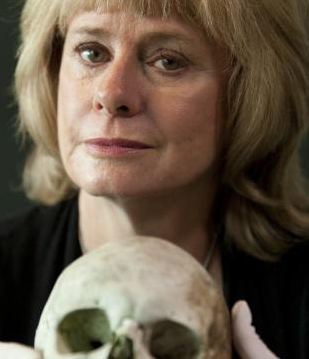 The muster room of hard-nosed female cops and investigators is not exactly a crowded place on Planet CriFi. Victoria Iphigenia Warshawski, Fiona Griffiths, Kate Brannigan, Cordelia Gray, Kay Scarpetta and Jane Marple have already taken their seats, but Temperance Brennan has, temporarily, given up hers for another child of her creator, Kathy Reichs (left). Sunday ‘Sunnie’ Night is a damaged, bitter, edgy and downright misanthropic American cop who has been suspended by her bosses for being trigger happy. She sits brooding, remote – and dangerous – on a barely accessible island off the South Carolina coast.
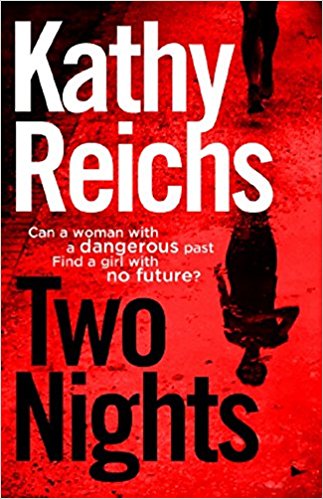 Half way through the novel we realise the significance of the title. Sunnie Night is not waging this war alone: her twin brother Augustus ‘Gus’ Night is also on the case and, to use the cliche, he ‘has her back’. Together they are certainly a deadly combination. By this point, though, Reichs has bowled us an unreadable googly – or, for American readers, thrown us a curveball – and it isn’t until the closing pages that we realise that we have been making incorrect assumptions. Which is, of course, exactly what the author planned! Those last few pages make for a terrific finale, as the twins desperately try to prevent an atrocity being carried out at one of America’s most celebrated sporting occasions.


 fullybooked2017