

 First, a word about the author, Ewan Lawrie (left). He comes to the book world by a rather different route than many of his fellow writers. There cannot be many authors who served for nigh on a quarter of a century in the armed forces – in this case, the RAF – and then turned to writing. His first novel, Gibbous House, (2017) introduced us to a gentleman called Alasdair Moffat, who rejoices in the appellation Moffat the Magniloquent. In that novel he was a prosperous and successful criminal in Victorian London, but now, a decade later, he – having fallen on hard times – has relocated to America, along with countless other folk of the “huddled masses”, the “wretched refuse” and the “tempest-tossed”. Unlike them, however, he is not seeking the “lamp beside the golden door”, but a rather better place in which to exercise his criminal talents.
It is 1861, and America is on the verge of the disastrous conflict which will shape the nation’s future for decades to come. Moffat has fetched up in St Louis, pretty much stony broke. With an unerring talent for sniffing out trouble, he murders a man named Anson Northrup, assumes his identity and, in order to pay off a brothel bill he cannot afford, accepts the task of delivering a mysterious package further down the Mississippi River. He boards the steam-driven riverboat The Grand Turk. The package he is carrying contains operational details of what was known as The Underground Railroad – a network of secret routes and safe houses established in America used by slaves to escape into freedom. Moffat, of course, being British, takes the metaphor literally, and it is some time before he realises that he is not carrying a conventional railway timetable, and that the late Anson Northrup is a key figure in a plot to steal silver bullion from the Mint in New Orleans – the major city in the state of Louisiana, which had just seceded from the United States.
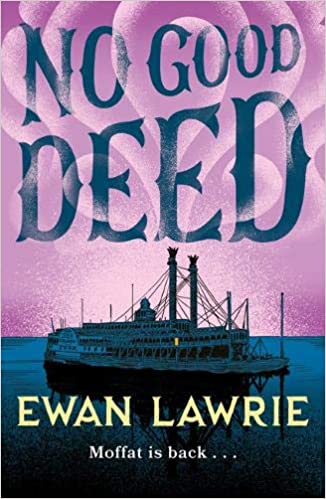 In his guise as Northrup (although not everyone is fooled) Moffat meets several larger-than-life and almost grotesque fictional characters, and lurches from one crisis to the next, but one of the most spectacular parts of the novel is when he meets Marie Laveau, a real life New Orleans character renowned for her mystical qualities, as well as her expertise in the black arts of voodoo.
Lawrie is an entertaining writer who has clearly done his historical homework, but also adds a heady combination of whimsy, smart jokes and improbable situations to make for an entertaining read. The rather old fashioned literary term picaresque came into my mind as I was reading this, but I needed to check what it meant. The ever-present Google says that it is:
“relating to an episodic style of fiction dealing with the adventures of a rough and dishonest but appealing hero.”
I think that pretty much sums up No Good Deed. The novel succeeds not through the particular integrity of the plot, but more through the relentlessly entertaining episodes, and the grim allure of Moffat himself. There is more than a touch of George MacDonald Fraser and his likeable coward Harry Flashman about this book, and I can thoroughly recommend it to anyone who enjoyed that series of novels. No Good Deed is published by Unbound Digital, and is out now.




 Fictional police officers come in an almost infinite number of guises. They can be lowly of rank, like Tony Parsons’ Detective Constable Max Wolfe, or very senior, such as Detective Superintendent William Lorimer, as imagined by Alex Gray. Male, female, tech-savvy, Luddite, happy family folk or embittered loners – there are plenty to choose from. So where does Peter Lovesey’s Peter Diamond fit into the matrix? As a Detective Superintendent, he pretty much only answers to the Assistant Chief Constable, but for newcomers to the well established series, what sort of a figure does he cut? Lovesey lets us know fairly early in The Finisher, the nineteenth in a series that began in 1991 with The Last Detective. Diamond is on plain clothes duty keeping a wary eye on a half marathon race in the historic city of Bath:
 There’s a dazzling array of characters to act out the drama. We have an earnest school teacher who forces herself to run the race in order to make good a lost donation to a charity; there is a statuesque Russian, wife of a cynical businessman, determined to lose weight and gain her husband’s respect; instant villainy is provided by a paroled serial seducer and sex-pest who has taken on a new role as personal trainer to the rich; at the bottom of the pond, so to speak, are a pair of feckless Albanian chancers who have escaped from an illegal work gang, and are trying to avoid the retribution of their controllers.


 His London copper, DC Max Wolfe, becomes involved when a refrigerated lorry is abandoned on a street in London’s Chinatown. The emergency services breathe a huge sigh of relief when they discover that the truck is not carrying a bomb, but their relaxed mood is short-lived when they break open the doors to discover that the vehicle contains the frozen bodies of twelve young women. The bundle of passports – mostly fake – found in the lorry’s cab poses an instant conundrum. There are thirteen passports, but only twelve girls. Who – and where – is the missing person?
 Max Wolfe certainly gets around for a humble Detective Constable, but he is an engaging character and his home background of the Smithfield flat, young daughter, motherly Irish childminder and adorable pooch make a welcome change from the usual domestic arrangements of fictional London coppers with their neglected wives, alcohol dependency and general misanthropy. Parsons (right) is clearly angry about many aspects of modern life in Britain, but he is too good to allow his writing to descend into mere polemic. Instead, he uses his passion to drive the narrative and lend credibility to the way his characters behave.


 fullybooked2017