

Guy Portman created a brilliantly psychotic serial killer called Dyson Devereux, and over the three books in the series, Necropolis, Sepultura and Golgotha, Portman took aim at every sacred cow in modern British society. Nothing – and no-one – escaped unscathed, from lavishly tasteless funerals, ‘woke’ human resources officials, earnest (and useless) social workers, gender-identity professionals right through to so-called ‘community leaders’. Devereux was killed off in Golgotha, but in Sepultura we learned that Mr D had fathered a son, Horatio, the mother being a borderline hapless Antiguan lady called Rakesha. In Emergence, we discovered that the teenage Horatio is a case of ‘like father, like son’, as he murders his mum’s boyfriend Brendan, a man he calls Fool’s Gold. The murder was cleverly disguised to make it seem that the unfortunate chap died as a result of a sexual experiment gone wrong.
In Arcadia, Horatio enjoys a brief (but violent) sojourn in Antigua, but Cognizance sees him back in London, and attending a particularly awful high school. Horatio is about to upset some of his classmates in his gang-infested school, but he has a much older enemy, the man he nicknames ‘Rat’. ‘Rat’, properly known as Roland Barstow was best mates with the late Brendan, and is convinced (rightly) that Horatio killed him. ‘Rat’ seems to be around every corner, and waiting at every bus stop, but Horatio manages – for a while – to keep him at arms length.
In school, Horatio makes a serious error when he mocks a very large – and very stupid – fellow pupil. Unfortunately for our hero, this lad is gang-connected, and they take their revenge on Horatio in a rather smelly fashion in the boys’ toilets. Horatio vows revenge, and achieves this after a fashion when two rival gangs have a set-to in a particularly loathsome tower block of flats. Our hero has other worries, though, when he is attacked with a hammer, and left in a life – threatening condition.
Horatio’s sense of humour is suitably disturbed – and disturbing. While at his aunt’s funeral he remembers the fun he had when his mum’s boyfriend was laid to rest:
“When the casket was carried in at the start of Fools Gold’s funeral, the music was supposed to be Never Say Goodbye by Bon Jovi. However, I sneaked into the room where the music system was and changed it. Because everyone thought he had died from auto erotic asphyxiation gone wrong, I chose the theme tune for Top Gun. Take My Breath Away. Fools Gold’s father went beserk, as did Rat. It was hilarious.”
The running joke in the series is that literally no-one (with the exception of Rat) sees Horatio for what he is. He fools everyone else, including his mother, his delightful girlfriend Serena, and his teachers. What to make of a teenage killer, obsessed with algebra and trigonometry, a boy whose favourite book is Bleak House, and someone who, as his aunt lies dying of cancer, imagines her in hell, perishing in the flames, suffering the torments of Tantalus as a family size bag of Maltesers is dangled just in front of her, but forever out of reach?
What Guy Portman does is to merge merge domestic disaster with caustic comedy, and he turns our normal, family-orientated sense of decency on its head, and has us cheering for the devious Horatio. The more malign his misdeeds, the more we laugh. Of course, this book will not appeal to everyone, but for those of us with a dark sense of humour it is pure gold. Lovers of dystopian comedy, this is for you – I dare you not to laugh. Cognizance is published by Pugnacious Publishing and is available now.



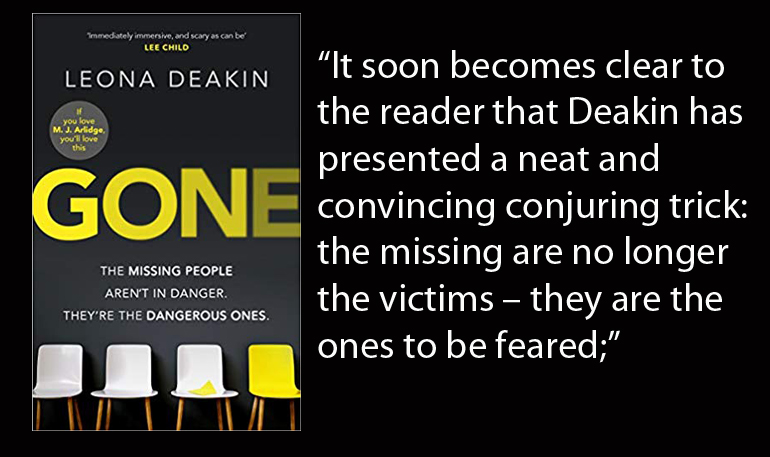

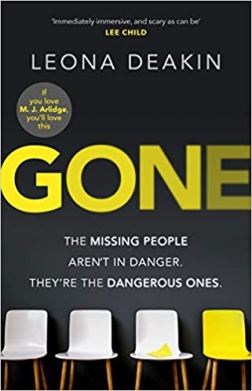 Jameson’s sister Claire has, for some time, fulfilled a mixed role of aunt, mother and babysitter to a teenage girl called Jane. Jane’s mother Lana, is a single mum, loving but chaotic, perhaps suffering from PTSD after several tours in conflict zones when she was a soldier in the army. Now she has disappeared, leaving Jane with no money for food or rent. Knowing of her mum’s fragile mental state. Jane was not initially alarmed, but when she began to investigate, after receiving no help from the police, she made several disturbing discoveries.
Lana disappeared on her birthday. Immediately before her disappearance she had received a mysterious card inviting her to play a game. The beautifully presented card bore the words, elegantly embossed in silver on cream:
Jameson’s sister Claire has, for some time, fulfilled a mixed role of aunt, mother and babysitter to a teenage girl called Jane. Jane’s mother Lana, is a single mum, loving but chaotic, perhaps suffering from PTSD after several tours in conflict zones when she was a soldier in the army. Now she has disappeared, leaving Jane with no money for food or rent. Knowing of her mum’s fragile mental state. Jane was not initially alarmed, but when she began to investigate, after receiving no help from the police, she made several disturbing discoveries.
Lana disappeared on her birthday. Immediately before her disappearance she had received a mysterious card inviting her to play a game. The beautifully presented card bore the words, elegantly embossed in silver on cream: Leona Deakin’s own experience and training in psychology gives this novel a framework of authenticity to which the more fanciful parts of the narrative can cling. It soon becomes clear to the reader that Deakin has presented a neat and convincing conjuring trick: the missing are no longer the victims – they are the ones to be feared; those left behind have become the prey.
The relationship between Bloom and Jameson is intriguing. It reminded me of the unresolved tension and undeclared love between Val McDermid’s doomed lovers Tony Hill and Carol Jordan. We are left to decide for ourselves what Augusta Bloom looks like; Deakin (right) suggests that she might be rather dowdy, an academic in flat shoes. She is certainly razor sharp mentally, however, and she plays a devastating human chess game with the organisation behind the birthday card disappearances.
Leona Deakin’s own experience and training in psychology gives this novel a framework of authenticity to which the more fanciful parts of the narrative can cling. It soon becomes clear to the reader that Deakin has presented a neat and convincing conjuring trick: the missing are no longer the victims – they are the ones to be feared; those left behind have become the prey.
The relationship between Bloom and Jameson is intriguing. It reminded me of the unresolved tension and undeclared love between Val McDermid’s doomed lovers Tony Hill and Carol Jordan. We are left to decide for ourselves what Augusta Bloom looks like; Deakin (right) suggests that she might be rather dowdy, an academic in flat shoes. She is certainly razor sharp mentally, however, and she plays a devastating human chess game with the organisation behind the birthday card disappearances.


 fullybooked2017