Search

fullybooked2017

Tag

Police Procedural

LAYING OUT THE BONES . . . Between the covers

LATB header

Kate Webb introduced us to DI Matt Lockyer and DC Gemma Broad in Stay Buried, which I read, reviewed and found most impressive. Briefly, Lockyer is a single man, son of Wiltshire farmers – who would be described as ‘hard-scrabble’ in America. His younger brother, Chris, was murdered in a street brawl a few years earlier. He is involved – at a distance – with Hedy Lambert, a woman whose murder conviction he helped overturn. She still served over a decade in prison.

Because of a previous professional misjudgment, Lockyer has been sidelined into cold-case crimes. One such is the death of Holly Gilbert who fell – or was pushed – from a bridge into the path of a an HGV. Now, the remains one of the men suspected as having being involved, and who disappeared shortly after, have been discovered on Salisbury Plain. Lee Geary was a giant of a man, superficially very scary with his height, skinhead hair and tattoos, but he was simple in mind and spirit and his criminal convictions were all for minor and non violent crimes.

Three other twenty-somethings who were suspected of being involved in the death of Holly’s death have all since died in ambiguous circumstances. Lockyer has much on his mind. His mother lies dangerously ill in hospital, infected by a Covid variant, while his father struggles to keep the farm going. Lockyer lives in – and is slowly renovating – an old cottage, but he discovers that something horrific happened within its walls decades ago and, as is often the case, the past can often rear its ugly head to disrupt the relative tranquility of the present. I’ll give you a teaser – the book’s title is shared with another of the same name. If you take the trouble to Google, you will discover a rather delicate and elegant connection.

In trying to find out the truth about Lee Geary’s death, Lockyer is drawn, as if pulled by a magnet, to Old Hat Farm. It is owned by Vincent and Trish O’Neill, who lead something of an alternative life. They are are almost archetypal ‘hippies’, with lives organised around the ancient festivals such as Samhain and Beltain. Fellow seekers after truth are welcome at the farm but, unfortunately all of the key residents had lives in the real world, and it is their misdeeds in their previous lives which make up the puzzle Lockyer and Broad have to solve.

The novel is lovingly set in a part of England that the the author clearly knows well, and Lockyer’s intimate connection with the landscape – the vastness of Salisbury Plain, Wiltshire’s ancient sites and old trackways – brings a literary sense of place that was deployed so well by Thomas Hardy, but has been used by more recent writers in the crime genre such as Jim Kelly and Phil Rickson. As locals will know, the ravages caused by military training are brutal scars on the old fields and byways, but they are what they are.

Laying Out The Bones is not just a superior police procedural novel, but a powerful evocation of how historic lies and misjudgments can return to plague those involved. The empathy between  Lockyer and Broad is utterly convincing, as is the awareness of what happened to us all during the Covid outbreak. The book’s  plot is intricate, but beautifully fashioned, and although Matt Lockyer has something of a shock in the last page, I am sure he will survive to feature in a future episode of his career story. Published by Quercus, this book is available now.

DEADLY ANIMALS . . . Between the covers

DA spine020 copy

The district of Rubery, on the edge between Birmingham and Worcestershire. 1981. Ava Bonney is thirteen years old, She lives with her mum and sisters in a rudimentary council flat. Her dad has flown the coop, but mum Colleen has a feckless boyfriend, Trevor. Ava is an unusual girl. She is fascinated with animal physiology, and absorbs information mostly from books, but also – on the rare occasions when her fellow pupils are not being disruptive – from science lessons at school.

Ava is startlingly intelligent, but also wise enough to disguise herself as an ordinary teenager when needs must. She has an unusual hobby. She collects roadkill – mostly small mammals – and she takes them to secret sites close to her home, and installs them in little shrines. She secretly visits these special places as the remains decompose, and records her observations in a notebook. The largest specimen she has collected is a fox, but when she sneaks out one night to examine it, she has an unpleasant surprise. The smell of putrefaction is far more pungent than she would have expected, but the reason is obvious. Just a couple of yards from the dead fox is the body of a local schoolboy who went missing a couple of weeks earlier.

Not the least of Ava’s skills is a talent for mimicry, and she disguises her voice as that of a well educated middle-aged woman to make a 999 call, reporting what she has found. Another body is found, and then a third boy disappears. By this time, after interviewing local youngsters who knew the boys, Detective Sergeant Seth Delahaye has his suspicions that ‘Miss Misty’, the caller nicknamed after the anonymous woman in the 1971 Clint Eastwood film, is none other than Ava. Given the nature of the wounds inflicted on the boys the police are, despite common sense and experience, coming close to believing that they might be seeking a ‘what’ rather than a ‘who.’

Ava, with the help of her friend John, begins to put together a theory about what might be happening, and she believes that there is a connection to an elderly man – a former farmer and dog breeder – who is languishing in a care home with dementia. Delahaye, meanwhile, is receiving strange and disturbing reports of a large unidentified animal being seen at night in several places. As the police and Ava – in their different ways, close in on the killer, they realise that the truth is indeed stranger than fiction.

In Ava, Marie Tierney has created one of the most startling and original characters in modern crime fiction. I suppose she is a savant, but her gifts are not the result of her being on any kind of autism spectrum. She is super-smart, but also sensitive to the needs and natures of other people.

This is an astonishing novel on so many levels. It combines horror, compassion, dark humour, narrative verve, a deeply embedded empathy with landscape and locale and – above all – Ava Bonney, a truly memorable creation. Deadly Animals is published by Bonnier Books and is available now.

THE WINTER VISITOR . . . Between the covers

TWV header

I wasn’t sure if I should tag this review as ‘historical crime fiction.’ The novel certainly takes us back to a 1991 England of Ford Sierras, four-star petrol, Spurs being managed by Terry Venables and captained by Gary Mabbutt. Perma-press slacks from C&A and  – on the telly – the brief wonder that was BSKYB. We are in and around the town of Colchester in Essex, and we are in one of those winters where it always used to snow. I am sure that there is a doctorate waiting to be written on why Essex is perceived to Britain’s Crime Central. Perhaps it might be to do with the White House Farm murders in Tolleshunt D’Arcy, the ‘Essex Boys’ murder at Rettendon, or the exploits of double murderer James Fairweather in Colchester.

In The Winter Visitor, James Henry echoes his love of ornithology by using the term used for birds who fly to Britain during the winter – among them Redwings, Fieldfares, and both Bewick’s and Whooper Swans. I reviewed an earlier James Henry novel with an avian title, Whitethroat, back in 2020, and you can read the review here.

Two birds of very different feather are Detective Sergeants Daniel Kenton and Julian Brazier, based in Colchester. Kenton is married, bespectacled and fairly civilised:

“Daniel Kenton stared blankly into the hairdresser’s mirror. He did not care to see himself as others surely would: a a weary man, with murky red eyes, closing in on thirty five but aged beyond his years.”

Brazier, however, is frequently uncouth, ostensibly insensitive, and with the dress sense of someone preening himself in a Southend pound shop.

“Brazier was in a green bomber jacket and baggy black trousers like Charlie Chaplin, with white trainers poking out the bottom of them. Pegged trousers with turn-ups as well – on such short a leg as Brazier’s they were not at all flattering.”

As a pair, though, they are extremely effective. They need to be. James Henry has presented us with an extremely complex murder case.

Bruce Hopkins, an Essex criminal – not a major gangster, but more of a conman who dabbled in the drugs business – returns from the Spanish hideaway he shares with many other dodgy British expats, but it is a huge mistake. He is kidnapped, shoved into the boot of a Sierra (what else) which is rolled into a reservoir. When the car and body are discovered Kenton and Brazier are assigned to the case, and it is a complex one.

Hopkins did not have a criminal history likely to provoke Mafia-style revenge, so there seems to be no point in rounding up ‘the usual suspects’. Even so, Kenton is despatched to Marbella to interview former Essex bad boys, but he returns literally clueless. There is also a current investigation into an arson attack on a local church, and it is that Kenton and Brazier get the first hint of a breakthrough when they begin to suspect that Hopkins’s death may be linked to a small preparatory school called Bryde Park and some of its former staff and pupils.

James Henry is a very good writer. He captures the period perfectly, and his appreciation of the nature of Essex’s relationship with London is acute:

“Billericay, South Essex. Home of the East Ender made good. Traders, jobbers, grafters on the stock market. Leave school in May at fifteen, straight on the train into Liverpool Street towards plum jobs with brokers in the city, pulling in wedge before their smarter ‘O’ Level classmates finish in the exam hall.”

Kenton and Brazier have to visit an old fashioned mental hospital in the course of the investigation, and Henry captures its menace:

“…the institution itself had teetered on the fringe of an archaic medical world best forgotten. At the forefront of experimental medicine in the fifties, the place was synonymous with lobotomies, padded cells, terrifying screams, and all the nightmares associated with the restraint of insanity.”

We are lead this way and that as we share the detectives’ struggles to make sense of the death of Bruce Hopkins. The solution is as unexpected as it is elegant, and this is superior crime fiction. Published by Riverrun/Quercus, it is available now.

LOST AND NEVER FOUND . . . Between the covers

LANF header

Screen Shot 2023-12-14 at 17.40.34If the tags “Oxford”, “Murder” and “Detective” have you salivating about the prospect of real ale in ancient pubs, choirs rehearsing madrigals in college chapels, and the sleuth nursing a glass of single malt while he listens to Mozart on his stereo system, then you should look away now. Simon Mason (left) brings us an Oxford that is very real, and very now. The homeless shiver on their cardboard sleeping mats in deserted graveyards, and the most startling contrast is the sight of Range Rovers and high-end Volvos cruising into car washes manned by numerous illegal immigrants from God-knows-where, all controlled by criminals, probably embedded within the Albanian mafia.

Against this background, meet Detective Inspector Ryan Wilkins, and his partner DI Ray Wilkins (no relation to Ryan or the late footballer). Ray is from a wealthy Nigerian family, happily married, photogenic and a rising star in the police hierarchy, while Ryan is – to put it bluntly – what some people might call a Chav. His idea of workwear is silver shell-suit bottoms, baseball cap and knock-off Nike hoodie. He is working hard to revive his career after being suspended. His former girlfriend died of a drug overdose, while his son – Ryan junior, – is largely looked after by Wilkins’s sister.

I missed the first novel in the series, but enjoyed the second, The Broken Afternoon, which I reviewed in December last year. Now the unlikely partners are faced with a new mystery. A formerly wealthy heiress, who has frittered away most of her privilege on drugs and a hedonistic lifestyle, has gone missing. Her Rolls Royce is found abandoned after colliding with the gates of the station car park. The tabloids, who have a huge library of back copy on Zoey Fanshawe, sniff a sensation, and they are not wrong. When Ryan finds her body, brutally strangled in an empty Oxford property owned by her former husband, the world and his wife are leaning on him to find the killer.

The concept underpinning this series is the contrast between Ray and Ryan, and that Ryan – the anarchic slob – is the one with the real detective’s brain. He is also unlucky in love. His current girlfriend, ostensibly a flourishing florist, has a dark past. We meet an officer who seems to be everyone’s favourite copper, the charismatic Assistant Chief Constable, Chester Lynch. There isn’t a contemporary box she doesn’t tick. Female?√ Black?√ Media friendly?√ Wears leather and designer shades?√ So far, her career trajectory has not been impeded by awkward bastards like Ryan Wilkins, who has a habit of asking difficult questions. This is all about to change.

While Ray seems mesmerised by Lynch (who has just offered him a serious promotion) Ryan is immune to the hype, and suspects she is a player in the murky back-story of the late Zoe Fanshawe. The plot of Lost and Never Found is beautifully crafted, and the description of the underbelly of Oxford life – the homeless camping in the graveyards of its ancient churches, and the women plying their trade in the derelict garages of its bleak outer suburbs – is a salutary contrast to the “Dreaming Spires” trope. Another part of the spell that Simon Mason casts is the difference between what Ray and Ryan face when they go home at night. Ray is met by his eminently sensible and forbearing wife Diane, while Ryan faces only the wrath of his sister, and the fact that Ryan junior has fallen asleep yet again without a bed-time story from his dad. This book will be published by Riverrun on 18th January.

THE TEACHER . . . Between the covers

Teacher header

This is a welcome return for Tim Sullivan’s distinctive copper, Detective Sergeant George Cross. Based in Bristol, the series is centred upon this unusual police officer – unusual in that he has a mental condition variously described as Autism, or Aspergers Syndrome. Common symptoms of the condition include lavish attention to detail, the inability to understand figurative speech and an intense reliance on pattern and repetition in personal life. I loved the previous book, The Monk, and you can read what I thought by clicking the link.

Now, in a village not far from Bristol an elderly man has been found dead at the foot of the stairs in his cottage. Alistair Moreton was not well-loved in Crockerne . The former headmaster of a private school was abrupt and aloof – except at parish council meetings when he objected to anything and everything on the agenda, mainly because he could, and because he took pleasure at being a contrarian.

A few years previously, he had been wrongfully implicated in the disappearance of a local schoolgirl, and much damage was done before she presented herself at a London police station, admitting she had just run away from home. Moreton had managed to alienate almost everyone in Crockerne, particularly the London couple – the Cockerells – who had a weekend cottage next to his, and with whom he had engaged in several lengthy – and expensive – legal battles.

Moreton’s son Sandy is an MP whose right-wing views have resulted in his being ‘recalled’ by his constituents, and so he faces a by-election. When George Cross’s temporary boss, DI Bobby Warner makes a premature arrest, and organises a press conference alongside Sandy Moreton, Cross quietly continues his own investigations, troubled by the fact that Alistair Moreton’s ‘set-in-stone’ daily routine had changed significantly over the two weeks prior to his death.

Cross discovers that Moreton’s tenure as headmaster of All Saints was characterised by brutality and a cruel disregard, and that there are many grown men whose childhoods were disfigured by beatings at the school – and the almost universal disbelief of their parents when they were told what was going on. A Facebook group of All Saints ‘survivors’ has been set up, and Cross comes to think that Moreton’s killer may be one of the members.

Along the way we have an intriguing glimpse into Cross’s family life. His father came out as gay later in life, but his partner has died, while Cross’s mother has remarried. A local priest is perhaps the closest thing Cross has to a friend and the cleric – Stephen – acts as an unofficial master of ceremonies in this unusual ménage.

The Crown Prosecution Service have been persuaded to put Barnaby Cotterell on trial for murder, but the case falls apart. Meanwhile disturbing information has come to light about the professional behaviour (or otherwise) of DI Bobby Warner.

Tim Sullivan leads us a merry dance and we whirl through a plethora of potential killers until, with just a few pages to go, we finally learn just who – from a classroom full of suspects – did away with the vicious and sadistic former schoolmaster. George Cross is a remarkable character – resolute, hugely intelligent, baffling to many of his colleagues, but blessed with insights that make him unique among modern fictional coppers. The Teacher is published by Head of Zeus and will be available on 18th January.

THE WATER DOESN’T LIE . . . Between the covers

twdl spine022 copy

The story begins back in the day, in grisly fashion. A lad, in the so-called ‘care’ of a Roman Catholic children’s home in Scotland has been sexually abused to the extent that his self esteem is shattered and he sees no  reason to live. He hangs himself from a beam, using torn up bed-sheets. The police are eventually called, but the patriarchal attitude of the priests (and a handy golf club connection with a top copper) means that the death is just written off for what it was, a suicide, but the cause goes uninvestigated.

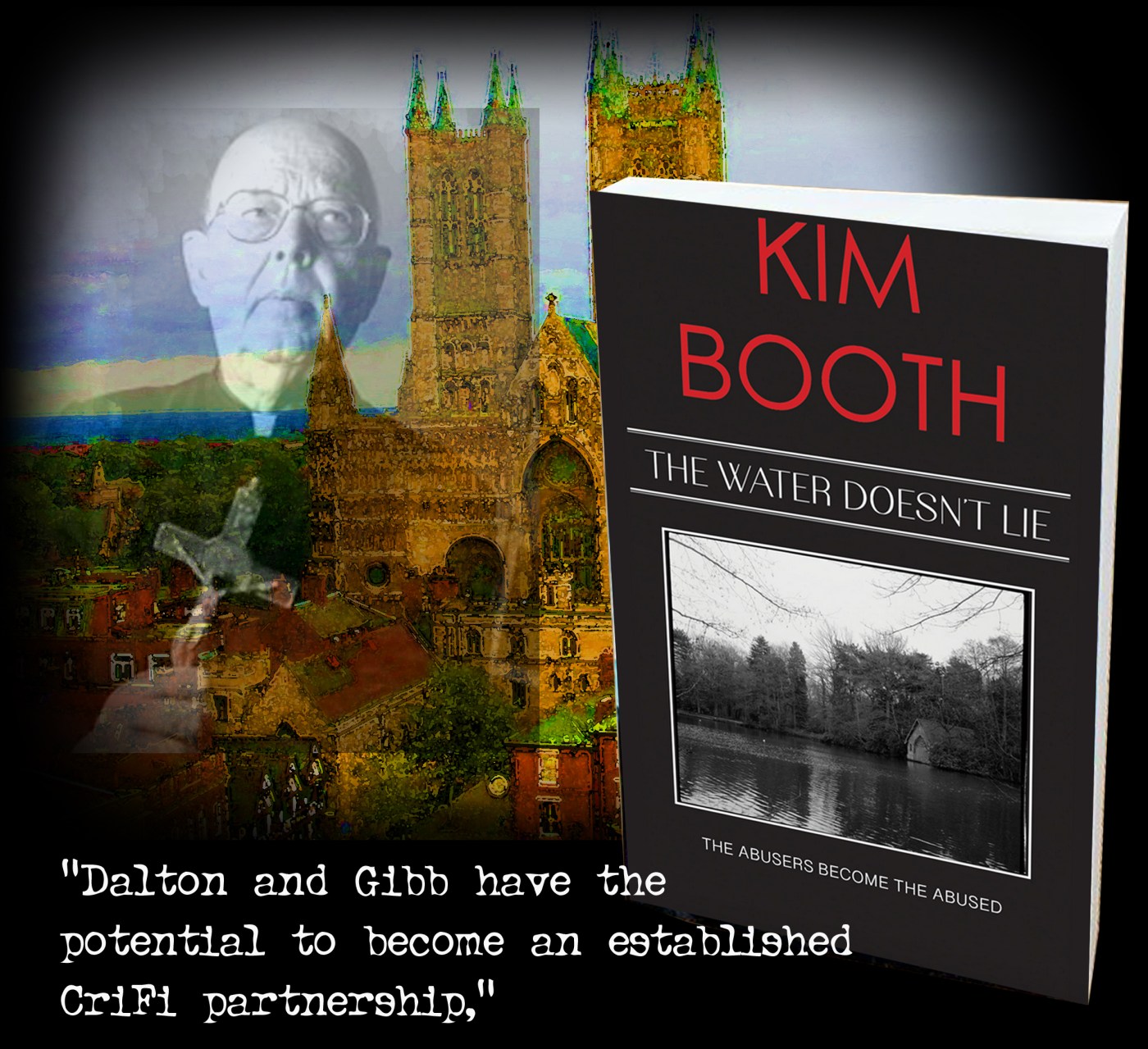
Cut to the present day and we are in the cathedral city of Lincoln. The location gave me a huge amount of pleasure, as one half of my ancestry is as Lincolnshire as haslet, Sincil Bank, Mablethorpe, the wonderful Wolds – and Lincoln’s imp itself. When a body is fished out of a local lake and eventually identified as a former Roman Catholic priest (and child abuser), DI Dalton and his oppo, DS Gibb, are drawn into a murder investigation that will take them away from their bailiwick to Glasgow, and the less than salubrious visitors’ rooms of HMP Barlinnie. Someone – maybe with an accomplice – scarred by their brutal days in church care has decided to take revenge, and the body count increases.

Dalton and Gibb follow one or two false trails before they are forced to face the fact that not only is their quarry extremely adept using modern technology, and suspiciously familiar with the way modern police work is done, but they are also something of a weapons expert. As a keen target shooter myself, I can vouch for the fact that a 7.62mm rifle with a decent scope is a formidable weapon in the hands of a sniper. I am not sure if KIm Booth has had the misfortune to fall foul of the deeply secretive and self-protective world of the Roman Catholic church, but the crimes he describes here sound grimly authentic.

The procedural aspects of the story are totally convincing as one might expect from a former police officer – after several jobs and a brush with the law Booth decided to join the Lincolnshire Police, where he served 35 years mainly in investigative roles. The attention to crime-scene detail, the awareness of sharp-eyed defence lawyers for any slight slip-up in the chain of evidence and the debilitating effect form-filling and box-ticking can have on investigators is described in detail. Perhaps the author (in my view) has taken something of a risk in the way he chooses to end the search for the children’s home avenger, but Dalton and Gibb have the potential to become an established CriFi partnership, and I hope that future books will let us know a little more about the men and what makes them tick as people.

Kim Booth was born in Lincolnshire. After leaving the police he worked as a Corporate Security Manager for a well know international holiday company for a number of years. Currently he has started to fulfill a long standing intention to write true crime and crime fiction books. He lives in the city of Lincoln. The Water Doesn’t Lie is available now.

THE RAGING STORM . . . Between the covers

RS spine

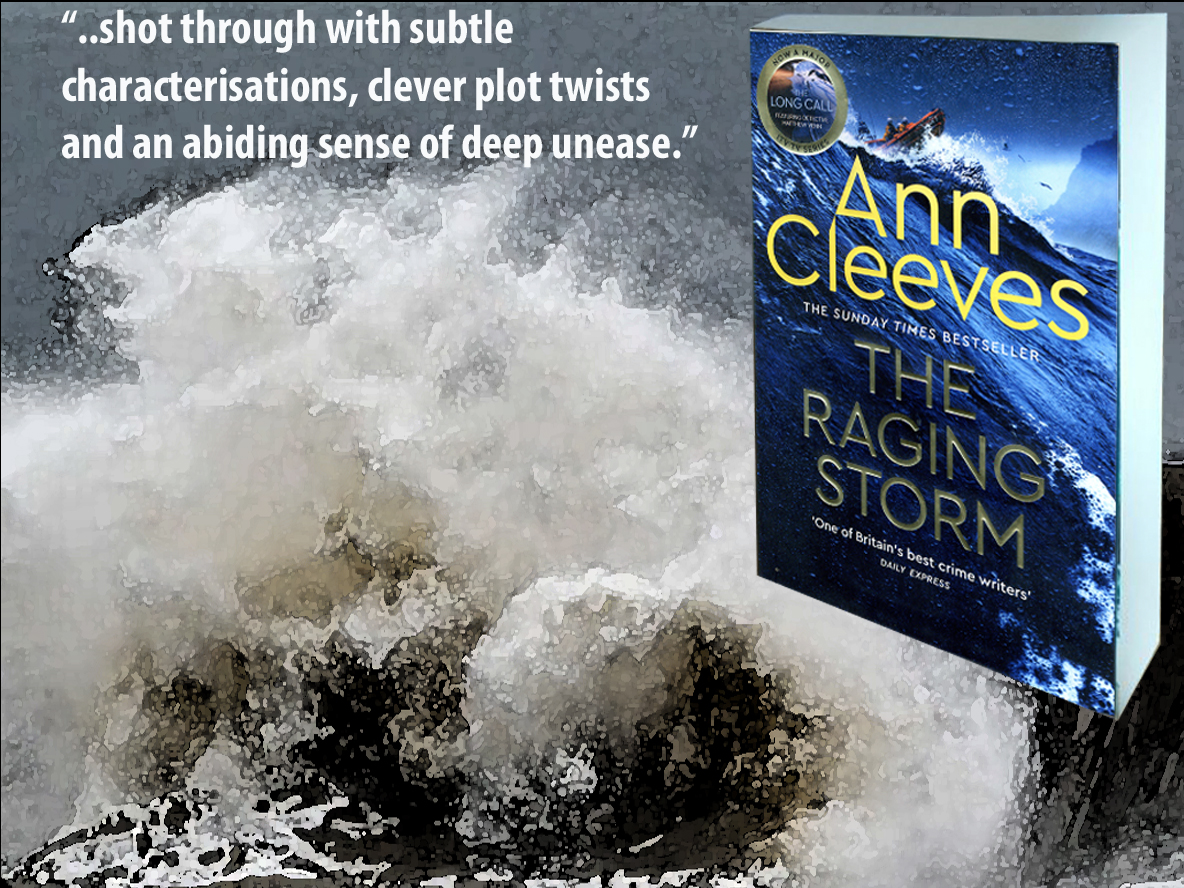
Ann Cleeves introduced us to Detective Matthew Venn in The Long Call (2019). Police officers in crime fiction are ten-a-penny, so writers strive to make their creations a bit different, or to have what marketing people call a USP. Venn is married to a creative arts chap called Jonathan. This is, to say the least, an unusual circumstance in the rugged North Devon fishing village of Greystone, where he goes to investigate the mysterious death of a media-savvy – and much televised –  adventurer and sailor called Jem Rosco. Venn is, however, no stranger to Greystone. It is where he was brought up as a member of an exclusive group of evangelical Christians called The Barum Brethren.

Rosco has turned up in Greystone, more or less out of nowhere, although the villagers have seen him often enough on their TV screens. After a few weeks of holding court in the village pub – The Maiden’s Prayer –  Rosco disappears, but is then found dead in a little boat anchored just off-shore, in a violent storm. The local RNLI bring his body back, and then his demise becomes a case for Matthew Venn, based in Barnstaple, the largest town in the area.

This is certainly not one of those ‘murder comes to seaside idyll’ stories. Greystone is a grim little village which is frequently battered by the weather. For Its residents life is something of a struggle; there are few amenities, and employment is hard to come by. With all the skill she displays in her other  novels set by the sea, Ann Cleeves allows the village to develop a rather forbidding character all of its own.

There are several well-drawn local characters, all of whom Venn is forced to consider as he tries to answer the age old question about a mysterious death – “Cui Bono?“. Pub landlord Harry Carter may be every bit of the jovial ‘mine host’ he appears to be, but do shady financial dealings in his past bring him into the web of suspects? Mary Ford is the first woman to be skipper of the local lifeboat, but her life is shot through with anxiety over the future of her son who suffers from a degenerative disease. As a teenager, she had an unrequited passion for Jem Rosco, so has his re-emergence in the village triggered an act of revenge for past slights? Barty Lawson, alcoholic Commodore of the nearby Morrisham Yacht Club,  has bitter memories of the days when Rosco – irreverent, mocking and disrespectful – used his celebrity to belittle him. The hint of an old romance between Rosco and Lawson’s wife Eleanor has further soured the man’s mind but, in a rare sober moment, was he capable of engineering the complex piece of theatre which appears to have framed the discovery of the sailor’s body?

When Lawson’s body is later found shattered at the foot of a towering cliff, Venn wonders if this was the final act of a guilty man, but Ann Cleeve provides a solution to the mystery that is much more elegant – and unexpected.  The Raging Storm is, on one level, a standard whodunnit, and sticks to the standard framework of a police procedural novel, but it is shot through with subtle characterisations, clever plot twists and an abiding sense of deep unease. Published by MacMillan, the book is available now.

THE WIT AND WISDOM OF BERNIE GUNTHER

PK

Over the thirty years and fourteen books of the series, Philip Kerr’s wonderful antihero Bernie Gunther was never afraid to speak his mind, both to us as readers, and often to the real-life characters – as diverse as Reinhardt Heydrich, William Somerset Maugham and Eva Peron – who peopled the stories. Sometimes he could be profound, sometimes savagely funny, but always observant. Here is a selection of his best lines.

Most of us who love great novels were aware that Philip Kerr was ill, and it was a moment of great sadness when we learned of his death in March 2018. We could not grieve in the full sense of the word. That was for his family. But we could only dream of what other adventures PK could have dreamed up for his magnificent creation, had he been granted more years. As it was, Metropolis – ironically, the book featuring Bernie at his youngest – was published posthumously. The Gunther books will be read as long as people have the desire to learn about 20thC history and the people who – for good or ill – shaped it. Also, as long as there are readers who enjoy a well-turned insult and a melancholy gaze into the human soul, Bernie Gunther will live for ever.

THE MISPER . . . Between the covers

misper spine014 copy

Central to this powerful novel is one of the great social scourges of modern Britain – the County Lines illegal drug distribution structure. It is horribly simple. The big drug barons, most probably masquerading as genuine businessmen, use a complex hierarchy to deliver the product – weed, crack, whatever is in vogue – to their customers. The criminal equivalent of the cheerful Eastern European Amazon man who delivers your parcel on time is, typically, a teenage boy, perhaps still of school age (but he rarely attends) possessed of nothing more sinister than a bicycle, a hooded sweat shirt and a bandana to cover his lower face. The youngsters have a huge advantage over the police, glued as they are these days to the seats of their patrol cars. These lads can pedal down one-way streets, navigate the narrowest town alleys and passageways, be here one moment and gone the next. Their immediate bosses provide them with cheap burner ‘phones, which are as expendable as the people carrying them.

On this depressing armature Kate London sculpts her story. Ryan Kennedy is  a teenager hooked into one of these criminal gangs, and one of his handlers has given him a handgun. When he is cornered in a Metropolitan Police operation, he shoots dead Detective Inspector Kieron Shaw,  who was trying to persuade him to throw away the weapon. When Ryan is tried for murder, clever lawyers manage to hoodwink the jury, and he is given a relatively lenient jail sentence. Once inside, of course, he is lauded by fellow inmates as someone who “killed a Fed”, and the big wheels in his organisation make sure his prison term is comfortable.

Kate London then introduces the other people whose lives are radically changed by Shaw’s murder. There is DC Lizzie Griffiths who has had an affair with Shaw and now looks after Connor, the result of that liason. DC Steve Bradshaw was the undercover cop who became close to Ryan Kennedy and, in one way, created the fatal showdown.  Detective Sarah Collins was deeply involved in the case, but has now been transferred to another force in the north.

Ryan Kennedy may be many things, but he is not stupid, and he pulls the wool over the eyes of his probation officer and is relocated to the country town of Middleton and given a job in a bike shop. He wastes no time in resurrecting his criminal career and is soon known as NK (apparently a Game of Thrones character) and continues to exert his malign influence.

The “misper” of the title is a fifteen year-old called Lief, who has fallen into the clutches of one of the gangs. He goes missing, and  his mother – Asha – eventually alerts the police. The police tie in Lief’s disappearance with the re-emergence of Ryan Kennedy as local boss of drugs distribution in Middleton. No spoilers from me, but what happens next is a tense and vivid narrative that is crying out for a screenplay.

On one level, Kate London has written an an intense and gripping police procedural thriller, but she also poses many questions. Perhaps it is unfair to expect that novelists should provide us with answers to real-life social problems, but the questions still need to be asked. Readers of this novel can infer what they like but, for what it’s worth, my conclusions are: (1) One of the greatest calamities to befall British society is the absence of traditional fathers in the bringing up of male children in certain communities. Ryan Kennedy has no father. Lief has no father. A cynic might say that Connor has no father, because he was shot dead by a criminal drug runner. (2) The British police are being overwhelmed by a tide of budget cuts, aggressive criminal defence lawyers, strident social justice warriors and a cataclysm of civil liberties activists.

Kate London is a former police officer and has written a grimly convincing story of a part of British society that is broken, and a criminal justice system barely fit for purpose. The Misper is published by Corvus and is available now.

Blog at WordPress.com.

Up ↑