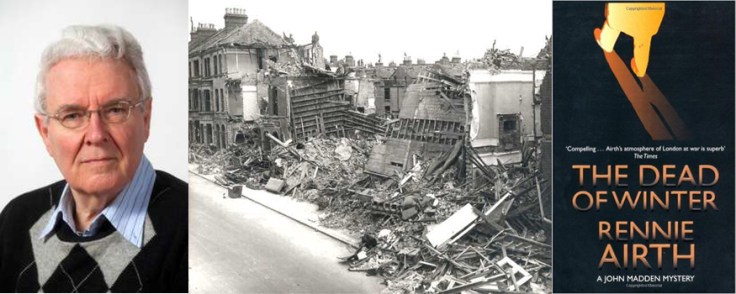
Rennie Airth, a South African by birth, now lives in Italy, but I mention these details only because his descriptions of wartime England in The Dead of Winter are so evocative that it is hard to believe that the writer did not experience the conditions at first hand. More of this in a while, but first, the story.
 We are in the weeks leading up to Christmas 1944, deep in what would prove to be the last winter of a war which, thanks to the Luftwaffe, had brought death and destruction to the doorsteps of ordinary people in towns and cities up and down the country. German aircraft no longer drone over the streets of London; instead, the Dorniers and Heinkels have been replaced by an even more demoralising menace – the seemingly random strikes by V1 and V2 rockets. Despite the fact that the rockets need no visible target to aim at, the ubiquitous blackout is still in force. An Air Raid Precaution Warden, whose job has become as redundant as that of those manning anti-aircraft batteries, makes a chilling discovery. He stumbles – literally – on the body of a young woman. Her neck has been broken by someone clearly well-versed in killing, and the only clue is a number of spent matches lying by the body.
The dead woman is soon identified. She is Rosa Nowak, a Polish girl who has sought refuge in Britain, and has been working on a farm in Kent. What was she doing in London? Visiting her aged aunt, apparently. The police struggle to find a motive for the killing. It wasn’t sexual, it wasn’t robbery, so who on earth stood to gain from the murder? The investigation is led by Chief Inspector Angus Sinclair, a senior detective who might have retired years ago, were it not for the manpower shortage in the Metropolitan Police caused by the war.
With one of those wonderful coincidences which only ever seem to happen in crime novels, Sinclair learns that the farm where Rosa had been working is none other than that owned by a former colleague – John Madden. Rennie Airth introduced us to the former Inspector in River of Darkness (1999) and we followed his progress in The Blood Dimmed Tide (2004). Madden served with distinction in The Great War, but the conflict has left him with scars, more mental than physical and, despite marrying, for the second time, a country doctor who he met in River of Darkness, he still grieves for the deaths of his first wife and their young daughter.
 There is more than a touch of The Golden Age about this novel, but it is much more than a pastiche. Although the killing of Rosa Nowak is eventually solved, with a regulation dramatic climax in a snow-bound country house, Rennie Airth allows us to breathe, smell and taste the air of an England almost – but not quite – beaten down by the privations of war. Many of the characters have menfolk away at the war, including Madden himself and his wife Helen. Their son is in the Royal Navy, on the rough winter seas escorting convoys. The contrast between life in the city and in the country is etched deep. In the city, restaurant meals are frequently inedible, the black market thrives unchecked due to depleted police manpower, and even the newsprint bearing cheering propaganda from the government is subject to rationing. Travelling anywhere, unless you are fiddling your petrol coupons, is arduous and unpleasant.
“Though inured like all by now to the rigours of wartime travel, to the misery of unheated carriages, overcrowded compartments and the mingled smell of bodily odours and stale tobacco, he was still recovering from his trip down from London that afternoon when for two hours he had sat gazing out at a countryside that offered little relief to the eyes weary of the sight of dust and rubble, of the never-ending vista of ruined streets and bombed-out houses …..”
There is an element of the modern police procedural about the book, but such is the quality of Airth’s writing that we willingly forgive him for John Madden’s occasional flashes of insight which redirect the well-intentioned but bumbling coppers in their search for the killer of Rosa Nowak.
In addition to the two previous John Manning novels, our man returns in The Reckoning (2014) and is set to make another appearance in 2017 with The Death of Kings.


 The van skids to a halt on the lonely hill top lane. Occasional distant lights from isolated farms and cottages are all that pierce the darkness. The young men inside the van giggle as they open the rear doors and throw the girl from the dirty mattress on which she has been sprawled. She hits the roadside with a body-jarring crunch.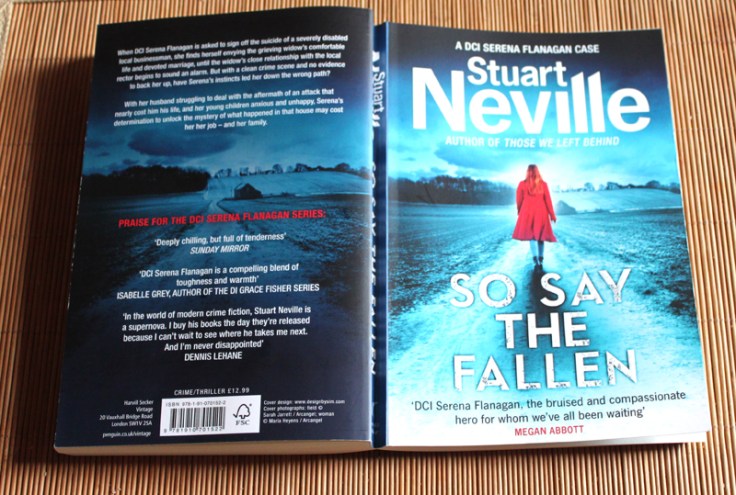
 Stuart Neville (left) returns with another hard-bitten and edgy tale of life and crimes in Northern Ireland. Set in a fictional village on the edge of Belfast, we are reunited with DCI Serena Flanagan, who first appeared in Those We Left Behind. Like much of life in Ulster, fictional and real, religion and the stresses and strains it places on secular life is never far from the surface. The sacred influence in this case is provided by the Reverend Peter McKay. The clergyman is a widower, but we find that he has been taking his parochial duties above and beyond what is normally expected. The recipient of his pastoral care is Roberta, the attractive wife of Henry Garrick.


 fullybooked2017