

 n a fictional world overflowing with disfunctional detectives who happen to be rather good at their jobs, Joseph Knox has raised, or perhaps lowered, the bar considerably with his DC Aidan Waits. We first met Waits in Sirens (2017) and then in The Smiling Man (2018). Now, in The Sleepwalker, Knox takes us on another guided tour of the dystopian underbelly of contemporary Manchester.
 Together with his grotesque partner and immediate boss, DI Peter Sutcliffe, Waits always gets the shitty end of the stick. ‘Sutty’ Sutcliffe is, you might say, a good old fashioned copper. Waits goes to meet him in a dingy rock-and-roll boozer:
“Sutty was standing in the corner, explaining something to one of the other customers. To make sure the man was really listening, he’d lifted him off the ground by his ears and begun banging his head into the wall to the beat of the drum.
He let the smile slide, dramatically, off his face when he saw me.
‘Oh’, he said, over the music. ‘It’s the great depression. Shouldn’t you be queuing up for a loaf of bread instead of buying beer?’ “
Waits and Sutcliffe have been assigned to a Death Watch. In hospital, a notorious serial killer nicknamed The Sleepwalker because of the bizarre circumstances of his arrest, is dying of cancer. Years ago, he was convicted of slaughtering a family – wife and children – and the older daughter’s body has never been found. In the faint hope that Martin Wick’s dying breath will reveal the final resting place of twelve year-old Lizzie Moore – a sombre echo of the misplaced faith that believed Ian Brady would finally say where he had buried Keith Bennett – Waits and Sutcliffe sit by the dying man’s bedside, their ears close to whatever utterance escapes his shriveled lips.
 hy is Aidan Waits such a tortured character? Well, how long have you got? His childhood was loveless and chaotic, and spent largely in institutions where he rubbed shoulders with trainee failures, malcontents and killers. Echoing Nietzsche’s chilling remarks about the moral abyss, Waits has, more recently, gazed too long into a chasm inhabited by a repellent Manchester crime lord called Zane Carver. Carver has fed Waits’s drug habit, and the two have fought over women. Carver has a particular talent with women:
“Zain Carver was a magician when it came to ruining women’s lives.
He surrounded himself with these beautiful assistants and then delighted in sawing them up, making them disappear. Sometimes a new girl on his arm might end up on the game, or in hospital, or back with her parents feeling five years older, a permanent faraway look in her eyes.”
 s distinctive as Knox is as a stylist, and as much as he is a master of the inky black metaphor, he has a tale to tell and a plot to spin. The sepulchral calm of Martin Wick’s closely guarded hospital room is shattered by a savage attack which Waits survives, but puts him at the head of the queue as the police and the gutter press search for scapegoats. With Carver having decided to exact revenge on Waits by donning his black cap and pronounced the death sentence, Waits is on the run both from the gangster and, no less implacably, his politically motivated senior officers, but he keeps them at bay. He discovers faint-but-fatal fault lines in the original case against Martin Wicks, and finds that both Kevin Blake, the detective who brought Wicks to justice, and Frank Moore, the father of the murdered children, still have songs to sing.
 Joseph Knox writes like an angel. Possibly an Angel of Death, but he grasps the spluttering torch of English Noir once carried by such writers as Derek Raymond, and runs with such vigour that the flame burns brightly once again. He is not without humour, and there are many – if unrepeatable – gags exchanged between the cynical cops and their low-life prey. The politically correct nature of modern policing doesn’t escape his attention, either:
“The conference space and interview rooms had a bland, mass-produced, modern aesthetic. If Hitler’s bunker had been designed by Travelodge, it couldn’t have communicated quiet despair any more effectively.”
No-one who has had the misfortune to require A & E treatment on any given weekend evening – in Manchester, Middlesborough, Maidenhead or Milton Keynes – will be unfamiliar with this baleful description, as Waits searches for a suspect:
“I looked about me. Bloodshed, fist-fights and stab wounds. Confused, stunned people, drunk, on drugs, with life-altering injuries. Stick-thin single mothers on food bank diets, with morbidly obese babies.”
 nox has his grim fun with a Manchester police force that is barely honest, city down-and-outs who have lost most of the trappings of humanity, and an infestation of tattooed, Spice-addicted thugs straight from Central Casting – with Hieronymus Bosch as the agency’s head of HR. He also leaves us with a delightfully enigmatic final few pages. The Sleepwalker is published by Doubleday and will be on the shelves from 11th July


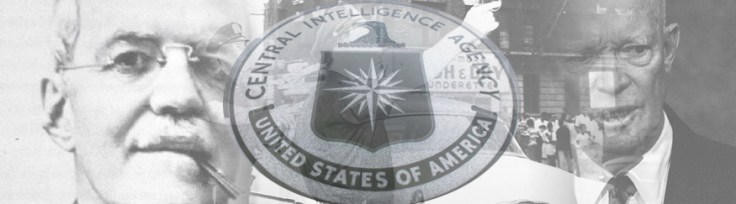
 Cassidy is an ex-serviceman, and in Night Watch he becomes involved in an issue which is way, way above his pay-grade. The initial reaction of the USA to former Nazis in the months immediately following May 1945 was simple – Hang ‘Em High. But as the government realised that highly trained German scientists and engineers were being harvested by the new enemy – Soviet Russia – the bar was significantly lowered, with the philosophy that these men and women might be bastards, but at least they’re our bastards.
 concentration camp survivor, ostensibly just an old guy driving tourists around Central Park in his horse cab, but secretly hunting down those who imprisoned him and killed his family, is found dead with strange puncture wounds in his neck. A businessman dives through the high window of his hotel – without bothering to open it first – and no-one saw anything. Not the concierge, and especially not the dead man’s co-workers, who were in an adjacent room. Two deaths. Two cases which Cassidy’s boss wants put to bed as quickly as possible. Two lives snuffed out, and Cassidy senses a connection. A connection leading to money, national security, powerful people – and big, big trouble for a humble NYPD cop.
 here are one or two significant name drops which help boost authenticity, amongst them a guest appearance by the sinister head of the CIA, Allen Dulles. Cassidy himself doesn’t do wisecracks, but there is plenty of snappy dialogue and verbal slaps in the face to keep us awake. This, after a post mortem:


 Later that year, with Brixton quieter, despite other English towns and cities erupting in copycat anger, Hobbes has become embroiled in a bitter internal dispute. A fellow copper, Charlie Jenkes (who rescued Hobbs from the mob on that fateful April night) after being indicted for savagely beating a black suspect, has taken his own life. And the officer who testified to Jenkes’s violence? Henry Hobbes, who, with that single act of honesty, is branded as a Judas by his own colleagues.


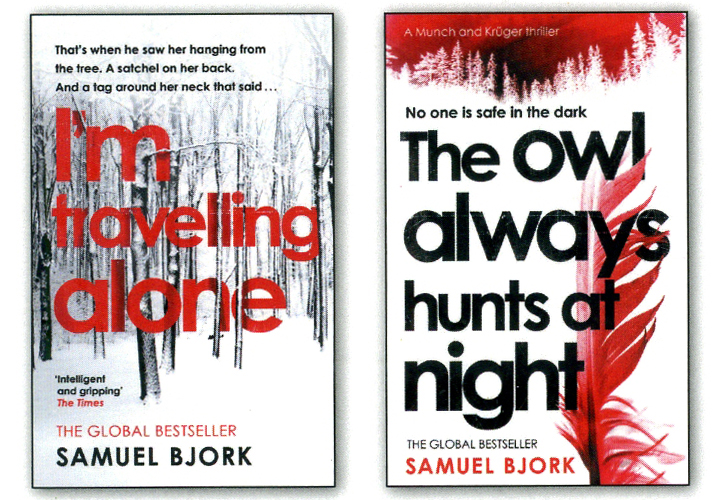



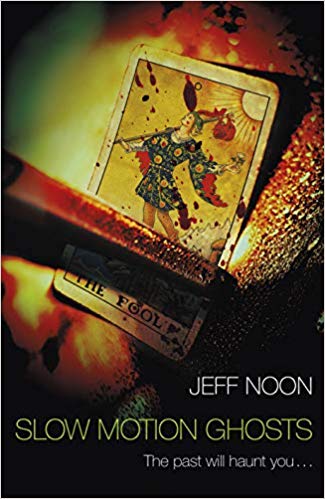
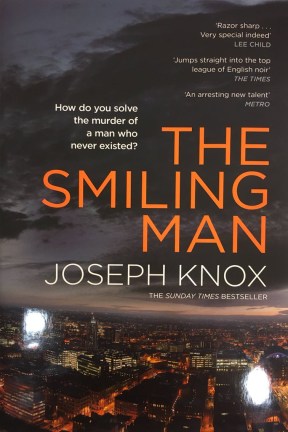 This is all too much like hard work for Sutcliffe, but despite warnings from his saturnine superior, Superintendent Parr, Waits digs deeper. He uncovers a labyrinthine series of connections between an absent solicitor doing his rich-white-man things among the bar girls of Thailand, an apparently gay businessman and his estranged wife, the corpse (now renamed The Smiling Man), and another hotel room, its floor saturated with pint after pint of human blood.
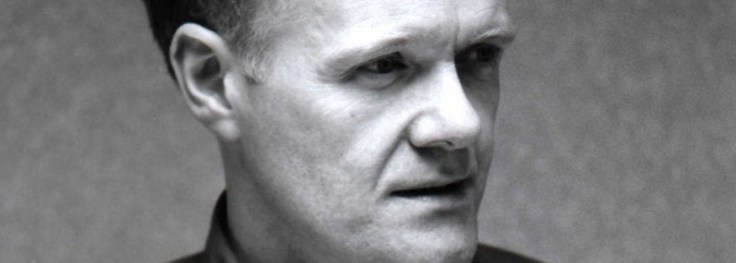
 This is little short of a modern masterpiece. You might imagine Joseph Knox (right) to be a weathered, life-weary cynical misanthrope, hunched in a corner of the pub, savouring a roll-up, rather like a latter day Derek Raymond, but anyone who has had the privilege of meeting Joseph will know that this is far from the case. He is well versed in the art of Noir, though, as he revealed when he spoke to us around the time that his first novel, Sirens, was published.
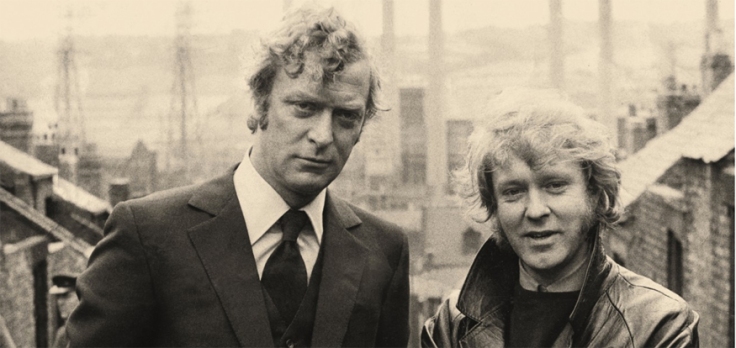
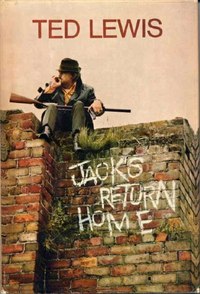 In 1965, All the Way Home and All the Night Through was published. It is a thinly disguised autobiographical novel, but Lewis’s breakthrough came in 1970 with the publication of Jack’s Return Home. The title was, bizarrely, taken from a spoof melodrama acted out by Tony Hancock, Hattie Jacques, Sid James and Bill Kerr as an episode of Hancock’s Half Hour. The novel, however, has few laughs. It describes the revenge mission of a London-based enforcer, Jack Carter, as he returns to his northern home town to investigate the death of his brother. The novel was adapted and filmed as Get Carter, and the rest, as they say, is history. Fame – and money – did not sit comfortably on Lewis’s shoulders, however. A mixture of drink and personal demons led to the break-up of his marriage, and a solitary return to Barton to live with his widowed mother. He died there, of heart failure connected to his ruinous drinking, in 1982.
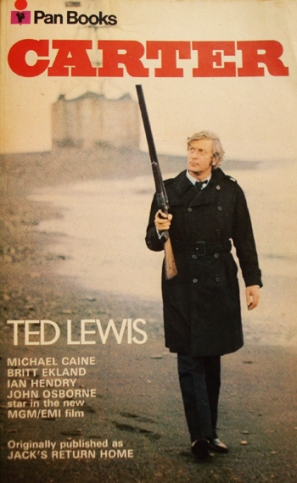 The centrepiece of Triplow’s book is, quite rightly, concerned with the novel itself, and its journey from a brutally honest and ground-breaking novel through to a partial re-imagining as one of the finest crime films ever made. Of Jack Carter, Triplow stresses that, despite the iconic image created by Michael Caine and director Mike Hodges
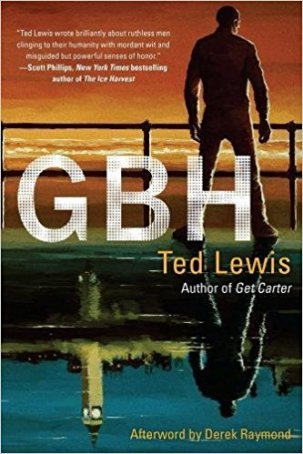 Aside from describing what must have been harrowing conversations with Lewis’s widow and children, Triplow employs both the depth and breadth of his knowledge of British crime fiction to convince us just how good Ted Lewis was. It is intriguing that Triplow, supported by no less an authority than the magisterial Derek Raymond, makes a fascinating case for GBH being the apotheosis of Lewis’s talent, despite the groundbreaking style and success of Jack’s Return Home. Getting Carter is a sober and sombre account of the life of a man whose talent both defined and destroyed him, and Triplow makes no attempt to sanitise his subject. Lewis was clearly a man of huge personal charm when not in the grip of drink, but from the early days of illegally bought pints of beer in the 1950s through to the grim years of decline and death, alcohol had him firmly by the throat.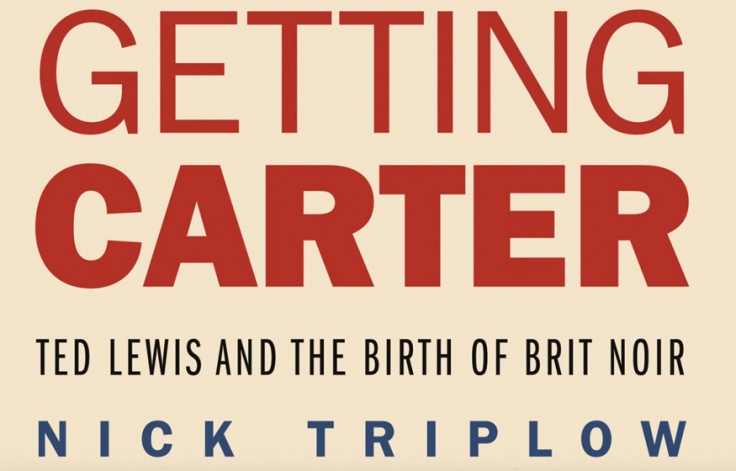


 So, when Gabriel answers the door bell one day only to behold the wedge-shaped and granite faced personage of Farrelly – chauffeur, enforcer and general gofer for Frank Parr – he is led, like a naughty boy tweaked by his ear, to Parr’s sumptious office building. To say that Parr – now a respectable media mogul – has something of a history, is rather like saying that Vlad The Impaler was someone of interest to Amnesty International. Parr made his money – loads of it, and of the distinctly dirty variety – by publishing magazines which were not so much Top Shelf as stacked in the stratosphere miles above the earth’s surface.
 “For a while, I wandered the streets of Soho, as I had on the day I’d first visited forty years ago. Doorways whispered to me and ghosts looked down from high windows.”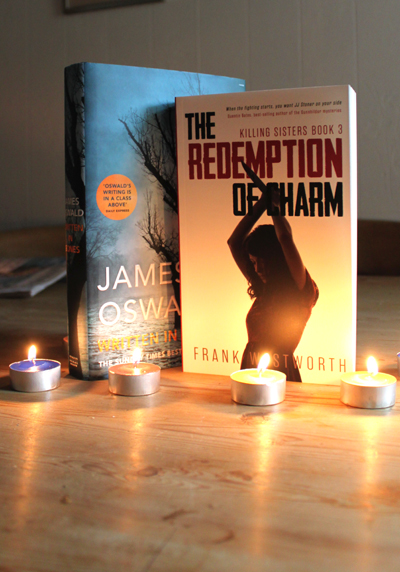

 First out of its protective wrapper was the latest from one of my favourite British writers, Frank Westworth. He has created a noirish world of grimy London music venues, peopled with frequently freakish characters and misfits, all of whom live out the heartbreaking three-chord trick of the Blues in their real lives. Presiding over the mayhem is a moody and reclusive investigator, cum killer, cum doer-of-dirty-deeds for the British establishment. His name is JJ Stoner, and as well as bending his guitar strings into shivering blue notes, he has an uneasy and unique relationship with three weird sisters. Note the absence of capitals, as these ladies are not the cauldron-stirring crones of The Scottish Play, but three violent and devious sexual predators. We have met Charity and Chastity in the first two books of the trilogy, but as Westworth wraps the series up, he introduces us to Charm.
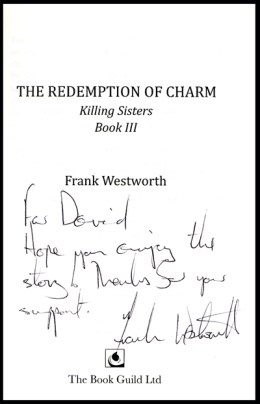 What happens in the book? I can do no better than to quote a line from the best motorbike song ever written. Like the biker outlaw James in Richard Thompson’s awesome Vincent Black Lightning 1952, JJ is “running out of road …running out of breath,” Stoner is surrounded by brutal enemies on all sides, and all the old acquaintances from whom he might expect a favour or three are walking by on the other side. This is one book which will certainly not end up in a charity shop or casually passed on to friends, because mine came with a personal touch. You folks are definitely not going to lay hands on my copy, and I’m afraid you will have to wait until the end of next month for yours. In the meantime, you can check out a mischievous and beautifully written piece by Frank Westworth
 and demanding) day jobs of current authors, Oswald has achieved what might have seemed to be an impossible task. He has created a engaging and totally believable Scottish copper who, over the space of six previous novels, has sharp-elbowed his way in the room crowded with such characters as John Rebus and Logan McRea.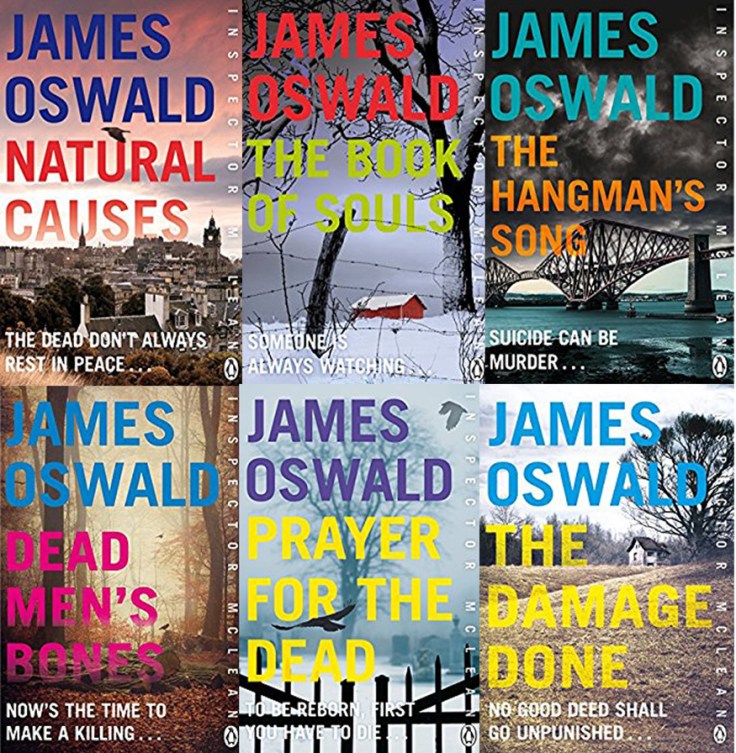

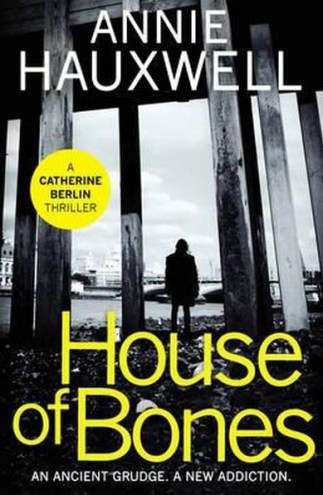 It’s always fun to come late to an established series that has many established followers, if only to see what all the fuss is about. I had covered Catherine Berlin in writing brief news grabs, but House of Bones was to be my first proper read. There is a wonderfully funereal atmosphere throughout the book. Sometimes this is literal, as at the beginning:


 fullybooked2017