
Search

fullybooked2017

Tag

Nick Harkaway

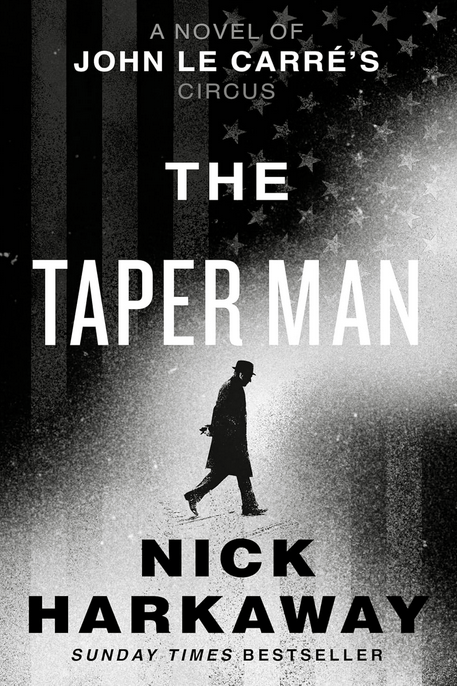
THE TAPER MAN . . . Between the covers

Nick Harkaway, aka Nicolas Cornwell, sets us down in the mid 1960s in this, his second re-imagining of the world of British Intelligence during the Cold War years, a world so memorably portrayed in his father’s novels about George Smiley and ‘The Circus’, properly known as MI6. When Bill Haydon, a field operative is shot and wounded in a Helsinki market, George Smiley is told to investigate. Haydon’s companion, a woman called Lara Koski, was killed in the exchange, as was a man who is later identified as Rolan Gusev, a Russian agent. Gusev was due to fly on to America, where he was booked in to stay at The Reconstruction Club, a luxurious Los Angeles establishment regarded by the CIA as a place with strong links to Soviet Russia.

Another Circus operator, Roy Bland, is meanwhile experiencing problems of his own in Leningrad, where he is staying in a health spa. Bland, officially employed in Bulgaria, is one of the more unusual Circus employees. Although highly educated and multilingual, he is of working class origins. He was brought up in east London, where his father was a docker. ‘Control’, the otherwise nameless boss of The Circus, believes that Gusev was on his way to California to make contact with a Russian spy deeply embedded within the American intelligence services, and he is anxious to find out who this person is. Why? Although Britain was still, notionally, an international power, its post – Suez reputation is not good, particularly in the eyes of the Americans.

To use a seasonal metaphor, it is Britain’s autumn, and the trees, with their leaves blasted away by strong winds, are nearly bare. The American CIA are blunt, disruptive and vigorous. They view the inherent caution and subtlety of MI6 as fey and ineffective. Roy Bland, almost by accident has discovered what might be a key to unmasking the American spy, and it is in Leningrad where most of the serious action takes place. Bland is on the verge of applying for Russian citizenship, more through expediency than conviction, because he realises that his high profile defection may give him the opportunity to help Control.

Smiley, meanwhile, is sent to California, ostensibly to attend a conference but, in reality, to discover why Gusev was headed to Los Angeles, and who he was scheduled to meet. Along the way, we rub shoulders with many of Le Carre’s stock characters, such as the fiercely intelligent Connie Sachs and the devious Toby Esterhase. The more vigorous action – shootings, seduction, film negatives hidden in waste pipes and other skullduggery all takes place in Leningrad, but the quiet and persistent wisdom of George Smiley – ostensibly a mere bookkeeper or accounts clerk – which unmasks the traitor.

Finland features tangentially in the narrative, and it is worth remembering its strange place in European history. Having valiantly resisted the Russians in The Winter War, they then cosied up to Hitler, but suffered a savage revenge by Stalin after the war. The title? It originated in England’s Gunpowder Plot. An unidentified participant had the job of accompanying Fawkes on his fatal mission, carrying a shielded flame to be used in an emergency. In modern espionage terms, it has been used to describe a survivor of a busted spy plot, who keeps his or her head down and keeps the faith while the network is being destroyed above their heads. This is not easy reading. The plethora of references to the original books keeps us on our toes, but Harkaway preserves the enigma of the ‘little round man’, the impenetrable and unknowable George Smiley. The Taper Man will be published by Penguin/Viking on 5th November.
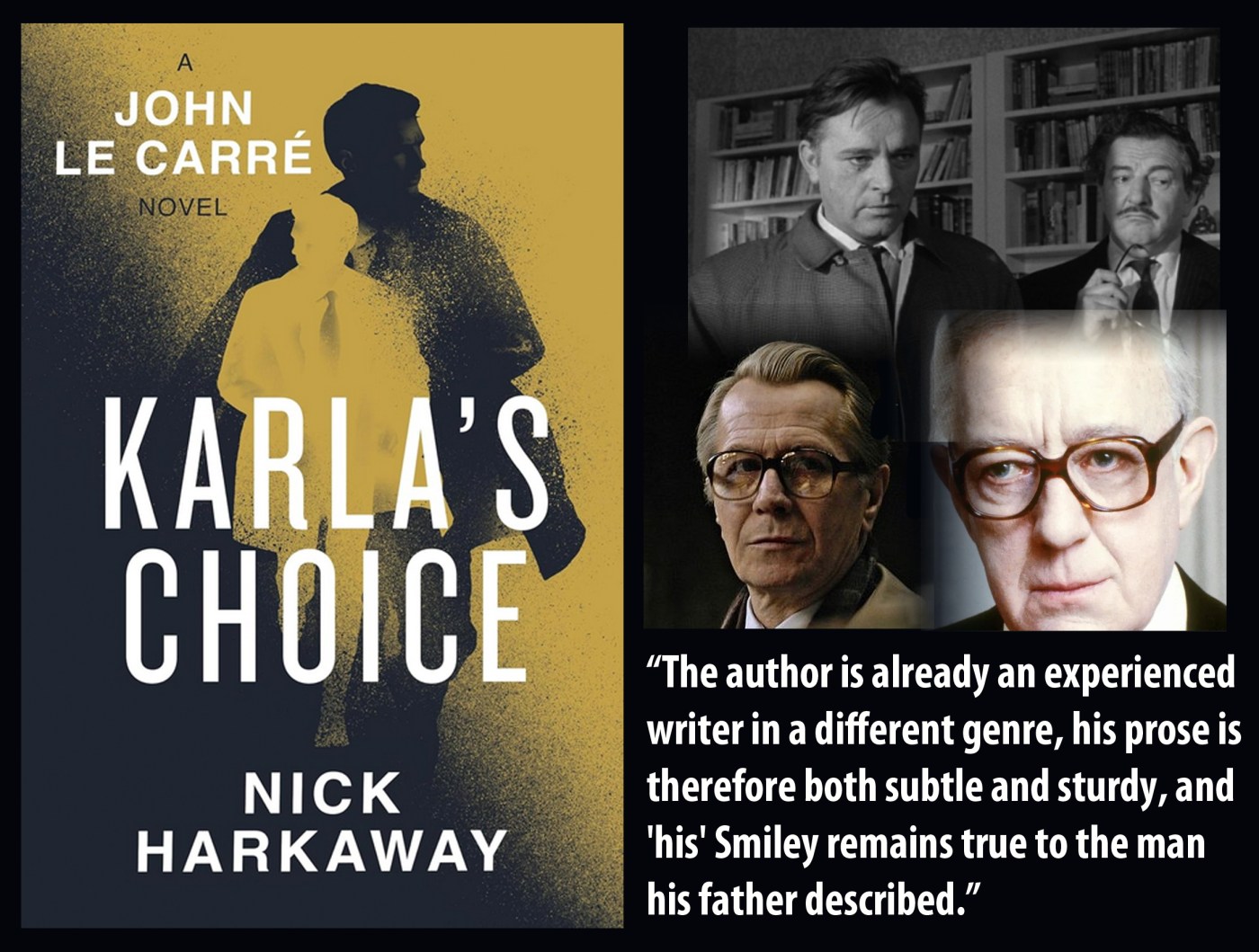
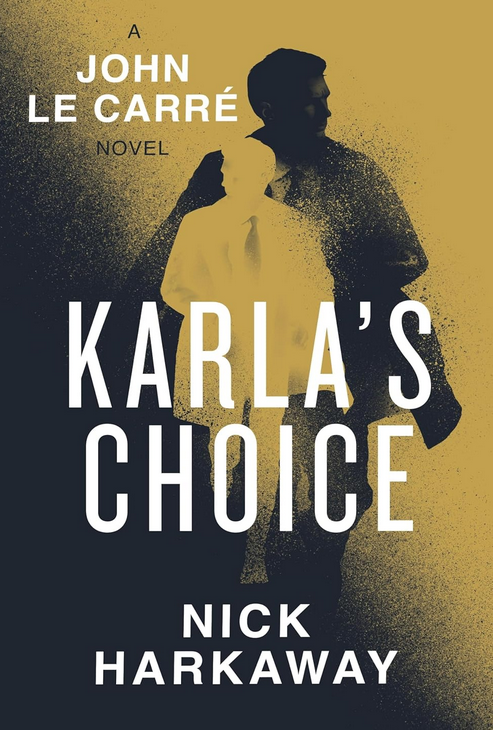
KARLA’S CHOICE . . . Between the covers

kc086 copy

We are in a wintry London in 1963. Older readers will recall that it started snowing on Boxing Day 1962, and it barely relented for weeks, with temperatures plummeting across the country. Susanna Gero is just one of the many thousands of Hungarians who fled to the west just 6 years earlier, after Russia had put down an uprising with its trademark brutality. She works at a shabby literary agency called Baánáti & Clay. Mr Clay never existed, and Laszlo Baánáti is missing. As part of a scheme of retribution devised by the Kremlin, agents have been despatched to the West to kill people who had the effrontery to leave the Soviet Union and its vassal states. One such is Miki Bortnik, and his target is Baánáti . Between the airport and Baánáti’s office Bortnik has a kind of epiphany, and meekly surrenders to the British authorities.

Baánáti’s disappearance is brought to the attention of the British intelligence service, and for old Le Carré buffs, we are back in the familiar world of The Circus, alongside Control, Connie Sachs, Percy Alleline, Bill Haydon, Toby Esterhase and – of course – George Smiley. Our man has taken early retirement of sorts in the wake of his involvement in the death of double agent Alec Leamas on the Berlin Wall (The Spy Who Came In From The Cold, Richard Burton in the film). Smiley is persuaded to make a temporary return to work in order to trace Baánáti, who is actually a Soviet agent called Ferenzc Róka. There is mention of the ominous sounding Thirteenth Directorate. This was basically a KGB hit squad, set up to deliver Moscow’s summary justice to former citizens across the world who had irritated Stalin.

Smiley discovers the reason for Róka’s disappearance. He has a son, now in his early twenties. Léo is young man of much promise, something of a gilded youth, but prone to upsetting local communist party officials. The lad has now been taken into custody. Róka has abandoned the pretence that he is a mild-mannered London literary agent, and via a series of false passports is on his way to central Europe to save his son. It is with  some inevitability that Control sends Smiley off to Berlin, to rescue Róka and his son from the Ministerium für Staatssicherheit (Stasi).  Smiley hopes that assistance will be given by Hans-Dieter Mundt, nominally leader of the East German Secret Service, the Abteilung. Mundt is actually a double agent who works for the British.

The book’s title, by the way, refers to the man who leads The Thirteenth Directorate. In the three books known as The Karla Trilogy, Le Carre provides an extensive biography of the agent, but we never meet him in person. The BBC cast Patrick Stewart in the role for TV, but he was glimpsed only briefly.

Control complicates matters by sending Susanna off to Berlin in the belief that her presence may help to smoke out Róka. The ploy does not work, as Susanna goes ‘rogue’ on her Circus companions, and things come to a head with a dramatic encounter on the streets of Budapest

How does it feel to be back among old friends? To be honest, it is such a long time since I read the original books or watched any adaptations, that I had to use Google to remind me of some of the characters, but the chill of the Cold War remains inescapable. Harkaway cannot be aiming purely at aficionados of his father’s books, so what will younger readers make of it, coming as they do to the Le Carré ensemble for the first time? The author is already an experienced writer in a different genre, his prose is therefore both subtle and sturdy, and ‘his’ Smiley remains true to the man his father described.

George Smiley remains one of fiction’s most enduring but enigmatic characters. He is not, however, a fragile Ming vase too delicate to be handled. Here, he not only survives, but is given fresh shape and form in a vivid reminder of how espionage was done in the dark ages before the digital revolution. Karla’s Choice is published by Viking/Penguin and is available now.

Screen Shot 2024-10-03 at 19.54.12

Blog at WordPress.com.

Up ↑