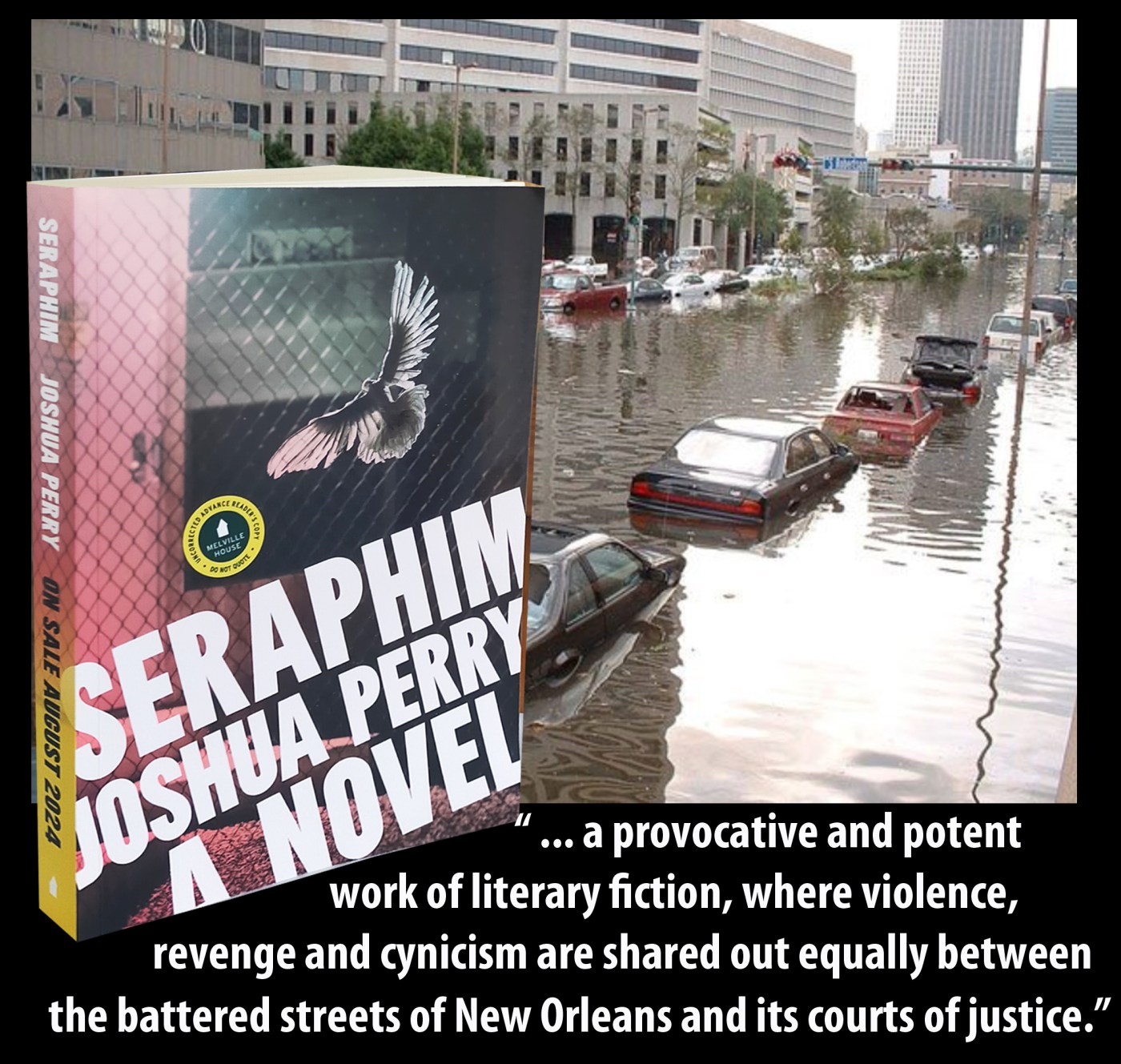

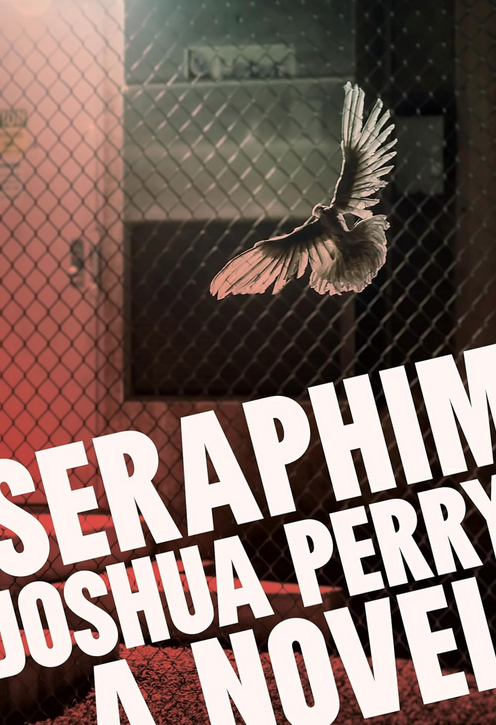
Seraphim – red-winged angels which, with Cherubim, are among the first hierarchy of angels next to the throne of God. According to the Book of Isaiah in the Old Testament, they had six wings, one pair for flying, another covering the face and the third pair covering the feet.
Ben Alder is a Jewish lawyer from Massachusetts, but currently working, with his partner Boris, in post Katrina New Orleans. The pair work for the Public Defender’s Office, meaning they pick up what we in the UK call Legal Aid work. It is badly paid and they deal with people who are at the very bottom end of society. The novel deals with Ben’s attempts to save a father and son from a lifetime in jail. The father, Robert McTell is accused of burglary by going equipped with tools to steal copper pipe from a school abandoned after the destruction of Storm Katrina. His son, Robert Johnson is in much more serious trouble. He has admitted shooting dead a much loved community figure, Lillie Scott, who has been a leading light in the attempts to rehabilitate and rebuild the city after the devastation of the storm. Another savage murder, where four youngsters, were gunned down while they were listening to music in a stationary car, works its way into the story
Reviewers of crime fiction like to put books in genre pigeon holes. If nothing else, it gives potential readers a heads-up about the content and style of a novel. After all, there are thousands of new CriFi books published every year and, for many readers, leisure time is a valuable commodity. I have to say that Seraphim refuses to be categorised. The closest I can get is to call it literary crime fiction. Despite the blurbs, it certainly isn’t a legal thriller. There are no tense courtroom exchanges between defenders and prosecutors. The world Ben Alder inhabits is a dystopia of broken lives, broken homes and broken promises, fogged in a miasma of disillusionment, cynicism and expediency.
One commodity that is notable for its absence in the criminal justice world of New Orleans is truth. Everyone, from the judge down, through legal counsel to the men shackled in cells – lies. Habitually and constantly. The prisoners don’t deal in truth, because experience tells them it will bring only pain. The lawyers’ version of truth is to put a story together that a jury might possibly believe, and this tale can be many miles away from what actually happened.
The timeline of the novel needs you to pay attention. Some sections are the here and now, while others are pre-Katrina. Other events take place far away from New Orleans in places like Memphis, where the homeless are temporarily re-homed. Neither Ben nor readers of this powerful novel ever do find out who shot Lillie Scott. There was certainly another boy, Willard, present on that fateful evening, but in spite of Ben’s elaborate narrative – designed to be told in court – that Willard was smaller and much more clever, and Robert was clinging to him as his only friend, the ‘truth’ never emerges. This, of course, is entirely in keeping with the premise of the novel, which is basically that there is no such thing as truth. Ben, shyly homosexual, even invents two mythical sons so that he can throw them into conversations to boost rapport with his clients.
The narrative is shot through with grim poetry, sonnets of death, rejection and betrayal. Despite not being a devoted Jew, Ben’s upbringing and education make the symbolism of the Hebrew bible very important to him, hence the title of the book. Seraphim is a provocative and potent work of literary fiction, where violence, revenge and cynicism are shared out equally between the battered streets of New Orleans and its courts of justice. Published by Melville House, it is available now.


 James Lee Burke (left) turned 81 in early December 2017. When I picture the face of his majestic but flawed hero, Dave Robicheaux, it is his creator’s face I see. The Robicheaux books have been filmed several times but the best one I have seen is In The Electric Mist (2009) starring Tommy Lee Jones, and Mr Jones is good a ringer for Mr Burke – and my vision of Robicheaux – as you will ever see.
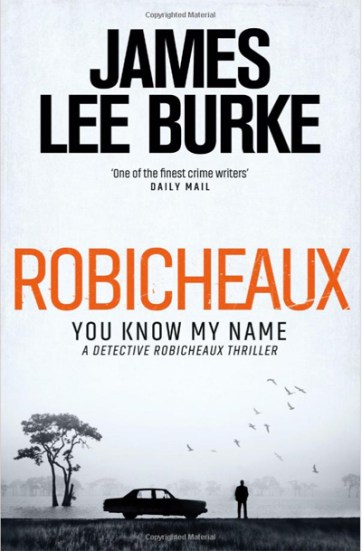 “That weekend, southern Louisiana was sweltering, thunder cracking as loud as cannons in the night sky; at sunrise, the storm drains clogged with dead beetles that had shells as hard as pecans. It was the kind of weather we associated with hurricanes and tidal surges and winds that ripped tin roofs off houses and bounced them across sugarcane fields like crushed beer cans; it was the kind of weather that gave the lie to the sleepy Southern culture whose normalcy we so fiercely nursed and protected from generation to generation.”


 Thrill Kill is a brisk, no-nonsense police procedural thriller set amidst the hurley burley of Carnival season in New Orleans. Homicide cop Quentin ‘Q’ Archer sets out to bring to justice a serial killer whose calling card is a can of aerosol coolant – tradename ‘Chill’ – beside the bodies of his victims. Archer burns the midnight oil to solve the crime, but it is not the only thing on his mind. He is not a native of The Big Easy, but a displaced person from Detroit, where his police career became violently complex when his wife was mown down by a car, and Archer was forced to turn against his own family in a personal war against police corruption, drugs and racketeering.
 Don Bruns himself (right) is an interesting character. As well as the first book in the Quentin Archer series Casting Bones, he has written two other series, Caribbean and Stuff. He describes himself as “a musician, song writer, advertising guru, painter, cook, stand-up comic and novelist who has no idea what he wants to be when he grows up.” His music is mainstream country, but with a little twist of this and that to spice things up. You can hear


 fullybooked2017