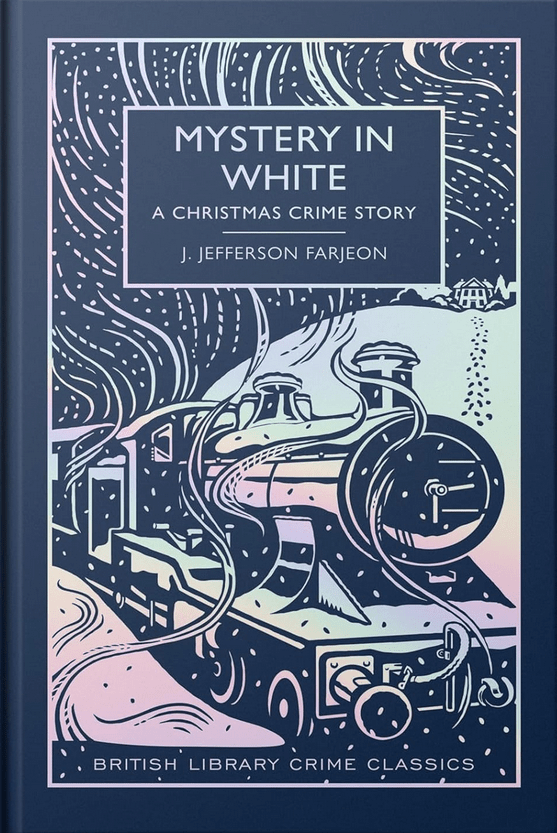
Largely forgotten now, Joseph Jefferson Farjeon was a dramatist and novelist who died in 1955. His reputation has perhaps been eclipsed by that of his sister Eleanor. Coming at the tail end of The Golden Age, Mystery In White was published in 1937. Another book which begins in the snow, The Nine Tailors, came out three years earlier, but that is where the resemblance ends. Wimsey and Bunter’s misadventure in a snow-filled Fenland ditch moves on quite quickly, and covers a much longer period of time.
Here, the 11.37 train from Euston ends up stationary, the line blocked by snow. In one compartment are a variety hall dancer bound for Manchester, a middle class brother and sister named David and Lydia, a rather gauche clerk called Thomson, an old colonial hand referred to only as ‘the bore’, and an older man, Edward Maltby, who claims to be a psychic researcher. He is heading for Naseby, where he hopes to commune with the spirit of King Charles I. Not that it matters, but examining the route of the old LMS line, we might assume that the action takes place somewhere in Bedfordshire.
The beleaguered train guard can offer little hope of quick deliverance for the stranded passengers, and Maltby takes – literally – a bold step, and jumps down from the carriage, stating he will find his way to the nearest village. The others, after a while and quite implausibly, decide to follow him, and after several misadventures in the drifts, arrive at an isolated house, with an unlocked door. Inside is a puzzle, inside a mystery, inside an enigma. A kettle is merrily boiling away on the stove, as if in anticipation of a brew of tea, but the house is, as far as the group can see, unoccupied.
The escapees from the train are busy dusting themselves down and thawing out, when Edward Maltby arrives, in the company of a rough stranger, who soon leaves. Then, the bore from the train, named Hopkins, also arrives and informs the group that in the next compartment* of the carriage, a man has been found dead.
*Back in the day, railway carriages consisted of a number of separate compartments, designed to seat perhaps seven or eight people. Along the right (or left) side of the carriage ran a corridor, and each compartment had a door which opened into it.
The plot develops at pace. The loutish cockney, Smith, who first arrived with Maltby has left, returned and then left again after provoking a one-sided fight with the bore, who we now now is called Hopkins. Young Thomson was sent to bed with a high temperature, but after alarming dreams, got up in a daze, but has now been brought downstairs. The dancer, Lucie Noyes, had injured her foot in a fall, and was also packed off to bed to rest. She has disturbing thoughts about the bed, however, as it seems to have a certain ‘presence’ which is not altogether pleasant, and she took is now downstairs. Meanwhile Maltby has assumed the role of a kind of Magus, and is making enigmatic statements about the psychic dangers of the building. On a more practical note, a letter was discovered which partly explains the open door and tea being laid. A servant had been looking after the house, and was expecting visitors, but of the retainer and the guests there is no sign.
This changes when David decides to go out into the night and look around. Eventually, he finds a young woman wandering about in the snow. She tells him she is Nora Strange, and that she and her elderly father were trying to drive to Valley House. The car became stuck in a drift. David quickly surmises that they were heading for ‘the house’ itself, and the trio make their way back there.
The human story behind the seemingly inexplicable mystery is revealed in a kind of seance in the small hours of Christmas Day. It is not a seance in the accepted sense,as Maltby later explains:
“We hatch ghosts in our own minds out of the logic that is beyond us. Logic, through science, may one day recapture the sounds of the Battle of Hastings, but this will not mean that the battle is still going on. Believe me, Mr. Hopkins, there are quite enough astounding, uncanny, mind-shattering experiences within the boundaries of sheer logic to eliminate the necessity of ghosts for our explanations or our thrills. We are only touching the fringe of these things. We have only touched the fringe of them in this house.”
This is a book of huge charm. The style and dialogue are, inevitably, of their time, but they only add to the magic combination of snow, mystery, Christmas, and, dare I say it, happier times. The novel was republished as a British Library Crime Classic in October of this year.