
Search

fullybooked2017

Tag

murder

THE RAGING STORM . . . Between the covers

RS spine

Ann Cleeves introduced us to Detective Matthew Venn in The Long Call (2019). Police officers in crime fiction are ten-a-penny, so writers strive to make their creations a bit different, or to have what marketing people call a USP. Venn is married to a creative arts chap called Jonathan. This is, to say the least, an unusual circumstance in the rugged North Devon fishing village of Greystone, where he goes to investigate the mysterious death of a media-savvy – and much televised –  adventurer and sailor called Jem Rosco. Venn is, however, no stranger to Greystone. It is where he was brought up as a member of an exclusive group of evangelical Christians called The Barum Brethren.

Rosco has turned up in Greystone, more or less out of nowhere, although the villagers have seen him often enough on their TV screens. After a few weeks of holding court in the village pub – The Maiden’s Prayer –  Rosco disappears, but is then found dead in a little boat anchored just off-shore, in a violent storm. The local RNLI bring his body back, and then his demise becomes a case for Matthew Venn, based in Barnstaple, the largest town in the area.

This is certainly not one of those ‘murder comes to seaside idyll’ stories. Greystone is a grim little village which is frequently battered by the weather. For Its residents life is something of a struggle; there are few amenities, and employment is hard to come by. With all the skill she displays in her other  novels set by the sea, Ann Cleeves allows the village to develop a rather forbidding character all of its own.

There are several well-drawn local characters, all of whom Venn is forced to consider as he tries to answer the age old question about a mysterious death – “Cui Bono?“. Pub landlord Harry Carter may be every bit of the jovial ‘mine host’ he appears to be, but do shady financial dealings in his past bring him into the web of suspects? Mary Ford is the first woman to be skipper of the local lifeboat, but her life is shot through with anxiety over the future of her son who suffers from a degenerative disease. As a teenager, she had an unrequited passion for Jem Rosco, so has his re-emergence in the village triggered an act of revenge for past slights? Barty Lawson, alcoholic Commodore of the nearby Morrisham Yacht Club,  has bitter memories of the days when Rosco – irreverent, mocking and disrespectful – used his celebrity to belittle him. The hint of an old romance between Rosco and Lawson’s wife Eleanor has further soured the man’s mind but, in a rare sober moment, was he capable of engineering the complex piece of theatre which appears to have framed the discovery of the sailor’s body?

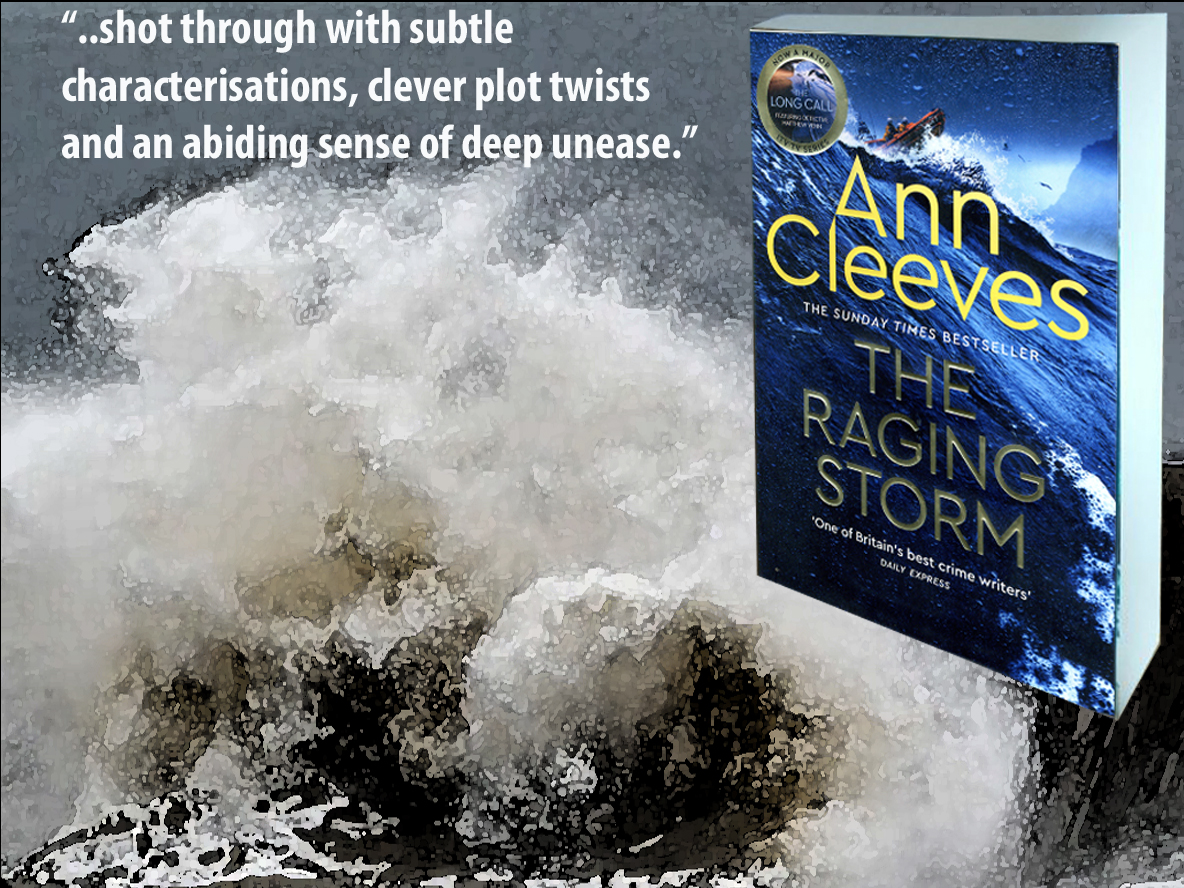
When Lawson’s body is later found shattered at the foot of a towering cliff, Venn wonders if this was the final act of a guilty man, but Ann Cleeve provides a solution to the mystery that is much more elegant – and unexpected.  The Raging Storm is, on one level, a standard whodunnit, and sticks to the standard framework of a police procedural novel, but it is shot through with subtle characterisations, clever plot twists and an abiding sense of deep unease. Published by MacMillan, the book is available now.


THE MISPER . . . Between the covers

misper spine014 copy

Central to this powerful novel is one of the great social scourges of modern Britain – the County Lines illegal drug distribution structure. It is horribly simple. The big drug barons, most probably masquerading as genuine businessmen, use a complex hierarchy to deliver the product – weed, crack, whatever is in vogue – to their customers. The criminal equivalent of the cheerful Eastern European Amazon man who delivers your parcel on time is, typically, a teenage boy, perhaps still of school age (but he rarely attends) possessed of nothing more sinister than a bicycle, a hooded sweat shirt and a bandana to cover his lower face. The youngsters have a huge advantage over the police, glued as they are these days to the seats of their patrol cars. These lads can pedal down one-way streets, navigate the narrowest town alleys and passageways, be here one moment and gone the next. Their immediate bosses provide them with cheap burner ‘phones, which are as expendable as the people carrying them.

On this depressing armature Kate London sculpts her story. Ryan Kennedy is  a teenager hooked into one of these criminal gangs, and one of his handlers has given him a handgun. When he is cornered in a Metropolitan Police operation, he shoots dead Detective Inspector Kieron Shaw,  who was trying to persuade him to throw away the weapon. When Ryan is tried for murder, clever lawyers manage to hoodwink the jury, and he is given a relatively lenient jail sentence. Once inside, of course, he is lauded by fellow inmates as someone who “killed a Fed”, and the big wheels in his organisation make sure his prison term is comfortable.

Kate London then introduces the other people whose lives are radically changed by Shaw’s murder. There is DC Lizzie Griffiths who has had an affair with Shaw and now looks after Connor, the result of that liason. DC Steve Bradshaw was the undercover cop who became close to Ryan Kennedy and, in one way, created the fatal showdown.  Detective Sarah Collins was deeply involved in the case, but has now been transferred to another force in the north.

Ryan Kennedy may be many things, but he is not stupid, and he pulls the wool over the eyes of his probation officer and is relocated to the country town of Middleton and given a job in a bike shop. He wastes no time in resurrecting his criminal career and is soon known as NK (apparently a Game of Thrones character) and continues to exert his malign influence.

The “misper” of the title is a fifteen year-old called Lief, who has fallen into the clutches of one of the gangs. He goes missing, and  his mother – Asha – eventually alerts the police. The police tie in Lief’s disappearance with the re-emergence of Ryan Kennedy as local boss of drugs distribution in Middleton. No spoilers from me, but what happens next is a tense and vivid narrative that is crying out for a screenplay.

On one level, Kate London has written an an intense and gripping police procedural thriller, but she also poses many questions. Perhaps it is unfair to expect that novelists should provide us with answers to real-life social problems, but the questions still need to be asked. Readers of this novel can infer what they like but, for what it’s worth, my conclusions are: (1) One of the greatest calamities to befall British society is the absence of traditional fathers in the bringing up of male children in certain communities. Ryan Kennedy has no father. Lief has no father. A cynic might say that Connor has no father, because he was shot dead by a criminal drug runner. (2) The British police are being overwhelmed by a tide of budget cuts, aggressive criminal defence lawyers, strident social justice warriors and a cataclysm of civil liberties activists.

Kate London is a former police officer and has written a grimly convincing story of a part of British society that is broken, and a criminal justice system barely fit for purpose. The Misper is published by Corvus and is available now.

THE BONE HACKER . . . Between the covers

BH spine012 copy

Kathy Reichs introduced us to Montréal forensic anthropologist Temperance “Tempe” Brennan in Déjà Dead (1997). The latest episode of this long running series begins with Tempe – as ever – investigating a particularly revolting partial corpse – ‘partial’ due to an encounter with a boat propeller – in the Bickerdike Basin. A geography lesson about Montréal and the St Lawrence River can wait for another time, as most of the action takes place elsewhere.

The remains are that of a young man who was a very long way from home – fifteen hundred miles across the ocean in the Turks and Caicos Islands. He didn’t drown. He didn’t die from the swirling blades of a propeller. He had been shot. Straight through the chest.  Perhaps now is the time for a little geography. TCI is a tiny chain of islands in the Atlantic. To the south is Haiti and The Dominican Republic; sail south-east and you hit Cuba; north-west lie The Bahamas and the Florida; sail north east for half a lifetime and you may end up in Bantry Bay.

When Brennan makes contact with the TCI police she speaks to Detective Tiersa Musgrove. Not only is Musgrove interested in the death of her young countryman, she surprises Brennan by insisting on flying straightway to Montréal. The demise of the young man – a gang member called Deniz Been – is not the reason Musgrove is anxious to be face-to-face with Tempe Brennan. Her motivation is to persuade Brennan to fly to TCI and cast her eye over a series of unexplained deaths which have completely baffled the TCI authorities. I’m not entirely sure why Brennan would drop everything and fly off into the unknown, but this is, after all, crime fiction, and pretty much anything can happen.

Brennan arrives in TCIcapital city Providenciales, known as Provo – and finds a luxury holiday paradise, complete with the corpses of a handful of young male tourists – each minus a hand. When Musgrove is found dead in her apartment, Brennan realises that she is neck-deep in a criminal swamp that threatens to drag her under and choke out her life. There are enough conundrums to satisfy the most demanding Sherlock Holmes buffs. Why was a state-of-the-art luxury boat found drifting off-shore? Why has an FBI agent ‘gone rogue’ on the island? Was Musgrove killed by her vengeful ex, or the same person who killed the young men?

After the demise of Detective Musgrove, enigmatic local copper Monck (who has been in the wars –  he has a titanium hand) reluctantly brings Brennan into the investigation. When she eventually gets access to a sufficiently powerful microscope she discovers that the blade which separated the young men from from their hands bears the stamp of discernible writing, and it is in Hebrew. A local shochet (kosher slaughterman) looks a shoo-in for the one-handed corpses, in that he has all the right kit, but why? He does himself no favours when he goes on the run, and it is not until the arrival on the island of two suitably tight-lipped and sharp-suited FBI men, in search of their errant colleague, that it dawns on Brennan and Monck that there is a deeper criminal conspiracy at work here, and one that involves ransom demands and an international conspiracy.

The Bone Hacker has qualities which one finds in so many American thrillers – it is slick, pacy and immensely readable. Tempe Brennan is quick-tongued and even quicker of thought, and the gory medical details bear witness to the author’s distinguished career as an academic and as one of her country’s foremost forensic anthropologists. The book is published by Simon and Schuster, and is available now.

AND THEN I’LL KNOW . . . Between the covers

atik spine010 copy

This novel is, on one level, an entertaining and robust police procedural. On another level, however, it is a study in obsession, and something of an object lesson about what happens when, metaphorically speaking, people lift heavy stones and are surprised at what they see scurrying around underneath. Amber Ryan is a detective sergeant with the Manchester police. The greater part of the book has a then and now narrative. ‘Then’ describes, Amber’s childhood which turns out to have many a tragic twist. Her father, a policeman, goes missing. Then, her mother dies of cancer. She and her sister Rachel are taken in by their aunt and uncle but when her uncle is killed in a road accident and her aunt goes to pieces emotionally and physically, the two girls are taken into local authority care.


Back in ‘Now’
, Amber’s obsession is to find out what actually happened to her father. On the pretext that a local murder of a young woman is connected to similar murders in London, she requests permission to go to the capital and look at the files. In truth, however, she is more interested in the fact that the women killed in London all had connections to a children’s home and cases of child abuse. She knows that her father was involved in investigating this case and  is convinced that she will turn up evidence which will lead her to the truth of what happened to him.

With a mixture of good fortune, instinct and background knowledge, Amber is able to refocus the investigating team on the murder of the young women. As a result she is then seconded for a further two weeks and comes something of a blue eyed girl in the eyes of the senior officers. This is not to the satisfaction of everyone in the team. Temporarily promoted to Detective Inspector, it has to be said that she pushes her luck she interviews some of the men who were found guilty of historic child abuse crimes. The interviews are not particularly friendly or gentle, and she moves from one appointment to the next hoping to stay ahead of phone calls of complaint to Professional Standards. Amber also suspects that there is someone on the investigating team who is leaking information to the very people they are trying to track. But who?

Two thirds of the way through the book it turns into anything but a police procedural as Amber breaks every rule in the book in her determination to find the truth. This final section of the book,where Amber goes very much off piste, may not be to everyone’s taste and it has to be said some of it does stretch credulity. There is certainly something of a “with one bound she was free”element to what goes on. Amber’s heroics result in the bad guys being brought down, but it does not bring the outcome that she was looking for. She is almost drowned by a tidal wave of betrayal, shattered childhood dreams and a bitter sense of betrayal. It could be said, though, that at the very end Amber does gaze into the abyss but sensibly turns away before the abyss gazes back at her. She is left with another personal challenge, another search and possibly a deeper sense that this final quest will bring her personal happiness.

And Then I’ll Know is certainly a gripping read (I finished it in two or three sessions) and is clearly a departure from Brady’s previous two novels – comedy thrillers on the theme of food. The Meal of Fortune and Tinker, Tailor, Soldier, Chef may not have caused much of a stir in the world of crime fiction, but this latest book deserves to be read and admired by a wider audience. And Then I’ll Know is published by 5W Press and is available now.

https://www.kobo.com/gb/en/ebook/and-then-i-ll-know

VOICES OF THE DEAD . . . Between the covers

VOTD spine009 copy

Edinburgh physician Dr Will Raven returns for the fourth in the series set in Edinburgh in the middle years of the nineteenth century. Ambrose Parry is the husband and wife writing team of Chris Brookmyre and Dr Marisa Haetzman. For new readers, a brief ‘heads-up’ about the personal dynamics between the main characters might be useful. Raven is assistant to – and disciple of – Professor James Young Simpson, pioneer anaesthetist and the only real life character in the book. Sarah Fisher was once Simpson’s housekeeper and, briefly, Raven’s lover, but he has since married, as did she, but her husband is now dead. She has a burning ambition to become a doctor.

VOTD cast

When Raven is summoned to Surgeon’s Hall by his friend Henry Littlejohn he becomes caught up in a chain of events which range from the comically macabre through to the murderous. Wrapped in a blanket and  deposited in the bottom of a cupboard, a human foot has been discovered. The head of the College, the aloof and irascible Dr Archibald Christie has been informed. Anxious to avoid any whiff of scandal, and aware that Raven has something of a reputation as an amateur investigator, Christie orders Raven to discover the origin of the foot without alerting the police. Things spiral beyond Raven’s control, however, when other body parts are located. Along with the irascible detective James McLevy, all concerned initially make a wrong assumption about the person whose limbs seem to be randomly scattered around the city. Will Raven’s past is punctuated with several episodes that might be described as unfitting for a respectable physician, and one such – by way of an all-too-human ghost from the past – sets him back on his heels.

We are soon drawn into a fascinating parallel plot involving the  ‘science’ of mesmerism. Its creator, the German physician Franz Mesmer has been dead for over thirty years, but displays of what we now call hypnotism are still able to draw crowds. The flames of interest in mesmerism are being found by the activities of two people. One, Richard Kimble is more of a stage illusionist but the other, Doctor Harland Malham, seems to have better credentials, so much so that Sarah is extremely interested in what he is doing. Her interest is heightened because, when meeting her for the first time, he suggests that she has an aptitude for mesmerism and could possibly be taken on by him as a trainee. Raven of course is deeply sceptical, but is acutely aware of Sarah’s determination to succeed in the medical profession by one way or another. Is she being duped? And who is the mysterious local businessman, Mr Somerville, to whom Sarah has become attracted?

One of the key elements in this series – and this book is no exception – is the nature of the relationship between Raven and Sarah, now Raven is married. He already has one child, a small son, and another is on the way. He is devoted to his wife Eugenie, but there is always a frisson between him and Sarah and we wonder, as readers, where this will end.

It doesn’t take a critical genius to work out that Brookmyre is providing the plotting and textual nuances while Haetzman is providing the (sometimes grisly)medical details and sense of medical authenticity. This is certainly one literary partnership that works very well, and the world of 1850s Edinburgh is portrayed in vigorous detail, contrasting the often squalid lives of the poor with the very different world of the more advantaged. The bottom line is that this is a bloody good crime novel, full of twists and turns, convincing historical ambience and main characters we believe in. It is published by Canongate Books and is available now.

EVERYONE HERE IS LYING . . . Between the covers

EHIL HEADER

One of the most resilient tropes of the modern domestic psycho-thriller is the bland suburban community where something goes terribly, terribly wrong. This is bread-and-butter for Shari Lapena, and she introduces us to the manicured lawns and domestic harmony of Stanhope, a small  town where, at opposite ends of Connaught Street, live Dr. William Wooler and Nora Blanchard. They are both married, with children, but they have been having an affair. When Nora ends it, abruptly, at their regular tryst in a seedy motel, William drives home distraught, only to find his nine year-old daughter Avery in the house. She has been sent home from school after yet another outburst of disruptive behaviour. Avery is the very last person William wants to see, and they fight.

Avery Wooler is, frankly, a junior monster. She has all manner of letters after her name. Think of a syndrome, and she has it. She disrupts other little girls’ birthday parties because she can’t open the presents first. She drives her mum and dad to distraction and, in her father’s case – violence. On this afternoon. Avery greets her dad with her usual insouciance and he snaps, giving her a slap round the face. After making sure that no serious damage has been done, Wooler – his mind a turmoil of rejection and anger –  storms out of the house. Or does he?

When the rest of Wooler’s family – wife Erin and son Michael – arrive home, Avery is nowhere to be found. Eventually, the police are alerted, the panic button is hit, and a huge search ensues. The prescience of the book’s title becomes ever more apparent as – one house at a time – the families who live on Connaught Street are sucked into the mystery. The cops leading the hunt for Avery Wooler – officers Bledsoe and Gully – follow one false lead after another, not because they are particularly dim, but rather because they simply don’t have a physical trace of Avery. At the back of their minds is the awful truth that in child abduction cases, if the victim isn’t found alive within the first few hours, then it becomes a hunt for a body.

Shari Lapena describes in grim detail the psychological disintegration of the families involved, the Woolers and the Blanchards, but about two thirds of the way through she lets us know what actually happened to Avery so – in one sense – our suspense and stress are relieved, but our x-ray view of what is going on behind inside the walls of the houses on Connaught Street still allows for a few shocks. In my review of one of Shari Lapena’s earlier novels (click the link below) I used the term Anxiety Porn, and that’s what the Canadian novelist does really well.

BETWEEN THE COVERS . . . The End Of Her

Lapena’s speciality is describing how unfortunate events can tug away at domestic security like a loose thread being insistently pulled from a much-loved cardigan, with the result that the cosy garment disintegrates and becomes unwearable. Everyone Here Is Lying will be published on 6th July by Transworld Digital as a Kindle and Bantam in hardcover.

CLASSICS REVISITED . . . The Drowning Pool

TDP header

One of the abiding tropes of private eye fiction is that the book begins with a glamorous and mysterious woman knocking on the door of the PI’s office. Ross McDonald doesn’t disappoint.

“If you didn’t look at her face she was less than thirty, quick bodied and slim as a girl, her clothing drew attention to the fact: a tailored shark skin suit and high heels that tensed nylon-shadowed calves. But there was a pull of worry around her eyes and drawing at her mouth. The eyes were deep blue with a sort of double vision. They saw you clearly, took you in completely, and at the same time looked beyond you. They had years to look back on, and more things to see in the years that a girl’s eyes had. About thirty-five, I thought, and still in the running.”

Maude Slocum has been sent an anonymous letter which is demanding money with the threat of exposing her marital infidelity. After much sparring, because Maude is giving little away,  Lew Archer agrees to take the case.

The cast of characters, as in all good PI novels, is diverse: Maude Slocum is married to James Slocum, an amateur actor who is kept in funds by his mother Olivia, with whom he and his family live. Maude and James Slocum have a teenage daughter, Cathy, who is physically and mentally older than her years. Olivia Slocum owns a large plot of land in Quinto, the only place in the town which has not been brought up by an oil syndicate headed by Walter Kilbourne. Kilbourne, obese and devious has a wife, Mavis. Detective Frank Knudson is connected to the Slocum family. Pat Reavis is a tall good looking young man who is something of a Walter Mitty character.

When Olivia Slocum is found dead in her swimming pool, Archer is drawn into a web of lies and scheming which sideline his original quest for the author of the threatening letter.

More erudite critics than I have written about the comparison between Chandler’s Philip Marlowe and Lew Archer.  We need to remember that The Drowning Pool was published over a decade after the ground breaking The Big Sleep. For me, Macdonald takes the style and attitude of – let’s call him ‘the master’- and simply refines it while  never departing from the same bleak poetry that is unique to the sun scorched and wind blown California landscape.

“The water in the pool was so still it seemed solid, a polished surface reflecting the trees, the distant mountains and the sky. I looked up at the sky to the west, where the sun had dipped  behind the mountains. The clouds were writhing with red fire as if the sun had plunged in the invisible sea and set it flaming. Only the mountains stood out dark and firm against the conflagration of the sky.”

Archer has a sharp eye – and an even sharper tongue – for some of the characters he comes across.

“While I was eating a woman came through a door at the end of the bar. She was tall and big- boned, with more than flesh enough to cover her bones. The skirt of her cheap black suit was wrinkled where her hips and thighs bulged out. Her feet and ankles spilled over the tops of very tight black pumps. Her north end was decorated with a single grey fox, a double strand of imitation pearls approximately the same colour, and enough paint to preserve a battleship. Her chest was like a battleship’s prow, massive and sharp and uninviting. She gave me a long hard searchlight look, her heavy mouth held loose, all ready to smile. I took a bite of my sandwich and munched at her. The searchlights clicked off almost audibly.”

The title of the book is both literal and metaphorical. It is literal in the sense that Olivia Slocum is found dead in the family swimming pool, and later in the book Archer is subject to a kind of water torture from which he has great difficulty in escaping. But there is also the metaphorical sense that the frailties of many peoples lives are exposed,  and they are seen as perhaps basically decent people drowning in a moral swamp not entirely of their own making – the Aeschylean conundrum much loved by Shakespeare and Hardy.

Blood feuds in California (at least the fictional California) seem only ever about two things. One, as in Chinatown is water, and the other – in this case –  is oil. Archer battles his way through the corruption and venality of rich men and women to reach a conclusion which is at least morally satisfying but, as ever, leaves him financially no better off. The Drowning Pool is full of pain, poetry and compassion, all of which are as vivid now as they were almost three quarters of a century ago when it was first published. This new edition of the novel, thankfully free from the malign attentions of Sensitivity Readers, will be published by Penguin on 13th July, as part of the first tranche of novels issued as an homage to the wonderful Green Penguins of yesteryear.

TO DIE IN JUNE . . . Between the covers

TDIJ header

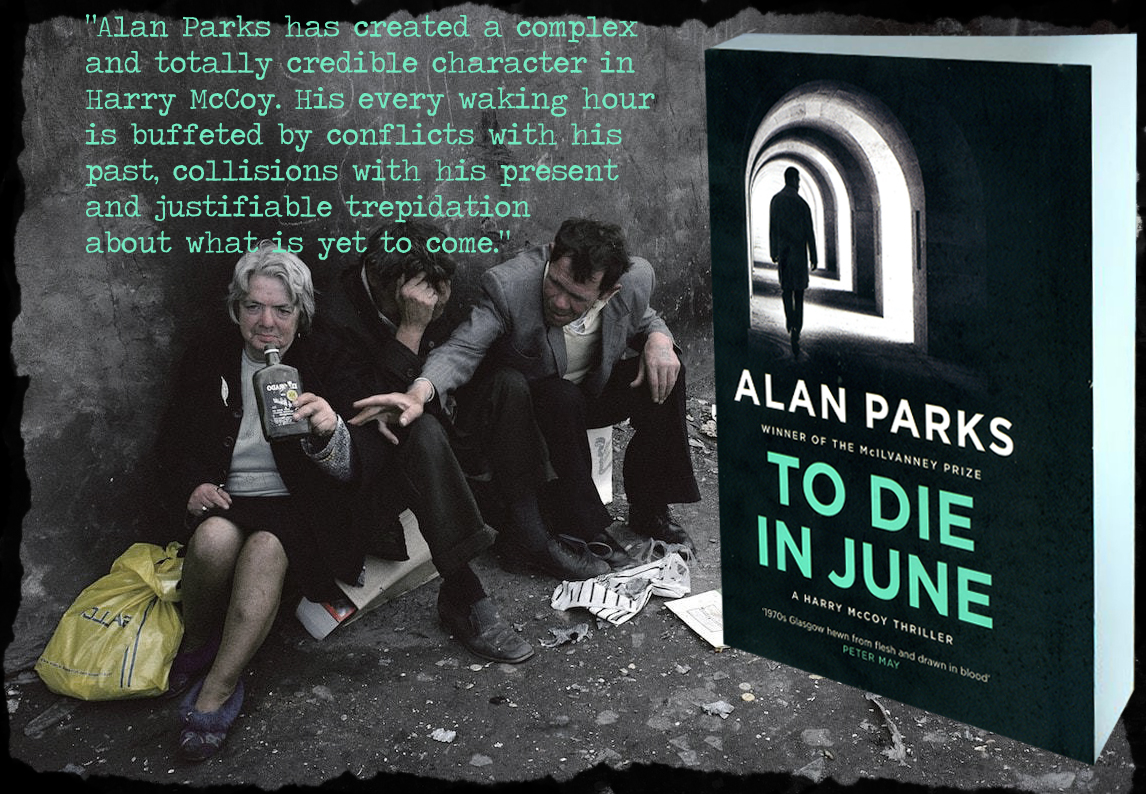
Screen Shot 2023-06-05 at 07.43.52Alan Parks (left) introduced us to Glasgow cop Harry McCoy in 2018 with Bloody January, and he has been resolutely working through the months with succeeding novels. Fictional Detective Inspectors in British crime fiction are many and varied. You would certainly need a fair sized village hall to seat them comfortably were they all to meet, so what about Harry McCoy? He has a fairly dark back-story. He was in and out of care institutions as a child. His mother is long dead, and his father – never the most consistent of parents – has now abandoned any sense of normality and is a homeless alcoholic. Through childhood connections – both were in care – he is connected to underworld boss Stevie Cooper. While not exactly in his pay, McCoy owes his old friend big-time, due to incidents in their shared past.

We are in the summer of 1975 so, in one sense this a historical novel, with many little period features that the author has to get right. No internet, computers or mobile phones, obviously, but early on in the story Parks sets the scene beautifully. McCoy has a celebrity girlfriend – a famous actress – and they are together at an showbiz awards function in the company of a young Billy Connolly, Stanley Baxter, Marie McDonald McLaughlin Lawrie (Google her) and Hamish Imlach. For those not versed in Scottish entertainers, Parks has Michael Aspel overseeing the evening.

McCoy has been transferred from his usual base to the insalubrious district of Possil, an area renowned for crime and deprivation. There is a purpose behind the move. McCoy’s boss, Chief Inspector Murray, believes that a group of detectives at the Possil station are corrupt, and he wants McCoy to infiltrate the cabal. Before McCoy can get close to the bent coppers, two urgent cases demand his attention. First, a vagrant is found dead, foaming at the mouth from having imbibed some kind of toxic drink. McCoy attends the scene, praying that the victim is not his dad. It isn’t, but the blasé dismissal of the case by the ‘experts’ as “just another alkie drank himself into an early grave” annoys him, and he senses something more sinister.

Then, a distraught woman presents herself at the station telling him that her young son has been abducted. Understandably, McCoy takes the woman at her word, and hits the panic button, with ensuing door-to-door, enquiries, blue lights flashing everywhere, and all leave cancelled. The woman then has some kind of fit and is hospitalised. When McCoy visits the home, and talks to the woman’s husband, the Reverend West, he is told that there is no son – never was – and that his wife has been  suffering with sever mental health issues for some years. West is the pastor at an obscure fundamentalist church, The Church of Christ’s Suffering.

When Mrs West throws herself to her death from a bridge, and more homeless men are found dead, McCoy hardly knows which way to turn. Added into the mix of his misery is that his old chum Stevie Cooper is about to initiate a turf war with a rival gangster, and expects McCoy to play his part. The plot twists this way and that, and there is a final hairpin bend which runs off the road anyone who is hoping for a warm and comfortable outcome to to this case for Harry McCoy.

lan Parks has created a complex and totally credible character in Harry McCoy. His every waking hour is buffeted by conflicts with his past, collisions with his present and justifiable trepidation about what is yet to come. To Die In June was published by Canongate on 25th May.

FLESH AND BLOOD . . . Between the covers

FABheader

This is book number eleven in the series, so a quick heads-up for new readers.
Time: the present
Place: Humberside
Main characters: Detective Inspector (recently promoted from DS) Aector McAvoy. He is a Scot, huge and bear-like, a gentle soul but a formidable copper. His wife Roisin; she is of Irish Gypsy stock, romantic but fiercely protective of Aector and their children – Fin and Lilah. Detective Superintendent Patricia ‘Trish’ Pharoah, thirty years in the force, and as tough as nails. Trish and Aector worship each other, but it is a purely platonic relationship. McAvoy is on holiday with his family in the Lake District, living in a traditional Romany Vardo.

In this book:
Reuben Hollow, a serial killer, serving several life sentences for murdering people he judged as having escaped justice. He was captured by McAvoy. Detective Chief Superintendent George Earl. Promoted because Trish Pharoah turned down the job. Earl is the very model of a modern media friendly senior police officer:

Trish is not immune to the pleasures of the flesh, and she is in bed with an Icelandic copper she met on a course. Their post coital bliss is disturbed by Trish’s car alarm going off, and Thor Ingolfsson runs downstairs to investigate. He is attacked with an adze and left for dead. Thor happens to be a dead ringer for Aector, and when the local police arrive to find the man face down in the road, they put two and two together, and make seventeen. Aector is very much alive and well, however and, despite being told to stay well away by Earl, he is determined to find out what is going on. David Mark’s description of Earl will ring horribly true to anyone who has experienced senior management in corporate services in recent years:

“George Earl is a tall, slim, straight-backed careerist who exudes the gentle earnestness and Anglican-priest sincerity of a Tony Blair. He has a habit of clasping his hands together when he talks, and makes a great show of telling his staff that his door is always open, and there’s no such thing as a stupid question.”

David Mark spent years as a crime reporter for a regional newspaper, and so he is well aware of the depths of villainy which are regularly plumbed by apparently ordinary and innocuous men and women. He also knows that – despite graduate entry – some of the people who are accepted as police officers are not “the brightest and best of the sons of the morning.” (Activists – please feel free to substitute the gender of your choice)

“The three uniformed constables milling around at the rear….he’s noticed that none of them seem to be able to breathe through their nose. All in their twenties and look as though they would be more comfortable working in a phone shop or flogging gloriously chavtastic trainers in a sports shop.”

What follows is pure mayhem. A former police colleague of Trish Pharoah meets an elaborate death by wood-carving chisels, McAvoy narrowly escapes death by hanging, in an execution house probably last used by Albert Pierrepoint, the chaos of Trish Pharoah’s previous life is laid bare to the world, and our man emerges – not unscathed – but able to fight another day.

Flesh and Blood veers violently between the darkest noir imaginable and a simple – but affecting – poetry. It is published by Severn House and will be available on 6th June. The final sentence sums up this brilliant series:

“And inside McAvoy’s head, another voice joins the chorus of the dead.”

https://fullybooked2017.com/tag/david-mark/

Blog at WordPress.com.

Up ↑