Search

fullybooked2017

Tag

Los Angeles

CLASSICS REVISITED . . . Sleeping Dog

In 1985, Dick Lochte presented us with perhaps the most extraordinary detective pairing in the long history of the genre. Leo Bloodworth is an LA investigator, Korean war veteran in his 50s, overweight, unfit, and tends to come off second best in fights with the bad guys. Serendipity Renn Dahlquist is 14 years old, as smart as a tack but would probably be described as ‘on the spectrum’ in these ever-so-enlightened days. Her dad never made it back from Vietnam, her mum is, as they used to say, ‘no better than she ought to be’, and the girl lives with her grandmother, an actress in a long-running TV soap.

What brings them together? Bizarrely, it is because Sarah (for short) has a dog, a bulldog called Groucho. And he has gone missing. When she goes to the police, one of the officers jokingly refers her to Bloodworth. While he never formally agrees to take on the case, events force Leo and Sarah into a reluctant partnership. In one Chandleresque paragraph, Bloodworth describes the situation: 

“I had a dead partner. I had a plastic faced knife artist. I had guys in suits tossing my office and my apartment looking for something called the Century List and talking about blackmail. I had an old lady who’d had a wall toppled on her. I also had a kid with a lost dog and her mother was mixed up in dog fights with some low life from the Mex Mafia.”

The plot spins this way and that, and draws in financial swindlers, the grim subculture of dog-fights, impersonations enabled through cosmetic surgery, and incompetent PIs. The core of the book, however, is the relationship between Bloodworth and Serendipty. It would have been as fraught with risks in 1985 to suggest any sense of sexual spark between the two as it would be now. However, on a couple of occasions, Lochte (left) flirts with danger. There were several subsequent novels featuring Leo and Serendipity, but I have not read them, so I am unable to report on how their relationship developed.

This novel, 40 years on, will not disappoint fans of LA investigator crime fiction. Of course, Lochte doesn’t hold a candle to Chandler, but then who did? I would nominate Robert B Parker as a contender, but then Spencer operated in Boston, so the milieu was altogether different.The plot spins this way and that, and draws in financial swindlers, the grim subculture of dog-fights, impersonations enabled through cosmetic surgery, and incompetent PIs. The core of the book, however, is the relationship between Bloodworth and Serendipty.

The story behind the initial search for Groucho is as complex as anything ever dreamed up by Chandler. At least we do not have to ask, “Who killed the chauffeur.?” In a rather contrived ending, Bloodworth, several tequilas to the good, explains it all away to his former cop partner, Rudy Cugat – and, of course, to us.

THE GHOST ORCHID . . . Between the covers

TGO spine018 copy

I suppose in the kingdom of detective partnerships, Holmes and Watson will never be dethroned, and quite rightly, too. I would however nominate (alongside Rizzoli and Isles, Morse and Lewis, Bryant and May, Wolfe and Goodwin) Alex Delaware and Milo Sturgis. Jonathan Kellerman’s duo of a child psychologist and LA homicide cop have for me, in dozens of novels, never failed to deliver. Yes, there’s a formula at work here, but that’s what makes all these partnerships work. Sturgis is abrasive, socially insecure and, because of his homosexuality, fighting an endless battle against his censorious LAPD colleagues, but he is a brilliant investigator: add into the mix Delaware’s social awareness, acutely attuned antennae for  people telling lies, and you have a winning mix.

A glamorous woman and a younger man are found shot dead at a Bel Air property. Her expensive jewellery has not been taken, and it looks like a professional job. Sturgis asks Delaware to take a look at the crime scene*.

*For new readers who wonder why Delaware is brought into the case, it’s simple. It’s the way the books work. Sturgis is something of a maverick, loose-cannon, lone-wolf – choose your own metaphor- and as long as he does the business, his colleagues leave him alone, so he always welcomes the extra pair of eyes and psychological insight that Delaware brings. In case you were wondering, Delaware earns a good living as a court-acknowledged expert in legal cases involving children so, thankfully for fans like me, he can afford the time to help Sturgis.

It transpires the dead woman is Meagin March, whose husband Doug is a real estate billionaire, and the corpse alongside hers belonged to, as they say, her toy-boy. Not short of a cent or three himself, Giovanni Aggiunta is the errant younger scion of a top draw Italian shoe making firm. He receives a generous allowance to amuse himself while his older brother and other family continue creating wealth with their exclusive designer footwear.  is not all she seems to have been, however, and it turns out that in a previous life she was a Vegas glamour escort. Yes, she finally snared Mr Right – and a life of luxury – but Delaware and Sturgis can find no-one who has a bad word to say about the murdered lovers, but become convinced that the woman was the intended target, and that her Italian lover was, sadly, collateral damage.

Doug March is a thoroughly unpleasant fellow. He was away on a business trip at the time, so it wasn’t his finger on the trigger of the .38 revolver, but could he have been so angry at Meagin that he hired a contract killer? Delaware is convinced that there is a message waiting to be discovered in one of the rooms of the March’s mansion. Meagin was an amateur artist and the room was her studio. All but one of her paintings are unremarkable ‘chocolate box’ scenes, but the exception seems to be a particularly severe abstract. Eventually, Delaware’s live-in romantic interest, Robin, identifies as a painting of a strange and rare flower, known as a ghost orchid*.

*Dendrophylax lindenii, the ghost orchid (a common name also used for Epipogium aphyllum) is a rare perennial epiphyte from the orchid family. It is native to Florida, the Bahamas, and Cuba. Other common names include palm polly and white frog orchid.

Robin provides more insight by suggesting that Delaware and Sturgis take a look at the unusual spelling of the dead woman’s name. I won’t say any more, but it’s not too hard an anagram to solve. These fresh clues result into a deep dive into ‘Meagin’s’ childhood which reveals horrors hitherto unsuspected. Delaware and Sturgis finally get their killer, but not quite in the way they were expecting. This is another classy and absorbing tale from the casebook of one of modern crime fiction’s most endearing partnerships. It is published by Century/Penguin Random House and will be out on 15th February.

CLASSICS REVISITED . . . The Big Sleep

tbs spine048 copy

Screen Shot 2023-11-13 at 20.27.10The Big Sleep was published in 1939, but the iconic film version, directed by Howard Hawks, wasn’t released until 1946. Are the dates significant? There is an obvious conclusion, in terms of what took place in between, but I am not sure if it is the correct one. The novel introduced Philip Marlowe to the reading public and, my goodness, what an introduction. The second chapter, where Los Angeles PI Marlowe goes to meet the ailing General Sternwood who is worried about his errant daughters, contains astonishing prose. Sternwood sits, wheelchair-bound, in what we Brits call a greenhouse. Marlowe sweats as Sternwood tells him:


“I seem to exist largely on heat like a newborn spider, and the orchids are an excuse for the heat. Do you like orchids?”
“Not particularly.”
“They are nasty things. Their flesh is too much like the flesh of men. And their perfume has the rotten sweetness of a prostitute.”

The General can no longer drink alcohol, but he enjoys watching men who can:

“The old man licked his lips watching me, over and over again, drawing one lips slowly across the other with a funereal absorption, like an undertaker dry-washing his hands.”

“I used to like mine with champagne. The champagne as cold as Valley Forge and about a third of a glass of brandy beneath it.”

Sternwood has two daughters. The elder, Vivian, was married to a an ex-IRA bigshot called Rusty Reagan, a man much admired by his father-in-law, but he has disappeared. The younger girl, Carmen, has gone off the rails completely, and has been sucked into a world of drugs, vice and pornography.

Initially, Marlowe’s brief from the General is to find out what is going in with Carmen. He soon discovers that she is involved with a pornographer called Geiger. He goes to Geiger’s house, and sits in his car outside, the rain teeming down.

“As the darkness folded back on it and ate it up a thin tinkling scream cried out and lost itself among the rain drenched trees. I was out of the car and on my way before the echoes died. There was no fear in the scream. It had a sound of half pleasurable shock, an accent of drunkenness, overtone of pure idiocy. It was a nasty sound. It made me think of men in white and barred windows and hard narrow courts with leather wrist and ankle straps fastened to them.”

Forcing his way into the house, Marlowe finds an interrupted photoshoot:

“Neither of the two people in the room paid any attention to the way I came in, although only one of them was dead. She was wearing a pair of long Jade earrings. They were nice earrings and had probably cost couple of hundred dollars. She wasn’t wearing anything else.”

The drugged Carmen Sternwood had clearly been in the middle of a pornographic photo shoot and beside her is Geiger – shot dead. After taking Carmen back to the Sternwood mansion Marlowe returns to Geiger’s house, where he has left his car. He finds that Geiger’s body has gone and the crime scene has been interfered with. Wondering who has taken the corpse, he makes the celebrated comment:

“Dead men are heavier than broken hearts.”

Screen Shot 2023-11-13 at 20.28.07

The plot then becomes something of a whirling dervish pirouetting in the California dust, sometimes moving so fast and in such unexpected directions that it is not easy to keep track of what is going on.  We meet Joe Brody, a small-time spiv who is trying to muscle in on Geiger’s pornography racket. He is shot dead by Geiger’s homosexual lover, and then Marlowe becomes aware of a much more sinister figure – gangster Eddie Mars, who is connected to Vivian Sternwood. This mad dance however is subsidiary to the poetry of Marlowe’s view of the dark world he inhabits. Chandler’s genius portrays Marlowe as a man trying to keep his footing while tiptoeing along the crumbling rim of a volcano, gazing down into the furnace below and doing his best to avoid being scorched.

In the end, as in all great novels it comes down to who we as readers care about. We don’t care too much for Carmen. We don’t care at all for the scattering of underworld figures who populate the book. We care about Vivian, who is damaged but perhaps redeemable. We care about the dying general still trying to protect his daughters and his legacy. Another cruel irony for the old man is the fate of Rusty Reagan, his corpse long since dumped in one of oil wells that have brought the family their immense wealth Above all, however, we care about Marlow and the bruises – mental and physical – he sustains while trying to do his job.

Screen Shot 2023-11-13 at 20.29.04The book began with an optimistic Marlowe:

“I was wearing my powder blue suit, with dark blue shirt, tie, and display handkerchief, black brogues, black wool socks with dark blue clocks on them. I was neat, clean, shaved and sober, and I didn’t care who knew it.”

It ends with him making a bitter deal with Vivian, that she will take Carmen as far away as possible from the moral cesspit she has been bathing in, and that the fate of Rusty Reagan will be kept from her father.

“Me, I was part of the nastiness now. Far more a part of it than Rusty Reagan was. But the old man didn’t have to be. He could lie quiet in his canopied bed, with his bloodless hands folded on the sheet, waiting. His heart was a brief, uncertain murmur. His thoughts were as grey as ashes. And in a little while  he too, like Rusty Reagan, would be sleeping the big sleep.”

The edition I read for this review was published by Penguin, and is part of their recent series of ‘Green Penguin’ crime classics. It is paired with Farewell My Lovely, and is available now.

CLASSICS REVISITED . . . The Drowning Pool

TDP header

One of the abiding tropes of private eye fiction is that the book begins with a glamorous and mysterious woman knocking on the door of the PI’s office. Ross McDonald doesn’t disappoint.

“If you didn’t look at her face she was less than thirty, quick bodied and slim as a girl, her clothing drew attention to the fact: a tailored shark skin suit and high heels that tensed nylon-shadowed calves. But there was a pull of worry around her eyes and drawing at her mouth. The eyes were deep blue with a sort of double vision. They saw you clearly, took you in completely, and at the same time looked beyond you. They had years to look back on, and more things to see in the years that a girl’s eyes had. About thirty-five, I thought, and still in the running.”

Maude Slocum has been sent an anonymous letter which is demanding money with the threat of exposing her marital infidelity. After much sparring, because Maude is giving little away,  Lew Archer agrees to take the case.

The cast of characters, as in all good PI novels, is diverse: Maude Slocum is married to James Slocum, an amateur actor who is kept in funds by his mother Olivia, with whom he and his family live. Maude and James Slocum have a teenage daughter, Cathy, who is physically and mentally older than her years. Olivia Slocum owns a large plot of land in Quinto, the only place in the town which has not been brought up by an oil syndicate headed by Walter Kilbourne. Kilbourne, obese and devious has a wife, Mavis. Detective Frank Knudson is connected to the Slocum family. Pat Reavis is a tall good looking young man who is something of a Walter Mitty character.

When Olivia Slocum is found dead in her swimming pool, Archer is drawn into a web of lies and scheming which sideline his original quest for the author of the threatening letter.

More erudite critics than I have written about the comparison between Chandler’s Philip Marlowe and Lew Archer.  We need to remember that The Drowning Pool was published over a decade after the ground breaking The Big Sleep. For me, Macdonald takes the style and attitude of – let’s call him ‘the master’- and simply refines it while  never departing from the same bleak poetry that is unique to the sun scorched and wind blown California landscape.

“The water in the pool was so still it seemed solid, a polished surface reflecting the trees, the distant mountains and the sky. I looked up at the sky to the west, where the sun had dipped  behind the mountains. The clouds were writhing with red fire as if the sun had plunged in the invisible sea and set it flaming. Only the mountains stood out dark and firm against the conflagration of the sky.”

Archer has a sharp eye – and an even sharper tongue – for some of the characters he comes across.

“While I was eating a woman came through a door at the end of the bar. She was tall and big- boned, with more than flesh enough to cover her bones. The skirt of her cheap black suit was wrinkled where her hips and thighs bulged out. Her feet and ankles spilled over the tops of very tight black pumps. Her north end was decorated with a single grey fox, a double strand of imitation pearls approximately the same colour, and enough paint to preserve a battleship. Her chest was like a battleship’s prow, massive and sharp and uninviting. She gave me a long hard searchlight look, her heavy mouth held loose, all ready to smile. I took a bite of my sandwich and munched at her. The searchlights clicked off almost audibly.”

The title of the book is both literal and metaphorical. It is literal in the sense that Olivia Slocum is found dead in the family swimming pool, and later in the book Archer is subject to a kind of water torture from which he has great difficulty in escaping. But there is also the metaphorical sense that the frailties of many peoples lives are exposed,  and they are seen as perhaps basically decent people drowning in a moral swamp not entirely of their own making – the Aeschylean conundrum much loved by Shakespeare and Hardy.

Blood feuds in California (at least the fictional California) seem only ever about two things. One, as in Chinatown is water, and the other – in this case –  is oil. Archer battles his way through the corruption and venality of rich men and women to reach a conclusion which is at least morally satisfying but, as ever, leaves him financially no better off. The Drowning Pool is full of pain, poetry and compassion, all of which are as vivid now as they were almost three quarters of a century ago when it was first published. This new edition of the novel, thankfully free from the malign attentions of Sensitivity Readers, will be published by Penguin on 13th July, as part of the first tranche of novels issued as an homage to the wonderful Green Penguins of yesteryear.

UNNATURAL HISTORY . . . Between the covers

UH spine

Guilty pleasures? At my time of life, there should be no guilt involved. I have no intention of troubling the funeral director just yet, but I am nearly six years over my biblically allotted span and I will take every opportunity to enjoy my reading on my terms, and I do love a good series. Yes, I know the analogies – comfortable slippers, well-worn cardigan and all the rest. But why not? When time is not on one’s side, what is the point of enduring the pain of breaking in new shoes? Other metaphors are available, but here are a few of my favourite series by authors who are still with us.

Series

With that heartfelt (not) apology out of the way, here’s my take on the latest Alex Delaware novel from Jonathan Kellerman, Unnatural History. Quick bio. of Dr Alex Delaware (who first appeared in 1985, so he is one of those characters for whom time stands still). He is a Los Angeles forensic psychologist, his live-in girlfriend is a builder/restorer of high end guitars and stringed instruments, and he is involved in crime due to his friendship with Detective Milo Sturgis who is gay, very smart, and a man who, if eating were an Olympic event, would be a multiple gold medal winner.

Adonis ‘Donny’ Klement, an artist who specialises in photography, has been found shot dead in his converted warehouse studio. Three bullets to the chest, bang, bang bang – a concise equilateral triangle. Donny is a member of a very unusual family. His father Viktor is an elusive and secretive billionaire businessman, so careful to escape publicity that not a single photograph of him exists. He has a strange habit. He marries, fathers a child, and then moves on. Donny was the latest progeny, but he had several half-siblings.

By all accounts, Donny was gentle, talented, but rather naive. His most recent project was called The Wishers. He recruited several homeless down-and-outs, dressed them in exotic and fantastical costumes,and photographed them. They were well paid, but was one of them deranged enough to come back and murder the man who, if only for a brief hour, had enabled them to act out their fantasies?

Delaware and Sturgis are convinced that the murder of Klement is connected with the street people he brought into his studio, and when one of them – a deaf mute woman called Jangles – is found strangled, it begins to look as if they are right. Or are they? There is an elegant and clever plot twist which confirms that they were, but not quite in the way they were expecting.

As well as Kellerman’s taut dialogue and plotting, we should not forget that he is up there with the best writers (including his contemporary Michael Connolly and the Master himself, Raymond Chandler) in bringing to life the dramatic contrasts of the LA landscape, with its beaches, grim neon strip-malls, spectacular hills and – more recently – the horrific shanty cities full of homeless down-and-outs. Yes, of course this is ‘formula fiction’, but it is also CriFi of the highest quality. Delaware and Sturgis are perfect partners; they are a long way from being ‘two peas in a pod’, but each feeds off the other’s strengths and abilities. Unnatural History is a riveting read, and will be available from Century/Penguin Random House from 16th February. Click the image below to read more reviews of books by Jonathan Kellerman.

JK footer

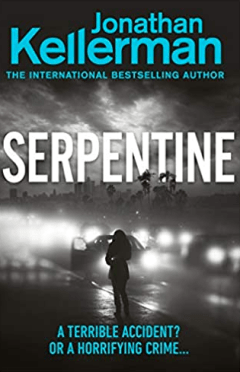
SERPENTINE . . . Between the covers

Serpentine Header

No-one could ever accuse Jonathan Kellerman of not being industrious. It seems like only the other day that I reviewed The Museum of Desire (it was 9th November last year, in fact), but now Dr Alex Delaware and Milo Sturgis are back again in the hills and canyons of LA, solving another mystery. A quick bio. for readers new to the series. Delaware is a practicing child psychologist who often (this is the 36th book in the series) helps LAPD detective Milo Sturgis with cases. Delware lives with a woman who repairs stringed instruments, while Sturgis has a partner, and has come through the dark years when being gay was something of a no-no in police ranks. The plot is as wonderfully convoluted and labyrinthine as ever. So (takes a deep breath), here goes.

Screen Shot 2021-02-04 at 18.47.53Sturgis has reluctantly taken on the coldest of cold cases. His orders have come down from some very well-connected people in the political and civic life of LA, and so he has been pulled off all other work. The mystery? What is the truth behind the death of a woman decades earlier, found in the wreckage of her burnt out Cadillac at the bottom of a canyon bordering Mulholland Drive? Careless driving? Might have been, were it not for the fact that she had also been shot in the head.

The woman pulling the strings is Ellie Barker, a millionaire former businesswoman, and daughter of Dorothy Swoboda the lady in the canyon. She was only three at the time, has no recollection of her mother, and never knew her natural father, having been brought up by her stepfather, Stanley Barker.

Anton Des Barres was a wealthy industrialist who made his money manufacturing high quality surgical equipment. After his second wife died, he became something of a womaniser, inviting young women back to his mansion where he and his children still lived. Delaware and Sturgis learn that Dorothy was one of Des Barres’s ‘harem’. They also discover a strange coincidence. Arlette Des Barres, the man’s second wife died after a fall from her horse in the rugged country near where Dorothy died. Stanley Barker was found dead, possibly as a result of a fall, in the same area.

Historic deaths are one thing, but when Ellie Barker’s boyfriend is shot, Delaware and Sturgis are faced with the uncomfortable thought that whatever the truth behind Dorothy’s murder, it is far from being dead and buried. It is alive and well, and extremely dangerous.

Screen Shot 2021-02-06 at 13.50.48

PendantThe title of the book refers to a piece of jewellery, which Delaware and Sturgis eventually discover is deeply significant. Actually, the pair make many assumptions about the case, and most of them prove to be wrong, which only adds to the credibility as investigators. They are not super-sleuths; they are mortal, fallible – and consequently completely convincing.  It is only in the final pages that they – and we – learn the truth about the life and death of the woman who called herself Dorothy Swoboda, and it is dark stuff indeed.

Cynics might turn up their noses at this book and dismiss it as “formula fiction”. Fair enough, and, as the saying goes, “opinions are like (insert anatomical detail) – everyone has one”. What such critics find hard to cope with, I suggest, is that writers like Kellerman are rather like alchemists, in that they take base metal – cops, bad guys, slick dialogue, zooming around in cars, and turn it into gold – conviction, reading pleasure, empathy with the characters and a sense of “can’t wait for the next novel“. That is pretty impressive, at least in my book.

Serpentine is published by Century, and is out now.

THE MUSEUM OF DESIRE . . . Between the covers

MOD coverThe strange-looking empty mansion in the dry hills above Los Angeles is rented out as a venue for everything from cancer charity fundraisers to wild parties. As the much put-upon guy from the agency wearily pushes his cart of cleaning materials up the hill, he is expecting the usual joyless cocktail of spilled food, used needles and condoms. What he actually finds causes him to part company with his breakfast burrito.

In a stretch limo parked in front of the house, he finds four people, each very, very dead, and with the floor of the car swimming in blood. Cue another case for LAPD Detective Milo Sturgis and psychologist Dr Alex Delaware. Veterans of the long-running series (this is book number 35 since When The Bough Breaks in 1985) will know the basic set-up. Delaware’s day job is in child psychology, while Sturgis is, in now particular order, gay, unkempt, a brilliant cop and eternally hungry.

The four corpses in the limo seem to have nothing at all in common aprt from being dead; a thirty-something professional bachelor with an insatiable – but perfectly legal – love life, and elderly chauffeur, a gentle and harmless man with mental problems who lives in sheltered accommodation, and a rather unprepossessing middle-aged woman who, it transpires, had drink and drug issues, and lived mostly on the streets. To add to the mystery, the forensic team analyses the blood on the floor of the car – and it is canine.

Delaware and Sturgis are convinced that the killings took place elsewhere, and the interior of the limo was an elaborate stage set. But who is the director of this hellish drama, what is the message of the play, and who was the intended audience?

jonathan-kellermanBit by bit, one slender thread at a time, the tangle of the mystery is unpicked. As per usual Kellerman (right) gives us a spectacularly complex solution to the quadruple murder. It’s almost as if we are passengers on a train journey, and some of the sights that flash by the window before we reach our destination include erotic Renaissance paintings, a chillingly damaged autistic teenager and a brief glimpse of Herman Göring’s fabled collection of looted art.

There will be, no doubt, some people who will look down their noses at this book – and others like it – while dismissing it as formulaic. Of course it is written on a certain template, but that’s what makes it readable. That’s why readers turn, again and again, to books that are part of long running series. We don’t want John Rebus to start behaving like Jack Reacher, any more than we will be happy for Carol Jordan to turn into Jane Marple. The Museum of Desire is slickly written, for sure, but I think a better word is ‘polished’. Both the dialogue and interaction between Delaware and Sturgis crackle with their usual intensity, and we are not short-changed in any respect in terms of plot twists and deeply unpleasant villains.

The Museum of Desire is published by Century/Arrow/Cornerstone Digital, came out in hardback  and Kindle earlier this year, but this paperback edition will be available from 12th November.

GATHERING DARK . . . Between the covers

gd013

indexCandice Fox (left) is an Australian novelist who is perhaps best known for her collaborations with James Patterson, but back in 2019 I reviewed her solo novel Gone By Midnight, and if you click the link you can read the review. That book was set in the Queensland city of Cairns, but in her latest, she goes Stateside to Los Angeles for Gathering Dark.

To borrow a cliché much loved by sports commentators, Candice Fox leaves nothing in the changing room here in the way of characters. The larger-than-life cast includes former top paediatrician jailed for murder and now working in a fast food joint, her kleptomaniac and drug-addicted chum from prison, a fixated female cop whose career seems to be spiralling out of control, and a six-foot black female gangster and strip-club owner.

What brings this formidable quartet together? The search for the missing daughter of Sneak, the aptly named kleptomaniac. After randomly robbing Blair Harbour at her greasy take-out counter, Dayly has disappeared into the nightmare neon slick that is the criminal underbelly of Los Angeles.

gd014We all love a good coincidence, and cop Jessica Sanchez just happens to have been gifted a sumptuous LA property which sits next door to the house where Blair’s son Jamie has been fostered since his mother’s unfortunate spell in jail. And who was one of the cops involved in Blair being put away for ten years? Christian name begins with J and surname starts with S!

Fox has woven a wonderfully complex web of a plot. Blair isn’t sure why the gangster, Ada, is offering to help, but she thinks it might be because she is returning a favour notched up while the two were in jail together. We eventually learn, a little way before Blair does, that Ada doesn’t do gratitude, and has an ulterior motive.

The cop, Jessica, is pretty much loathed by LAPD colleagues, and she is warned that if she accepts the multi-million dollar mansion, she will be drummed out of the force for accepting bribes.

The unholy Trinity of Ada, Blair and Jessica plough a violent and relentless furrow in their search for Dayly, and it all comes to a head in a claustrophobic and bloody shoot-out in a sewer beneath an LA suburb. Fox is a gifted storyteller and this ‘guns and gals’ thriller will guarantee a few hours of excellent entertainment. Gathering Dark is published by Arrow and is out now in paperback.

CHARCOAL JOE … Between The Covers

Mosley


“This money is from me, Easy. I’m the one hirin’ you”
“Cheddar or blue?” I asked, taking the cash.
“Say what?”
“I just wanna know what kind of cheese is in this trap.”

Thus Walter Mosley’s Los Angeles PI Ezekiel ‘Easy’ Rawlins takes a thick wad of cash from his long term buddy Raymond ‘Mouse’ Alexander, as a down payment on his latest case, to extricate 25 year-old Dr – of physics – Seymour Brathwaite from a murder rap. The fact that Easy, like a huge number of fellow Angelinos, could never say “no” to Mouse, is one thing; Mouse may well be the most dangerous man in the city, but the legendary Charcoal Joe is probably next in line. And it’s Joe who had called in a favour of Mouse.

Seymour Brathwaite has been found at a murder scene in Malibu beach with two corpses lying on the floor. When LAPD’s finest catch a black man at the scene of a shooting, that’s normally case closed, give or take a few minutes of paperwork, but this is different. Brathwaite has no connection with either the corpses or crime in general, and he seems to have a very powerful friend in underworld fixer, arranger of violent death and generally lethal string puller Rufus Tyler – better known as Charcoal Joe.

Joe is currently residing in one of LA’s more relaxed and well appointed correctional facilities, serving a short sentence for some minor infraction. Easy pays him a visit to learn more about why young Dr Brathwaite was in the wrong place at the wrong time, and finds Joe attended by his minders and gophers. He asks why Joe is so convinced of Seymour’ innocence.

“The young man is a doctor of science,” Rufus Tyler the prodigy intoned. “He’s teachin’ at UCLA right this semester while he finishes his postgraduate work. Now how’s a man like that gonna be some kinda niggah like the people you and me consort with?”
I could think of a dozen ways. The universities in the late sixties were hotbeds of bombers, Liberation bank robbers and stone-cold killers.

Despite his misgivings, Easy sets about his work. At this point, it may be the moment to bring people new to the series up to speed with the who, what and why of the world of Easy Rawlins. Our man fought for Uncle Sam in WW2, and returned to an America where the yoke of oppression may have been lifted in Western Europe, but not in hometown USA. Battling everyday racism, put-downs and casual affronts, he has survived death on several occasions by the thickness of a cigarette paper, managed to earn the grudging respect of certain members of the LAPD, and has raised a family – albeit an unconventional one. Conscious that his work is always attracting new readers Mosley – like the weaver of dreams he is – fills in the biography with the deftest of touches, as he goes along.

Inevitably, Easy is being lied to by pretty much everyone involved in the case of the naïve Dr Brathwaite. The body count is spectacular, and even as he mourns the loss of his best love, Easy manages to squeeze in a couple of ‘romantic encounters’. The euphemism is mine. One of Mosley’s skills is to dance his way deftly through the minefield that faces writers who tackle sex scenes. Where many tread too heavily and die, Mosley escapes unscathed.

Mosley009The plot, as they say, thickens – to the point where you may need to skip back a few pages just to be sure that you are certain who has done what to whom. To me, this is neither here nor there. Sometimes cliches are unavoidable because they tell a simple truth, and with any Easy Rawlins novel it is all about the journey rather than the destination. An Easy Rawlins tale is what you get when a poet writes crime fiction. If Raymond Chandler were a deity, then I would worship him, but I would be hard pressed to summarise the detailed plots of Philip Marlow’s cases. I could, however, rattle off a dozen one-liners and brilliant descriptions which have made Chandler immortal. So it is with Mosley.

Easy goes to an illegal club called The Black Door Bar, and is reunited with an old flame.

“Hey, Easy,” Louise Lash said.
She was maybe forty with a face that would be beautiful twenty years after her death. Her skin was black and flawless. Even when she wasn’t talking her mouth seemed to be saying something elusive.

Read this book, and cherish it. Mosley is not an old man by today’s standards, but there will come a time when there will be no more Easy Rawlins, and the world will be a poorer place for his passing.

Follow the link to get your copy of Charcoal Joe.

Mosley010.jpg


Blog at WordPress.com.

Up ↑