Search

fullybooked2017

Tag

Lincolnshire

THE SPALDING POISONER . . . Edward Bell (2)

TSP HEADER

Timeline new

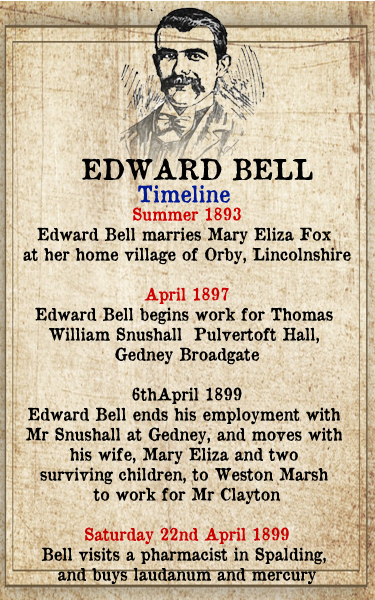
Spring 1899. Edward Bell, farm labourer of Weston Marsh, Spalding,  is dissatisfied with his wife Mary Eliza, who has borne him six children in six years, and is determined to get her out of the way so that he can pursue a passion for a younger woman. Mary Hodson. He has bought poison from a chemist in Spalding. He has also bought a soda siphon. Over the weekend of 23rd/24th April he begins to administer the poison to his wife, mixed with the soda, saying that it is a tonic which will calm stomach problems from which she regularly suffers.

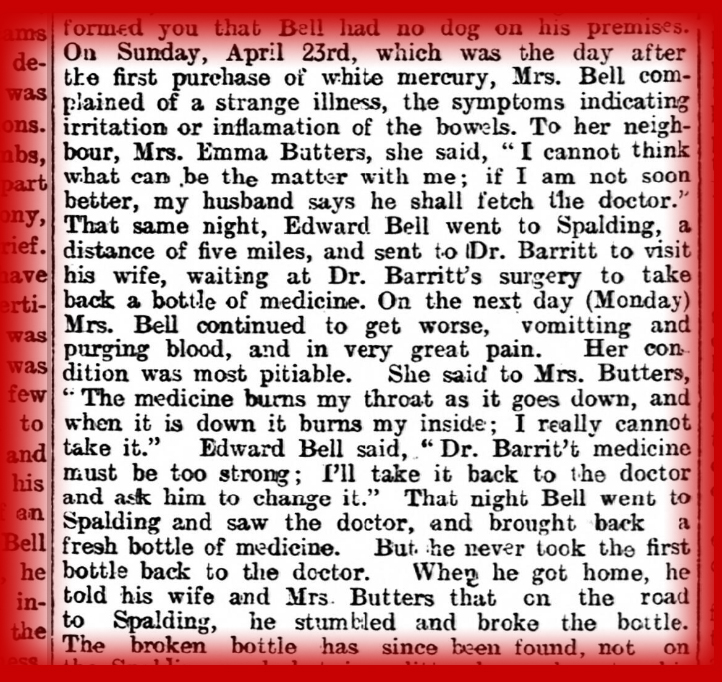
On Monday 24th April, Mary Eliza Bell begins to suffer agonising symptoms. Her mother is summoned from Orby to be at her side, and Edward Bell fetches the doctor, who diagnoses inflammation of the bowels. Over the next two days, Bell attempts to buy more poison and completely pulls the wool over the eyes of both the doctor and the chemist. What happened next is best described in the words of various astonishing reports in newspaper later in the case when Bell’s crime had been unmasked. These are  from the Sheffield and Rotherham Independent:
Extract 1

Extract2

Bell’s behaviour might appal the reader over a century after his dreadful crime, but what he did next is little short of unbelievable. After watching his wife die in the extremes of agony, he calmly walked into Spalding again, knocked on Dr Barritt’s door, informed him that his wife had died, and asked for a death certificate, which the medical man duly wrote out, citing the cause of death as the bowel condition for which he believed he had been treating her. Wasting no time, Bell then organised the removal of his wife’s corpse to her home village of Orby. She left the family cottage in a cart, and her remains were conveyed by railway for the remainder of the journey.

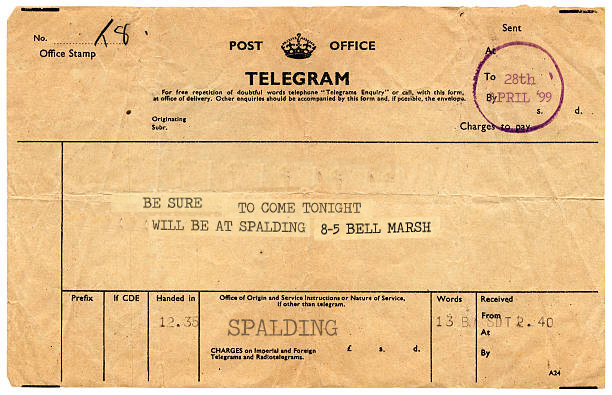
Mary Eliza Bell’s funeral was scheduled for Saturday 28th April, and Edward Bell left left Spalding on an early train to play the part of the grieving husband, but not before finding time to send this telegram (facsimile below) to “Miss Hodson, Rectory, Barton-le-Cley”
Telegram

Bell’s arrogance- or stupidity – is barely credible. And yet, and yet. He had already hoodwinked his wife, the local doctor, a Spalding pharmacist, so it is only to be supposed that he thought he was on a winning streak. What happened next was to show that Bell’s trust in the gullibility of both the law – and ordinary people – was misplaced.

NEXT – An anonymous letter,
the final indignity inflicted upon Mary Eliza Bell,
and, in the end, justice is served.

THE FORGOTTEN … A series re-evaluating forgotten authors. Part Three – Colin Watson (1)

CW header

To be unfashionable is no crime, especially at a time when fame is so fleeting that it makes Andy Warhol’s fifteen minutes seem like a lifetime. Even if he were still alive and working, the books of Colin Watson would not be found bulk-bought and jostling for space with the latest James Patterson between the party goods and the lottery machine at the local ASDA. Am I being snooty? Almost certainly I am, but I’m also more than happy to wear my love of Watson’s humour, ingenuity and exquisite use of English, as a badge of honour. Watson was, in his day, very well thought of. His Flaxborough novels sold well, and until relatively recently were always well represented on library bookshelves, because local library users were not, by and large, fools.

It would be tempting – but incorrect – to think that Watson would be turning in his grave at some of the writing which is passed off as crime fiction these days. Incorrect because he was a man who, by all accounts, was at peace with himself and with those around him. Another Lincolnshire man, Alfred, Lord Tennyson, imagined his pale Queen Guinevere describing Sir Lancelot:

“For manners are not idle, but the fruit
Of loyal nature, and of noble mind.”

Those words are inscribed on Watson’s tombstone in the village churchyard at Folkingham, where he is buried under a beautiful and ancient chestnut tree. It was a curious reflection on the fickleness of fame that when I first visited Folkingham, the good natured locals who showed me to the headstone had no idea who Watson was, or what he had written. In part two of this feature, I will look in more detail at Watson’s novels, but I am indebted to Stuart Radmore who has researched and prepared this timeline for Colin Watson.

CW bio

TO BE CONTINUED

THE POET AND THE NOIR NOVELIST

Henry Treece was a poet, and a writer of historical fiction for children. In 1939 he took the job of teacher of English at Barton-upon-Humber Grammar School. When war came, he joined the RAF as an intelligence officer, and was well acquainted with the many air bases in Lincolnshire. This poem dates from that time.

Lincolnshire Bomber Station

All well and good, you may say, but what has this to do with crime fiction? The connection is that one of the pupils at the Grammar School was a boy called Ted Lewis. Throughout his time at the school he had excelled in art and English, and when he left, it was his ambition to go on to art school. His parents were against the idea, and it was only the intervention of Henry Treece on Ted’s behalf that persuaded them to allow him to go.

Lewis’s first novel, All The Way Home and All The Night Through, was published in 1969, but it was the 1971 novel Jack’s Return Home, later filmed as Get Carter, which was to make Lewis one of the immortals of crime fiction writing. Below, Treece and Lewis, both busy at their typewriters.

Treece Lewis

Blog at WordPress.com.

Up ↑