

Joseph Knox made his name with a deadly dark trilogy of police procedural novels featuring Manchester copper Aidan Waits (click to read the reviews) and followed these with the standalone True Crime Story. His latest novel takes a leaf out of the book of Josephine Tey, whose novel Brat Farrar (1949) many consider to be her finest work. That novel was inspired by a real case, known as The Tichborne Claimant, where a New South Wales butcher claimed that he was Roger Tichborne, heir to a huge fortune, but who was supposed to have perished in a shipwreck. The butcher, Arthur Orton, was eventually found guilty of fraud in 1874 and given a long jail sentence.
Here, we meet Lynch, a young English conman. He flies out of Paris, with only the cheap suit he is standing up in, with no money, no prospects and only the bitter memory of his latest failed venture on his mind. En route, he meets a milfy heiress called Bobbie Pierce who mistakes him for her long lost brother, Heydon. Lynch immediately corrects her mistake, but is intrigued. Heydon is assumed to be dead. No trace of him has been found since his abandoned car was found on a Thames bridge five years earlier. Bobbie is something a ship foundering on storm tossed rocks, as she is on her way to yet another expensive bout of rehab in the States. She sends him a text message which contains the key codes to her parents’ house, and suggests that, as he is broke and pretty much down and out, he might find plenty of valuable items in the house to relieve his immediate Micawberish state.
Lynch, as much out of curiosity as anything else, goes to the house but, once inside, he is detained by security men. He then meets Miranda Pierce, the family matriarch and former film star, and Bobbie’s sister Reagan. Lynch makes no claim to be the missing Heydon, but Miranda has a use for him. Just before he disappeared, Heydon Lynch borrowed money from a loan shark called Bagwan, and left a case containing family items as security. Badwan has contacted the family, calling in the loan – now greatly inflated. Miranda and Reagan want Lynch, posing as Heydon, to meet Badwan, pay him off, and recover the case.
The case is recovered, and one of the things it contains is Heydon’s phone. Through what it contains, Lynch learns two things: one, Heydon Pierce was convinced he was being targeted by some shadowy organisation; two, he had become involved with a man calling himself Vincent Control, basically a conman trying to lure gullible people into a crypto currency scam. Lynch confronts Control and learns that there was, indeed, some dark security agency involved, but their conversation is interrupted by a masked gunman. Control is shot dead, but Lynch escapes.
At this point, half way through the book, I did ask myself why Lynch didn’t just disappear. He now has plenty of money, having being richly rewarded by Miranda Pierce, so why not simply get away, maybe fly back to Paris on his forged passport, and use his new-found wealth to fund another project designed to separate fools from their money? He then sets out his reasons. He has discovered that he is dealing with some very powerful and resourceful people who, he figures, will be able to find him and settle scores wherever he goes, and however long it takes.
The plot is of Chandleresque complexity, as Lynch ducks and dives between various encounters which prove fatal for some of the characters. He suspects first one person, and then another, as he tries to find exactly why he was hired in the first place, and what actually happened to Haydon Pierce. The truth is only revealed to him (and us) in the final pages of the book.
This is a clever, tense and nervy thriller, which dwells on betrayal and the pernicious effect that the misuse of digital communications and media can have on human lives. Lynch is a long way from being an admirable character, but his street-smarts and survivalist instincts are straight out of the How To Be A Conman instruction manual.. Imposter Syndrome was published by Doubleday on 11th July.


 If you can get your head around the idea, Knox (left) plays himself here and the book is a series of statements, made to a fellow author by a cast of characters who were part of Zoe’s life. Initially, we have her parents, her twin sister, and an array of other young people who were part of her life prior to her disappearance after a night clubbing in Manchester, but as Zoe Nolan is gradually transformed into someone with a huge bag of secrets slung over her shoulder, more voices are added to the account.
 The statements made by the ‘witnesses’ give us an overview – albeit imperfect, given that we don’t know who to trust – of the hours leading up to Zoe’s disappearance, and the months and years which led up to a promising young singer being rejected by the Royal Northern Collegee of Music and having to settle for a less prestigious place at Manchester University.


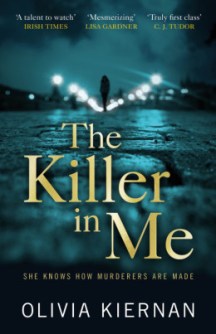 There are some very special Irish crime writers these days. Some mine the uniquely bitter and bleak seam of Belfast, with its raw and recent memories, while further south the city of Dublin, where “the girls are so pretty”, has its fair share of malcontents and evil doers. Olivia Kiernan and her Chief Superintendent Frankie Sheehan were new to me, but
  Staying in Ireland, it has to be said that Jo Spain is ridiculously talented. She has created a bankable stock character in the affable Dublin copper Tom Reynolds, but this has not stopped her from writing such brilliant stand-alones as
  Vulnerability as a character trait is perhaps more common in British fictional coppers that their American counterparts, and few fit that bill quite like James Oswald’s Edinburgh detective Tony McLean.
  In
In 


 n a fictional world overflowing with disfunctional detectives who happen to be rather good at their jobs, Joseph Knox has raised, or perhaps lowered, the bar considerably with his DC Aidan Waits. We first met Waits in
  Together with his grotesque partner and immediate boss, DI Peter Sutcliffe, Waits always gets the shitty end of the stick. ‘Sutty’ Sutcliffe is, you might say, a good old fashioned copper. Waits goes to meet him in a dingy rock-and-roll boozer:
 hy is Aidan Waits such a tortured character? Well, how long have you got? His childhood was loveless and chaotic, and spent largely in institutions where he rubbed shoulders with trainee failures, malcontents and killers. Echoing Nietzsche’s chilling remarks about the moral abyss, Waits has, more recently, gazed too long into a chasm inhabited by a repellent Manchester crime lord called Zane Carver. Carver has fed Waits’s drug habit, and the two have fought over women. Carver has a particular talent with women:
 s distinctive as Knox is as a stylist, and as much as he is a master of the inky black metaphor, he has a tale to tell and a plot to spin. The sepulchral calm of Martin Wick’s closely guarded hospital room is shattered by a savage attack which Waits survives, but puts him at the head of the queue as the police and the gutter press search for scapegoats. With Carver having decided to exact revenge on Waits by donning his black cap and pronounced the death sentence, Waits is on the run both from the gangster and, no less implacably, his politically motivated senior officers, but he keeps them at bay. He discovers faint-but-fatal fault lines in the original case against Martin Wicks, and finds that both Kevin Blake, the detective who brought Wicks to justice, and Frank Moore, the father of the murdered children, still have songs to sing.
 Joseph Knox writes like an angel. Possibly an Angel of Death, but he grasps the spluttering torch of English Noir once carried by such writers as Derek Raymond, and runs with such vigour that the flame burns brightly once again. He is not without humour, and there are many – if unrepeatable – gags exchanged between the cynical cops and their low-life prey. The politically correct nature of modern policing doesn’t escape his attention, either:
 nox has his grim fun with a Manchester police force that is barely honest, city down-and-outs who have lost most of the trappings of humanity, and an infestation of tattooed, Spice-addicted thugs straight from Central Casting – with Hieronymus Bosch as the agency’s head of HR. He also leaves us with a delightfully enigmatic final few pages. The Sleepwalker is published by Doubleday and will be
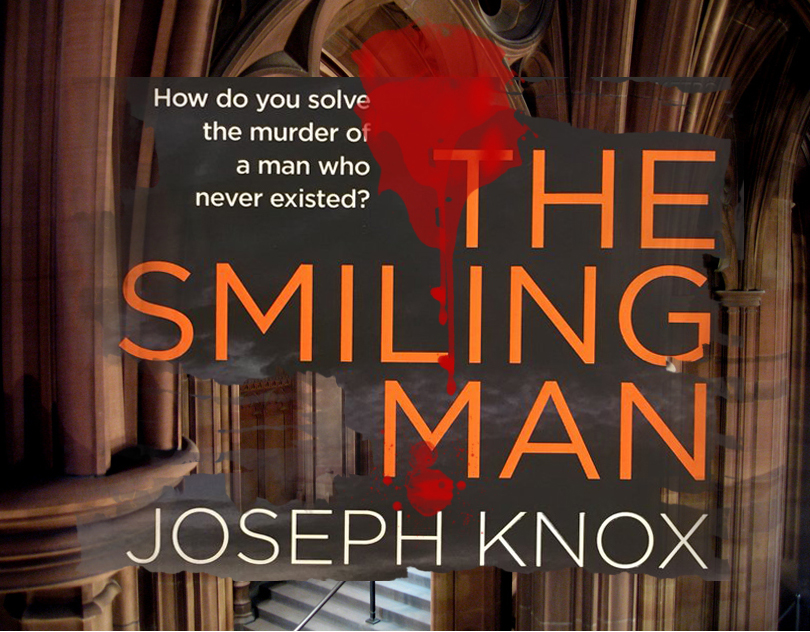

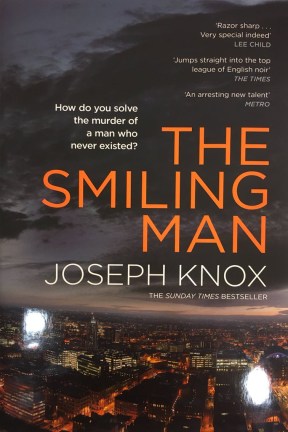 This is all too much like hard work for Sutcliffe, but despite warnings from his saturnine superior, Superintendent Parr, Waits digs deeper. He uncovers a labyrinthine series of connections between an absent solicitor doing his rich-white-man things among the bar girls of Thailand, an apparently gay businessman and his estranged wife, the corpse (now renamed The Smiling Man), and another hotel room, its floor saturated with pint after pint of human blood.
 This is little short of a modern masterpiece. You might imagine Joseph Knox (right) to be a weathered, life-weary cynical misanthrope, hunched in a corner of the pub, savouring a roll-up, rather like a latter day Derek Raymond, but anyone who has had the privilege of meeting Joseph will know that this is far from the case. He is well versed in the art of Noir, though, as he revealed when he spoke to us around the time that his first novel, Sirens, was published.
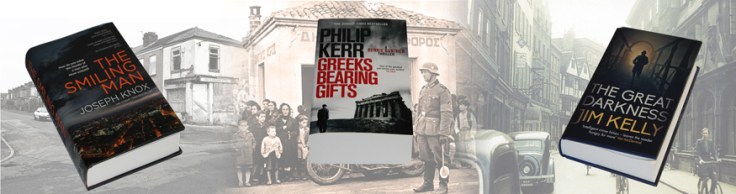
 Just as George MacDonald Fraser had his magnificent bounder Harry Flashman working his way through all the major political and military events of the the second half of the 19th century, so Philip Kerr (right) has positioned his wearily honest – but cynical – German cop Bernie Gunther in the 20th. We know Gunther fought in The Great War, but his service there is only, thus far, alluded to. We have seen him interact with most of the significant players in the decades spanning the rise of the Nazis through to their defeat and escape into post-war boltholes such as Argentina and Cuba. In the 13th book of this brilliant series, Gunther, joints creaking with advancing old age, is now working for an insurance company who want him to investigate a possible scam involving a sunken ship. His work takes him to Athens, where he discovers an unpleasantly familiar link to evil deeds committed under the baleful gaze of Adolf Hitler and his henchmen. Some of Bernie Gunther’s earlier exploits are covered


 Every book I’ve mentioned won admirers from different sections of the reading public but, for me, the die was cast when a rather shy young man read the opening paragraphs of his soon-to-be-published novel at a book promotion evening in a smart Fitzrovia Hotel. Joseph Knox (left) may still have work to do to become a Richard Burton in the making, but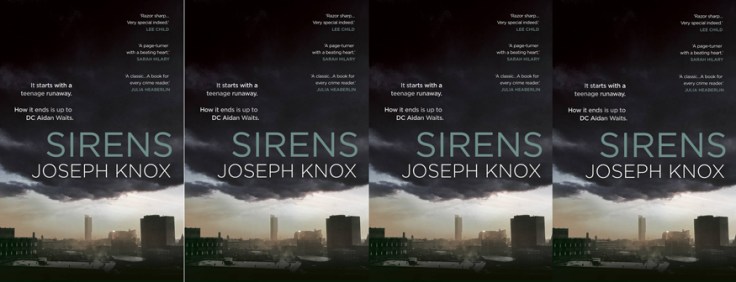


 So, Waits plays a dangerous double game which involves being undercover yet in full view. This paradox is essential. Obviously drug lord Zain Carver will know that Waits is a suspended copper; the deception will only work if Waits can convince the gangster that he is prepared to damage his former employers with leaked information. It requires no acting ability whatsoever for Waits to appear dissolute, addicted and troubled – that is his normal persona. However, a big problem looms. A rich and influential Member of Parliament has “lost” his teenage daughter. Isabelle Rossitter is one of the satellites fizzing around the planet Carver. Daddy is desperate to get her back, and Waits is given the task.


 fullybooked2017