
Sometimes, how co-writing works seems fairly obvious. Ambrose Parry is the husband and wife writing team of Chris Brookmyre and Dr Marisa Haetzman. Their books are set in early 19th century Edinburgh, and centre on a physician called Will Raven. I imagine Chris provides the crime fiction experience – plotting, dialogue and such, while Marisa provided the (sometimes gory) medical details. Much as I admire James Patterson for his early books (and his amazing work for charity) I imagine that these days, when you see a novel by JAMES PATTERSON (large print) WITH (slightly smaller print) RANDOM NAME, all he is doing is replicating the painting school in Renaissance Europe, where a painting might be identified today as “school of” Raphael, or Leonardo, but was actually produced by apprentices working to a set formula. Incidentally, I am told that there is a “school of” Damien Hurst, which involves budding young artists sitting in a studio making objects in the stylle of ‘the master’. I am a huge fan of Jonathan Kellerman’s Alex Delaware books, and if his son has some input with this, the latest book in the Clay Edison series, then fair play, as long as it is readable – and it certainly is.
Clay Edison is a former San Francisco coroner, and I reviewed previous books in the series, Lost Souls and The Burning (click the links to go the reviews). Now, Edison has given up working for the state, and is registered as a private investigator. This case starts when an old friend is unexpectedly named as executor in a deceased relative’s will. He asks Edison for help, because he has discovered that the old lady had been paying monthly amounts for years into what seems to have been a mortgage on a property in a remote coastal settlement called Swann’s Flat.
Initially doing much of the work online, Edison suspects that a massive scam has been set up. Yes, Swann’s Flat exists, but the houses and building plots are nothing like those shown in the glossy brochures which have sucked in many gullible people. The business structure is a complex web of false corporations hiding behind other companies that exist in name only.
Edison makes the long drive to see for himself. The place is wild, remote, and the last few miles into the settlement are a terrifying drive along a steep trail that rises and the plummets between vertiginous cliffs and gullies. When he finally makes it into the tiny town, he finds one or two larger houses behind forbidding security arrangements, but most of all he sees ‘streets’ that have name posts, but no houses, no utilities and a general sense of being abandon. There is, however, a hotel, where he checks in under an assumed name. Later, after meeting Beau Bergstrom and his father Emil, who seem to be the town bigshots, he convinces them that he is looking to buy a building plot.
By now, the writers have introduced what seems to be a separate plot involving a missing college-age boy called Nicholas Moore, whose poster was pinned up, with several others, outside a grocery store in the next town along. Edison is intrigued by this, and when he leaves Swann’s Flat, telling the Bergstroms that he is going to sort out all the arrangements for the land purchase they think he is going to make, he returns to The Bay Area, and makes contact with the boy’s mother,Tara. She is single, neurotic, and initially doesn’t trust Edison. She tells him she no money to pay for another investigation, but gives him the name of the last person she hired, a woman called Regina Klein.
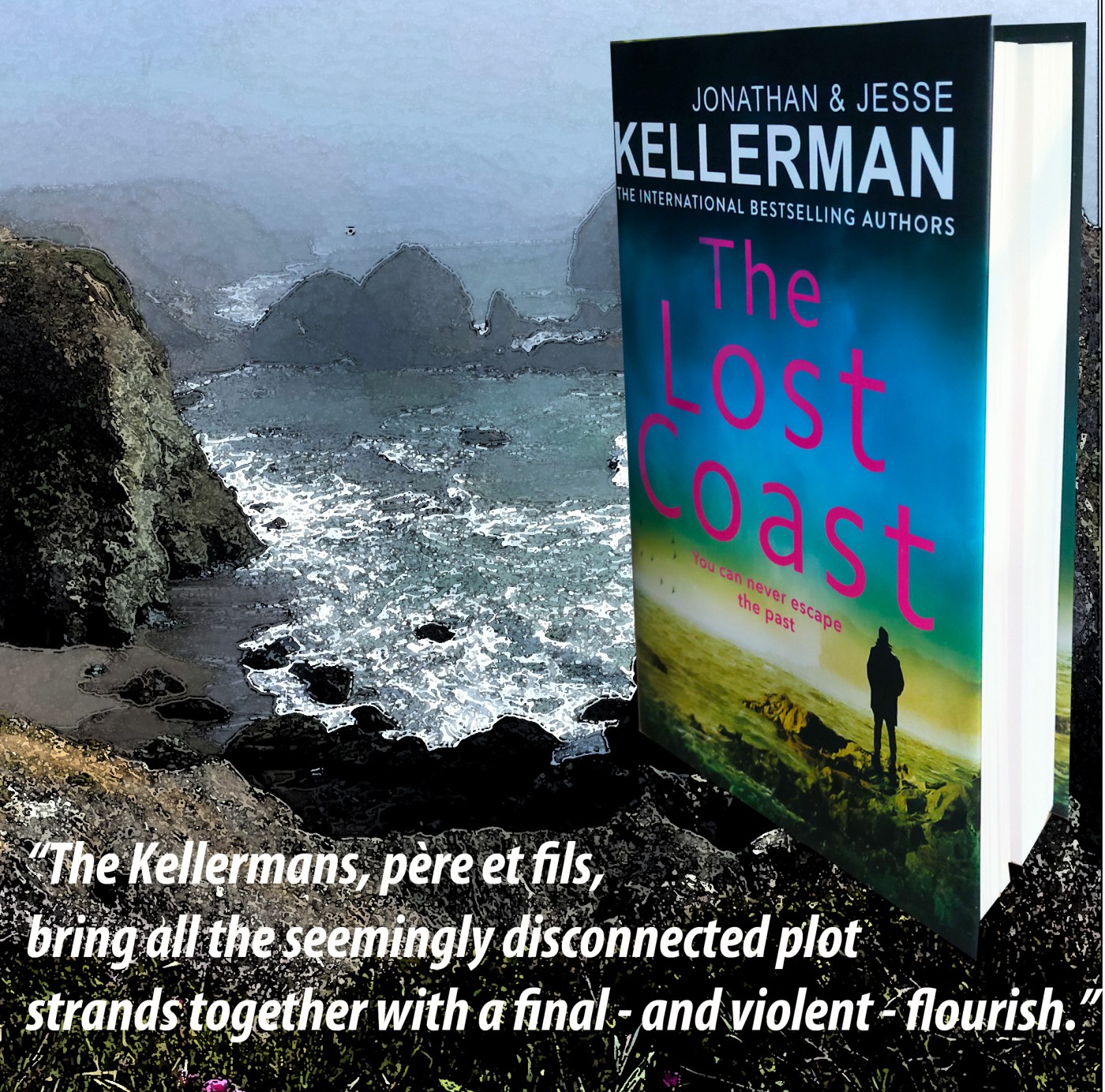
There is yet another strand to the plot, and this involves an avant-garde novelist called Octavio Prado, with whom Nicholas had become obsessed. Prado, too, has disappeared, leaving only the one widely acclaimed published work, and another which was so over-the-top that his agent failed to find a publisher. It remains, in original handwritten form, and this becomes key to what is going on. The case has thrown up many seemingly unconnected questions, but Edison believes that the answers to them all lie in Swann’s Flat. He persuades Regina Klein to join him and, posing as man and wife they return. The Kellermans, père et fils, bring all the seemingly disconnected plot strands together with a final – and violent – flourish. This entertaining thriller is published by Century and is available now.

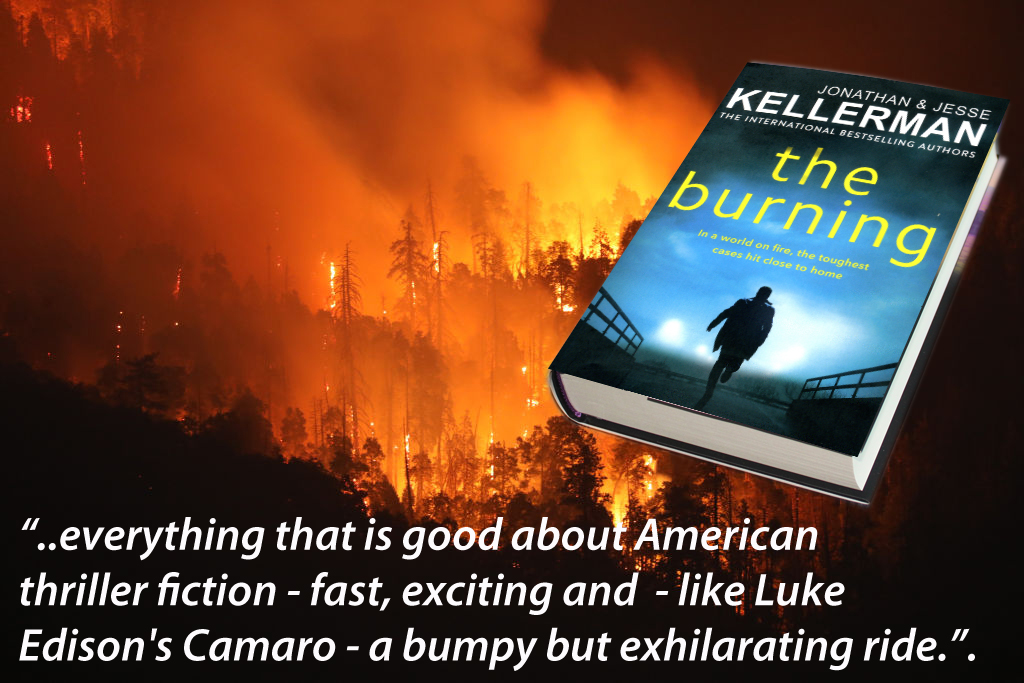

 But back to Clay Edison. He is a Deputy US Coroner in Berkeley, California, and The Burning begins, quite topically, with a destructive bush fire that has knocked out power supplies for everyone except those with their own generators. When Edison and his partner are summoned to retrieve a corpse from a mansion up in the hills, they find that Rory Vandervelde – a multi millionaire – has died from gunshot wounds. He was an avid collector. Rare baseball and basketball memorabilia, Swiss watches, antique knives – you name it, and Vandervelde had bought it. It is when Edison is inspecting the dead man’s astonishing collection of classic cars, stored in a huge garage, that he discovers something that sends a shiver down his spine, and not in a pleasant way.


 Lost Souls is something of an oddity, and no mistake. There’s nothing at all wrong with the novel itself apart from something of an identity crisis. Search for it on Amazon UK, and up it comes, but the page URL contains the title Half Moon Bay. Search for Half Moon Bay and up comes the same novel, but with a different cover. It looks as though Half Moon Bay is the Penguin Random House American title, while on this side of the Atlantic Century are going with Lost Souls.
 As Edison tries to link the skeleton of the baby with the abandoned cuddly toy, he accepts an ‘off-the-books’ job. A wealthy businessman, Peter Franchette, asks him to try to find the truth about his missing sister. Possibly abducted, perhaps murdered, she has disappeared into a complexity of disfunctional family events – deaths, walkouts, divorces, remarriages and rejections.


 fullybooked2017