Search

fullybooked2017

Tag

Inspector Banks

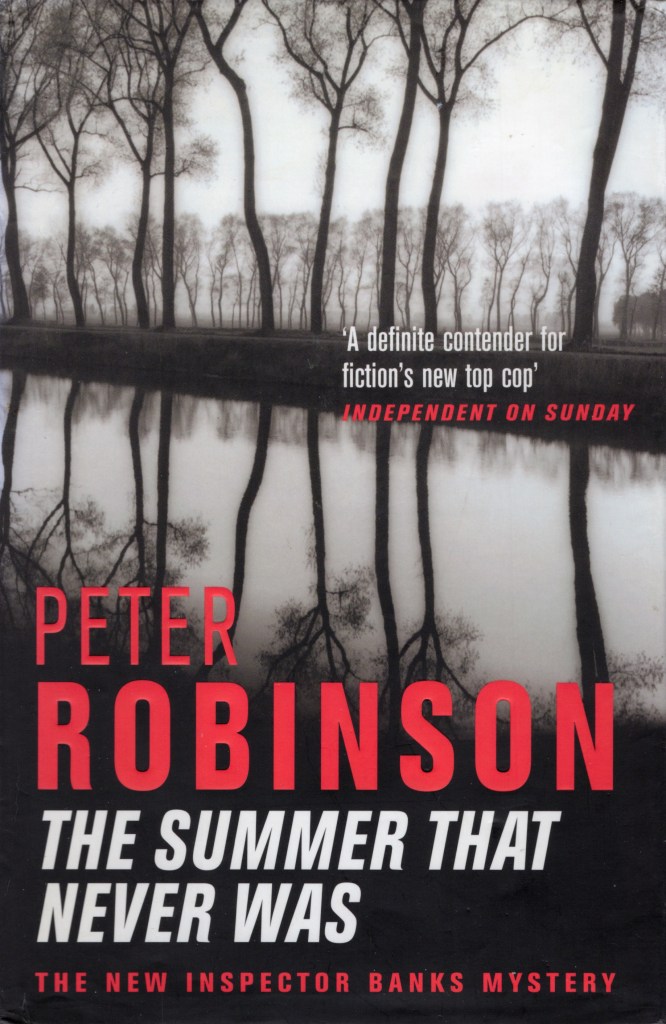
PAST TIMES – OLD CRIMES . . . The Summer That Never Was

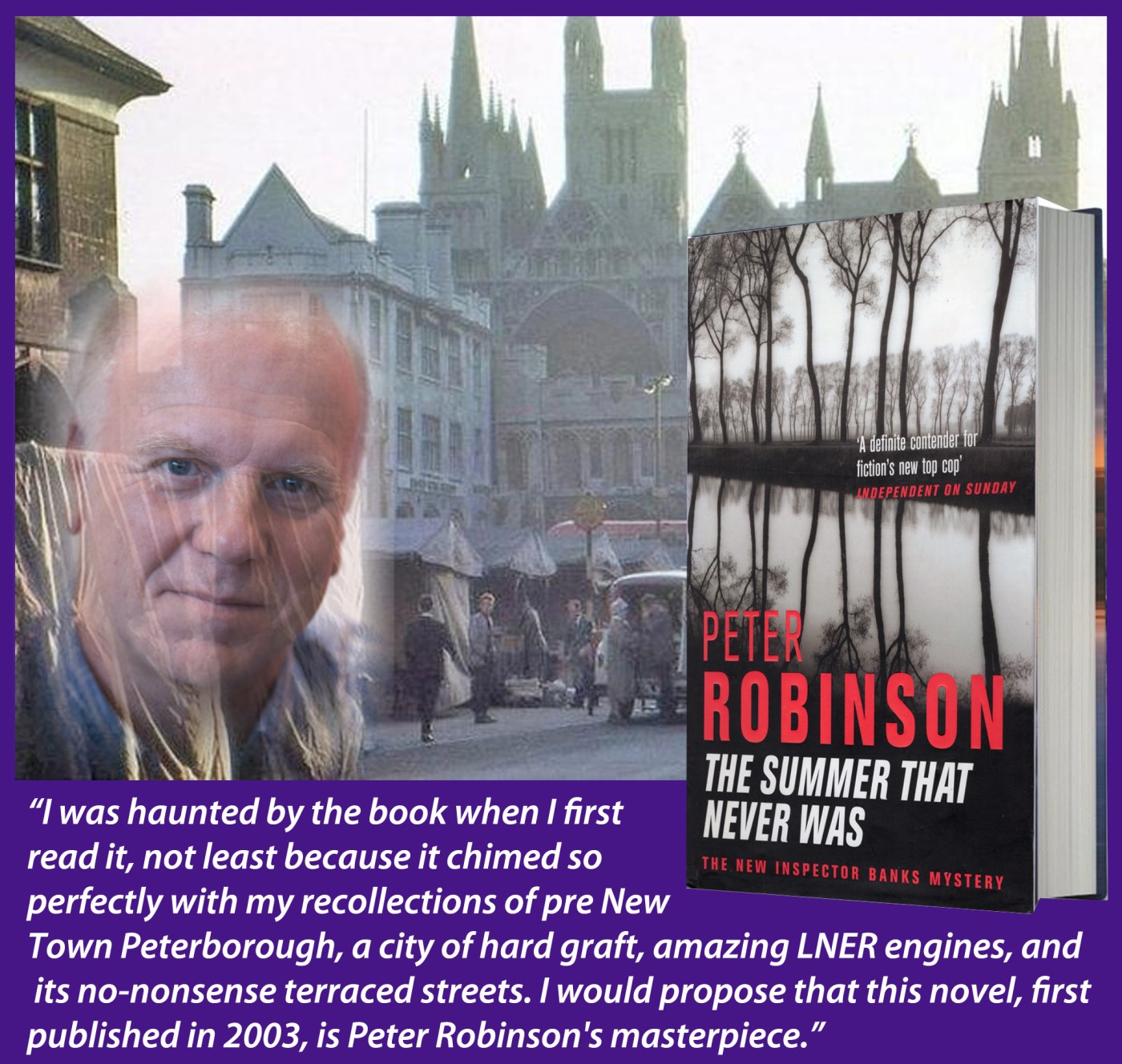
Yes, I know, I am cheating here. My PT-OC limit was supposed to be 2000, but I am making an exception here. After all, what is three years in a lifetime? In the lovely song Just A Song At Twilight, there is a phrase, “Once in the dear dead days beyond recall..”. I had those days, and back then, before publishers and authors trusted me with free copies of their novels, I was an inveterate user of our local public library. I mostly borrowed crime fiction, and I came to love the books of writers like Phil Rickman, Nick Oldham, Jonathan Kellerman, Jim Kelly and Peter Robinson. I quote another memorable song, “Some are dead and some are living..” and, sadly, Peter Robinson is one of the latter.

He is best remembered for his Inspector Banks novels, and I have chosen one of those for this feature. Banks, of course, does his coppering in the Yorkshire Dales, but this story takes him back to his childhood in Peterborough. Peterborough is, in some ways, a strange place. It has a majestic cathedral, was once in Northamptonshire, but now seems to be in Cambridgeshire. Like Banks in the novel, I remember it in the 1960s, when it was a grimy little town, surrounded by brickworks but, even then, a vital railway hub. I knew it from my days as a trainspotter, hair excessively Brylcreemed, and with a school satchel packed with sandwiches, fizzy pop and Ian Allen train books. Then came Peterborough’s designation as a New Town, with the massive expansion turning it into a kind of Milton Keynes, all roundabouts and fancifully named new housing estates.


Strangely, there is nothing in online information to suggest that Robinson was a youngster in Peterborough (he was born and brought up in Leeds) but then novelists make us believe things that actually never happened – that’s what they are good at. Here, Robinson creates a brilliant counterpoint, like two independent melodies dancing along together in perfect harmony, Banks, of course, is the link.

Down in Peterborough, a skeleton is discovered on a building site. It is that of a childhood friend of Banks, who disappeared when he was a teenager. Graham Marshall disappeared one morning while doing his paper round and, despite an extensive police investigation, no trace of him was ever found. Back in the present day, Banks’s offsider and onetime lover, Annie Cabbot is investigating the disappearance of Luke Armitage, a brooding and rather troubled youngster with celebrity parents. After what appears to be a fake kidnap-ransom demand, his body is found in a moorland tarn.

For Banks, with the aid of a resourceful Peterborough copper Michelle Hart, the solution to Graham Marshall’s murder involves a painful dismantling of what he remembers of an innocent friendship. The death of Luke Armitage involves individuals who, while innocent of malice, are certainly guilty of several of the Deadly Sins.

Banks, in his determination to secure justice for both boys, comes to realise that the boundaries between victim and perpetrator, between law guardian and law breaker can sometimes be blurred almost into indistinction. Faulkner said, in his memorable line from Requiem For A Nun, “The past is never dead. It’s not even past” and here, Banks’s return to the unremarkable Peterborough housing estate of his youth brings about not only the warmth of nostalgia brought about by the magazines and pop songs of his teenage years, but something darker and much more discomforting. I was haunted by the book when I first read it, not least because it chimed so perfectly with my recollections of pre New Town Peterborough, a city of hard graft, amazing LNER engines, and its no-nonsense terraced streets. I would propose that this novel, first published in 2003, is Peter Robinson’s masterpiece.
ON MY SHELF

ON MY SHELF is a regular feature looking at recent and upcoming books which  will be of interest to crime fans.

JULY 2016

OMS1

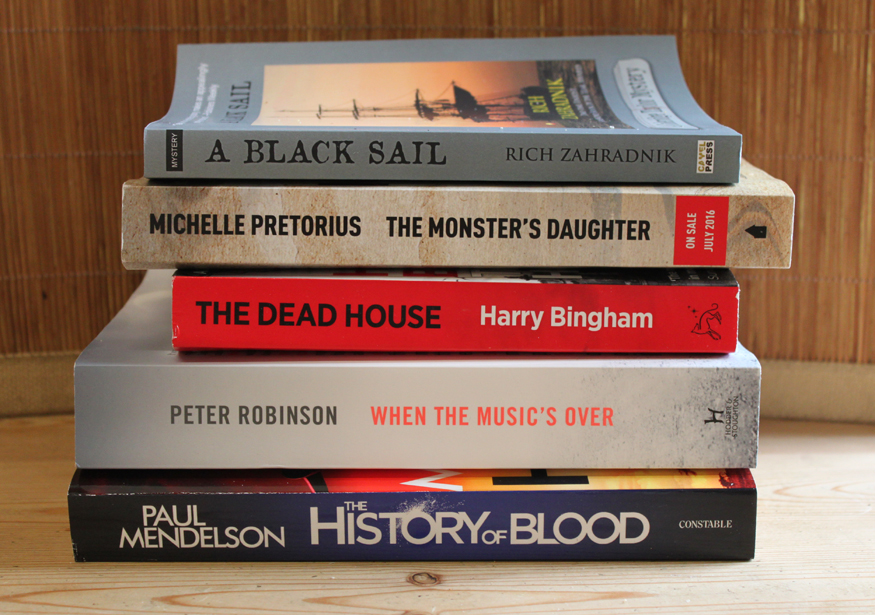
The History of Blood by Paul Mendelson
Sadly, the euphoria over Nelson Mandela’s Rainbow Nation has long since faded, and political and social reality has taken its place. The Republic is one of the most dangerous and crime blighted places in the world, and we take a grim journey through that reality, led by the beleaguered Colonel Vaughn de Vries and Don February of the Special Crimes Unit. Corruption is never far from the surface, and the scars of historic misdeeds are still raw and – in some cases – still bleeding. Buy The History Of Blood here.

When The Music’s Over by Peter Robinson
Twenty three books in, and one of CriFi’s most enduring – if not endearing – glum and introspective coppers, Alan Banks, now promoted to the dizzy heights of Detective Superintendent, shows no signs of retiring. His foil and sometime-soulmate Annie Cabbot is also still going strong, and the pair investigate apparently unconnected crimes. Cabbot’s is the brutal death of a teenage girl, apparently tossed from a moving vehicle like a discarded chocolate bar wrapper, while Banks wades into the murky waters of a historic allegation of sexual abuse involving a celebrity. Buy Peter Robinson’s latest novel here.

The Dead House by Harry Bingham
How can feisty, crazy, fearless and utterly adorable Fiona Griffiths still only be a humble Detective Constable? Only her creator, Harry Bingham, knows, but our girl is back for her fifth battle with the forces of evil. Fi suffers from Cotard’s Syndrome, a bizarre condition which is occasionally incapacitating, but also gifts the sufferer with startling insights. The ‘dead house’ of the title is a place where, in medieval times, corpses were laid prior to burial. A very modern murder challenges Fi, however, and her empathy with the dead takes her into places where modern malice and ancient evil combine to terrifying effect. Check out Harry Bingham’s Amazon page for more information about the startling DC Fiona Griffiths.

The Monster’s Daughter by Michelle Pretorius
Back now to South Africa. The root of the story lies not in the modern Republic, with all its contradictions and uncertainties, but in the even darker days at the turn of the twentieth century, when the Boer rebellion against British rule was put down with all the ferocity that a colonial power could muster. One of the least honourable contributions to world history by Britain was the invention of the concentration camp. In one such place, a British doctor conducts horrific experiments on prisoners. A century later it becomes horribly obvious that his work did not die with him. A young constable with the South African police becomes drawn into a case which will take her into a world where the reality is even worse than her nightmares. The Monster’s Daughter is out later this month.

A Black Sail by Rich Zahradnick
Despite the name of the main character, Coleridge Taylor, and the evocative cover, this is not a historical novel. OK. it’s set in the 1970s, but maybe that doesn’t count. Coleridge Taylor is a journalist. He is also an ex-cop, dismissed for an over-inventive approach to evidence. It’s the eve of the 1976 bicentennial, and the citizens of The Big Apple are drawn to the waterfront, where a whole fleet of replica tall ships are assembled to add to the spectacle. In this, the third of the series, Coleridge Taylor gets sucked in to a very modern murder mystery involving bricks of heroin, Chinese gangs and the traditional Mafia goons of New York City. A Black Sail will be out in USA later in the year.

Blog at WordPress.com.

Up ↑