Search

fullybooked2017

Tag

Historical Crime Fiction

THE ROOM WITH EIGHT WINDOWS . . . Between the covers

8windows header

December 1930. Henry Johnstone, a former Detective Chief Inspector with the Metropolitan Police, has been forced to resign due to a debilitating injury. Now, he ekes out a solitary existence in a crumbling Brighton house, empty except for a large library assembled by the former owner, the late Sir Eamon Barry. Johnstone’s task – one given to him by a friend, concerned about his mental state – is to catalogue the thousands of books in the library. He is convinced he is being stalked, perhaps by someone linked to an old case. Then, he disappears. We know how – if not why – but his friends, among them his sister Cynthia and his former Sergeant Mickey Hitchens, are left with few clues, but one – left behind by Johnstone – suggests there is a link to a mysterious death and disappearance five years earlier.

When Johnstone is eventually found, he has been beaten within an inch of his life by a criminal gang, and is in no fit state to help the investigation into what seems to be a brutal and very well organised smuggling cartel. England’s south coast has been the backdrop for smuggling for centuries. I am reminded of the romantic lines of Kipling:

“If you wake at midnight, and hear a horse’s feet,
Don’t go drawing back the blind, or looking in the street,
Them that ask no questions isn’t told a lie. Watch the wall my darling while the Gentlemen go by.
Five and twenty ponies,
Trotting through the dark –
Brandy for the Parson, ‘Baccy for the Clerk.
Laces for a lady; letters for a spy,
And watch the wall my darling while the Gentlemen go by!”

These days, sadly, the smugglers don’t tend to deal in the traditional commodities of brandy and tobacco, but in the more profitable contraband of human lives. I would like to think that back in the day, the profiteers were not aided and abetted by the historical equivalent of the RNLI and the Border Force, but that is a debate for another day As Henry Johnstone slowly recovers his strength, Hitchens – and his slightly odd (but learning something new every day) Sergeant Tibbs – eventually get to the root of the mystery, but not before more lives are lost.

As is only right and proper in novels set in the 1930s, Jane A Adams makes us aware that most of her protagonists have a shared history – that of The Great War. Those over the age of 35 will have either fought in that conflict or lost husbands and sons: Younger people will have fathers they will never see again, with only a marble gravestone somewhere in France as a far-away reminder of what they have lost.

The period details in The Room With Eight Windows are impressive and convincing, as are the quirks and foibles of the main characters. This excellent and atmospheric thriller will be published by Severn House on 4th July.

TWO MEN IN BERLIN . . . Bernie Gunther and John Russell (part one)

Berlin Header

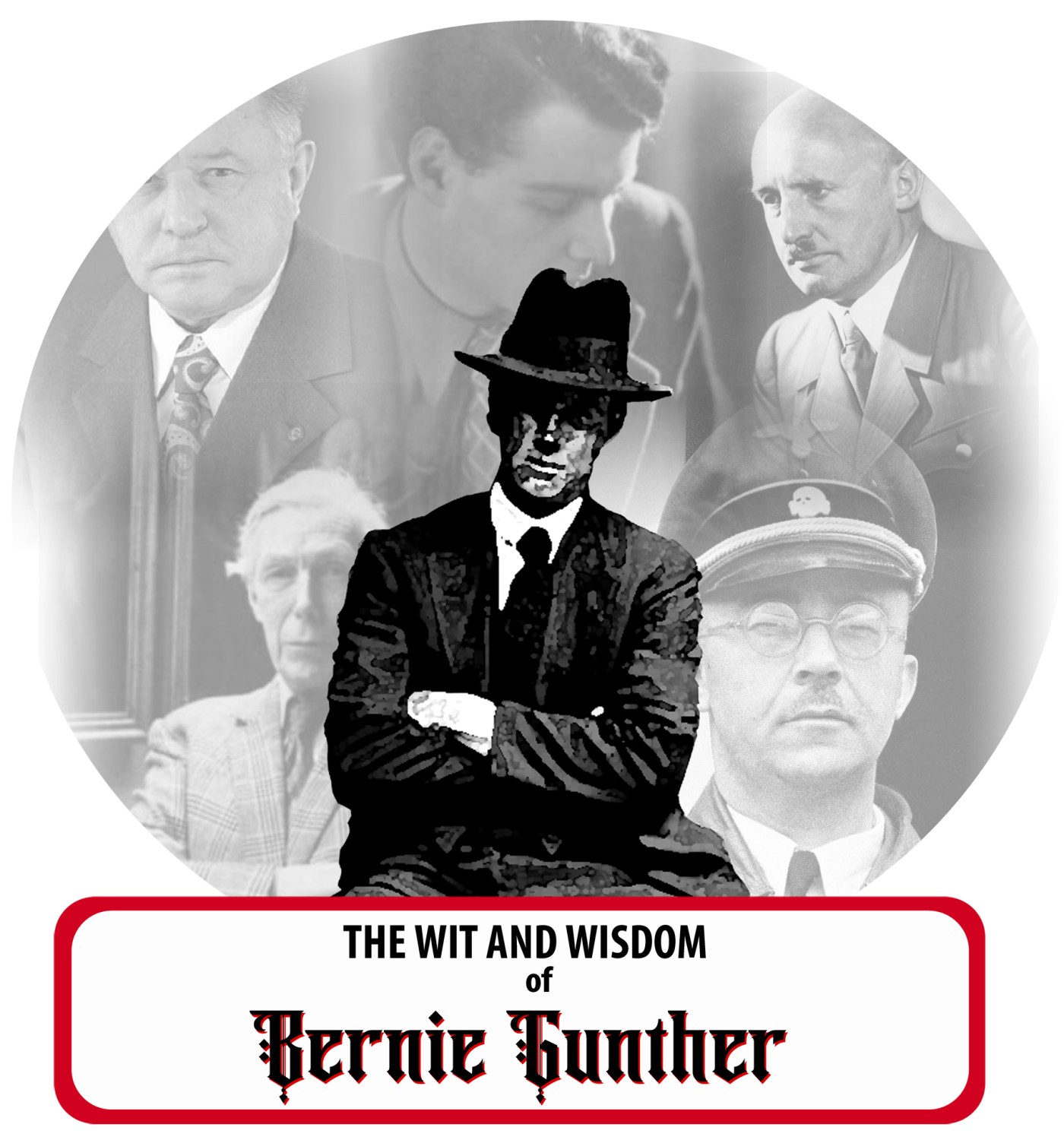
Bernie Gunther is the anti-hero of fourteen novels by the late Philip Kerr. Berlin cop, turned private investigator, sometime employee of Goebbels and Heydrich, and finally an international pariah, Gunther’s exploits span post Great War Germany to international intrigue in the 1950s. John Russell is an Anglo American journalist who begins the series of seven books by David Downing based in Germany. The books are all named after railway stations and span the years 1938 – 1948.

BERNIE GUNTHER

Screen Shot 2023-06-02 at 20.14.08Philip Kerr’s Berlin Noir series was published between 1989 and 1991, and introduced the world to Bernie Gunther. Strangely, it wasn’t until 2006 that the books March Violets, The Pale Criminal and A German Requiem were followed up with The One from the Other, and until his death the Edinburgh-born author brought us regular episodes from the life of his tough, resourceful and compassionate hero. The final novel in the series, Metropolis, was published in 2019 after Kerr’s death and, ironically, is set in the earliest part of Gunther’s career.

To begin with, Gunther has survived two world wars and seen death in all its forms. However, what makes the series fascinating is the challenge he faces, which is to keep his moral compass steady. Uniquely amongst fictional detectives, Bernie has to operate during the dark and savage days of the Third Reich.

Having returned from the trenches of The Great War, Gunther becomes a member of Kripo (Kriminalpolizei), the investigative branch of the Berlin police. During the turbulent years of the 1930s, he tries to steer an even and honest course between the rival political thuggery of the Nazis and the Communists, and when Hitler seizes power he eventually finds himself forced to join the SD (Sicherheistdienst), the intelligence division of the SS. Sent to Ukraine as part of an extermination group but having no stomach for this, he is shunted into the Wehrmacht on the Eastern Front, and is captured by the Russians. After the War, his ambiguous record makes him a person of interest to the Americans, the Russians and the leadership of the GDR, and he leads a dangerous existence among Nazi refugees in Cuba and South America.

Like John Lawton and George Macdonald Frazer, with their respective Freddie Troy and Flashman series, Kerr places fictional characters within real events and alongside celebrated or notorious historical figures. And, he manages to do so in a fascinating and totally plausible way. Assuming that Gunther was born in the mid-to-late 1890s, he can still be at work in the mid 1950s, albeit a heavier, slower and more breathless version of his former selfa latter day Ulysses.

“Made weak by time and fate, but strong in will to strive, to seek, to find and not to yield,” writes Kerr of his hero.
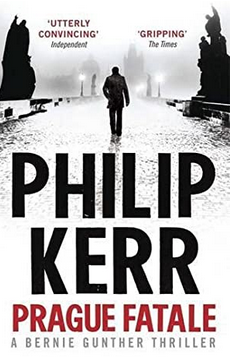
Screen Shot 2023-06-02 at 20.15.51The author’s style, particularly his use of dialogue, set him apart from most contemporary writers. His books were genuine literature, although I suspect written without literary pretension. In Prague Fatale,  he described Gunther meeting an American war correspondent in a Berlin blackout:

“His Old Spice and Virginia tobacco came ahead of him like a motorcycle outrider with a pennant on his mudguard. Solid footsteps bespoke sturdy wing-tip shoes that could have ferried him across the Delaware….his sweet and minty breath smelled of real toothpaste and testified to his having access to a dentist with teeth in his head who was still a decade off retirement.”

In his toughness, moral strength and cynical view of the world, Gunther is very much the heir of Philip Marlowe. His descriptions, sarcasm and one-line put-downs can be very funny. This is a line from A Quiet Flame, which came out in 2008:

“The isosceles of muscles between her chin and her collar-bone had stiffened, like something metallic. If I’d had a little wand I could have used it to tap out the part for triangle in the Bridal Chorus from Lohengrin.”
For more on Bernie Gunther, click the link below

https://fullybooked2017.com/tag/bernie-gunther/

JOHN RUSSELL

Russell is an English journalist with an American mother. Until 1927 he was a member of the Communist Party but, like many others, he fell out of love with the kind of socialism being espoused by Stalin and his acolytes. After serving with the British army in The Great War, he moved to Berlin, married Ilse, and they had a son – Paul. The marriage didn’t last.

Screen Shot 2023-06-02 at 20.17.47In terms of the actual time setting, Wedding Station (2021) gives us the earliest glimpse of John Russell.It is just months after Hitler’s rise to power, and Russell watches the Reichstag burn. Four weeks after Hitler’s accession, brownshirt mobs stalk the streets and the press prints what the Party tells it to.

In the first book (in publication terms) in the series, Zoo Station (2007) we are are introduced to Russell. It is 1939, Berlin, and Russell is an accredited American journalist, safe (for now) from the excesses of Hitler’s government. He has a glamorous girlfriend in Effie Koenen, who is a rising star in German cinema, but he still has a relatively civilised relationship with Ilse – and her new husband – and has regular access to Paul.

His communist background, American passport and fluency in both Russian and German make John Russell a unique target for the intelligence services of all the major powers and, almost like a serial bigamist he becomes wedded to the Sicherheitsdienst, the NKVD, the Abwehr, and the OSS. He plays each one off against the other, more or less successfully and, along with Effie and son Paul, survives the war, but finds ‘the peace’ post 1945 just as traumatic. In Masaryk Station (2013) set in 1948, Russell is told by a Soviet stooge that there is still a war, but that it is different:

“That war is over. It’s time you realised that another struggle – one every bit as crucial – is now underway.”
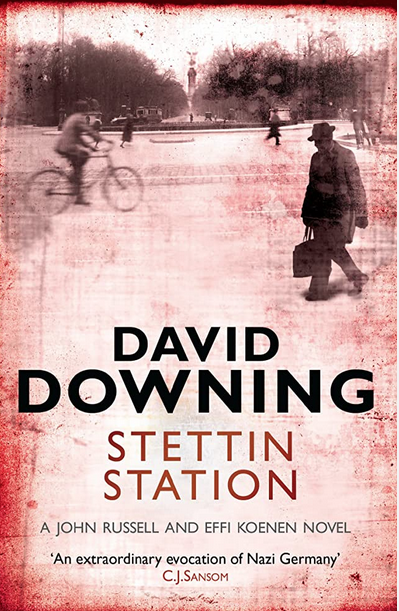
Screen Shot 2023-06-02 at 20.18.57One of the main anxieties in Russell’s complex life is his son Paul. As the boy reaches his teens he becomes – like millions of other German lads – a member of the Hitlerjugend, and this threatens to drive a wedge between father and so. In Stettin Station (2009) we are in November/December 1941, and a famed German air ace of WW1, Ernst Udet is dead. In fact, he shot himself, disillusioned with Luftwaffe chief Goering, and the general conduct of the war, but for the purposes of national solidarity the official story is that he died in a plane crash. As his elaborate funeral cortege passes their viewing point, Paul chides his father for not making the Seig Heil salute with enough reverence. Russell dreads the day when Paul is conscripted to the army and sent to fight on the Eastern Front.

John Russell’s contact with senior Nazi officials is limited, but he does occasionally come face to face with Wilhelm Canaris, the head of the Abwehr, the intelligence service of the German army. One of Russell’s many uneasy allegiances is to the Abwehr which, in fiction if not in fact, has been seen as the acceptable face of the Third Reich. This is perhaps born out by the fact that Canaris was executed for treason on 9th April 1945, in the dying days of Hitler’s regime.

Russell’s connection with Joseph Goebbels is more distant, and it is through Effi Koenen. She is probably the most ‘box office’ star of German cinema, and Goebbels – as propaganda minister – has absolute control over what films can be made, and what message they send out. As such, Effi is much sought after. Again in Stettin Station David Downing presents us with the bitter irony that Effi – pale, dark haired and sexually vibrant – is required to play a Jewish woman in a film with a vehemently anti-Jewish screenplay. For full reviews of Silesian Station and Wedding Station click the link below.

https://fullybooked2017.com/tag/david-downing/

IN PART TWO OF THIS FEATURE
I will examine the differences – and similarities between Bernie Gunther and John Russell.

TOO GOOD TO HANG . . . Between the covers

TGTHheader

Confession time. I try to be honest and objective in my reviews, but there are certain authors who are so sure-footed that I know their novels will not disappoint, even before I have read the first page. One such is Sarah Hawkswood and her beguiling Bradecote series. They are not complicated. Central figure is Hugh Bradecote, noble of birth and Under-Sheriff of Worcestershire in the middle years of the 12th Century. I suppose he is the early medieval equivalent of a modern Detective Inspector and – like them – he has underlings. Bradecote is supported by the grizzled and worldly Sergeant Catchpoll and the Under Sergeant – a callow but rapidly maturing young man called Walkelin. My earlier reviews of the series can be found by clicking the link below:

https://fullybooked2017.com/tag/sarah-hawkswood/

This story begins in April 1145 with a terrible miscarriage of justice in a tiny hamlet called Ripple, the southernmost parish of Worcestershire. It is a real place, a beautiful village just north of Tewksbury. A young ploughman called Thorgar is about to be hanged for murder. He was found in the village church, crouched over the lifeless body of the priest, Father Edmund. Despite his protestations that he is unscyldig (Middle English – innocent), at the insistence of the Reeve, a man called Selewine, the villagers bear him away and he is hanged from an ancient oak tree. Thorgar’s sister Osgyth makes her way to Worcester and reports what she sees as the murder of her brother, which prompts Bradecote, Catchpoll and Walkelin to ride south to investigate.

They soon discover that Father Edmund’s death is linked to two deadly sins. The first is avarice; Thorgar, while ploughing has unearthed a treasure trove of silver artifacts – a priceless chalice, some coins and ornamental buckles dating back to Saxon times. The second is lust; this is far more sinister, as Father Edmund has been using his priestly influence to abuse young girls in Ripple, thus giving every angry father a motive for striking the ungodly cleric down.

Bradecote and his men eventually expose not one murderer – but two  – and there is a macabre finale when the respective killers are forced to disinter the mortal remains of their victims and take them to be given a Christian burial. Apart from the powerfully evocative atmosphere, this is a bloody good detective novel, but particularly impressive is the way Sara Hawkswood handles the dialogue. I suspect no-one has the faintest idea about how people spoke to each other in the 12th century, but the author establishes a style and sticks to it. As a long-time critic of what I consider to be botched attempts at authentic historical conversation in novels, I found Sarah Hawkswood’s method to be both satisfying and convincing.

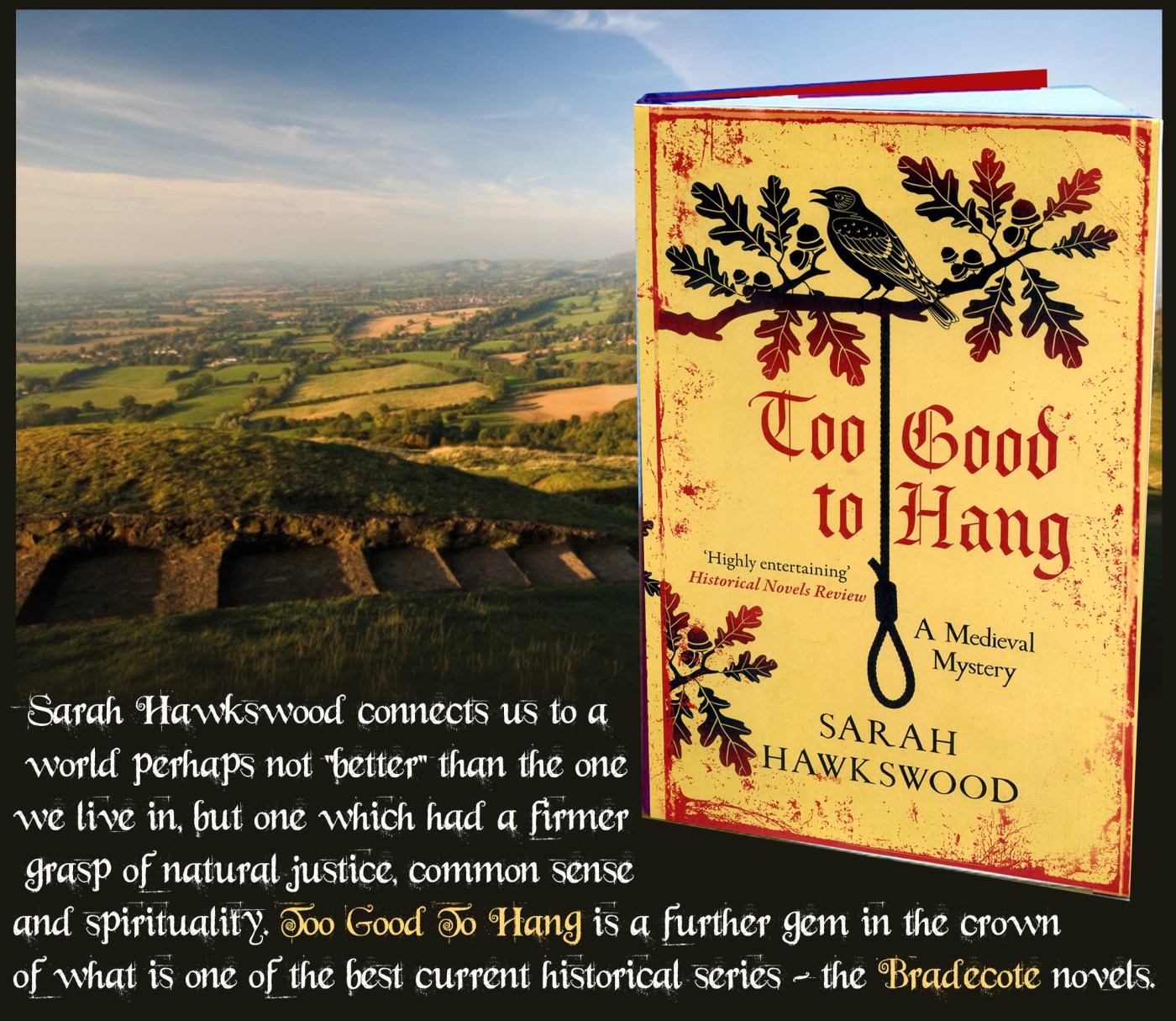
EM Forster’s most celebrated – and enigmatic – dictum was, “Only connect.” Taking him literally, my goodness how Sarah Hawkswood connects. She connects us to the wonderful landscape of the Worcestershire/Gloucestershire borders, overlooked by the golden heights of the Malvern Hills. She connects us to the powerful – and sometimes destructive – presence of the River Severn. She connects us to a time when poor people lived hard-scrabble lives, totally dependent upon the whims of nature and weather and almost umbilically bound to the central focus of every town, village and hamlet – the church. She connects us to a world, perhaps not “better” than the one we live in, but one which had a firmer grasp of natural justice, common sense and spirituality. Too Good To Hang is a further gem in the crown of what is one of the best current historical series – the Bradecote novels. It is published by Allison & Busby and will be out on 18th May.

THE DEAD WILL RISE . . . Between the covers

TDWR header

Chris Nickson is a former music journalist, and has rubbed shoulders with the Great and The Good across the history of rock music, but in these latter days he has earned a considerable reputation as a historical novelist. His books are mostly centred on Leeds, and they cover different historical periods from the 1730s to the 1950s. His latest book features Georgian thief-taker Simon Westow. Back then, there was no organised police force; the only legal officials were parish constables, who tended to be elderly, infirm and incompetent. Westow is more like the 20th century concept of a Private Eye; he recovers stolen property and catches criminals – for a fee.

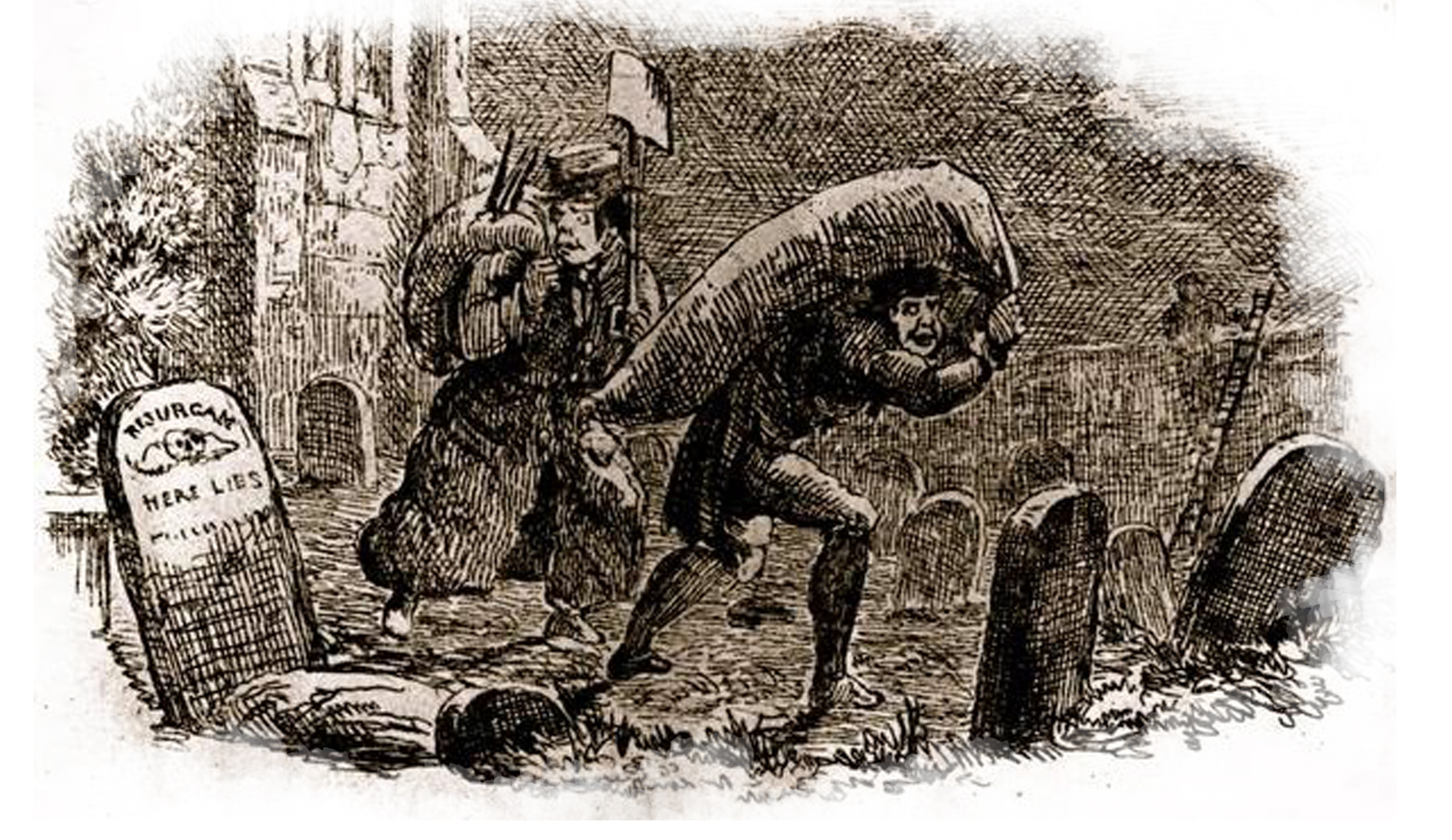
Here, he has an unusual assignment; Local factory boss Joseph Clark asks him to find the men who stole the buried corpse of Gwendolyn Jordan, the daughter of Harmony Jordan, one of his employees. The crime of body snatching is unique in that it involved acts of criminality carried out in the name – some might argue – of a greater good, that being anatomical and medical research. Westow wastes no time on moral philosophy, and with his assistant Jane he sets out to find the Resurrection Men.
RESMEN

Jane is, for me, the most compelling character in any of Nickson’s novels. Raped by her father, disowned by her mother, the teenager has made her living on the streets. Not in the conventional sense by selling her body, but by employing preternatural skills of awareness of danger, cunning and speed of thought; most fearsome of all is the fact that she will use her knife without a moment of compassion or hesitation. She is a stone-cold killer, as many men – now dead and buried – would testify, were they still able to.

Westow’s case load becomes more complex when he and Jane are summoned to the elegant mansion of the infamous Mrs Parker – infamous because she is renowned in Leeds for  marrying a series of wealthy men, who then die, leaving her with an ever expanding fortune. Just for once, she has been bested. A lover has swindled her out of £50 – over £5000 in today’s money – and she wants recompense.

When the usually invulnerable Jane is bested by one of the thugs involved in the corpse trade, and is hurled from a bridge, she is lucky to escape with cuts and bruises. Her pride is hurt more, though, and she vows vengeance. Eventually the elusive Resurrection Men are tracked down, but Westow and his wife Rosie are convinced that there is one big player in the racket left to catch, and this leads to a thrilling – and unexpected –  end to the case,

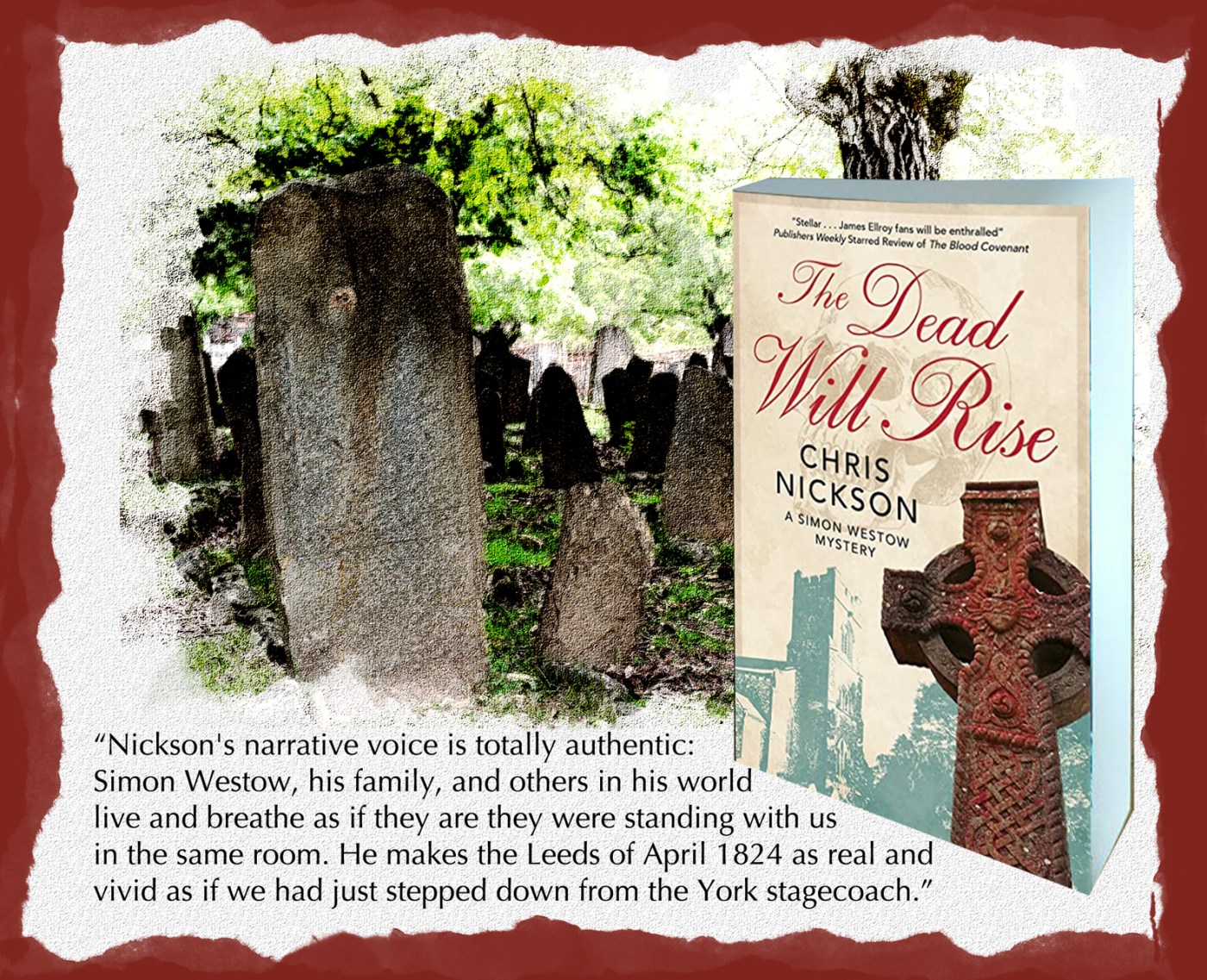
Nickson’s narrative voice is totally authentic: Simon Westow, his family, and others in his world live and breathe as if they are they were standing with us in the same room. He makes the Leeds of April 1824 as real and vivid as if we had just stepped down from the York stagecoach. The Dead Will Rise is published by Severn House and is out now.

Nickson footer

THE POISON MACHINE . . . Between the covers

TPM HEADER

There is nothing new in historical fiction writers having their own invented characters  mix with real life figures. Among the writers who have done this with great success in the crime genre are Philip Kerr, John Lawton, Chris Nickson, and MJ Trow (click the links for further information). I was delighted to be able to review The Bloodless Boy by Robert J Lloyd just about a year ago. He introduced us the (fictional) scientist Harry Hunt and brought back personal memories of ‘O’ Level Physics by featuring Robert Hooke, of Hooke’s Law* fame.

*Hooke’s Law states that the force (F) needed to extend or compress a spring by some distance (x) scales linearly with respect to that distance—that is, Fs = kx, where k is a constant factor characteristic of the spring (i.e., its stiffness), and x is small compared to the total possible deformation of the spring.

I didn’t understand it then, and I still don’t, but no matter. In The Bloodless Boy King Charles II played quite a significant part, but his Roman Catholic wife, Queen Catherine is more to the fore in The Poison Machine, principally because after an eventful sojourn in France, Harry Hunt discovers a plot to murder her. The story begins in London in 1679, where Harry is humiliated when an experiment he is conducting in front of some very distinguished men goes badly wrong. Feeling unsupported by Robert Hooke, he distances himself from the London scientific world by taking on a criminal investigation,

Screen Shot 2022-10-16 at 19.18.26In far-off Norfolk, men repairing flood defences near Denver Sluice have discovered what appears to be the remains of a child inside the rotted skeleton of a boat. Hunt, accompanied by Colonel Michael Field, a grizzled veteran of Cromwell’s army, and Hooke’s niece, Grace. When the trio arrive in Norfolk, Hunt soon determines that the remains are not those of a child, but the mortal remains of Jeffrey Hudson, who was known as the Queen’s Dwarf – the Queen in question being the late Henrietta Maria (left), wife of Charles I. The situation becomes more bizarre when Hunt learns that Hudson is not dead, but living in the town of Oakham, 60 miles west across the Fens. Hunt and his companions’ journey only delivers up more mystery when they find that ‘Jeffrey Hudson’ has left the town. Hunt knows that the jolly boat* which contained the skeleton belonged to a French trader, Incasble, which worked out of King’s Lynn.

*Jolly boats were usually the smallest type of boat carried on ships, and were generally between 16 feet (4.9 m) and 18 feet (5.5 m) long. They were clinker-built and propelled by four or six oars. When not in use the jolly boat normally hung from davits at the stern of a ship, and could be hoisted into and out of the water. Jolly boats were used for transporting people and goods to and from shore.

Sancy diamond ndexHunt’s odyssey continues. In King’s Lynn, Hunt and his companions are summoned to the presence of the Duchesse de Mazarin. Hortense Mancini is one of the most beautiful women in Europe. She is highly connected, but also notorious as one of Charles II’s (several) mistresses. She reveals that the mysterious dwarf – or his impersonator – may be in possession of a a legendary gemstone – the Sancy – a diamond of legendary worth, and the cause of centuries of intrigue and villainy. The Duchesse bids Harry to travel to Paris, but once there, his fortunes take a turn for the worse.
The layers of deception and double dealing in Lloyd’s plot are sometimes breathtakingly complex, but the page-and-a-half of dramatis personnae at the front of the book is a great help. When Harry Hunt, apparently betrayed by Colonel Fields, finds himself incarcerated sine die in la Bastille, one fears the worst for our intelligent (but not particularly swashbuckling) hero.

Robert J Lloyd once again works his magic in the twin roles of formidable historian and fine storyteller. We have fantastical escapes, improbable machines (a kind of 17thC steampunk) and perilous journeys to entertain us, and they do this most royally. The Poison Machine is published by Melville House and is available now.

FOUR THOUSAND DAYS Days . . . Between the covers

FTD header

I am pushed to think of another modern writer who is more prolific, but yet so consistently readable as MJ Trow. Not only that, until a few years ago he actually ‘worked for a living’ outside of his writing career. He and I walked along one or two shared paths. We went to the same school, but I was a couple of years ahead of him, and neither of us noticed one another’s presence. We both took up a career in teaching, and shared a deep contempt for the corporate management styles in English comprehensive schools. He exploited that in his superb series centred on the world of Peter ‘Mad’ Maxwell, Head of History at a fictional school in the Isle of Wight. I say fictional, but Maxwell was, to all intents and purposes, the author himself. One imagines (and hopes) that the murders in the books were purely imaginary ones, but the troubled and often complex teenagers and preposterous members of the Senior Leadership Team were all too true to life.

Before Maxwell came Trow’s homage to Conan Doyle’s Inspector Lestrade. Bumbling and incompetent in the original books, Lestrade is portrayed by Trow as a decent copper, nobody’s fool, and doing his best, but frequently upstaged by his flashier nemesis from Baker Street. There are also series featuring Kit Marlowe, the Elizabethan dramatist, here recast as one of Gloriana’s secret agents. I have also enjoyed the Grand and Batchelor Victorian mysteries. Trow is a great humorist and punster. mixing comedy and word play with superb plotting and  – the real pull, for me – the introduction of real historical characters in to the narrative. In addition he has written extensively in other genres, including True Crime.

Having just realised I am over 200 words into the review without mentioning the book in question, I must get back on task. Margaret Murray was the first celebrated woman archaeologist, and in Four Thousand Days she is at the centre of an intriguing mystery. We are in London, October 1900, and while the Boer War is still very much alive, the Boer leader Paul Kruger has fled to Europe, the ‘game’ is pretty much over, and the first British troops are returning from South Africa.

A young woman is found dead, apparently by her own hand, in a sleazy tenement bedroom. Further investigation reveals that she led at least two different lives, one as a prostitute, but another as a modest and attentive student, a regular attendee at Margaret Murray’s free Friday afternoon lectures at University College London. Another student of Em-Em, (Margaret Murray) Angela Friend, is drawn into the case by her soon-to-be boyfriend, Police Constable Andrew Crawford.

Edmund_Reid_001x copy

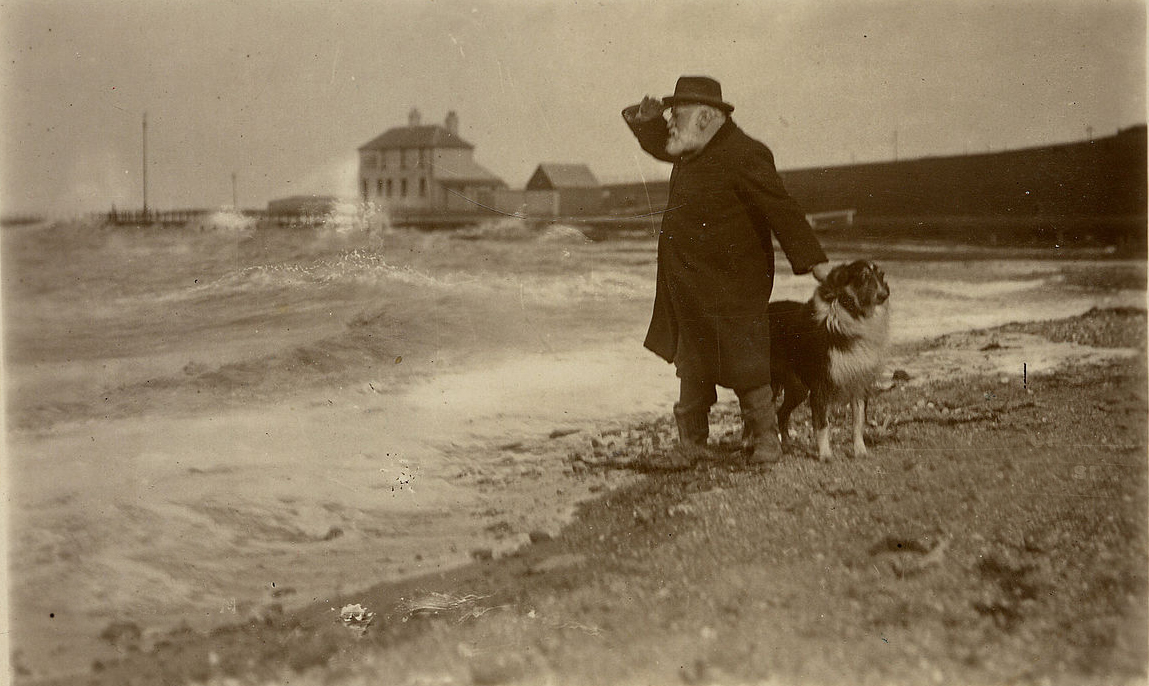
Enter another real-life character in the shape of retired copper, Edmund Reid (above). Troubled by the recent death of his wife and his conspicuous failure a dozen years earlier to catch Jack the Ripper, he has resigned himself to a solitary existence down in Hampton on Sea, a village near Herne Bay in Kent. Hampton would eventually be obliterated by erosion and the force of the waves, but an early part of this process – the collapse of a sand dune – reveals to Reid the body of another woman, dead for some time. The fact she was another archaeologist, is too much of a coincidence. It transpires that she was attempting to excavate a Roman coastal fort. What she found – and was murdered for – has the potential to turn Christian history on its head. He teams up with Margaret Murray to solve the mystery. The book’s enigmatic title? All is revealed in the final pages, but I will not spoil it for you.

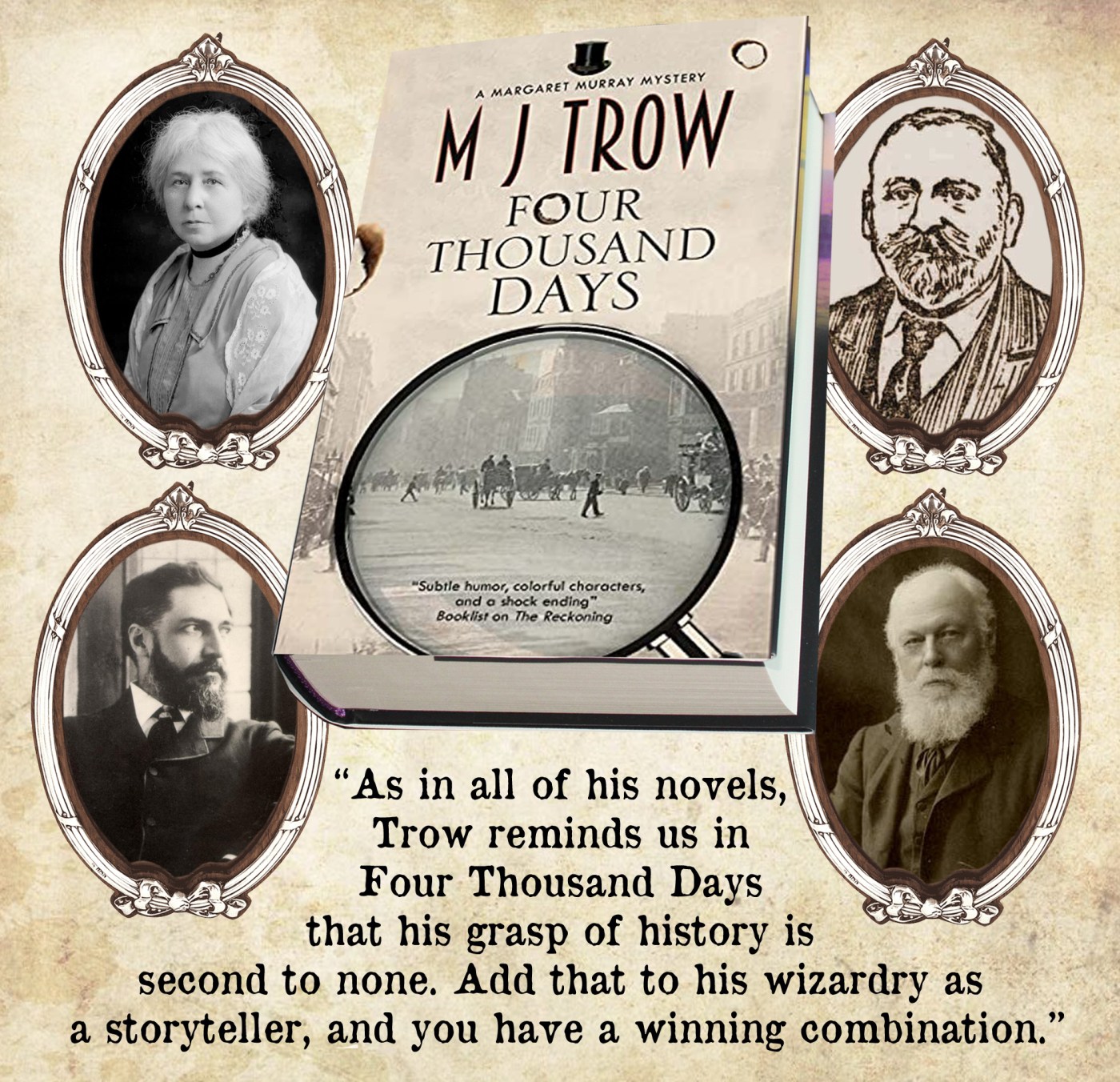
Trow introduces other historical characters, and one of his many skills is to make us believe that how they behave in his book is just how they were in real life. As in all of his novels, Trow reminds us in Four Thousand Days that his grasp of history is second to none. Add that to his wizardry as a storyteller, and you have a winning combination. Four Thousand Days is published by Severn House and is available now.

For more on the novels of MJ Trow, click the image below.

Screen Shot 2022-10-12 at 19.07.47

A DARK STEEL DEATH . . . Between the covers

ADSD header

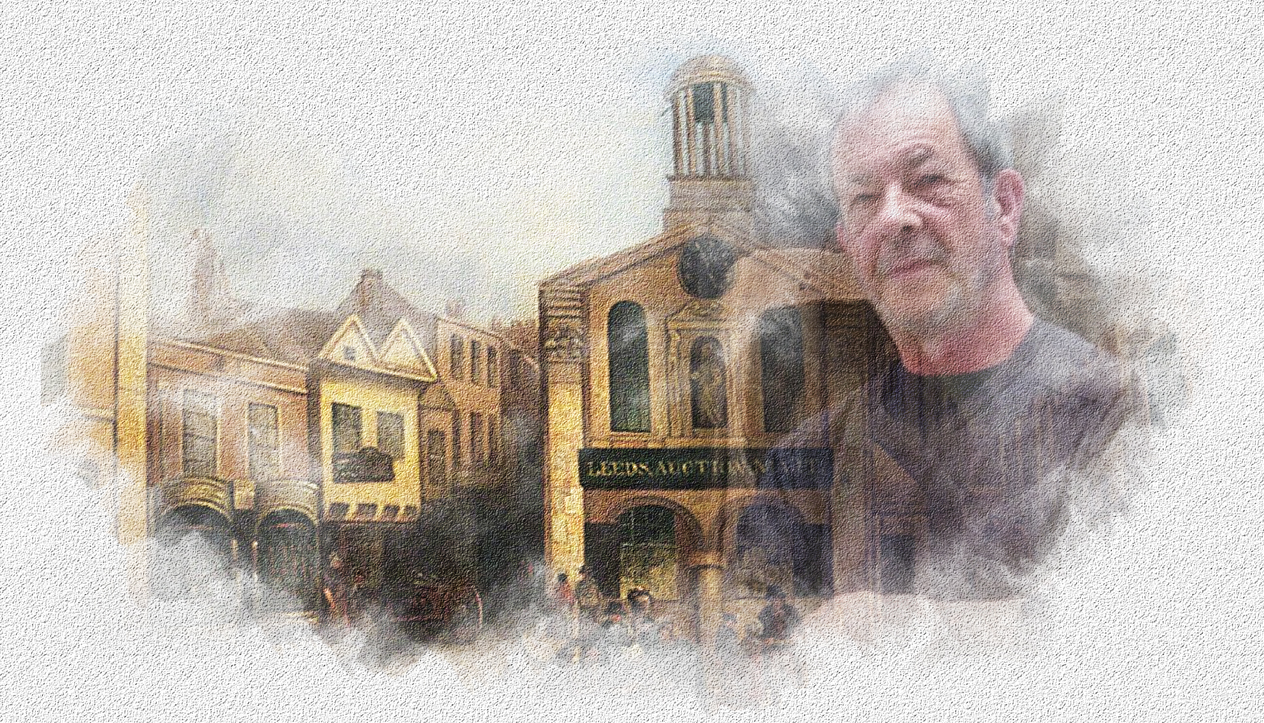
Chris Nickson’s long running saga about  Leeds copper Tom Harper continues with our man now Deputy Chief Constable. We are in January 1917 and, like in other major cities, patrols are on the look out for the silent peril of Zeppelins, while Harper has a possible act of sabotage to investigate after a pile of newspaper and kindling is found inside a warehouse used for storing military clothing. The book begins, however, a month earlier with a true historical incident.

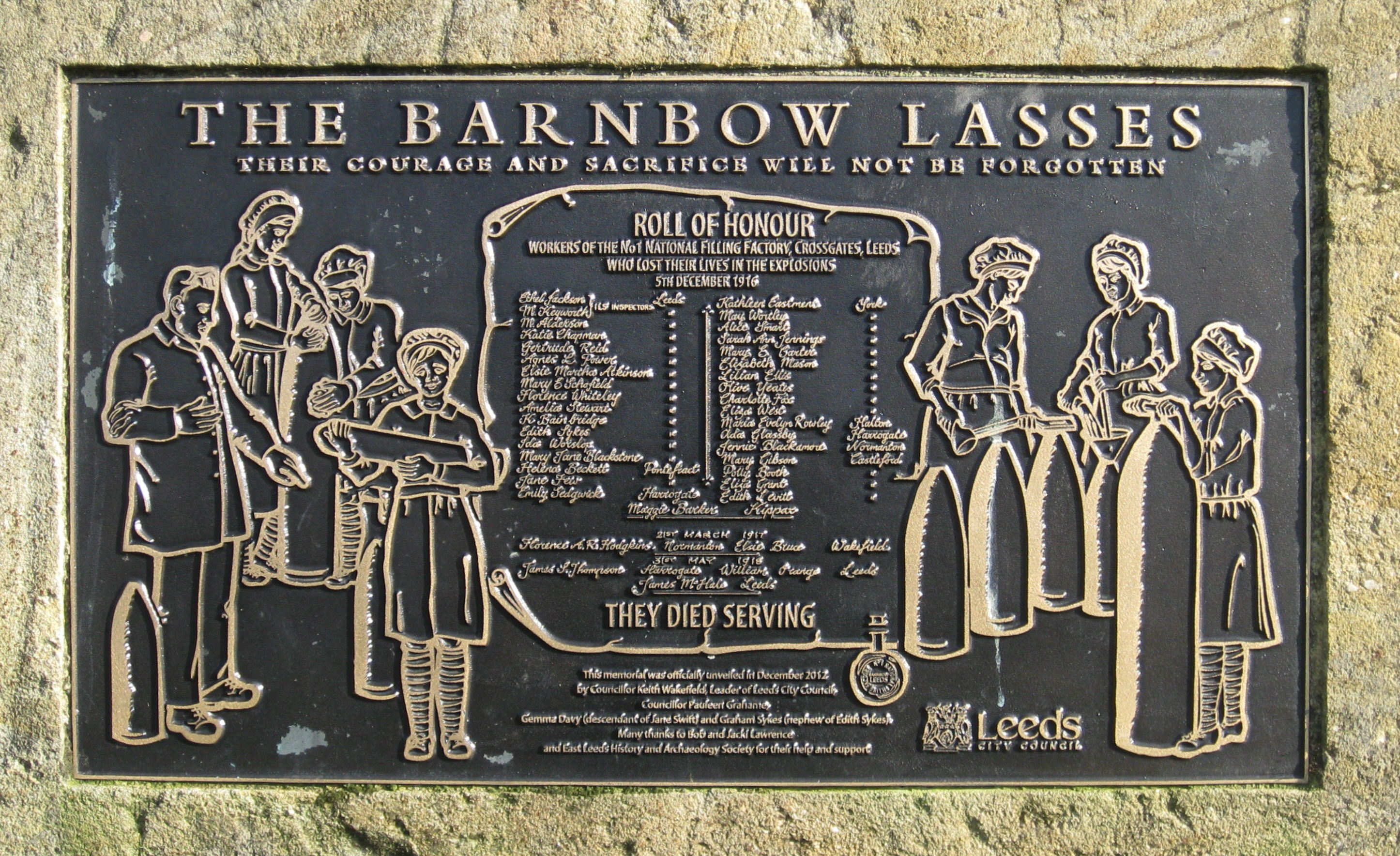
In nearby Barnbow, a huge munitions factory had been established from scratch in 1915. Its prime function was the filling of shells. With the constant drain of manpower to the armed forces, the workforce at Barnbow became over 90% female. On the night of 5th December 1916 a massive explosion occurred in Hut 42, killing 35 women outright, maiming and injuring dozens more. In some cases identification was only possible by the identity disks worn around the necks of the workers. It is believed that the explosion was triggered by a shell being packed with double the required amount of explosives. The dead women, at last, have their own memorial.

Barnbow_Lasses_park_memorial_3_26_August_2017

With the Barnbow investigation ongoing, Harper has more problems on his hands when a sentry outside a barracks in the city is shot dead with, it turns out, a SMLE (Short Magazine Lee Enfield) .303 rifle, adapted for sniping, which was stolen from the barracks own armoury.

There are so many things to admire about this series, not least being the meticulous historical research carried out by the author. One example is the development of police investigative techniques. Back at the beginning, in Gods of Gold (2014), the idea that people could be identified by their fingerprints would have been seen as pure fantasy but, as we see in this novel, it was an essential tool  for the police by 1917.

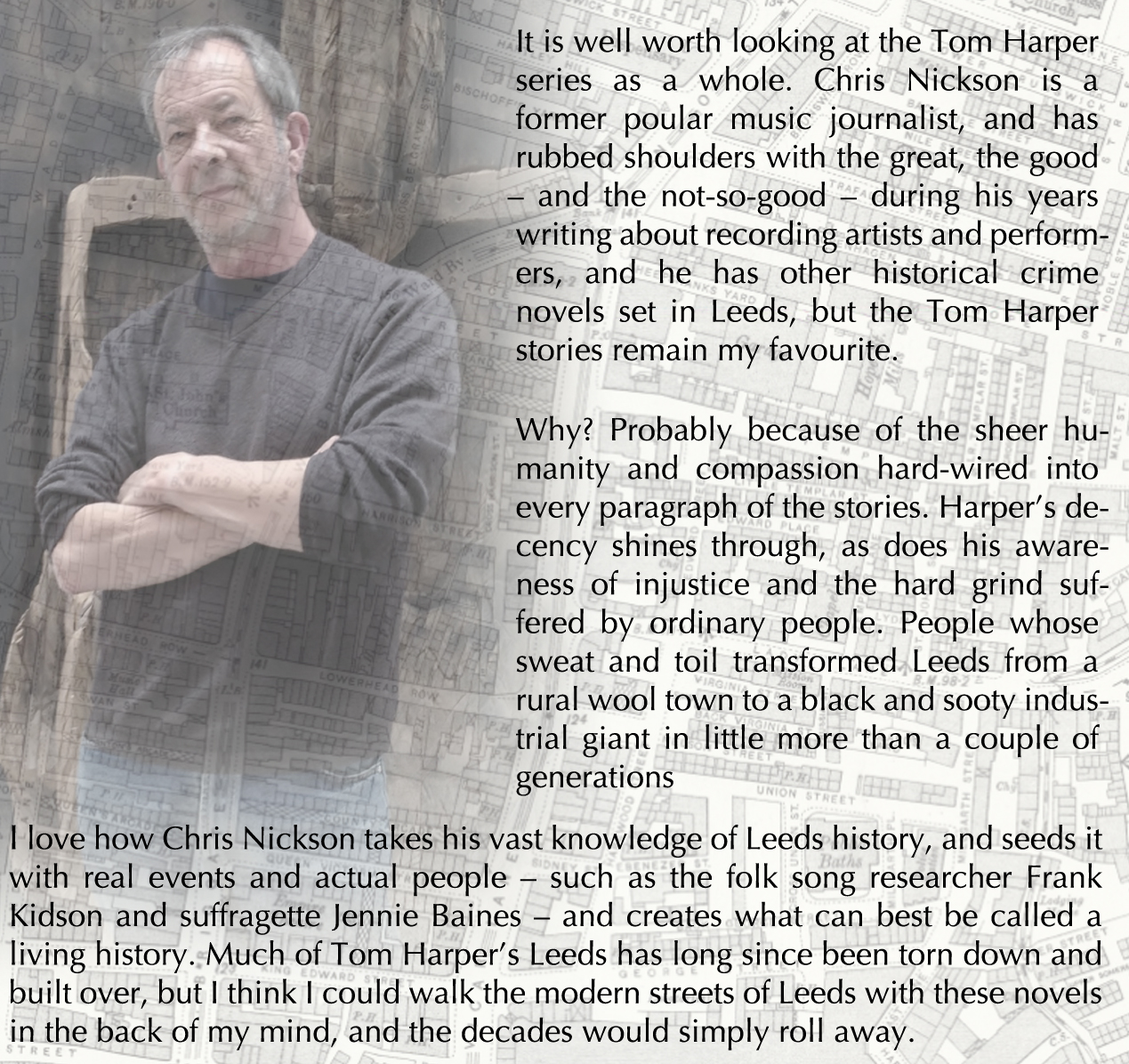
Nickson text

Back to Tom Harper’s current case. As he and his detectives sift what little evidence there is, they seem to be chasing their own tails. Harper’s worries don’t end as he closes his office door each evening. In an earlier book, we learned the grim news that his vivacious and beautiful wife Annabelle, a tireless campaigner for female equality, has developed early-onset dementia. Harper has employed a Belgian refugee couple to run Annabelle’s pub, and keep a close eye on his wife, but he never knows from one day to the next what state she will be in. If he is lucky, she will show glimpses of her old self; when she is having a bad day, she inhabits a totally imaginary world and slips from all the anchors of reality. The most painful moments for Harper come when Annabelle believes that he is her late first husband, Harry.

Eventually the case breaks. Harper and his team are astonished to find they are facing not just one killer, but a partnership. Two former soldiers, Gordon Gibson and James Openshaw were virtually buried alive when a shell exploded near them on the Western Front. Openshaw was a sniper and Gibson, not much of a shot but with superb eyesight, was his spotter. Both men were invalided out, but Openshaw, after a spell at the famous Edinburgh hospital, Craiglockhart, remains under constant medical care at Gledhow Hall, a Leeds stately home used as a hospital for the duration of the war. It seems that for whatever motive, Gibson smuggled Openshaw  and the rifle out of the hospital to commit the murder of the sentry. Now, Gibson is at large with the rifle and, despite his poor marksmanship, has shot at Tom Harper’s official car, and badly wounded a policeman.

The endgame takes place as Gibson uses all his fieldcraft to find his way into a heavily guarded Gledhow Hall to liberate Openshaw and resume their killing spree. The finale is breathtaking, powerfully written – and deeply moving. A Dark Steel Death is published by Severn House and is available now.

FOR MORE ON THE TOM HARPER SERIES CLICK THE IMAGE BELOW

LEEDS

THE GHOSTS OF PARIS . . . Between the covers

TGOP header

Ghosts cover

It is 1947, and in Europe both victors and vanquished struggle to rebuild shattered lives, towns, cities and democracy itself. Although nearly 30,000 Australian servicemen lost their lives, their homeland remained physically untouched. Former war reporter Billie Walker has set up as a private investigator in Sydney and, with her assistant Sam, is making a decent go of things, but their cases are very parochial and largely mundane. Then everything changes. She accepts a case to investigate the disappearance of Richard Montgomery, last heard of in London, and possibly Paris.

This book is full of interesting historical detail, some of which was new to me. For example, I never knew that flights between Australia and Britain at the time were often made in hastily converted Lancaster bombers, renamed ‘Lancastrians’. Billie and Sam, aboard one of these lumbering giants, take three days to reach London, and when their hearing and sleep patterns have returned to normal, they begin their investigation.

It soon becomes clear that the Richard Montgomery’s London trail has gone cold, and so the pair move to Paris where, from their luxurious HQ of the Paris Ritz they start to make enquiries. At this point, some of the back-story needs telling. Billie Walker was once married to Jack Rake, another war reporter and photographer, but in the vicious chaos that was wartime Central Europe, they became separated. Jack was last heard of in Poland but Billie has had no communication of any kind from him since then, and she fears he is dead. Back in Australia, on an earlier investigation, Billie had accidentally uncovered part of the ODESSA network. This had nothing to do with the Black Sea port, but was an acronym for Organisation Der Ehemaligen Ss-angehörigen, a highly secret group dedicated to smuggling as many former SS men out from under the noses of the Allies as possible. The encounter pitted Billie against one of the most vicious former Nazis in the organisation. She brought about his downfall, but ODESSA have neither forgotten nor forgiven.

le-stryge-17626773

Billie Walker is an admirably resilient and resourceful investigator, and Tara Moss tells a tale that gallops along at a cracking pace, and includes a very cinematic scene where Billie fights for her life on very rickety scaffolding high up on the wall of the Cathédrale Notre-Dame de Paris, with Le Stryge (above) gazing impassively at the struggle. The Ghosts of Paris is published by Dutton (an imprint of the Penguin Group) and is available now.

Tara Moss

Author Tara Moss  (right) has a pretty impressive CV. She holds joint citizenship of Canada and Australia, and is an international advocate for human rights, particularly those of women and children. She is renowned for researching the physical action in her novels, and this has included shooting firearms, being set on fire, being choked unconscious by Ultimate Fighter ‘Big’ John McCarthy, flying with the Royal Australian Air Force, spending time in morgues and courtrooms and obtaining a licence as a private investigator. She has also been a race car driver (CAMS), and holds a motorcycle licence and a wildlife/snake-handling licence.

A TASTE FOR KILLING . . . Between the covers

ATFK spine005

Sarah HawkswoodThose of us who are lucky enough to be sent printed copies of novels for review almost certainly have “keepers” – books which don’t go off to friends, free libraries or charity shops once they are read. Looking across at my shelves, I see books by Jim Kelly, Christopher Fowler, Philip Kerr, John Connolly, Phil Rickman, James Oswald, Peter Bartram – and Sarah Hawkswood (left). I was a late arrival at the ‘Bradecote Ball’, but these superb stories of medieval Worcester have joined my list of favourite books which I will not be parted from. A Taste For Killing is the tenth in this splendid series featuring the 12th century Worcester trio of Hugh Bradecote, Serjeant Catchpoll and Underserjeant Walkelin.

Blurb006

It is a bitter January afternoon in Worcester, 1145. The wells have frozen, the streets are empty, and decent folk are huddled around their fires. In the house of Godfrey Bowyer – remember the origin of many surnames – a skilled, but widely disliked maker of longbows, it is supper time. As Godfrey sups his pottage with his wife Blanche, the servants cower in another room, listening to the customary arguments and smashing of crockery. Godfey and Banche (his second wife) frequently disagree, but they are as one when it comes to the adage about it being better to let it all out than to keep it in. Tonight’s row takes an unexpected – and fatal – turn, as both Godfrey and Blanche collapse with the symptoms of poisoning. Blanche recovers quickly enough, but it is to be Godfrey’s last night on earth.

Catchpoll and Walkelin are summoned and are joined – reluctantly – by Bradecote, who was anxiously at the side of his heavily pregnant wife. She has miscarried before, and he is reluctant to leave her, but  suspected murder is what it is, and he joins his two colleagues. The row between Godfrey and Blanche which culminated in a dish of pottage (a soup thickened with grain, containing vegetables and – when available – meat) being thrown at the wall raises the crucial question – the contents of whose bowl redecorated the wall of the house? Was it Blanche’s, and did Godfrey then sup from the bowl intended for his wife? What was the poison, and who put it in the pottage?

It transpires that the Bowyer ménage is far from simple. Runild the servant girl is pregnant, but by whom? Alwin, Bowyer’s apprentice is out of the frame as he is too shy to even look at a girl, let alone do anything more physical, but there is another suspect. The late Godfrey’s  hands often followed not far behind his roving eye, as more than one Worcester woman can testify. Furthermore, what was Blanche’s relationship with the Steward of Worcester Castle, Simon Furneaux, a pompous individual who has a hate-hate relationship with Hugh Bradecote? There was little love lost between Godfrey Bowyer and his younger brother Herluin the Stringere, also a maker of bows, and a man who has his eyes on his late brother’s business. There is even a rumour that they do not share the same father.

medieval-bow-maker_bowyer

One of the many captivating qualities of this book is the reminder of the potent symbolism of the Yew tree in human history. The traditional home of the Yew tree in England is the village churchyard, and there is a deep irony that its wood was used to produce the fine – and lethal – bows that were to dominate medieval warfare. The Yew is also a more direct cause of death, however, as its wood contains toxins that bow makers had to wash from their hands before eating, and the seeds in the delightful red berries contain a deadly alkaloid.

When there is yet another death in the Bowyer household, a local herbalist and bone-setter called Roger the Healer, who has thus far been on the fringe of events, takes centre stage. He suspects that Yew killed Godfrey Bowyer, but a glance at the cover of the novel will give readers a clue as to what caused the second tragedy.

The chemistry between Bradecote, Catchpoll and Walkelin is a work of alchemy in itself. Bradecote is, I suppose, minor nobility, quick-witted and well educated, while Catchpoll is grizzled, rough round the edges, but wily. Walkelin, in the earlier books, was simply a clever but callow lad. Now, however, he uses his apparent naivety and lack of guile to extract information from people who would otherwise be too deferential to Bradecote, or too fearful of Catchpoll’s reputation as a street fighter.

A Taste For Killing is raw-knuckle historical crime fiction which, while it never flinches from describing the often brutal lives of people in 12th century England, still paints a picture of decent, thoughtful folk living honest lives as best they can. Thanks to Sarah Hawkwood’s skill, that picture has a timeless quality. The book is published by Allison & Busby and is out today, 12th May. Click on the images below for my reviews of earlier books in the series.

ROS

BRT

WATD

Blog at WordPress.com.

Up ↑