Search

fullybooked2017

Tag

English Crime Fiction

TED LEWIS . . . A Lincolnshire perspective

TL header

lincolnshire-bomber-station1Alfred Edward Lewis was born in Stretford, Manchester on 15th January 1940, but in 1946 the family moved to Barton upon Humber. Five years later, Lewis passed his 11+ and began attending the town’s grammar school. There, he was fortunate enough to come under the influence of an English teacher called Henry Treece. Treece was born in Staffordshire, but had moved to Lincolnshire in 1939, and although he ‘did his bit’ as an RAF intelligence officer, he was able to make his name during the war years as a poet.

Ted Lewis excelled at both Art and English, and when it came to leaving school, he was desperate to go to Art School in Hull (now the Hull School of Art and Design). His parents thought this idea frivolous and a waste of time, and were determined that he should get ‘a proper job’ locally. Henry Treece interceded on Lewis’s behalf and was able to persuade his parents to let the young man cross the murky waters of the Humber to study.

HWBAfter leaving the college, it seemed that Lewis was going to make his way as an artist and illustrator, and a book written by Alan Delgado, variously called The Hot Water Bottle Mystery or The Very Hot Water Bottle, can be had these days for not very much money, and the description on seller sites usually adds  “Illustrated by Edward Lewis”. That was the first serious money Ted ever made. He moved to London in the early 1960s to further his prospects.

Screen Shot 2023-12-27 at 17.08.18His first published novel was All the Way Home and All the Night Through (1965) and it is a semi-autobiographical account of the lives and loves of art students in Hull. I remember borrowing it from the local library not long after it came out and, looking back, it was a far cry from the novels that would make Lewis’s fame and fortune.

Five years later, Lewis was getting regular script work in television, but now his second novel was published. Its original title was Jack’s Return Home. I believe  that to be a reference to a mock Victorian melodrama of the same name, that featured in a Tony Hancock episode called The East Cheam Drama Festival. In Lewis’s book, the main character is Jack Carter, a London gangster returning to his home town to investigate the death of his brother. Re-badged as Get Carter, it was made into oneScreen Shot 2023-12-27 at 18.29.35 of the finest British films ever made. It was released in March 1970, and Lewis is credited, along with director Mike Hodges, with the screenplay. Incidentally, a hardback first edition of JRH can be yours – a snip at just £3,250 (admittedly with a hand-written note by the author)
Although the film is clearly set in Newcastle, the action in the book takes place in the far less glamorous setting of a ‘steel city’ much closer to where Lewis grew up – Scunthorpe, obviously. Sadly, the town was already regarded as a metaphor for somewhere awful, and the butt of many jokes, so setting Lewis’s story there would probably have been box office suicide.

Lewis wrote more novels, none achieving quite the success of Get Carter, although he returned to the character in his penultimate novel Jack Carter and the Mafia Pigeon (1977). By this time, however, Lewis was in a self induced spiral of decline, mainly due to alcohol abuse. His final novel, which many critics Screen Shot 2023-12-27 at 18.33.12believe to be his finest was GBH, published in 1980. Here, he unequivocally returns to Lincolnshire, and a bleak and down-beat out-of-season seaside town which is obviously Mablethorpe. The central character is George Fowler, a mobster who has made a living out of distributing porn movies, but has crossed the wrong people, and needs somewhere to hide up for a while. Rather like his creator, Fowler is in the darkest of dark places, and the novel ends in brutal and surreal fashion on a deserted Lincolnshire beach, with the wind howling in from the north sea as Fowler meets his maker in the remains of an RAF bombing target.

GET

With his marriage  over and career in ruins, Lewis returned home to Barton, to live with his mother, but his health had gone, and the Grimsby Evening Telegraph ran this melancholy story on 30th March 1982. There is something deeply sad about a man who had the world at his feet, immensely gifted as a writer and artist, and a man whose literary legacy would prove to be immense, being taken by ambulance from a modest semi in Ferriby Road to a ward in Scunthorpe hospital, where he would die a few days later.

So what was the legacy of Ted Lewis? Some critics have dubbed him ‘England’s Albert Camus’. I don’t buy into that, for any number of reasons, one of which is that I have never knowingly been captivated by any book written by the French existentialist, while GBH, to name but one of Lewis’s books, gripped me by the throat and never let go until I had reached the final page. Another description of Lewis is that he was the ‘Godfather of English Noir.’ There isn’t time here to go into what is and isn’t ‘Noir’ in books and films, but let’s settle for a few descriptions, in no particular order: bleakly pessimistic; realistic; violent; deeply flawed characters; full of dark humour.

The more sharp-eyed of you will see that the cover of GBH bears the legend ‘with an afterword by Derek Raymond.’ Raymond (aka Robin Cook) was also self destructive, but he managed to survive until 1994, and left a catalogue of brutal, compassionate and disturbing crime novels, perhaps the best of which is I Was Dora Suarez. There is no evidence that Raymond was influenced by Lewis, but he clearly recognised a kindred spirit. But this article is about Lincolnshire. Lewis’s life – and his greatest novels – are book-ended by the county. He described the grimy and frequently corrupt world of a town dominated by a thriving steel industry (Scunthorpe) in Jacks’ Return Home and – when his personal life was in total disarray – he made his last words play out in GBH, resonating over the often bleak seashores around Mablethorpe, a place he must have visited with his parents when he was young. For George Fowler, however, there was not to be the long walk from the railway station to the beach; no arcades with penny slot machines, not a sniff of the intoxicating sweetness of candy floss, no jingling of bells from the donkey rides, and not a hint of the itchy reassurance of Mablethorpe sand between his toes. All that remained was an almost surreal death, which Lewis described brilliantly, while making sure we readers were never certain about what was real and what was not.

The good folk of Barton upon Humber have, perhaps rather belatedly, chosen to honour their two most famous literary sons. There is a Ted Lewis Centre, and his mentor from back in the day is acknowledged with a blue plaque. For a more detailed account of Ted Lewis’s life, I can recommend Getting Carter by Nick Triplow.

TL footer

MURDER ON THE CHRISTMAS EXPRESS . . . Between the covers

motce spine040 copy

Screen Shot 2023-11-03 at 18.54.48

Alexandra Benedict (left) has confected a seasonal version of the traditional locked room mystery. Our locked room is actually a train, heading from Euston to Fort William just a few hours before the big day, but forced to stop in the middle of nowhere because of deep snow. Former Metropolitan Police copper Roz Parker is heading north on the train, not particularly for Christmas, but to be with her daughter who is about to give birth.

Her immediate fellow passengers are not people she would have chosen to be her traveling companions. There is Meg, a brittle, vacuous, Instagram-joined-at-birth, reality TV star and ‘influencer’, who live streams every moment of her life to her adoring followers. She was my odds on favourite to be bumped off, even before the Amazon publicity page for the book confirmed that it was she whose demise Roz would be investigating. Her boyfriend, Grant, is what they used to call ‘a nasty piece of work.’ By complete contrast we have Sally and Phil. Sally is stressed, jealous, and the mum-of-four, while husband Phil is a devoted dad and former teacher of Meg, the soon-to-be victim of the unknown killer.

Benedict sets out her list of suspects in the traditional way. Beck is a rather self-obsessed student and a passionate pub quizzer, while red parka-wearing Ember is an unhappy woman in her thirties with a dark past. A train steward, nicknamed ‘Beefy’, appears avuncular and honest, but it turns out he had a fixation with Meg – as did the mysterious Iain, who has no ticket for the the journey, therefore is keen not to be discovered by Beefy. He has gone one further than Beefy’s doe-eyed worship of Meg, and has stalked her to the extent of having a restraining order slapped on him. How about Craig, who Roz has taken a shine to? But he works for the Crown Prosecution Service so, surely, it can’t be him, can it?

The mechanics of ‘whodunnits’ are not particularly complex for writers, but for readers (who don’t cheat and skip to the last chapter) things can be be more complex. In this case, do we say that it couldn’t be Grant, because that would be too obvious? Or, do we think that the author is double bluffing us, and that it is the self-centred narcissist after all? It couldn’t be Phil, could it? Or did something happen back in the day when Meg was his pupil?

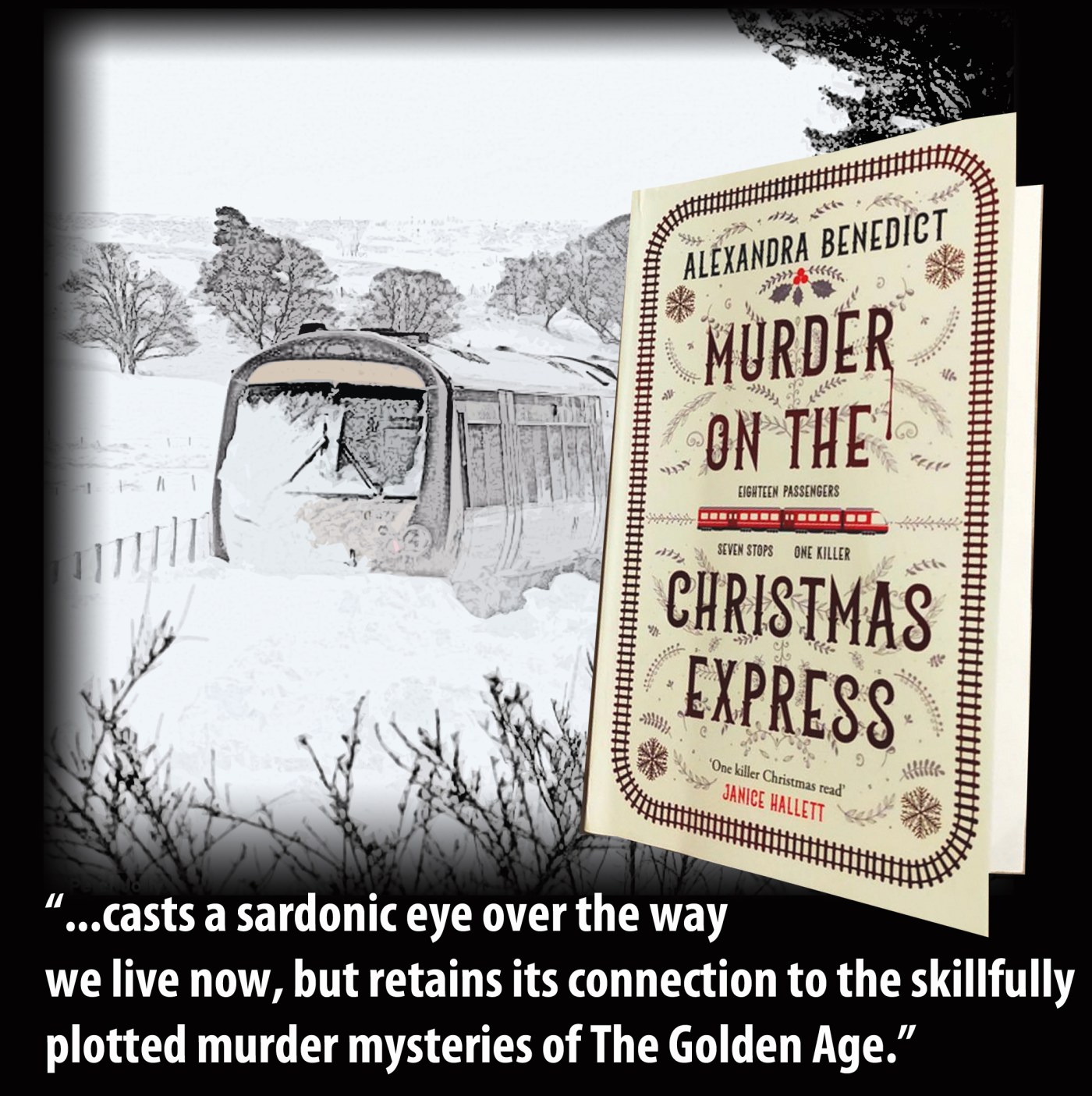
Needless to say, Roz Parker has to put aside her anxieties about her soon-to-be grandchild, and find out who killed Meg, a woman who may have been the most insubstantial of role-models, but was still a human being who deserves justice. Murder on the Christmas Express casts a sardonic eye over the way we live now, throwing in a conception-by-sperm donor for Roz’s daughter, and a sapiosexual love affair (look it up – I had to) while retaining its connection to the skillfully plotted murder mysteries of The Golden Age. For good measure, the author throws in some additional quiz attractions such as embedding the titles of Kate Bush songs in the narrative, and sprinkling some anagrams of her favourite poems and stories within the text. This entertaining novel is published by Simon and Schuster and is available now.


THE CHRISTMAS APPEAL . . . Between the covers

Appeal spine

Screen Shot 2023-11-04 at 19.22.52

Janice Hallett (left) invites us to return to the idyllic village of Lower Lockwood, where her book The Appeal (2021) was set. Then, law students Charlotte Holroyd and Femi Hassan solved a particularly nasty murder but, goodness me, murder seems to haunt Lower Lockwood rather as it does the unfortunate community of Midsomer, and so they are back again when another corpse is found, threatening the production of the annual village panto. Was ever a production of Jack and The Beanstalk so fraught with difficulties?

Our two sleuths (now fully qualified) spend little time on their hands and knees with magnifying glasses looking for minute physical traces which may betray the assailant; rather, they sit in front of their smartphones, perusing emails, WhatsApp messages, texts and other communications floating around in the digital ether. The clues are all there and, unlike the ancient trope of detectives trying to read messages from letters hastily burnt in fireplaces, these words can never be totally erased.
Text044

This novella is inventively set up with little or no conventional narrative and makes extensive use of graphics representing WhatsApp messages (above) and emails which are now known as  ’round-robins’. Being an old pedant, I have to say that this is a misuse of the expression, as the dictionary says:
Screen Shot 2023-11-05 at 18.30.05

The term has come to be used to describe emails cc-d to multiple recipients, and those awful little printed slips inside Christmas cards telling  friends (not for much longer, if I get them) all the wonderful things that have been happening to the sender’s family since the last Christmas card. Janice Hallett, by the way, makes fun of these dreadful things from the word go.

spoof2046

But I digress. You will either love the set up of the story, or hate it. I enjoyed it while it lasted – just 187 pages – but I suspect it wouldn’t work in a longer book.

The story begins when Charlotte and Femi receive a massive folder (all digital of course) of evidence from their former mentor, Roderick Tanner KC. The folder contains transcriptions of police interviews and copies of all communications between those involved when a long-dead body in a Santa Suit was found hidden in a giant beanstalk prop – made mostly of wood, papiermâché and, heaven forfend, possible traces of asbestos. The beanstalk was constructed years previously for a production of the play, and so this is the coldest of cold cases. The mystery is solved as Charlotte and Femi pick up the hints from the emails, texts and messages, but along the way, Janice Hallett takes the you-know-what out of some of the more insufferable pretensions in modern society (below).

Spoof

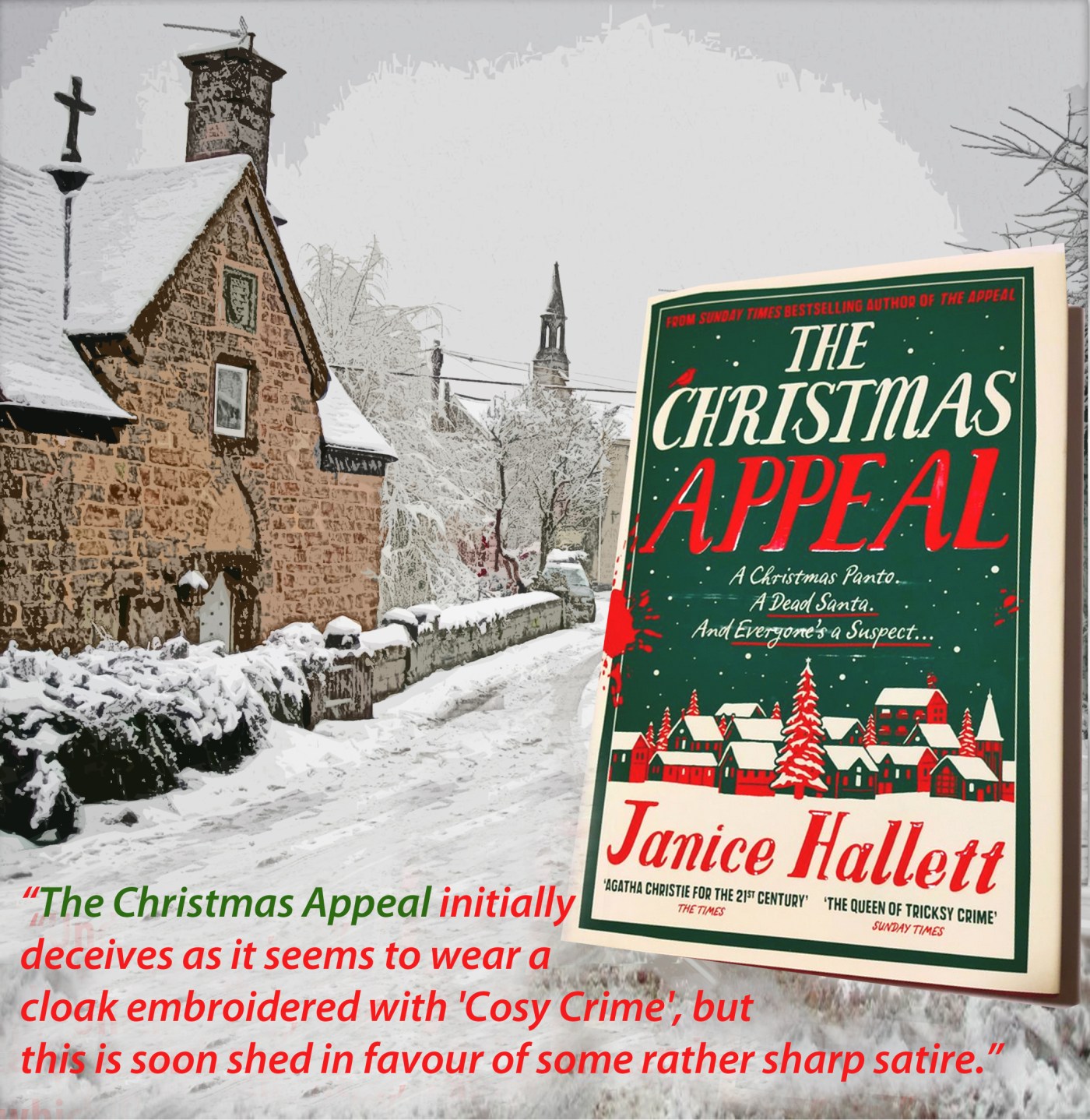
The Christmas Appeal initially deceives as it seems to wear a cloak embroidered with ‘Cosy Crime’, but this is soon shed in favour of some rather sharp satire. It has wit, charm and flair and is published by Viper. It is available now.

THE RAGING STORM . . . Between the covers

RS spine

Ann Cleeves introduced us to Detective Matthew Venn in The Long Call (2019). Police officers in crime fiction are ten-a-penny, so writers strive to make their creations a bit different, or to have what marketing people call a USP. Venn is married to a creative arts chap called Jonathan. This is, to say the least, an unusual circumstance in the rugged North Devon fishing village of Greystone, where he goes to investigate the mysterious death of a media-savvy – and much televised –  adventurer and sailor called Jem Rosco. Venn is, however, no stranger to Greystone. It is where he was brought up as a member of an exclusive group of evangelical Christians called The Barum Brethren.

Rosco has turned up in Greystone, more or less out of nowhere, although the villagers have seen him often enough on their TV screens. After a few weeks of holding court in the village pub – The Maiden’s Prayer –  Rosco disappears, but is then found dead in a little boat anchored just off-shore, in a violent storm. The local RNLI bring his body back, and then his demise becomes a case for Matthew Venn, based in Barnstaple, the largest town in the area.

This is certainly not one of those ‘murder comes to seaside idyll’ stories. Greystone is a grim little village which is frequently battered by the weather. For Its residents life is something of a struggle; there are few amenities, and employment is hard to come by. With all the skill she displays in her other  novels set by the sea, Ann Cleeves allows the village to develop a rather forbidding character all of its own.

There are several well-drawn local characters, all of whom Venn is forced to consider as he tries to answer the age old question about a mysterious death – “Cui Bono?“. Pub landlord Harry Carter may be every bit of the jovial ‘mine host’ he appears to be, but do shady financial dealings in his past bring him into the web of suspects? Mary Ford is the first woman to be skipper of the local lifeboat, but her life is shot through with anxiety over the future of her son who suffers from a degenerative disease. As a teenager, she had an unrequited passion for Jem Rosco, so has his re-emergence in the village triggered an act of revenge for past slights? Barty Lawson, alcoholic Commodore of the nearby Morrisham Yacht Club,  has bitter memories of the days when Rosco – irreverent, mocking and disrespectful – used his celebrity to belittle him. The hint of an old romance between Rosco and Lawson’s wife Eleanor has further soured the man’s mind but, in a rare sober moment, was he capable of engineering the complex piece of theatre which appears to have framed the discovery of the sailor’s body?

When Lawson’s body is later found shattered at the foot of a towering cliff, Venn wonders if this was the final act of a guilty man, but Ann Cleeve provides a solution to the mystery that is much more elegant – and unexpected.  The Raging Storm is, on one level, a standard whodunnit, and sticks to the standard framework of a police procedural novel, but it is shot through with subtle characterisations, clever plot twists and an abiding sense of deep unease. Published by MacMillan, the book is available now.

DIG TW0 GRAVES . . . Between the covers

DTG spine007 copy

I thoroughly enjoyed an earlier book in the series, and you can click the image below for the link.

Temenos

I mention this, because Dig Two Graves begins literally as the final scene of The Temenos Remains fades out. We are in Norfolk and crime fiction buffs will know that this is no rural idyll; readers of Jim Kelly’s Peter Shaw series – and the excellent Ruth Galloway novels by Elly Griffiths – will be well aware that away from the “Chelsea-On-Sea” second homes of North Norfolk and the gentle downlands beyond Sandringham, Norwich and Great Yarmouth provide, to adapt the immortal words of Ben Obi-Wan Kenobi, as wretched a hive of scum and villainy as one could wish to experience.

The “scum and villainy” in this case are provided by the brutal Lithuanian gangsters Constantin Gabrys and his psychopathic son Mica. As a local, Heather Peck will be only too cogniscant of the fact that Freedom of Movement in the dark days of EU membership brought tens of thousands of Eastern Europeans to the area to pick and process the food crops on which we all rely; like many others, she will also know that with the decent folk came gangsters, drug barons and people-traffickers, and this is the background to this novel.

DCI Greg Geldard and his team have found a Romanian woman – Madame Trieste, real name Adrianne Laurientiu – brutally murdered. The killers, in no particular order, have crucified the nail-bar owner, cut her throat, and made her swallow her own eyeballs The first police officer on the scene, DI Sarah Laurence has been abducted by the killers. The search for Sarah Laurence and the determination to bring her captors to justice drives the police on, and provides us with an excellent read.

I finished this excellent novel in just two sessions, and that should tell you that it is a genuine page-turner. My rather weather-beaten maxim for judging crime novels is in the shape of a question – do we care about the principal characters in the novel? Here, I can deliver a resounding ‘Yes!”. Geldard is thoroughly human and believable, and it doesn’t hurt that he his “significant other” is colleague DS Chris Matthews. Heather Peck doesn’t make a meal of this relationship, but she makes us aware that the police top brass are not entirely in favour. Peck resolves the problem, rather delightfully, in the last few paragraphs.

Dig Two Graves is a superior police procedural that rattles on at a breathtaking pace, and features genuinely vile criminals pursued by well-observed and authentic coppers. It was published by Ormesby Publishing on 28th June.

THE GENIUS KILLER . . . Between the covers

TGKspine011

The central character of this novel is Karl Jackson. He has survived a brutal upbringing punctuated with savage beatings by his drunken father, and sexual abuse from his uncle Charlie. Karl has a twin, Nathan,  but he never faced the same storm of violent rage. Karl Jackson is described in the cover blurb as a sociopath. I am no psychologist, but Jackson’s steady job as a chemistry teacher and his scrupulous and well-planned crimes make me think he is more psychopathic, but it does not matter. He is a genuinely awful human being. His spree of undetected killings started in his childhood when, merely for the fun of it, he pushed a young boy – fishing in the lake where they played – down into the water, and then watched with amusement as the lad struggled, choked, and then bobbed about on the surface as lifeless as the float attached to his fishing line.

Jackson’s genius (hence the title of the book) is to organise killings in such a way that no possible evidence can link the deaths to him. While Jackson was working as a student in Australia, one of his murders involved the ingenious combination of a sleeping bag, a sedative injection and a deadly Brown Snake on a hiking trail in the Blue Mountain region of New South Wales. Jackson exacts an elaborate – and some may say justified – revenge on his father by causing the old man’s death in hospital with a very clever use of cyanide and the sharpened end of a coat hanger.

The background to this novel is the atmospheric landscape of the English Lake District, where Jackson carries out another long delayed act of retribution on his abusive uncle Charlie by faking an accidental climbing death. When Charlie is found dead at the bottom of a solo climb, his head shattered like a melon hit with a hammer, no one believes it is anything other than an unfortunate error of judgement.

Thus far, Jackson has been clever enough to avoid any attention from the police but, inevitably, he meets his nemesis. Theodore “Tex” Deacon is a late career – but distinguished – detective slowly recovering from the trauma caused by the protracted death of his wife. As is the way with institutions these days, he is temporarily sidelined and identified as a vulnerable person in need of psychological help and treatment by the ubiquitous counselling profession. However, his many successes in tracking down murderers brings him to the attention of Debbie Pilkington, an ambitious young reporter with a local Lakeland newspaper. She alerts him to the many coincidences surrounding deaths in the Jackson family, and so he goes off piste to investigate the case.

Black humour is never very far away in this book, despite the body count. Here, Karl Jackson describes the man who is having an affair with his wife.

“Richard Turkington’s graying Beatle cut had a bald spot on top giving him the appearance of a rock star monk. A fleshy roll wobbled over the top of his chinos. Turkington had clearly ignored warning signs of middle age and had lived a pudgy existence preferring a world of pints and puddings. Quite a contrast to the sleek wire framed fell runners surrounded by them at a function like this. Richard looked like Mr Blobby.”

The Genius Killer rattles along at great pace and is sometimes darkly comic, but in Jackson, the author has created a genuine larger-than-life monster. The book ends rather enigmatically, but as it is described as No.1 in the Tex Deacon series, I suspect the Cumbrian copper will be back soon with another case. Mark Robson is a sports journalist and this is his debut novel. It is published by Orla Kelly Publishing and available now.

THE ROOM WITH EIGHT WINDOWS . . . Between the covers

8windows header

December 1930. Henry Johnstone, a former Detective Chief Inspector with the Metropolitan Police, has been forced to resign due to a debilitating injury. Now, he ekes out a solitary existence in a crumbling Brighton house, empty except for a large library assembled by the former owner, the late Sir Eamon Barry. Johnstone’s task – one given to him by a friend, concerned about his mental state – is to catalogue the thousands of books in the library. He is convinced he is being stalked, perhaps by someone linked to an old case. Then, he disappears. We know how – if not why – but his friends, among them his sister Cynthia and his former Sergeant Mickey Hitchens, are left with few clues, but one – left behind by Johnstone – suggests there is a link to a mysterious death and disappearance five years earlier.

When Johnstone is eventually found, he has been beaten within an inch of his life by a criminal gang, and is in no fit state to help the investigation into what seems to be a brutal and very well organised smuggling cartel. England’s south coast has been the backdrop for smuggling for centuries. I am reminded of the romantic lines of Kipling:

“If you wake at midnight, and hear a horse’s feet,
Don’t go drawing back the blind, or looking in the street,
Them that ask no questions isn’t told a lie. Watch the wall my darling while the Gentlemen go by.
Five and twenty ponies,
Trotting through the dark –
Brandy for the Parson, ‘Baccy for the Clerk.
Laces for a lady; letters for a spy,
And watch the wall my darling while the Gentlemen go by!”

These days, sadly, the smugglers don’t tend to deal in the traditional commodities of brandy and tobacco, but in the more profitable contraband of human lives. I would like to think that back in the day, the profiteers were not aided and abetted by the historical equivalent of the RNLI and the Border Force, but that is a debate for another day As Henry Johnstone slowly recovers his strength, Hitchens – and his slightly odd (but learning something new every day) Sergeant Tibbs – eventually get to the root of the mystery, but not before more lives are lost.

As is only right and proper in novels set in the 1930s, Jane A Adams makes us aware that most of her protagonists have a shared history – that of The Great War. Those over the age of 35 will have either fought in that conflict or lost husbands and sons: Younger people will have fathers they will never see again, with only a marble gravestone somewhere in France as a far-away reminder of what they have lost.

The period details in The Room With Eight Windows are impressive and convincing, as are the quirks and foibles of the main characters. This excellent and atmospheric thriller will be published by Severn House on 4th July.

FLESH AND BLOOD . . . Between the covers

FABheader

This is book number eleven in the series, so a quick heads-up for new readers.
Time: the present
Place: Humberside
Main characters: Detective Inspector (recently promoted from DS) Aector McAvoy. He is a Scot, huge and bear-like, a gentle soul but a formidable copper. His wife Roisin; she is of Irish Gypsy stock, romantic but fiercely protective of Aector and their children – Fin and Lilah. Detective Superintendent Patricia ‘Trish’ Pharoah, thirty years in the force, and as tough as nails. Trish and Aector worship each other, but it is a purely platonic relationship. McAvoy is on holiday with his family in the Lake District, living in a traditional Romany Vardo.

In this book:
Reuben Hollow, a serial killer, serving several life sentences for murdering people he judged as having escaped justice. He was captured by McAvoy. Detective Chief Superintendent George Earl. Promoted because Trish Pharoah turned down the job. Earl is the very model of a modern media friendly senior police officer:

Trish is not immune to the pleasures of the flesh, and she is in bed with an Icelandic copper she met on a course. Their post coital bliss is disturbed by Trish’s car alarm going off, and Thor Ingolfsson runs downstairs to investigate. He is attacked with an adze and left for dead. Thor happens to be a dead ringer for Aector, and when the local police arrive to find the man face down in the road, they put two and two together, and make seventeen. Aector is very much alive and well, however and, despite being told to stay well away by Earl, he is determined to find out what is going on. David Mark’s description of Earl will ring horribly true to anyone who has experienced senior management in corporate services in recent years:

“George Earl is a tall, slim, straight-backed careerist who exudes the gentle earnestness and Anglican-priest sincerity of a Tony Blair. He has a habit of clasping his hands together when he talks, and makes a great show of telling his staff that his door is always open, and there’s no such thing as a stupid question.”

David Mark spent years as a crime reporter for a regional newspaper, and so he is well aware of the depths of villainy which are regularly plumbed by apparently ordinary and innocuous men and women. He also knows that – despite graduate entry – some of the people who are accepted as police officers are not “the brightest and best of the sons of the morning.” (Activists – please feel free to substitute the gender of your choice)

“The three uniformed constables milling around at the rear….he’s noticed that none of them seem to be able to breathe through their nose. All in their twenties and look as though they would be more comfortable working in a phone shop or flogging gloriously chavtastic trainers in a sports shop.”

What follows is pure mayhem. A former police colleague of Trish Pharoah meets an elaborate death by wood-carving chisels, McAvoy narrowly escapes death by hanging, in an execution house probably last used by Albert Pierrepoint, the chaos of Trish Pharoah’s previous life is laid bare to the world, and our man emerges – not unscathed – but able to fight another day.

Flesh and Blood veers violently between the darkest noir imaginable and a simple – but affecting – poetry. It is published by Severn House and will be available on 6th June. The final sentence sums up this brilliant series:

“And inside McAvoy’s head, another voice joins the chorus of the dead.”

https://fullybooked2017.com/tag/david-mark/

THE FALL . . . Between the covers

FALL spine035

The Lancaut peninsula is a real place. It was created back in geological time when the River Wye made a spectacular loop on its way south to merge with the Severn. On the eastern bank is Gloucestershire, and to the west lies Monmouthshire and Wales. Gilly Macmillan has taken taken this rather special and ancient place, and used it as a backdrop for this intriguing thriller. The houses she describes – The Manor and The Barn –  do not exist, but the beautiful landscape certainly does.

Screen Shot 2023-05-22 at 19.59.40

The Barn is an ultra-modern glass and steel construction, something from a modern architect’s wildest dream. Rarely do building designers have a free reign, but when Tom and Nicole Booth won millions on the lottery, they were happy for the brutalist architects to let rip. In contrast, a couple of fields away, is The Manor. A crumbling jumble of genuine styles dating back to Tudor times, it is owned by Olly Palmer and his partner Sasha Dempsey. Olly is an aspiring novelist, perhaps the next literary ‘big thing’, while Sasha runs yoga classes in the The Manor’s former Great Hall. Aspiring (and perspiring) middle-class ladies are happy to pay over the odds to work on their Asana, Bandha and Chakra in such a historic environment.

Nicole returns to The Barn after a day out at a local agricultural show to find Tom dead, floating in their creatively designed swimming pool. The police are called, and Nicole seeks temporary refuge with Olly and Sasha while the emergency services do their thing. The obvious question is, ‘Who killed Tom Booth?”, but the answer to that is saved until very late in the book. Meanwhile we enjoy the frisson of each of the central characters unraveling, one strand at a time.

In addition to all the lies and gaslighting going on between the occupants of The Barn and The Manor, the modern house takes on a demonic life of its own, as Tom and Nicole were persuaded to install a complex AI system where everything – windows, doors, blinds, the sound system and security – all operate by voice command. Except (of course) they don’t, and this allows Gilly Macmillan licence to create all manner of horrors for Nicole, who is very much low-tech.

As with all good psychological thrillers set in domestic situations, no-one – save the two investigating coppers Hal Steen and Jen Walsh – is quite who they appear to be, particularly The Manor’s much put upon housekeeper Kitty, aka – well, that’s for you to discover, but her real identity is central to the story. I have to be honest and say that when I turn a page and see the chapter heading ‘Five Years Earlier’, I am tempted to throw the book down and consign it to the charity shop. I hate split time narratives, but I confess that Gilly Macmillan makes it work here, probably because she uses the device sparingly.

There are enough ironic twists in this story of deception and violent death to earn a benevolent smile from Thomas Hardy as he gazes down from his seat with The Immortals, and I particularly liked the way the pesky voice controlled system in The Barn is used to commit a rather clever murder. The Fall is published by Century and is out on 25th May.

Blog at WordPress.com.

Up ↑