

I reviewed an earlier book in this series, Final Term, in January 2023 and thoroughly enjoyed it, so it was good to become reacquainted with York copper, DI Geraldine Steel. Revenge Killing is a little bit different in that DI Steel is off on maternity leave. As much as she loves baby Tom, she is feeling very much out of the loop in terms of her police career. When her friend and colleague DI Ariadne Moralis asks for her advice, she leaps at the chance to help.
Moralis has a complete puzzle of a case on her hands. Initially, her husband – Greek, like Ariadne – has been visited by a friend and compatriot called Yiannis Karalis. Yiannis owns a property where one of the tenants – a small time drug dealer called Jay Roper – has been found dead at the foot of the stairs leading up to his flat. Ariadne assures him that he has nothing to worry about, but when the post mortem examination reveals that Jay was suffocated, things become more complicated.
Ariadne discovers that Yiannis is something of a fugitive, as he fled Greece during the fallout from the murder of his older brother and a subsequent vengeance death. Did he visit Jay to remonstrate with him about the drug dealing? Did the visit turn violent. One of Jay’s girlfriends, Lauren Shaw, has gone missing. What does she know? Another girlfriend, Carly, who works in what is euphemistically known as a gentleman’s club, is located, and she is completely antagonistic towards the police. Despite claiming that she and Jay had an ‘open’ relationship, was jealousy simmering just below the surface, and did she kill Jay on the grounds that if she couldn’t have him, no-one else would?
Leigh Russell cleverly lets us spend some time with Lauren, who has panicked. We know. from the early pages of the book that she and Jay had a blazing row which ended in him falling down the stairs. Now, terrified that the police will blame her for his death, she goes on the run, and we share her misery as she her meagre savings run out, and she discovers that life on the streets is miserable and dangerous.
Revenge Killing is, at its heart, an excellent and engaging police procedural, but Leigh Russell has an intriguing little subtext ticking away in the background, and it centres on Geraldine’s misgivings about her life trajectory. She dutifully attends a mothers and toddlers group, but feels only alienation:
“But the other mothers at the toddler group had never dealt with murder investigations in the real world. None of them had watched a post-mortem, knowing the cold flesh on the slab had once been a living breathing human being, whose life had been snatched away by someone in the grip of an evil passion. The other mothers had never learned to close their minds to the horrors of every day human brutality, so shock couldn’t prevent them from doing the job. Gazing at the cheerful faces around her, she regretted her choice of career and wished her life could be as simple as it was for the other women in the room. But her experience had cut her adrift from these chattering young women, with their sheltered upbringing and cosseted lives. They discussed their various tribulations as the infants crawled or toddled around the room, or sat propped up watching warily, like Tom.”
As with all good whodunnits, we are presented with just the right blend of surprise at the identity of the killer, and a few helpful nudges to point us in the right direction. Revenge Killing is published by No Exit Press and is available now.


 If the tags “Oxford”, “Murder” and “Detective” have you salivating about the prospect of real ale in ancient pubs, choirs rehearsing madrigals in college chapels, and the sleuth nursing a glass of single malt while he listens to Mozart on his stereo system, then you should look away now. Simon Mason (left) brings us an Oxford that is very real, and very now. The homeless shiver on their cardboard sleeping mats in deserted graveyards, and the most startling contrast is the sight of Range Rovers and high-end Volvos cruising into car washes manned by numerous illegal immigrants from God-knows-where, all controlled by criminals, probably embedded within the Albanian mafia.



 Alfred Edward Lewis was born in Stretford, Manchester on 15th January 1940, but in 1946 the family moved to Barton upon Humber. Five years later, Lewis passed his 11+ and began attending the town’s grammar school. There, he was fortunate enough to come under the influence of an English teacher called Henry Treece. Treece was born in Staffordshire, but had moved to Lincolnshire in 1939, and although he ‘did his bit’ as an RAF intelligence officer, he was able to make his name during the war years as a poet.
 After leaving the college, it seemed that Lewis was going to make his way as an artist and illustrator, and a book written by Alan Delgado, variously called The Hot Water Bottle Mystery or The Very Hot Water Bottle, can be had these days for not very much money, and the description on seller sites usually adds “Illustrated by Edward Lewis”. That was the first serious money Ted ever made. He moved to London in the early 1960s to further his prospects.
 His first published novel was All the Way Home and All the Night Through (1965) and it is a semi-autobiographical account of the lives and loves of art students in Hull. I remember borrowing it from the local library not long after it came out and, looking back, it was a far cry from the novels that would make Lewis’s fame and fortune.
  of the finest British films ever made. It was released in March 1970, and Lewis is credited, along with director Mike Hodges, with the screenplay. Incidentally, a hardback first edition of JRH can be yours – a snip at just £3,250 (admittedly with a hand-written note by the author)
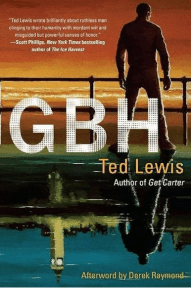 believe to be his finest was GBH, published in 1980. Here, he unequivocally returns to Lincolnshire, and a bleak and down-beat out-of-season seaside town which is obviously Mablethorpe. The central character is George Fowler, a mobster who has made a living out of distributing porn movies, but has crossed the wrong people, and needs somewhere to hide up for a while. Rather like his creator, Fowler is in the darkest of dark places, and the novel ends in brutal and surreal fashion on a deserted Lincolnshire beach, with the wind howling in from the north sea as Fowler meets his maker in the remains of an RAF bombing target.





 fullybooked2017