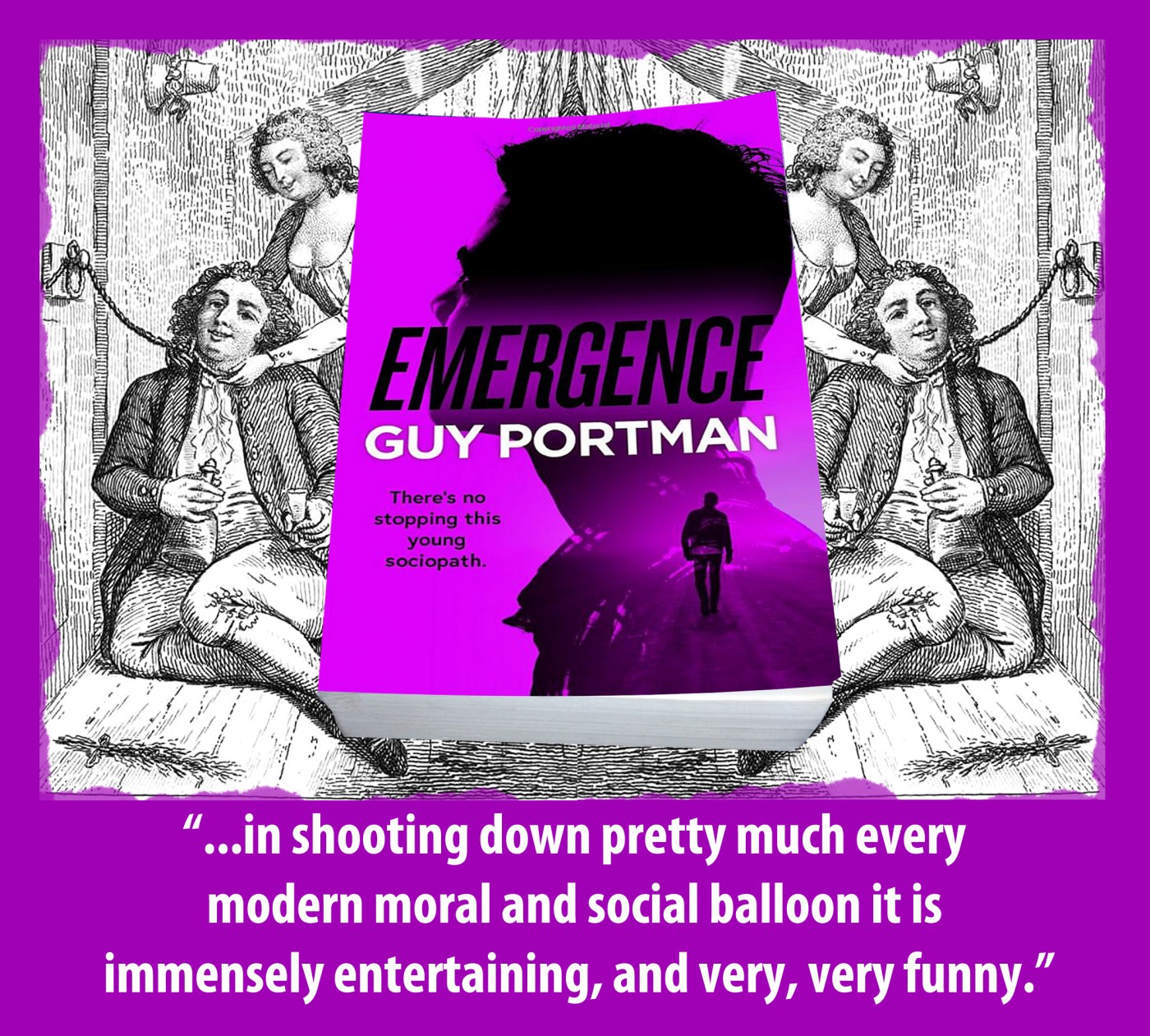

It has been a while since I read a Guy Portman novel. The last one I read was Golgotha, back in 2019, and clicking the link will take you to my review. That saw the demise of his wonderfully incorrect anti-hero Dyson Devereux, but now he introduces us to someone who might be a teenage version of DD. Horatio Robinson is clearly “on the spectrum”, as Special Educational Needs and Disabilities teachers might say. I confess to having Googled that to make sure it was still the ‘correct’ term as, having been out of schools for ten years, I wondered if the terminology had mutated into something more flowery and Californian.
Horatio is fixated with Trigonometry, reads French dictionaries and Dickens to relax, and has a visceral hatred of his mother’s boyfriend – an absolute oik called Brendan. Horatio’s mother – Rakesha – is from Antigua, but his father fled the scene when Horatio was five. Horatio is busy applying his love of sine, cosine and tangent in an art lesson, after the teacher sets the class the task of producing a completely symmetrical design. When the class bully – Dominic – damages Horatio’s work, Horatio – as you do – picks up a pair of scissors and impales Dominic’s hand to the desk. He is, of course, immediately suspended from school and, as part of the process, has to visit a counsellor. I don’t know what contact Guy Portman has had with these people but, from my experience, his version is chillingly authentic. Horatio, by the way, narrates the story:
“She does more talking, much more. She asks some questions. The spikey hair, grinning and whiny voice is terrible combination. And she keeps leaning towards me, close enough that I could smack her in the face.
‘I’ve heard about your issue at school. Could you tell me in your own words what happened?’
‘No.’
‘Well, it would be really helpful if you could.’
‘Helpful for whom?’ ‘
‘Well, you, of course.’
She’s grinning again.”
It took me a while to twig that Horatio’s absent father is, of course, none other than than Dyson Devereux himself. Horatio, permanently excluded from his school, now has time on his hands to perfect a way of ridding his world of the loathsome Brendan. After getting chased out his local library for researching (in the interests of science) Erotic Auto-Asphxiation, he concocts a complex plan which he hopes will remove Brendan in a way that will also shame the dead man, while in no way linking the crime to himself.
Portman says:
“I have always been an introverted creature with an insatiable appetite for knowledge, and a sardonic sense of humour. Throughout a childhood in London spent watching cold war propaganda gems such as He Man, an adolescence confined in various institutions, and a career that has encompassed stints in academic research and the sports industry, I have been a keen if somewhat cynical social observer.”
This cynicism is a sheer delight, especially to readers who, like me, cast a jaundiced eye over our descent into a progressive madness, typified by those in ‘public service’ who thoughtlessly espouse every insane social fad imported from America. Portman chooses his targets well in this novel. ‘Woke’ teachers, failed psychologists masquerading as counsellors, and the frequently dystopian world of mothers deserted by fathers, and the often calamitous consequences for the children of that disunion, all come under fire. Portman turns over a heavy stone, and all kinds of nasty creatures scuttle away to avoid the light of day. Emergence may be a polemic, but in shooting down pretty much every modern moral and social balloon it is immensely entertaining, and very, very funny. It is out now.


 n a fictional world overflowing with disfunctional detectives who happen to be rather good at their jobs, Joseph Knox has raised, or perhaps lowered, the bar considerably with his DC Aidan Waits. We first met Waits in
  Together with his grotesque partner and immediate boss, DI Peter Sutcliffe, Waits always gets the shitty end of the stick. ‘Sutty’ Sutcliffe is, you might say, a good old fashioned copper. Waits goes to meet him in a dingy rock-and-roll boozer:
 hy is Aidan Waits such a tortured character? Well, how long have you got? His childhood was loveless and chaotic, and spent largely in institutions where he rubbed shoulders with trainee failures, malcontents and killers. Echoing Nietzsche’s chilling remarks about the moral abyss, Waits has, more recently, gazed too long into a chasm inhabited by a repellent Manchester crime lord called Zane Carver. Carver has fed Waits’s drug habit, and the two have fought over women. Carver has a particular talent with women:
 s distinctive as Knox is as a stylist, and as much as he is a master of the inky black metaphor, he has a tale to tell and a plot to spin. The sepulchral calm of Martin Wick’s closely guarded hospital room is shattered by a savage attack which Waits survives, but puts him at the head of the queue as the police and the gutter press search for scapegoats. With Carver having decided to exact revenge on Waits by donning his black cap and pronounced the death sentence, Waits is on the run both from the gangster and, no less implacably, his politically motivated senior officers, but he keeps them at bay. He discovers faint-but-fatal fault lines in the original case against Martin Wicks, and finds that both Kevin Blake, the detective who brought Wicks to justice, and Frank Moore, the father of the murdered children, still have songs to sing.
 Joseph Knox writes like an angel. Possibly an Angel of Death, but he grasps the spluttering torch of English Noir once carried by such writers as Derek Raymond, and runs with such vigour that the flame burns brightly once again. He is not without humour, and there are many – if unrepeatable – gags exchanged between the cynical cops and their low-life prey. The politically correct nature of modern policing doesn’t escape his attention, either:
 nox has his grim fun with a Manchester police force that is barely honest, city down-and-outs who have lost most of the trappings of humanity, and an infestation of tattooed, Spice-addicted thugs straight from Central Casting – with Hieronymus Bosch as the agency’s head of HR. He also leaves us with a delightfully enigmatic final few pages. The Sleepwalker is published by Doubleday and will be


 fullybooked2017