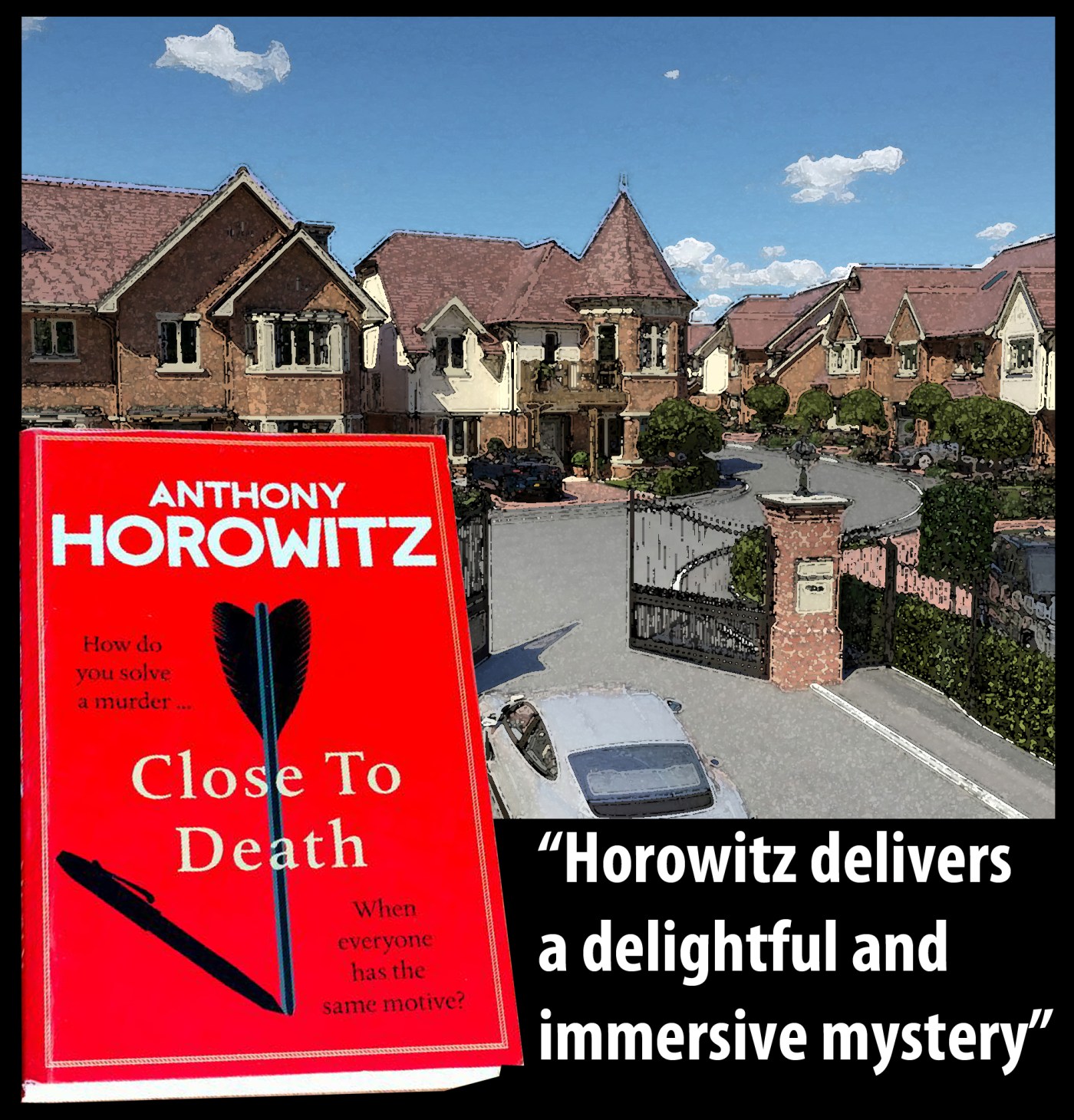

This series of novels has a unique concept. The author appears, more or less, as himself. We briefly meet his agent, his wife and his editor, while we learn about his hits and misses, both as a screenwriter, playwright and with his re-imagining of James Bond. When fiction appears, it is in the shape of an enigmatic former Metropolitan Police officer, Daniel Hawthorne. He was dismissed from the force after an ‘unfortunate accident’ happened to a deeply malevolent paedophile who was in police custody. Since then he has gone freelance, and has been instrumental in solving several high profile murder cases, working as an ‘advisor’ to the police. The four previous books in the series have Hawthorne investigating crimes, with Horowitz chronicling the events. I reviewed The Sentence is Death, and The Word Is Murder. Click the links to read what I thought.
This time things are slightly different. Horowitz has a deadline for a fifth book, is all out of ideas, and he hasn’t seen Hawthorne for ages. When he does find him, the former copper will only play ball by allowing a past case to be used, and he will co-operate by giving Horowitz the case notes – but just one packet at a time.
The murder was that of a hedge fund manager who was found dead in his house with a crossbow bolt through his throat. The house was one of six in Riverview Close (hence the novel’s title) in Richmond, South London. The little estate is self contained and with just the one security gate, so what we have here is not a locked room mystery, but a locked estate mystery. The residents are:
Adam Strauss and his wife Teri. Strauss is a former TV personality, but is now a professional chess player. Their house is called The Stables.
In Well House lives Andrew Pennington. He is retires, a widower and was once a well respected barrister.
May Winslow and Phyllis Moore are elderly ladies who share The Gables. They were both once nuns, and they run a little bookshop that specialises in Golden Age crime fiction.
Woodlands is the home of Roderick and Felicity Browne. He is a wealthy dentist, known as ‘dentist to the stars’ for his clientele of showbiz celebrities. Felicity has a degenerative disease and is mostly housebound.
Tom and Gemma Beresford live in Gardener’s Cottage. He is a local GP, while she has a high profile business making designer jewellery.
Finally, at Riverview Lodge we have the man on whose death this book centres. Giles Kenworthy is an old Etonian who, apparently makes a great deal of money in the city. He met his wife Lynda when she was an flight attendant on one of his overseas trips. They have two very boisterous boys, and several cars, which they tend to park with little consideration for the other people in the Close.
Kenworthy has also put in for planning position for a swimming pool and changing facility which the other residents believe will completely devalue the Close. Quiet words, along the lines of, “I say old chap, would you mind ….?” have had no effect whatever, and so a ‘clear the air’ meeting is called for everyone, but the Kenworthys don’t show up.
When Kenworthy is found murdered, it is quickly established by the Metropolitan Police, led by Detective Superintendent Tariq Khan, that the murder weapon was a crossbow belonging to Roderick Browne who, however, is mystified by how anyone could have broken into his garage and stolen the weapon. Khan is persuaded to engage the services of Hawthorne and his assistant, a man called John Dudley.
At this point, I should step away slightly and explain the complex structure of the story. It operates with different time frames and narrators. There is the author’s ‘now’ (actually 2019) where he describes his increasingly difficult relationship with Hawthorne, and the pressure he is under to complete the book. The main events in Riverview Close take place in the summer of 2014, and we observe these through the eyes of the inhabitants, but we are also a fly on the wall during the police investigation, and some of the subsequent work, independently, of Hawthorne and Dudley.
If this sounds complicated, it’s because it is. One of the little ironies is that at one point during the book Horowitz describes how he is not drawn to the fantastical nature of many classic locked room mysteries, but he has Hawthorn deliver a splendid speech when he, Dudley and Khan believe they are about the unmask the killer:
“What I’ve realised, since I arrived at Riverview close, is that nothing here is what it seems. Nothing! Every clue, every suspect, every question, every answer … It’s all been carefully worked out. Everyone who lives here has been manipulated too. So have you. So have. Something happens and you think that it somehow connects with the murder – but you’re wrong. it’s been designed to trick you. Smoke and bloody mirrors. I’ve never seen anything like it.”
Bottom line. For all its complexity and elaborate narrative framework, does Close to Death work? Yes, of course. Horowitz is too good a writer to trip up, and – as ever – he delivers a delightful and immersive mystery. The book is published by Century and will be out on 11th April.

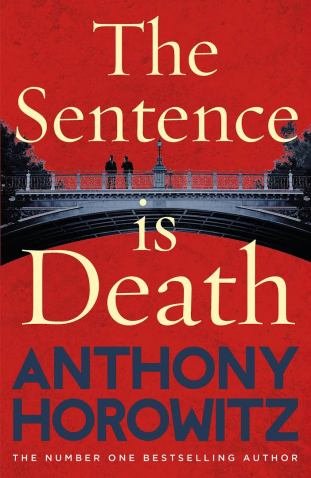 For those of you who are unfamiliar with the first book in this series, The Word Is Murder (and you can read my review
  The abundance of questions will give away the fact that this is a tremendous whodunnit. Horowitz (right) tugs his forelock in the direction of the great masters of the genre and, while we don’t quite have the denouement in the library, we have a bewildering trail of red herrings before the dazzling final exposition. But there is more. Much, much more. Horowitz’s portrayal of himself is beautifully done. I have only once brushed shoulders with the gentleman at a publisher’s bash, so I don’t know if the self-effacing tone is accurate, but it is warm and convincing. More than once he finds himself the earnest but dull Watson to Hawthorne’s ridiculously clever Holmes.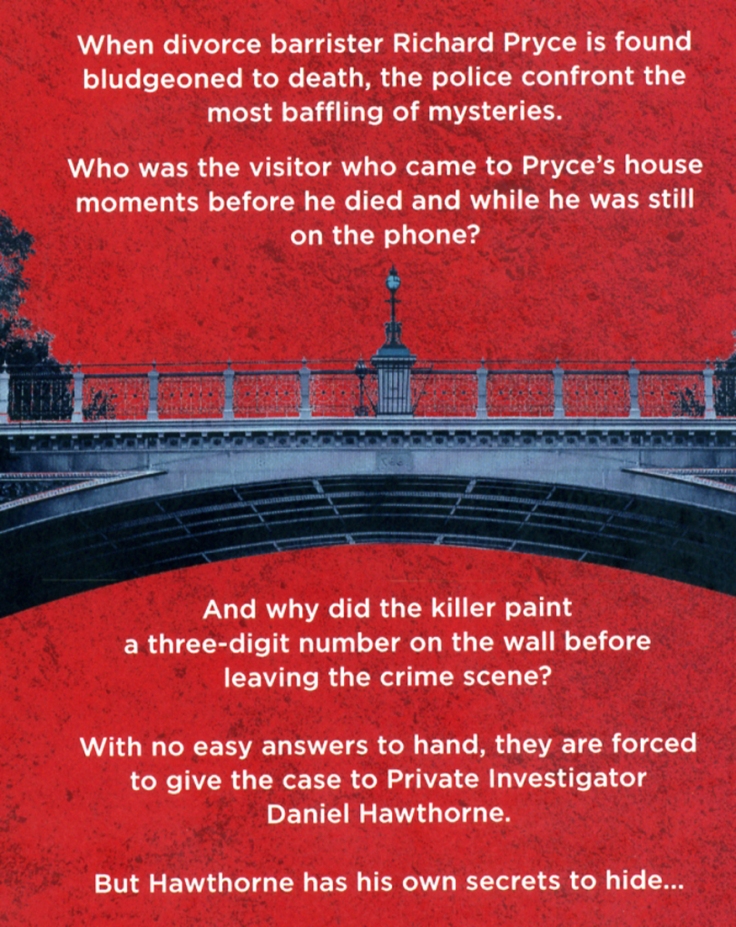


 fullybooked2017