
Search

fullybooked2017

Tag

American Crime Fiction

IF A FACE COULD KILL . . . Between the covers

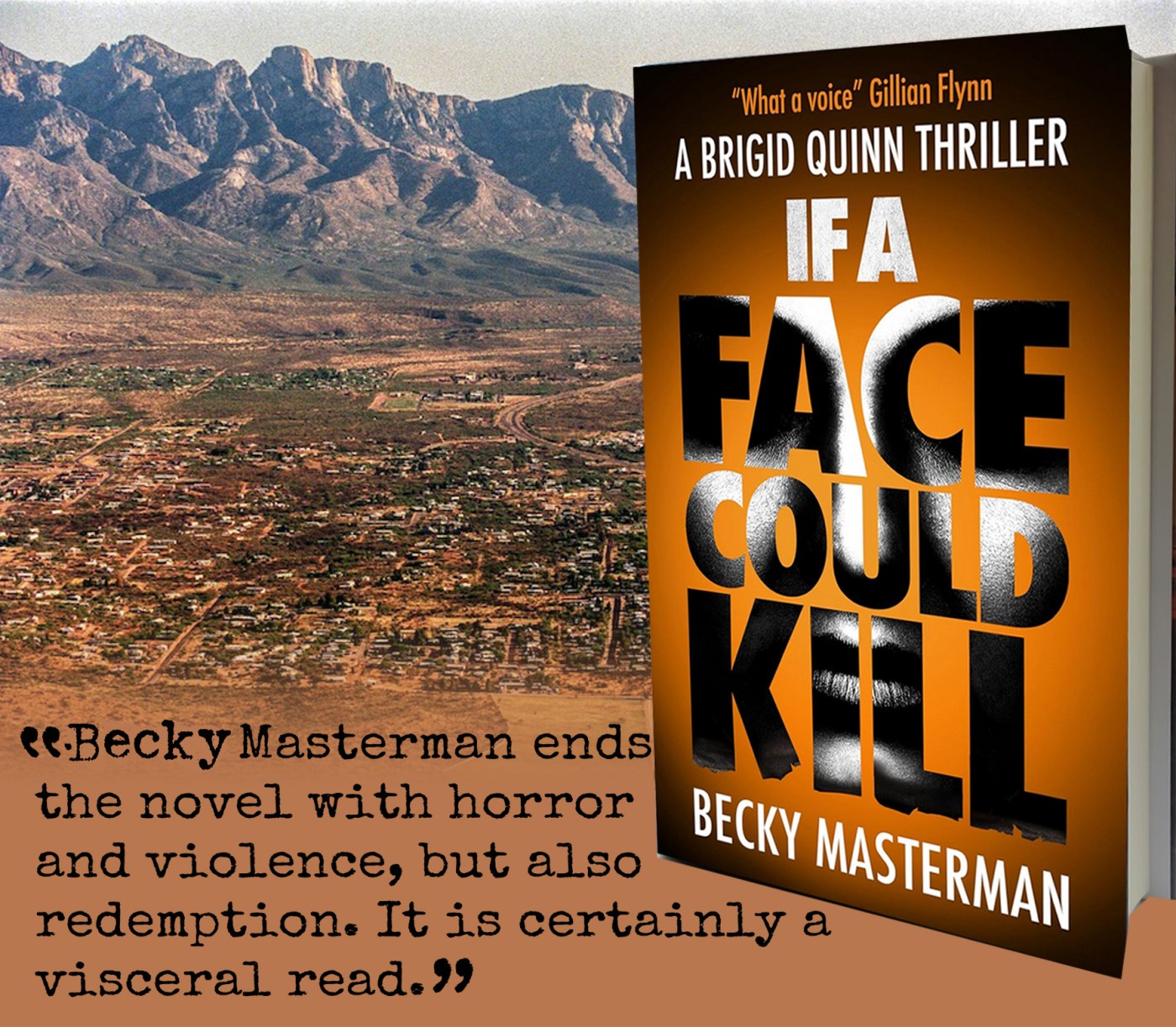
Brigid Quinn is a former FBI agent. She and her husband Carlo have retired to the rural community of Catalina in Arizona. At the end of their street is a property used by the authorities to house paroled offenders, one whom is a woman called Nicki, who went down for manslaughter after killing her abusive husband. The book begins with a botched burglary at this group house, which ends when the hapless was shot dead by a SWAT team after they were alerted by a 911 call from Nicki.After she retired from the FBI Brigid volunteered at Desert Doves, a refuge for victims of domestic violence, which is where she met the traumatised Nicki Gleason. There, she taught Nicki the basics of self defence, and it was that knowledge which resulted in jury foreman stating:

We find Nicole Gleason guilty of one count of involuntary manslaughter, your Honor.”

One of Brigid’s neighbours, an unpleasant busybody called Dorita, is organising a petition to have the occupants housed elsewhere. Dorita is as unpleasant looking as her behaviour is ugly:

“It struck me that her large face wasn’t so much like the Red Queen’s as like a painting of Martin Luther..”

Dorita and Brigid are destined not to get on well together, but the neighbourhood spat ends violently when Dorita is found dead in her garden. It seems as though she has been held down in a barbecue fire pit. Face down. The result is graphically not pretty, but then there are few beautiful people in this novel.
This is Nikki’s probation officer/mentor:

“She was the ugliest butterfly you’d ever seen, startlingly ugly. She didn’t have a moustache, but it wouldn’t have surprised me.A long, gaunt face with uncooked dumplings under her eyes to make up for the lack of flesh elsewhere. Her lipstick appeared to be a gallant attempt at redeeming her face, but even that failed as the shade contrasted severely with the colors in her top. An overbite. That was my three-second observation, but I don’t think I’m missing anything.”

For those who enjoy such things, we witness the exquisitely grisly autopsy on poor Dorita Gordano. She was killed by blunt force trauma to the face, and a gasoline soaked plug of rag was forced into her throat. The facial burning was clearly post mortem, and some kind of statement. But of what, and by whom? Neither does Becky Masterman spare us the details of what a vile specimen Nicki’s husband was. Vincent was obsessed with video games to the extent that one afternoon, anxious to get to his games console, he left daughter Ramona strapped into her car seat one blazing Arizona afternoon. He was also casually brutal about where he stubbed out his cigarettes. There is, obviously, a broader moral argument about whether such men deserve to be killed with a two litre vodka bottle, but this book is crime fiction, not a philosophical treatise, so we can roll with it.

After some humming and hahing, the local police, led by Sheriff Max Coyote, a former friend of Brigid’s (they have fallen out, big time) decide that Nicki is a person of interest in the murder of Dorita Gordano. The pathologist believes that the initial injuries to Dorita’s face were caused by a large concrete block, and in the garden of the group house is a recently built wall. And one of the concrete blocks bears blood traces.

Masterman’s prose is as sharp as tacks. Sometimes, American CriFi can be too slick, too polished, and too predictable. Quinn’s observations are frequently acerbic, and scatter broken glass for us to tread on. Here, she catches the over-effusive Eleanore Turner in an unguarded moment.

“She looked like hell. She tried to sit up straighter and force the corners of her mouth into her standard smile, but the corners twitched with the effort, like those of a politician being asked the one question they could not answer. None of it worked. She was smaller than I’d seen her in our last several encounters, some giant thumb pressing down on her for too long, and she could no longer resist.”

The action accelerates. First, someone firebombs the group home, and one of the residents, a young man called Jackson is killed in the resultant explosion. Then, a local Home Owners Association meeting is called and, despite Max Coyote trying to reassure residents, the mood turns ugly. Brigid’s rather strange niece Gemma Kate is attacked as she sits watching a horror movie in a theatre where she and her attacker are the only customers.

There is a narrative shift late in the book. Hitherto, everything we have read is through the eyes of Brigid. Then, quite abruptly, we have a chapter describing the thoughts of Nicki Gleason, followed by those of Eleanore, abducted and imprisoned in a locked casita. Becky Masterman ends the novel with horror and violence, but also redemption. It is certainly a visceral read. If a Face Could Kill will be published by Severn House on 3rd March.
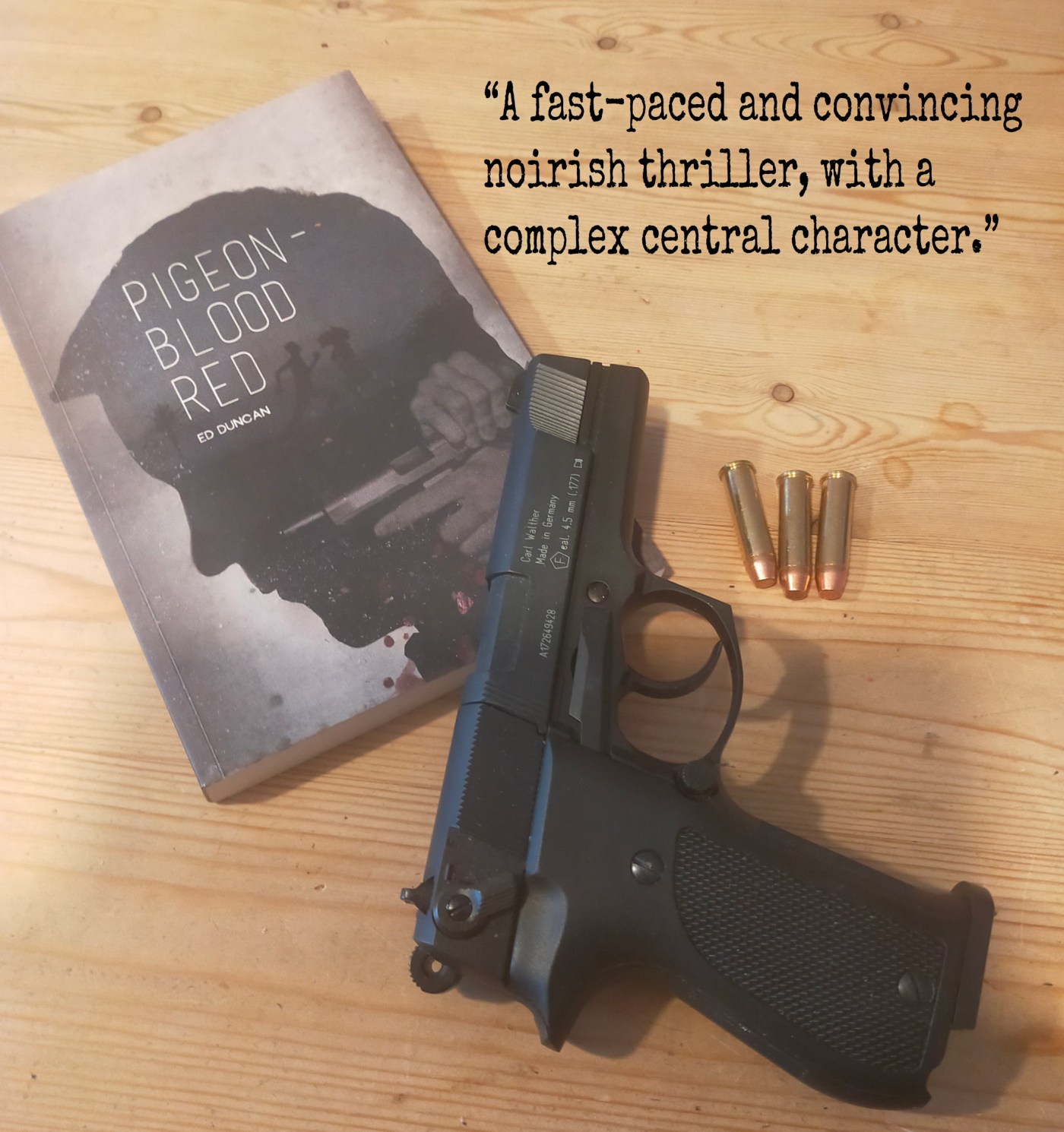
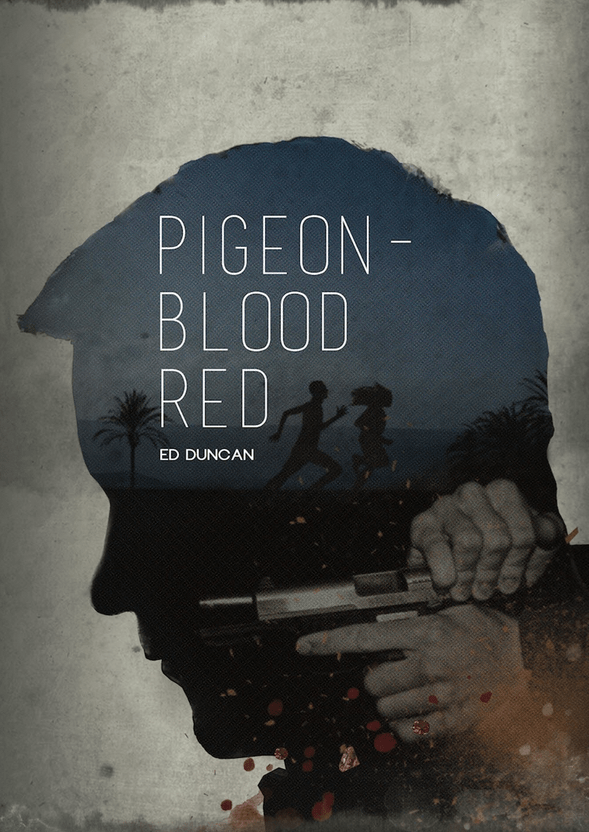
PIGEON-BLOOD RED . . . Between the covers

Frank Litvak is a Chicago loan shark. Rico and Jerry are his enforcers. Jerry is relatively mild mannered, but Rico is the alpha male. Killing and wounding those who are fellow bottom-feeders doesn’t stop him sleeping easy at nights. When Litvak gives them an expensive necklace to look after, it seems all in a day’s work, but accidents happen. While Rico is messing around with his girlfriend Jean on the back seat of Jerry’s car, the pouch containing the jewellery falls out of his pocket, and is later retrieved by the fourth passenger in the car, a deeply-in-debt businessman called Robert McDuffie.

McDuffie flees to Honolulu with his wife Evelyn, pursued by Rico. Also in the resort is Paul Elliott, a Chicago lawyer, taking an enforced break and still grieving for his wife, killed by a drunken driver months earlier. The best thrillers always have an instance of separate worlds colliding, and boy oh boy, how they collide here.

Arriving in Hawaii, Rico wastes no time in sourcing weapons, and follows Robert and Evelyn to a nearby Luau (a traditional Hawaiian feast, but now tailored to tourists). He is bemused that the McDuffies are now part of a foursome, but puts it out of his mind. As readers, we know that Paul Elliott is part of the group, and that he knew Evelyn from student days. The fourth person is Rachel Givens, a professional colleague of Evelyn’s, with whom Mrs McDuffie had intended visiting Hawaii. Robert has produced the necklace – made of priceless ‘pigeon-blood red’ rubies, and presented it to his wife in an effort to repair their marriage.

Hidden in the trees outside the Luau, Rico shoots Robert, and then Evelyn. Moving in between the panicking party-goers, he reaches down to retrieve the necklace from Evelyn’s neck, but it is not there. Making his escape, Rico later learns that the woman he shot was not Evelyn, but Rachel, and Evelyn still has the necklace.

Rico, Evelyn and Paul return to Chicago leaving the funeral directors to repatriate the remains of Robert and Rachel. Litvak, of course remains seriously unhappy, as he still wants the necklace back. His mistake is to present a binary choice to Rico: either Rico kills Paul and Evelyn and retrieves the necklace, or Jean will suffer the consequences. There is a messy finale involving the brother of a man Rico killed just before leaving for Hawaii is seeking revenge, but Rico’s rather unusual moral compass remains stable.

The ‘killer with a conscience’ trope is certainly nothing new in crime fiction. If there is any remote moral argument for killing, I suppose it is best encapsulated in the still flourishing admiration for long-dead British gangsters, the Kray Twins. The logic runs something along these lines: yes, they were brutal, but never harmed ordinary people; their victims were always fellow criminals, or rivals; and, of course, they loved their dear old mum. Amazon has this to say about the author:

“Ed Duncan is a graduate of Oberlin College and Northwestern University Law School. He was a partner at a national law firm in Cleveland, Ohio for many years. Ed currently lives outside of Cleveland, OH and recently completed the third installment of the Pigeon-Blood Red trilogy, Rico Stays.

Pigeon-Blood Red is a fast-paced and convincing noirish thriller, with a complex central character. It is published by Next Chapter, and is available now.

FIRE AND BONES . . . Between the covers

FAB SPINE066 copy

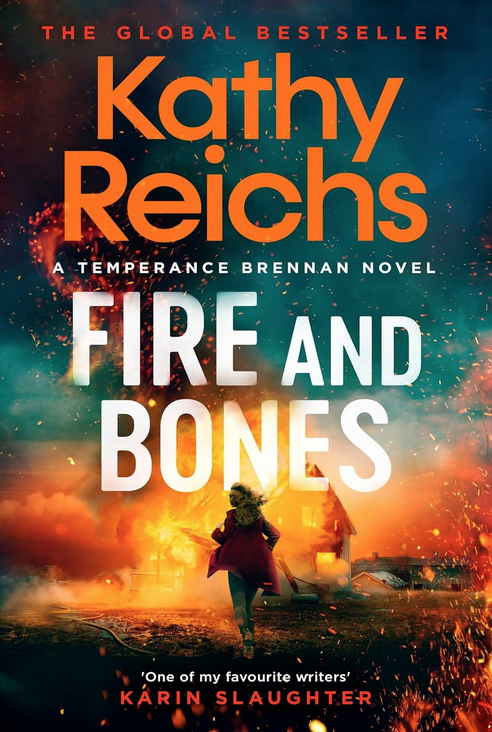
Screen Shot 2024-07-13 at 20.24.17To use a cricketing term, the Dr Temperance Brennan book series by Kathy Reichs (left) is 24 not out, and still looking good. The series featuring the forensic anthropologist began with Déjà Dead in 1997. For anyone new to the novels, I’ll just direct you here for background information. Tempe (her preferred nickname) is in her Charlotte NC autopsy room and has just finished one of her trademark investigations into long-dead human remains. She is planning a few days away with her long-time boyfriend, Quebec cop Andrew Ryan, but when she gets home, she has a series of ‘phone calls  which persuade her to drive to Washington DC to help with the investigation of a fatal fire in an old house in Foggy Bottom.

The Victorian property had been most recently used as a low rent boarding house, and amid the devastation, there are four dead bodies, all victims of the fire. When part of the ground floor gives way under the weight of one of the fire officers, a hidden cellar full of alcoves and passages is revealed, and it is in one of the chambers that Tempe discovers another corpse tied inside a burlap sack. While the charred remains of the four fire victims are quickly identified, the corpse in the burlap bag is more mysterious. The body is that of a woman, small and slender, but how long she had been in that bag, in that cellar is more problematic. Via one of those nerdish experts who specialise in arcane knowledge, Tempe learns that the sack in which the victim was confined probably dates from the late 1940s.

Screen Shot 2024-07-13 at 19.53.48

Tempe, with the help of a TV reporter called Ivy Doyle, learns that the reason for the fire may be connected to a group of hoodlums back in the prohibition era. The Foggy Bottom Gang. The ringleaders were Leo, Emmitt, and Charles “Rags” Warring, who had worked as laborers in their father’s barrel shop. When the (illegal) booze started flowing, all three quickly got caught up in the wild and sometimes violent underworld of Washington, D.C. But what is the connection between events decades ago and modern day Washington DC? Eventually, Tempe finds out the truth, and it reinforces the old adage about revenge being a dish best served cold and, in this case, slow.

The book rattles along at breakneck speed, and Tempe Brennan is her usual sassy, quick-thinking self, a persona that Kathy Reich’s millions of readers have come to know and love over the 27 years since Tempe first appeared. Thy narrative style is unmistakably and uniquely American – slick, witty, and sharp as a tack. It won’t appeal to readers who like gentle cosy crime mysteries set in idyllic British locations, but it is a testament to its style and commercial appeal that a TV series based on the books ran from September 13, 2005, concluding on March 28, 2017, airing for 246 episodes over 12 seasons. 

Fire and Bones is gripping and addictively readable, despite the fact that  – like books in other long-running American series by writers like Jonathan Kellerman, James Patterson and Harlan Coben – it is formulaic. The formula works, readers love it, so you will hear no complaints from me. It is published by Simon & Schuster, and is out today, 1st August.

Screen Shot 2024-07-13 at 20.20.13

CALICO . . . Between the covers

calico spine063 copy

Lee Goldberg baits the hook irresistibly within the first few pages of this novel. Disgraced former LAPD cop Beth McDade has been exiled to the desert wastes of Barstow, on edge of the Mojave Desert. She attends what seems to be a routine road death- pedestrian collides with motor home, only one winner – but the autopsy on the victim is astonishing. He was wearing jeans that hadn’t been made that way since the 1880s. What remains of his dental fillings reveal an amalgam not used in decades. His tobacco tin isn’t just repro. It is original, and contains tobacco not produced commercially since the end of the nineteenth century.

Things become even more baffling when a construction company doing groundwork for a new development unearth an old coffin containing equally old bones. Beth finds her ultra rational mindset severely challenged when the bones are dated to the early 20th century, but contain titanium implants only available to surgeons in more recent times. She then receives a visit from a former LA colleague (and lover) who is  on a missing persons case. He is looking for Owen Slader, a very 21st century social media personality and chef,who was last seen filling up his car with gas on the way to visit his daughter.

There are two parallel narratives, one being that of present day Beth McDade, and the other being the views and experiences of Owen Slader. On that February night he was engulfed by what appears to be a lightning storm and, when he recovers his senses, the freeway no longer exists, and he is stranded near the primitive and rumbustious silver mining settlement of Calico. And it is 1882. Slader hides his hired Mercedes in a cave, rigs up a solar battery charger to power his iPhone and, using his 21st century culinary skills, caries out a profitable life for himself cooking up delicacies for the hungry miners of Calico. He meets – and marries another refugee from another time, a woman called Wendy, but she was ‘taken’ by the Time Gods a couple of decades earlier than Slader. This is when the complexities and total unknowables of the time travel concept begin to cause brain hurt, and the obvious questions like the one below, can never be answered:
“If stamps on the titanium implants found in the bones within the ancient coffin identify the recipient as Owen Slader who, identifying as Ben Cartwright (1960s TV Western reference!), died in the early 1900s, how did he then father a daughter in the early decades of the 21st century?”

The author certainly has fun with some of the more bizarre aspects of being a time traveller. He has Ben Cartwright buying copies of new novels by writers like Mark Twain and Robert Louis Stevenson knowing that (as first editions) they will become immensely valuable decades ahead. When a cholera epidemic hits Calico, Cartwright, nursing the town judge in what seems to be his final fevered moments, takes out his iPhone and plays the dying man some music. Problem is, the judge doesn’t die, and when he recovers he goes around loudly humming ‘Somewhere Over The Rainbow.’

Meanwhile, Beth McDade struggles to reconcile facts that are, at the same time, impossible but also incontrovertible. She even finds, boarded up in a cave, the 2019 rental that Owen Slader was driving when he disappeared. It is, needless to say, improbably decayed and weathered given that it can only have been there a matter of months. Eventually, our heroine tackles – and bests –  the FBI and the implacable American military machine.

Lee Goldberg’s audacious plot and premise will not be for everyone, particularly those who think that Hamlet’s famous remark to Horatio was just the rambling of a confused and conflicted young man. Of course, time travel novels are nothing new, and Goldberg does nod in homage to the grand-daddy of the genre, Herbert George Wells, but also develops the ‘stepping on a butterfly’ trope that began with Ray Bradbury’s 1952 short story ‘A Sound of Thunder’. Key question, though. Does Lee Goldberg’s book work? Of course it does. The writer is also an experienced screenwriter, producer and TV executive, far too well versed in his trade to stretch  the credulity of his readers and viewers to beyond breaking point. Calico is immensely entertaining, with a runaway-train narrative drive. Published by Severn House, it came out in hardback and Kindlle in November 2023 and this paperback edition was published on 4th July.

Screen Shot 2024-06-28 at 21.01.23

THINK TWICE . . . Between the covers

think twice spine053 copy

A bit of back story. Myron Bolitar (read my review of an earlier book in the series HERE) is a New York sports agent who, before a career-ending knee injury, was a top basketball player. One of his bitterest rivals on the court – and in romance –  was Greg Downing. Bolitar went on to become his agent, but not before impregnating Downing’s soon-to-be wife Emily, a young woman they had fought over. The resultant child, Jeremy, now a serving soldier, was brought up to be the Downings’ son. Citing psychological problems, Downing retired from sport, and went to the Far East to “find himself”. He never returned, but his death was announced, and his ashes returned to the USA. Bolitar, being a decent man and putting past grievances to one side, gave the eulogy at his memorial service.

Understandably, Bolitar’s jaw drops when two FBI agents enter his office, and tell him that Downing’s DNA has been found at a recent murder scene. We know from the very start of the book that someone is very good at committing murder and putting someone else in the frame by acquiring their DNA via, say, a hairbrush or a used tissue, and leaving it at the scene of the crime. To say more would be to spoil the fun, but all I will say is that readers should not make assumptions. Across New York and its suburbs, people are looking at serious jail time for crimes we know they didn’t commit but, strangely, as well as irrefutable forensic traces, the suspects have motive, too. Like the young woman who worked a building contract with her father, for a big developer. When that developer simply refused to pay them, citing shoddy workmanship, was she finally driven to desperation, borrowed her father’s rifle and shot the crooked developer dead?

Many fictional American investigators have a brutal sidekick who can be relied upon to dish out extreme violence from time to time. Robert B Parker’s Spenser had Hawk, John Connolly’s Charlie Parker has Louis, and Myron Bolitar has Windsor Horne Lockwood III, a billionaire playboy who loves guns – and using them. Here, he rescues Bolitar from having a toe removed by mobsters, and plays an important part at the end of the book. The relationship between Win and Myron is complex. Win is borderline psychotic, and he does things which, in his mind, are for the good, while knowing full well that Myron would not conscience such behaviour. He doesn’t utter the words, but he is thinking, “I will do this so you don’t have to.”

The plot becomes more complex page by page, and I trust it is not a spoiler to say that Greg Downing is very much alive and well. What neither Bolitar, Win, Emily, Jeremy nor we readers know is why Downing faked his death and – most importantly – with whom. The FBI involvement develops far beyond the two agents we met at the beginning of the novel, and heads right to the core leadership of the agency, but all the while, the pieces of the puzzle stubbornly refuse to fit together, until Coben creates a tense and violent conclusion played out – of all places – under the gloomy Gothic shadow of the Dakota Building on the edge of Central Park, while a busker does his unknowingly ironic stuff with John Lennon’s Imagine.

The book is trademark Harlen Coben – razor sharp East Coast dialogue, relentlessly entertaining, witty, and with enough violence to keep noir fans satisfied. The back cover blurb describes the author as a ‘Global Entertainment Brand.’ I am a bit old fashioned, and would much rather think of him as an immensely talented writer. Think Twice is published by Century and will be out on 23rd May.

SMOKE KINGS . . . Between the covers

sk spine010 copy

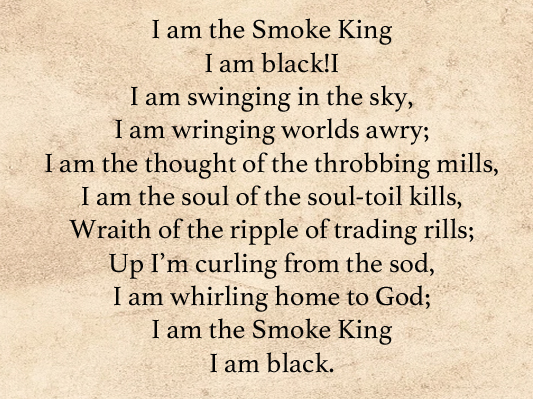
Titles of books and movies can be meaningless word pairings dreamed up by twenty-something publicists. Remember the scene in one of the Naked Gun movies at the Oscars? In the Best Picture shortlist were spoof films like Naked Attraction, Violent Lunch, Fatal Affair, Final Proposal, Basic Analysis..? So, what to make of Smoke Kings? A few moments spent on Google rewarded me with a poem written in 1905 by W.E.B. Du Bois.

Poem

The writer was an activist years ahead of his time, and by adapting his words, Jahmal Mayfield nails his colours to the mast, although his Amazon bio declares that Smoke Kings was inspired by Kimberly Jones’ passionate viral video, “How can we win?” After his cousin, Darius, has been been beaten to death by white teenagers, Nate plots his revenge. Rather than taking out the boys who killed his cousin, Nate targets the descendants of white men and women who, he argues, are responsible for lynchings, racist beatings and murders committed by their grandparents decades previously. Nate and three friends – Rachel, Isiah and Joshua – exact a kind of third party vengeance on a succession of targeted individuals. Most escape death only because they commit to paying sums of money every month to deserving causes in the black community.

Inevitably, the quartet bite off more than they can chew. One of their reprieved victims hires a former cop – Mason Farmer- on a ‘seek and destroy’ mission. He is freshly sacked from a private security firm after he fails to tick the right number of boxes on their Inclusion and Diversity check list, and he sets out to nail the quartet of avengers.

Nate  and  his buddies make another serious strategic error when they kill a random redneck called Chipper, and bury him in a remote grave. Sadly for them, Chipper’s brother Samuel is the charismatic leader of  a violently racist gang, and they are determined to avenge Chipper’s death.

Mayfield is at his most assured when describing the complex relationships between the four would-be avengers, and how they sometimes bicker about how black they actually are. Mason Farmer, too, has his preconceptions about race and identity tested when, while searching for Nate and company, he meets a mixed race woman – a campaigner for justice – called Elizabeth, and falls for her, despite her antipathy towards him. Farmer’s attitudes towards race and identity are already complicated, as his estranged daughter has a son by a black father.

The racist gang term themselves The Righteous Boys: they are deeply unpleasant, and live even worse lives:
“He drove on into the night, past fields of wild grass, old farmhouse buildings slumping like stacks of damp cardboard boxes, useless tractor equipment rusted the colour of dirty bricks. A forgotten and desolate wasteland. No wonder The Righteous Boys had chosen to call the area home.”

I read the novel pretty much back to back with re-reading a couple of Harlem Detectives novels by Chester Himes, and it left me wondering if someone had written A Rage In Harlem or The Real Cool Killers today, whether or not anyone would publish them, such is the glee with which Himes portrays the eccentricities and sometimes deeply venal nature of some of the characters. Smoke Kings is very different, as there is little ambiguity about where good and evil reside. The narrative of the book raises all kinds of very contemporary questions about ancestral guilt, both on an individual and national level. Smoke Kings is a breathless journey down the bumpy track that leads to revenge, and is published by Melville House, available now.

THE BONE HACKER . . . Between the covers

BH spine012 copy

Kathy Reichs introduced us to Montréal forensic anthropologist Temperance “Tempe” Brennan in Déjà Dead (1997). The latest episode of this long running series begins with Tempe – as ever – investigating a particularly revolting partial corpse – ‘partial’ due to an encounter with a boat propeller – in the Bickerdike Basin. A geography lesson about Montréal and the St Lawrence River can wait for another time, as most of the action takes place elsewhere.

The remains are that of a young man who was a very long way from home – fifteen hundred miles across the ocean in the Turks and Caicos Islands. He didn’t drown. He didn’t die from the swirling blades of a propeller. He had been shot. Straight through the chest.  Perhaps now is the time for a little geography. TCI is a tiny chain of islands in the Atlantic. To the south is Haiti and The Dominican Republic; sail south-east and you hit Cuba; north-west lie The Bahamas and the Florida; sail north east for half a lifetime and you may end up in Bantry Bay.

When Brennan makes contact with the TCI police she speaks to Detective Tiersa Musgrove. Not only is Musgrove interested in the death of her young countryman, she surprises Brennan by insisting on flying straightway to Montréal. The demise of the young man – a gang member called Deniz Been – is not the reason Musgrove is anxious to be face-to-face with Tempe Brennan. Her motivation is to persuade Brennan to fly to TCI and cast her eye over a series of unexplained deaths which have completely baffled the TCI authorities. I’m not entirely sure why Brennan would drop everything and fly off into the unknown, but this is, after all, crime fiction, and pretty much anything can happen.

Brennan arrives in TCIcapital city Providenciales, known as Provo – and finds a luxury holiday paradise, complete with the corpses of a handful of young male tourists – each minus a hand. When Musgrove is found dead in her apartment, Brennan realises that she is neck-deep in a criminal swamp that threatens to drag her under and choke out her life. There are enough conundrums to satisfy the most demanding Sherlock Holmes buffs. Why was a state-of-the-art luxury boat found drifting off-shore? Why has an FBI agent ‘gone rogue’ on the island? Was Musgrove killed by her vengeful ex, or the same person who killed the young men?

After the demise of Detective Musgrove, enigmatic local copper Monck (who has been in the wars –  he has a titanium hand) reluctantly brings Brennan into the investigation. When she eventually gets access to a sufficiently powerful microscope she discovers that the blade which separated the young men from from their hands bears the stamp of discernible writing, and it is in Hebrew. A local shochet (kosher slaughterman) looks a shoo-in for the one-handed corpses, in that he has all the right kit, but why? He does himself no favours when he goes on the run, and it is not until the arrival on the island of two suitably tight-lipped and sharp-suited FBI men, in search of their errant colleague, that it dawns on Brennan and Monck that there is a deeper criminal conspiracy at work here, and one that involves ransom demands and an international conspiracy.

The Bone Hacker has qualities which one finds in so many American thrillers – it is slick, pacy and immensely readable. Tempe Brennan is quick-tongued and even quicker of thought, and the gory medical details bear witness to the author’s distinguished career as an academic and as one of her country’s foremost forensic anthropologists. The book is published by Simon and Schuster, and is available now.

I WILL FIND YOU . . . Between the covers

COBEN header007

Sometimes, the best writers set themselves challenges by posing a plot problem that appears to deny a plausible solution. One such was back in 2021 when, in The Perfect Lie, Jo Spain pulled the wool over our eyes. There, the deception hinged on a few words – and our (wrong) assumptions.

https://fullybooked2017.com/2021/05/13/the-perfect-lie-between-the-covers/

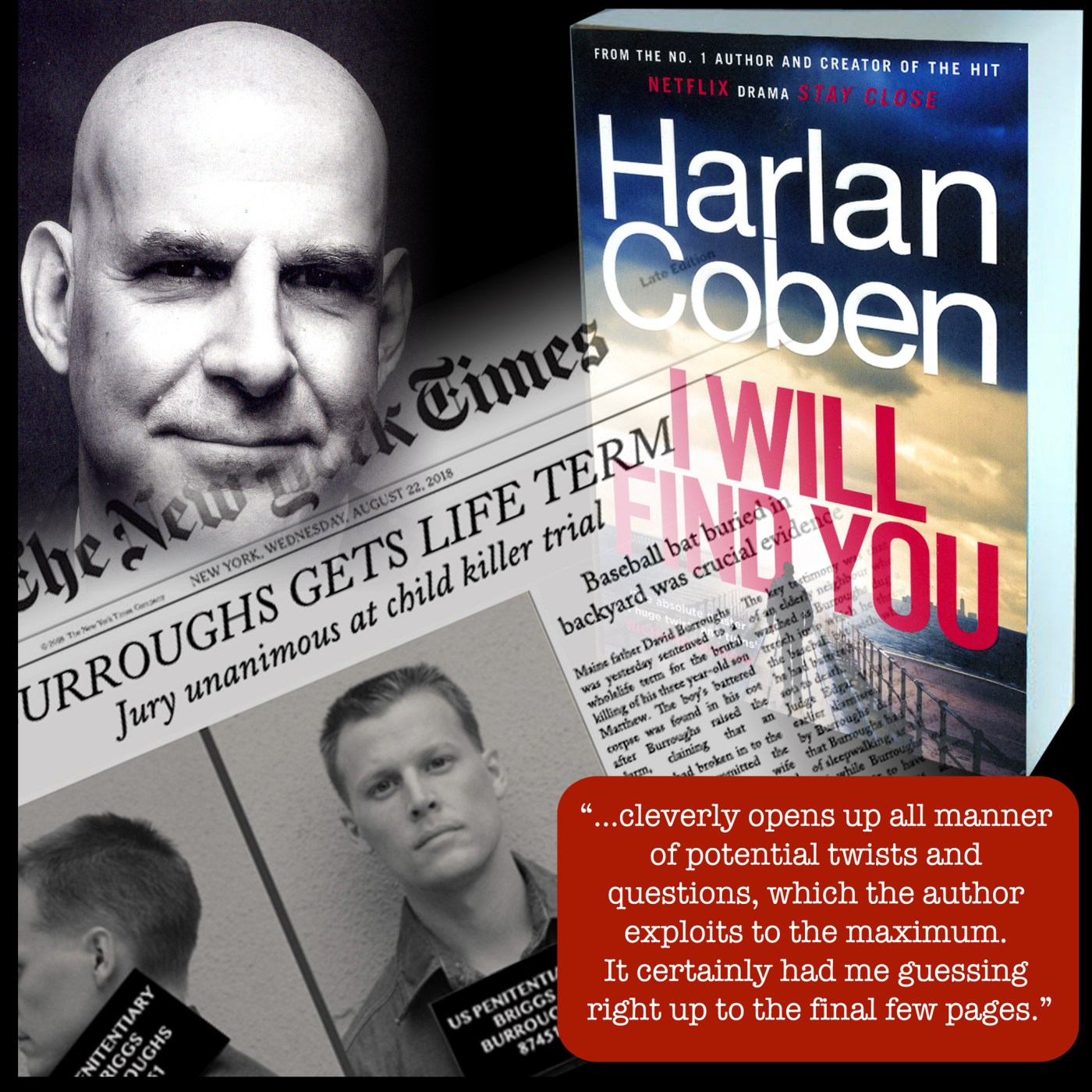
In his latest novel, Harlan Coben – to use the metaphor of Houdini – has wrapped himself in so many chains and padlocks that it seems impossible that he can set himself free. Why? Try this. Five years ago, David Burroughs was jailed for life for murdering his three year-old son, Matthew, with a baseball bat. He now languishes in the protected section of a high security jail, alongside child rapists, cannibals, and other monsters. After refusing to see any visitors for five years he is finally forced to see one – because he omitted to fill in the annual paperwork. It is his former sister-in-law Rachel; his wife, Cheryl has, inevitably, divorced him. Rachel shows David a photo (taken by a friend) of a family group at an amusement park. On the edge of the picture is a little boy, clutching the hand of an adult, otherwise out of picture. It is Matthew.

Coben gives us a drive-through account of the back story. David Burroughs was home-alone with Matthew that night. Cheryl, a surgeon,  was at work. David was in a bad mood, put his son to bed without a bedtime story, and proceeded to get outside of the best part of a bottle of Bourbon. Somehow awakened by a sixth sense that something was wrong, or perhaps by the smell of blood, David staggered to his son’s bedroom only to find a mangled and unrecognisable corpse on the bed.

The first key to the mystery is, of course, that the shattered boy’s corpse was just that – unrecognisable. It was, however, in Matthew’s bed, wearing Matthew’s pyjamas. When, a little while later a baseball bat, with David’s fingerprints all over it, is found buried in the garden, David’s status changes from bereaved father, through suspect, to convicted killer.

The next key has to be putting David in a situation – i.e. no longer behind bars – where he can investigate the possibility that the child in the photograph is Matthew, and prove that the murdered boy in Matthew’s bed was someone else. The Governor of Briggs Penitentiary is Philip Mackenzie, and he has history with David Burroughs. David’s dad, Lenny, was, long ago, a grunt in Vietnam with Phil. The pair survived and went on to become partners in crime prevention as precinct cops. Now, Phil is just months away from retirement and a double pension, while Lenny is in the advanced stages of dementia. Suffice it to say there is a fairly improbable break-out from Briggs but this is, after all, crime-fiction.

Coben then throws a fairly heavy spanner into the works by revealing that at a rough stage in their marriage, when Cheryl and David were unable to conceive, Cheryl booked an appointment at a sperm donor clinic. This cleverly opens up all manner of potential twists and questions, which the author exploits to the maximum. It certainly had me guessing right up to the final few pages. If I say this a typically American slick thriller, it is meant as an entirely positive description. Somehow – and I won’t say they are better than British writers – American novelists such as Coben, Connolly, Baldacci and Kellerman produce a polished and gleaming product which has, to extend the automobile metaphor, a distinctive ‘new car smell’. I Will Find You is published by Century and is out now.

UNNATURAL HISTORY . . . Between the covers

UH spine

Guilty pleasures? At my time of life, there should be no guilt involved. I have no intention of troubling the funeral director just yet, but I am nearly six years over my biblically allotted span and I will take every opportunity to enjoy my reading on my terms, and I do love a good series. Yes, I know the analogies – comfortable slippers, well-worn cardigan and all the rest. But why not? When time is not on one’s side, what is the point of enduring the pain of breaking in new shoes? Other metaphors are available, but here are a few of my favourite series by authors who are still with us.

Series

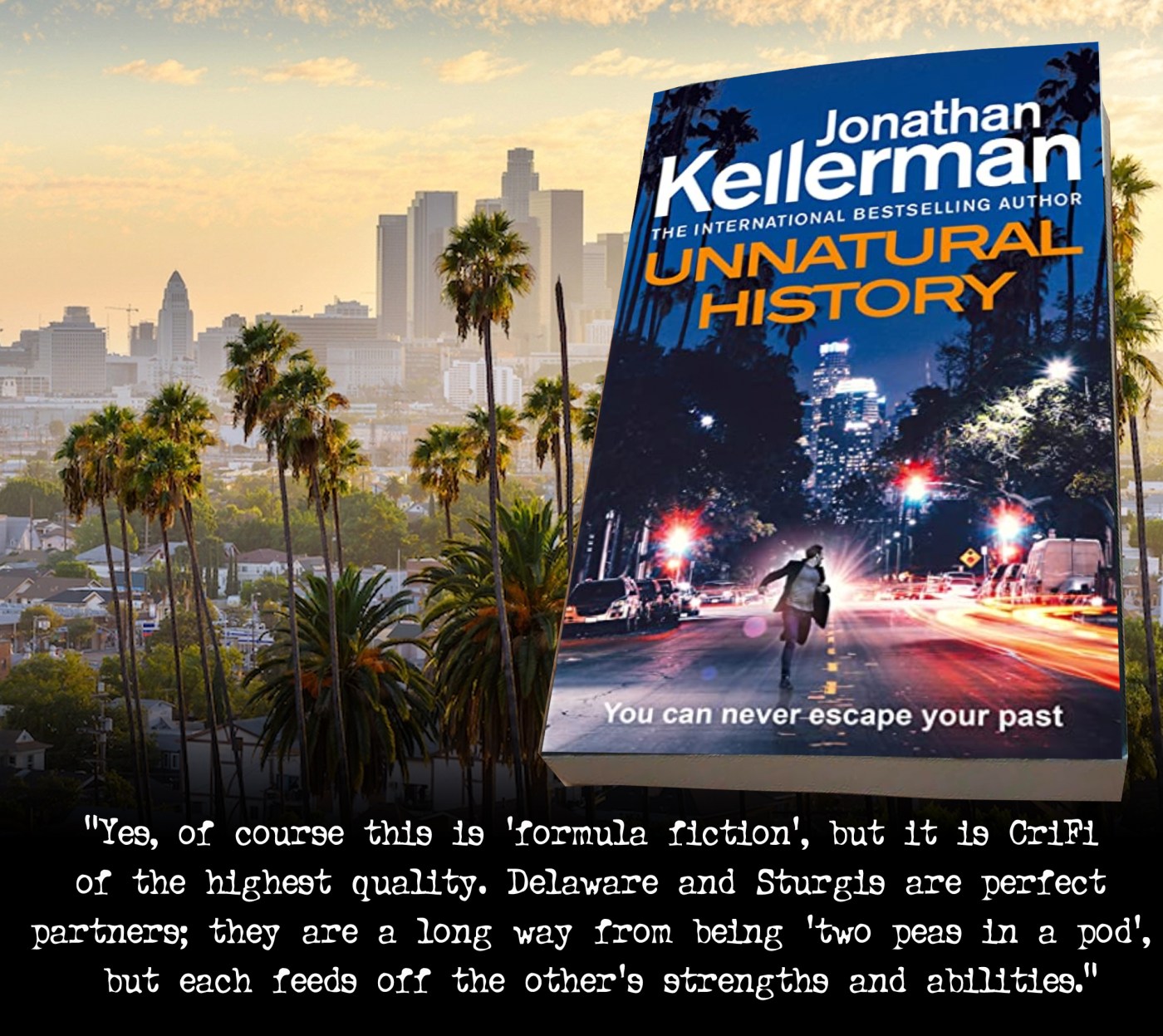
With that heartfelt (not) apology out of the way, here’s my take on the latest Alex Delaware novel from Jonathan Kellerman, Unnatural History. Quick bio. of Dr Alex Delaware (who first appeared in 1985, so he is one of those characters for whom time stands still). He is a Los Angeles forensic psychologist, his live-in girlfriend is a builder/restorer of high end guitars and stringed instruments, and he is involved in crime due to his friendship with Detective Milo Sturgis who is gay, very smart, and a man who, if eating were an Olympic event, would be a multiple gold medal winner.

Adonis ‘Donny’ Klement, an artist who specialises in photography, has been found shot dead in his converted warehouse studio. Three bullets to the chest, bang, bang bang – a concise equilateral triangle. Donny is a member of a very unusual family. His father Viktor is an elusive and secretive billionaire businessman, so careful to escape publicity that not a single photograph of him exists. He has a strange habit. He marries, fathers a child, and then moves on. Donny was the latest progeny, but he had several half-siblings.

By all accounts, Donny was gentle, talented, but rather naive. His most recent project was called The Wishers. He recruited several homeless down-and-outs, dressed them in exotic and fantastical costumes,and photographed them. They were well paid, but was one of them deranged enough to come back and murder the man who, if only for a brief hour, had enabled them to act out their fantasies?

Delaware and Sturgis are convinced that the murder of Klement is connected with the street people he brought into his studio, and when one of them – a deaf mute woman called Jangles – is found strangled, it begins to look as if they are right. Or are they? There is an elegant and clever plot twist which confirms that they were, but not quite in the way they were expecting.

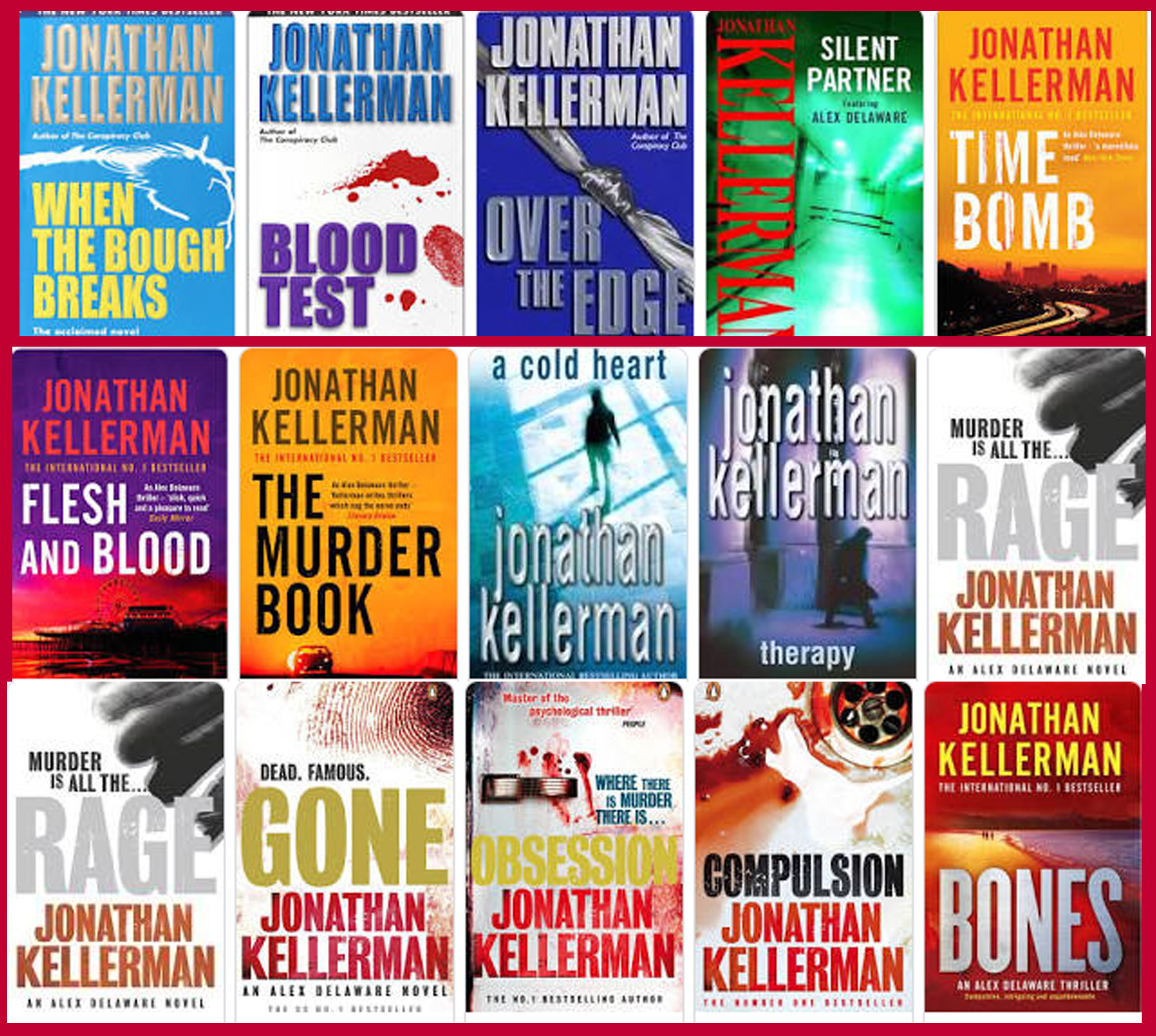
As well as Kellerman’s taut dialogue and plotting, we should not forget that he is up there with the best writers (including his contemporary Michael Connolly and the Master himself, Raymond Chandler) in bringing to life the dramatic contrasts of the LA landscape, with its beaches, grim neon strip-malls, spectacular hills and – more recently – the horrific shanty cities full of homeless down-and-outs. Yes, of course this is ‘formula fiction’, but it is also CriFi of the highest quality. Delaware and Sturgis are perfect partners; they are a long way from being ‘two peas in a pod’, but each feeds off the other’s strengths and abilities. Unnatural History is a riveting read, and will be available from Century/Penguin Random House from 16th February. Click the image below to read more reviews of books by Jonathan Kellerman.

JK footer

Blog at WordPress.com.

Up ↑