Search

fullybooked2017

Tag

Alex Delaware

THE GHOST ORCHID . . . Between the covers

TGO spine018 copy

I suppose in the kingdom of detective partnerships, Holmes and Watson will never be dethroned, and quite rightly, too. I would however nominate (alongside Rizzoli and Isles, Morse and Lewis, Bryant and May, Wolfe and Goodwin) Alex Delaware and Milo Sturgis. Jonathan Kellerman’s duo of a child psychologist and LA homicide cop have for me, in dozens of novels, never failed to deliver. Yes, there’s a formula at work here, but that’s what makes all these partnerships work. Sturgis is abrasive, socially insecure and, because of his homosexuality, fighting an endless battle against his censorious LAPD colleagues, but he is a brilliant investigator: add into the mix Delaware’s social awareness, acutely attuned antennae for  people telling lies, and you have a winning mix.

A glamorous woman and a younger man are found shot dead at a Bel Air property. Her expensive jewellery has not been taken, and it looks like a professional job. Sturgis asks Delaware to take a look at the crime scene*.

*For new readers who wonder why Delaware is brought into the case, it’s simple. It’s the way the books work. Sturgis is something of a maverick, loose-cannon, lone-wolf – choose your own metaphor- and as long as he does the business, his colleagues leave him alone, so he always welcomes the extra pair of eyes and psychological insight that Delaware brings. In case you were wondering, Delaware earns a good living as a court-acknowledged expert in legal cases involving children so, thankfully for fans like me, he can afford the time to help Sturgis.

It transpires the dead woman is Meagin March, whose husband Doug is a real estate billionaire, and the corpse alongside hers belonged to, as they say, her toy-boy. Not short of a cent or three himself, Giovanni Aggiunta is the errant younger scion of a top draw Italian shoe making firm. He receives a generous allowance to amuse himself while his older brother and other family continue creating wealth with their exclusive designer footwear.  is not all she seems to have been, however, and it turns out that in a previous life she was a Vegas glamour escort. Yes, she finally snared Mr Right – and a life of luxury – but Delaware and Sturgis can find no-one who has a bad word to say about the murdered lovers, but become convinced that the woman was the intended target, and that her Italian lover was, sadly, collateral damage.

Doug March is a thoroughly unpleasant fellow. He was away on a business trip at the time, so it wasn’t his finger on the trigger of the .38 revolver, but could he have been so angry at Meagin that he hired a contract killer? Delaware is convinced that there is a message waiting to be discovered in one of the rooms of the March’s mansion. Meagin was an amateur artist and the room was her studio. All but one of her paintings are unremarkable ‘chocolate box’ scenes, but the exception seems to be a particularly severe abstract. Eventually, Delaware’s live-in romantic interest, Robin, identifies as a painting of a strange and rare flower, known as a ghost orchid*.

*Dendrophylax lindenii, the ghost orchid (a common name also used for Epipogium aphyllum) is a rare perennial epiphyte from the orchid family. It is native to Florida, the Bahamas, and Cuba. Other common names include palm polly and white frog orchid.

Robin provides more insight by suggesting that Delaware and Sturgis take a look at the unusual spelling of the dead woman’s name. I won’t say any more, but it’s not too hard an anagram to solve. These fresh clues result into a deep dive into ‘Meagin’s’ childhood which reveals horrors hitherto unsuspected. Delaware and Sturgis finally get their killer, but not quite in the way they were expecting. This is another classy and absorbing tale from the casebook of one of modern crime fiction’s most endearing partnerships. It is published by Century/Penguin Random House and will be out on 15th February.

UNNATURAL HISTORY . . . Between the covers

UH spine

Guilty pleasures? At my time of life, there should be no guilt involved. I have no intention of troubling the funeral director just yet, but I am nearly six years over my biblically allotted span and I will take every opportunity to enjoy my reading on my terms, and I do love a good series. Yes, I know the analogies – comfortable slippers, well-worn cardigan and all the rest. But why not? When time is not on one’s side, what is the point of enduring the pain of breaking in new shoes? Other metaphors are available, but here are a few of my favourite series by authors who are still with us.

Series

With that heartfelt (not) apology out of the way, here’s my take on the latest Alex Delaware novel from Jonathan Kellerman, Unnatural History. Quick bio. of Dr Alex Delaware (who first appeared in 1985, so he is one of those characters for whom time stands still). He is a Los Angeles forensic psychologist, his live-in girlfriend is a builder/restorer of high end guitars and stringed instruments, and he is involved in crime due to his friendship with Detective Milo Sturgis who is gay, very smart, and a man who, if eating were an Olympic event, would be a multiple gold medal winner.

Adonis ‘Donny’ Klement, an artist who specialises in photography, has been found shot dead in his converted warehouse studio. Three bullets to the chest, bang, bang bang – a concise equilateral triangle. Donny is a member of a very unusual family. His father Viktor is an elusive and secretive billionaire businessman, so careful to escape publicity that not a single photograph of him exists. He has a strange habit. He marries, fathers a child, and then moves on. Donny was the latest progeny, but he had several half-siblings.

By all accounts, Donny was gentle, talented, but rather naive. His most recent project was called The Wishers. He recruited several homeless down-and-outs, dressed them in exotic and fantastical costumes,and photographed them. They were well paid, but was one of them deranged enough to come back and murder the man who, if only for a brief hour, had enabled them to act out their fantasies?

Delaware and Sturgis are convinced that the murder of Klement is connected with the street people he brought into his studio, and when one of them – a deaf mute woman called Jangles – is found strangled, it begins to look as if they are right. Or are they? There is an elegant and clever plot twist which confirms that they were, but not quite in the way they were expecting.

As well as Kellerman’s taut dialogue and plotting, we should not forget that he is up there with the best writers (including his contemporary Michael Connolly and the Master himself, Raymond Chandler) in bringing to life the dramatic contrasts of the LA landscape, with its beaches, grim neon strip-malls, spectacular hills and – more recently – the horrific shanty cities full of homeless down-and-outs. Yes, of course this is ‘formula fiction’, but it is also CriFi of the highest quality. Delaware and Sturgis are perfect partners; they are a long way from being ‘two peas in a pod’, but each feeds off the other’s strengths and abilities. Unnatural History is a riveting read, and will be available from Century/Penguin Random House from 16th February. Click the image below to read more reviews of books by Jonathan Kellerman.

JK footer

SERPENTINE . . . Between the covers

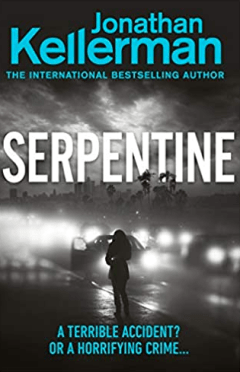
Serpentine Header

No-one could ever accuse Jonathan Kellerman of not being industrious. It seems like only the other day that I reviewed The Museum of Desire (it was 9th November last year, in fact), but now Dr Alex Delaware and Milo Sturgis are back again in the hills and canyons of LA, solving another mystery. A quick bio. for readers new to the series. Delaware is a practicing child psychologist who often (this is the 36th book in the series) helps LAPD detective Milo Sturgis with cases. Delware lives with a woman who repairs stringed instruments, while Sturgis has a partner, and has come through the dark years when being gay was something of a no-no in police ranks. The plot is as wonderfully convoluted and labyrinthine as ever. So (takes a deep breath), here goes.

Screen Shot 2021-02-04 at 18.47.53Sturgis has reluctantly taken on the coldest of cold cases. His orders have come down from some very well-connected people in the political and civic life of LA, and so he has been pulled off all other work. The mystery? What is the truth behind the death of a woman decades earlier, found in the wreckage of her burnt out Cadillac at the bottom of a canyon bordering Mulholland Drive? Careless driving? Might have been, were it not for the fact that she had also been shot in the head.

The woman pulling the strings is Ellie Barker, a millionaire former businesswoman, and daughter of Dorothy Swoboda the lady in the canyon. She was only three at the time, has no recollection of her mother, and never knew her natural father, having been brought up by her stepfather, Stanley Barker.

Anton Des Barres was a wealthy industrialist who made his money manufacturing high quality surgical equipment. After his second wife died, he became something of a womaniser, inviting young women back to his mansion where he and his children still lived. Delaware and Sturgis learn that Dorothy was one of Des Barres’s ‘harem’. They also discover a strange coincidence. Arlette Des Barres, the man’s second wife died after a fall from her horse in the rugged country near where Dorothy died. Stanley Barker was found dead, possibly as a result of a fall, in the same area.

Historic deaths are one thing, but when Ellie Barker’s boyfriend is shot, Delaware and Sturgis are faced with the uncomfortable thought that whatever the truth behind Dorothy’s murder, it is far from being dead and buried. It is alive and well, and extremely dangerous.

Screen Shot 2021-02-06 at 13.50.48

PendantThe title of the book refers to a piece of jewellery, which Delaware and Sturgis eventually discover is deeply significant. Actually, the pair make many assumptions about the case, and most of them prove to be wrong, which only adds to the credibility as investigators. They are not super-sleuths; they are mortal, fallible – and consequently completely convincing.  It is only in the final pages that they – and we – learn the truth about the life and death of the woman who called herself Dorothy Swoboda, and it is dark stuff indeed.

Cynics might turn up their noses at this book and dismiss it as “formula fiction”. Fair enough, and, as the saying goes, “opinions are like (insert anatomical detail) – everyone has one”. What such critics find hard to cope with, I suggest, is that writers like Kellerman are rather like alchemists, in that they take base metal – cops, bad guys, slick dialogue, zooming around in cars, and turn it into gold – conviction, reading pleasure, empathy with the characters and a sense of “can’t wait for the next novel“. That is pretty impressive, at least in my book.

Serpentine is published by Century, and is out now.

Blog at WordPress.com.

Up ↑