
Search

fullybooked2017

Tag

1914

THE GUNS OF AUGUST . . . Between the covers

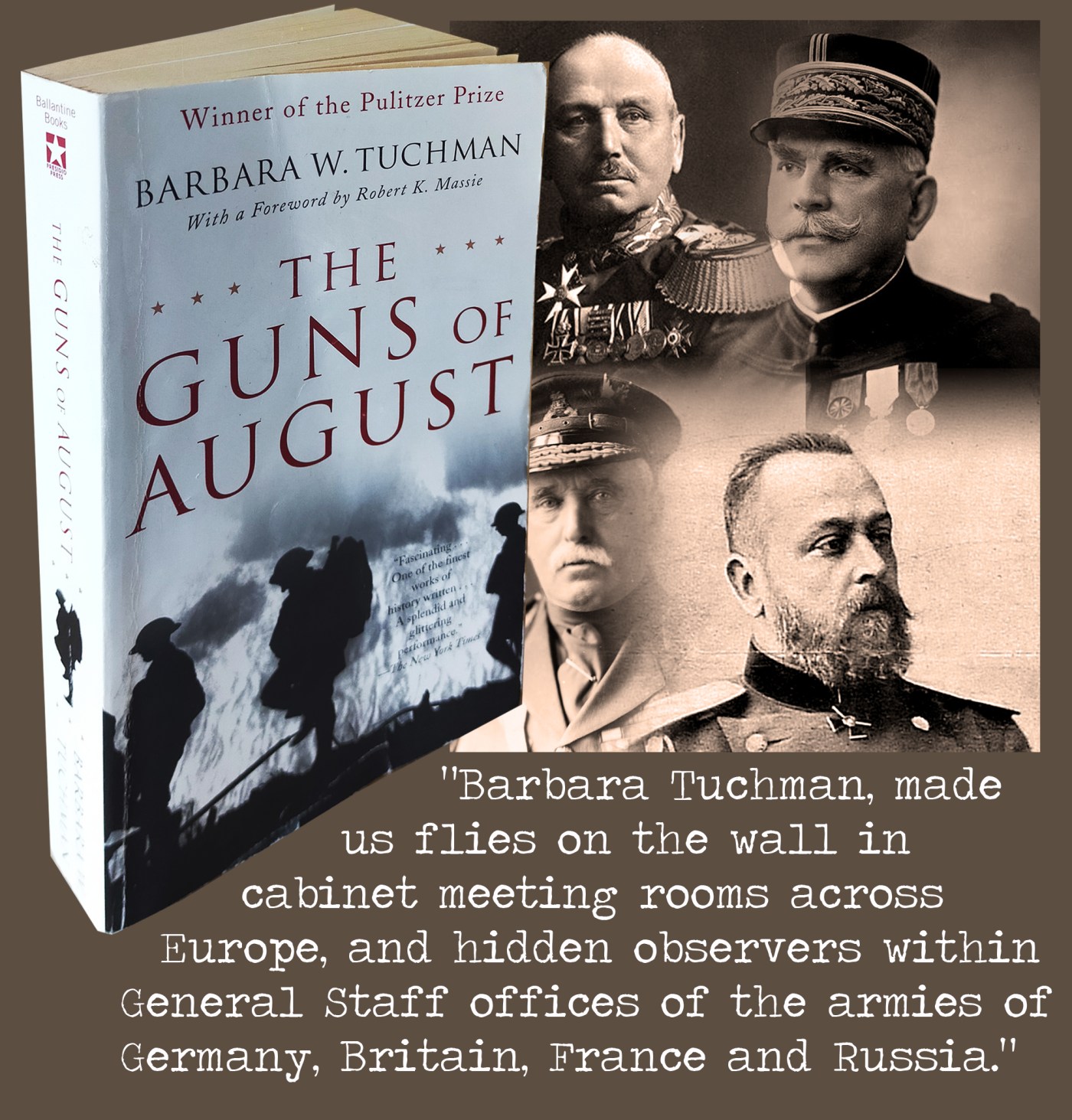
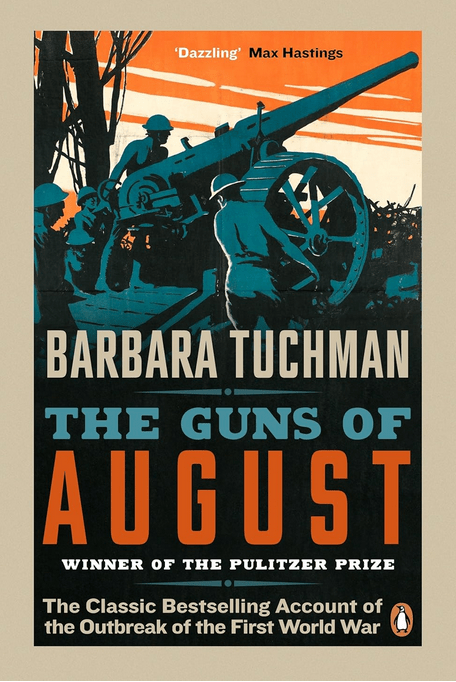
Barbara Tuchman’s The Guns of August was published in 1962. I was then 15 years old, and any reading I did was probably set texts for the looming ’O’ Level examinations, so I hope I can be forgiven for not reading her account of the events of 1914 earlier than 1973, when I was gifted a copy by a fellow teacher in Melbourne. Then, I read it at every opportunity, including the tram journeys to and from work along St Kilda Road. Her narrative drive, grasp of detail, and her ability to bring to life the petty and petulant relationships between senior military commanders and the sheer starving, parched and blood – shod lives of the poor bloody infantry, gripped me then, and I was determined to re-read it from the view of a widely-read and cynical near-octogenarian. 

First, some publishing context. Between the wars there were many personal memoirs of the Great War, some of which were well written and historically accurate, but others less so. In what we now call the Cold War period, writers began to revisit the various hells of The Great War.  Below is a very limited chronology of those 1960s publications.
1958 In Flanders Fields, Leon Wolff
1961 The Donkeys, Alan Clark
1961 Covenant With Death, John Harris*
1962 The Guns of August, Barbara Tuchman
1963 Haig, the Educated Soldier, John Terraine
1964 The Somme, Anthony Farrar Hockley
*This is a novel, albeit a very good one, based on the experiences of a Pals’ Battalion on !st July 1916.


Barbara Tuchman (nee Wurtheim) 1912 – 1989, won the Pulitzer Prize twice, once for this book and also for her account of a rather obscure (for Britons) episode in American history, the story of General Joseph Stilwell and his deeds in the Far East during WW2. One oddity is that in Tuchman’s account of the events leading up to the outbreak of WW1, and the chaotic eight weeks that followed, there is apparently little to interest her American readership, apart from the occasional reference to President Wilson, whose fervent desire for neutrality was never tested during this time. It is, admittedly, just one indicator, but when I logged in to Abebooks (other sellers are available) to check for second-hand copies, most of those on offer were in America. Incidentally, a mint first edition would set you back £ 918.72 plus £ 40.88 shipping. Even within the sometimes fantastical pricing world of second hand book dealers, one has to confess that, as good a book as it is, it is not that good.


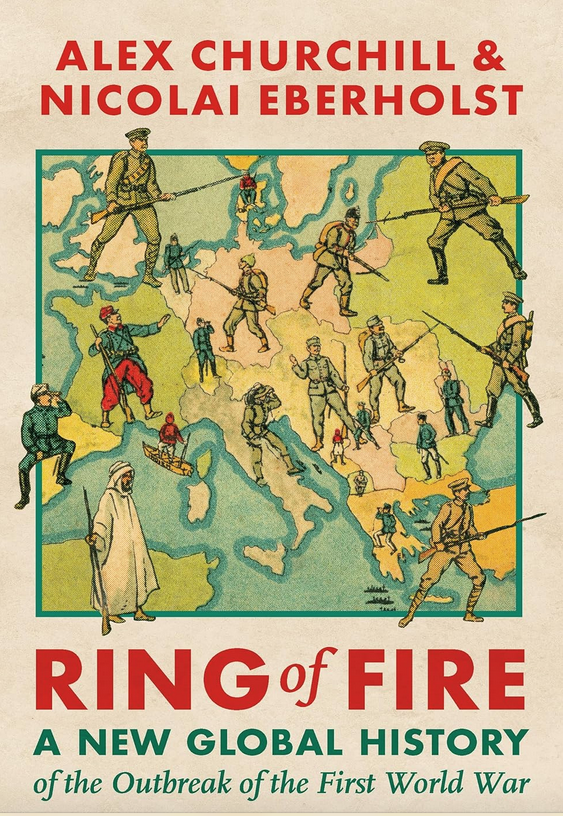
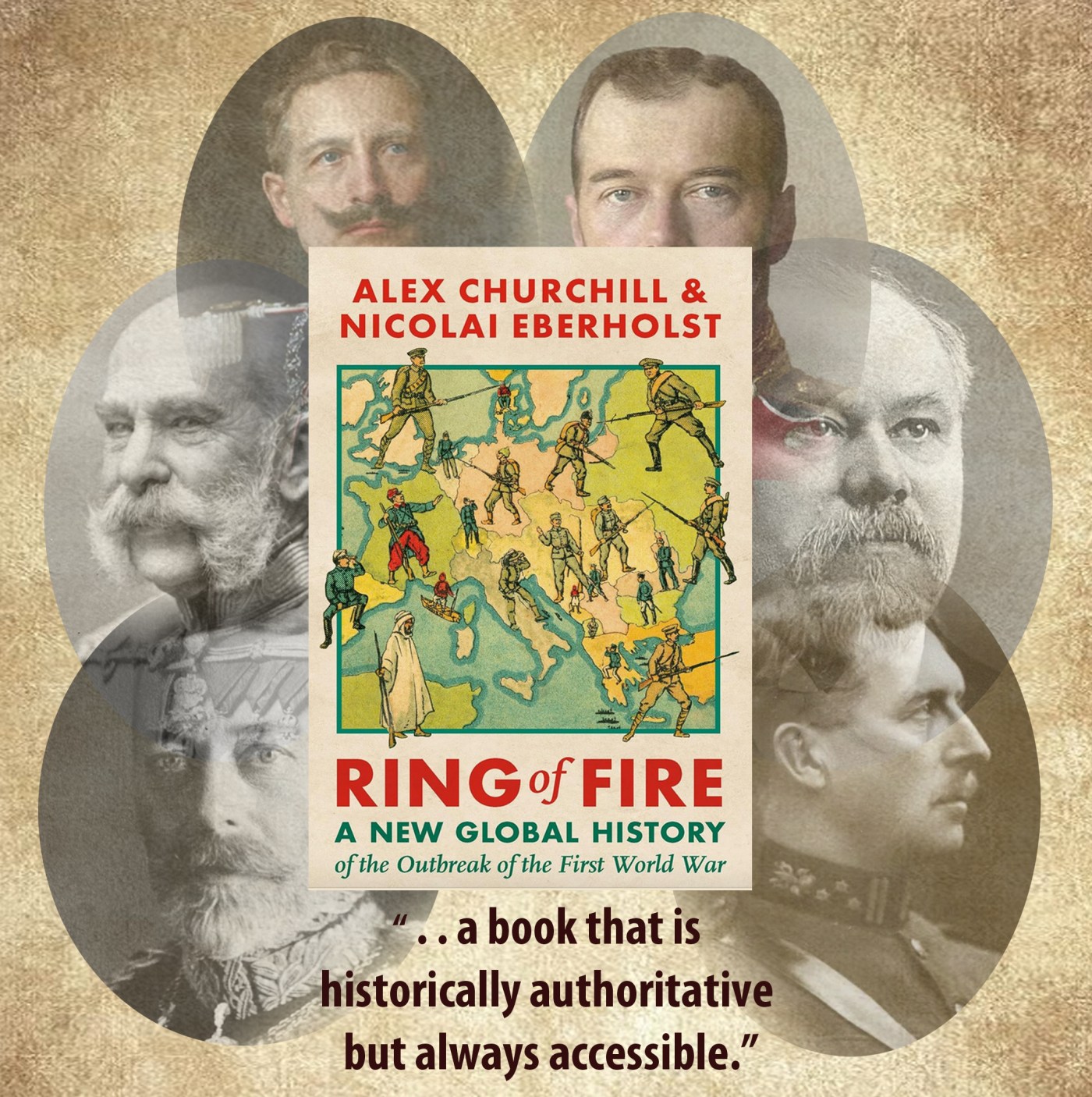
Sadly, in my recently acquired version of the book, the maps were poor, but Tuchman’s vivid narrative and her awareness of the geography were sufficient to let me see the ‘lie of the land’. Her account is not comprehensive. The Russian victories over Austria Hungary in Galicia are only mentioned in passing but, taking the long view, they were to have no lasting impact on the war. For a description of how the conflict flared up in other parts of the world, I must send you in the direction of Ring of Fire, by Alex Churchill and Nicolai Eberholst (link to my review here). Tuchman focuses on three main battle zones, the clash between Russia and Germany in East Prussia, the fighting on France’s eastern border with Germany in Alsace Lorraine and, crucially, the Schlieffen Plan, involving Germany’s thrust through Belgium and down into northern France.


As much as Tuchman shows an astonishing grasp of geography, strategy and tactics, at the core of the book is her vivid portrayal of the key political and military figures who strutted their brief hour on this most bloody of stages. Strutting around on the edge of the German war effort is, of course, the Kaiser, but Tuchman wastes little time on this vainglorious man, neither does she use up much of her word count on Tsar Nicholas who was, despite his grandeur, only remotely connected to the events at the Front. Bestriding the narrative like Shakespeare’s Colossus is Joseph Joffre, the French commander in chief. His main quality was his stoic imperturbability. His world was based around three meals a day, a deceptively placid and ruminative character, and what modern writers might call ‘the long view’.


On the German side, Von Moltke was, nominally the puppet master, but under his command were such men as the mercurial Von Kluck, in charge of Schlieffen’s dictum that ‘the last man on the right should have The Channel at his back.’ On the Russian front, despite the enormous manpower superiority of the Tsar’s army, chaotic and disorganised supply lines resulted in the catastrophic defeat at Tannenburg, after which the Russian general, Samsonov, shot himself in a nearby forest.

So how does Tuchman portray British involvement in these tumultuous and violent weeks? Dispassionately, I would say. At the centre is Sir John French, one of the few British WW1 commanders not as yet successfully ‘rehabilitated’ by modern historians. She gives us a nervous and fractious little man, on his right hand the fragile Sir Archibald Murray, while on his left the eternal schemer, the suave Francophile Sir Henry Wilson. All British Great War buffs have been brought up on the story of Mons, and the murderous rifle fire of the BEF’s Lee Enfield rifles. The subsequent retreat is no less factual, nor is Horace Smith Dorrien’s calculated rearguard action at Le Cateau ( in direct contravention of French’s directive) In the end, French – belatedly and with reluctance – committed the BEF on the Marne.

It would be comforting
to think that French’s custodianship of the BEF was a presage of the 300,000 men who lived to fight another day 26 years later at Dunkirk, but French then went on to preside over Ist Ypres, 2nd Ypres, Neuve Chapelle, Aubers Ridge and Loos, by which time most of the old BEF were just names on grave markers. Sir John’s own account of the events, 1914 (published in 1919) differs hugely from Tuchman’s account. French’s book (and I have read the relevant chapters) does, as one might expect from a man who was a brilliant cavalry leader in earlier war, exaggerated the role played the mounted troops. In his own lifetime, French’s book was vigorously criticised by none other than Sir John Fortescue, the official historian of the British Army. It is easy to criticise French, as he was ill-equipped for his role, but unlike General McLellan and his massive Army of The Potomac in the early stages of the American Civil War, he did not overestimate the strength of the enemy. The BEF’s six infantry divisions were dwarfed by the strength of both the Germans and the French.

Tuchman has a special place in her narrative for the military governor of Paris, Joseph Galieni. Wisely, she plays down the frequently exaggerated role played by the Paris taxis in the prelude to The Battle of The Marne, but she is unstinting in her praise for Galieni’s strategic awareness.

The social trope that involves the Germans employing impeccable strategy to secure sun beds in Mediterranean hotels, or their ability to devise cunning formations in football midfields must have had its birth somewhere, but it certainly wasn’t in the high summer of 1914. Yes, their precise railway timetables worked well up to a point, but became useless when it was realised that German engines and rolling stock wouldn’t work in Belgium or France because of different gauges. The relentless planned advance of Von Kluck’s divisions was all very well on paper, but when the field kitchens could not keep pace with the leading infantry units, and when men marched in wrecked boots filled with blood, the reality was very different. Tuchman paints a vivid picture of Germany’s armies, hundreds of miles from home, bloodshod and exhausted, sleepless and half – starved, facing a powerful French force and a largely intact BEF in what came to be known as the First Battle of The Marne.

She leaves us after the events of early September 1914, but the First Battle of The Aisne and The Race To The Sea are both well covered elsewhere. Her book remains a masterpiece of narrative history. To conclude, Barbara Tuchman makes us flies on the wall in cabinet meeting rooms across Europe, and hidden observers within General Staff offices of the armies of Germany, Britain, France and Russia. The edition pictured below was published in 2014.
RING OF FIRE . . . Between the covers

In my reading experience, the definitive account of the outbreak of The Great War remains Barbara Tuchman’s The Guns of August (1962). The author made us flies on the wall in cabinet meeting rooms across Europe, and hidden observers within General Staff offices of the armies of Germany, Britain, France and Russia. This book is very different. Its premise is that this was a truly global conflict, principally due to the vast colonial outreach of the major powers. Men and women, ordinary citizens of places in Africa that were ruled from London, Berlin, Paris and Brussels, remote settlements in the Caucuses who were subject to the rule of the Tsar, shoeless peasants in the outer reaches of the ailing Ottoman empire, and those living in the United States and South America who were part of the colossal diaspora from Europe – all felt the rough hand of destiny on their shoulder.

The celebrated (but not always admired) historian AJP Taylor famously argued that the outbreak of the war was inevitable, due to military planning relying on inflexible railway timetables. Once the trains, packed with tens of thousands of men, headed off to their destination, then conflict was inevitable. This theory is easily challenged but Churchill and Eberholst give this example:
Britain’s rail network comprised some 23,000 miles of track. On 4th August 1914, 130 companies were effectively taken over by the government. At Aldershot, from 5th August officers were being handed dossiers that revealed the plan for their departure. For instance: ‘Train No 463Y will arrive at siding B at 12.35 a.m., 10th August. You will complete loading by 3.40 a.m.’

Britain’s army in 1914 was tiny compared to those of France, Germany and Russia. It was even outnumbered by the army of Belgium, but it was superbly trained and had relatively recent battlefield experience in the Boer Wars. The key difference between Britain and the empires of France and Germany was in the existence of Britain’s white dominions. Australia, Canada, New Zealand and South Africa were, in theory at least, at one with the mother country’s foreign policy.

One of the many valid points made by the authors is the vexatious question of perceived neutrality. Long before the first shots were fired in the war, developed nations needed vast quantities of imports and, were they fortunate enough to possess natural resources, ships to export material and goods elsewhere. The ownership of cargo vessels was perhaps not as opaque then as it is now but, for example, if a Swedish ship sailed into Hamburg loaded with iron ore, did that compromise Sweden’s notional neutrality? What if an American ship loaded with wheat were headed for the Port of London? Did that make the vessel fair game for German submarines?

The authors remind us that by the time the trenches ran from Switzerland to the Belgian coast, maps were able to be made showing every dip or fold in the land and – literally – every large shell crater. In the dying days of August 1914, particularly in the rural areas of Galicia, East Prussia and Serbia, the landscape was a complete mystery to field commanders. Knowledge of the terrain was almost completely absent, resulting in disastrous tactical blunders by all sides.

Comparing different kinds of horror brought about by war is, perhaps, futile, but as an amateur historian brought up on grim tales of life in the Western Front trenches, I was struck by the descriptions of the relentless carnage of these early weeks of the war. Yes, it was a war of movement but, in particular, it was fought in intense August heat. Men on the march were driven mad by thirst; tinder-dry fields and woods caught fire quickly, cremating the dead and wounded alike. This was a new kind of war; medical services were woefully inadequate to meet carnage on this scale. I was quickly disabused of any notions I had that these early battles between the huge armies were somehow cleaner and less grisly than the trench warfare which followed them.

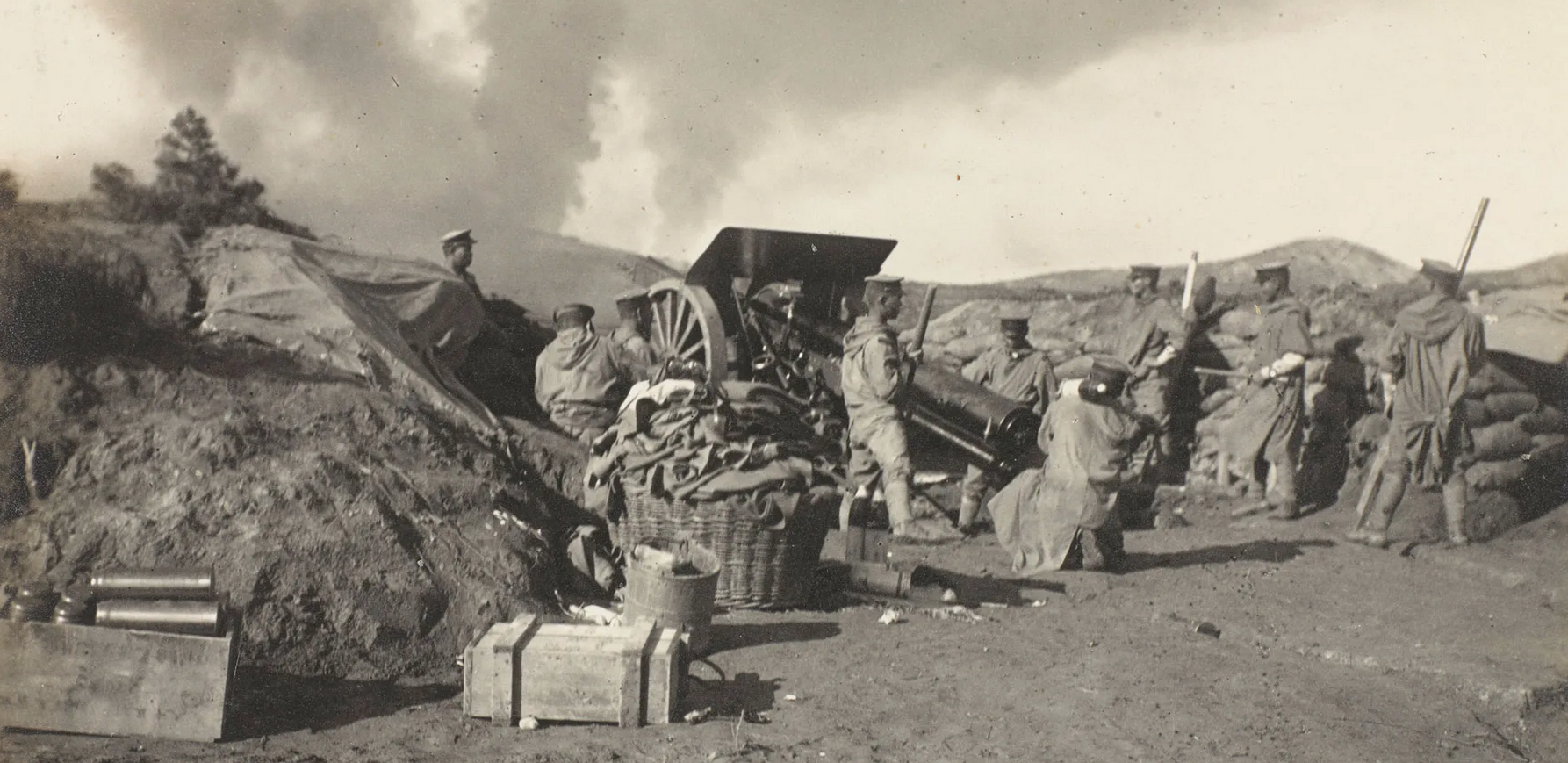
Another surprise (at least to this woefully ignorant reader) was to learn that Japan and Britain fought together to drive Germany out of Chinese city of Tsingtao (below) between August and November 1914. It is a sobering reflection on the fragile nature of national alliances to think that less than a decade earlier, Japan and Russia locked horns in a savage war. Now, they were, notionally, allies in a war against Germany.

As autumn turned into winter, the major powers were all unsteady on their feet. The French had suffered astonishing losses in the east, but had engineered a miracle on The Marne. Germany’s relentless advance through Belgium had been thwarted, and they had back-pedalled in disarray to dig in north of The Aisne. Despite the debacle at Tannenberg, Russia had inflicted a monstrous defeat on Austria Hungary in Galicia. This account, from a Hapsburg officer, is horrific :

‘Scenes from Dante’s Inferno were happening on the road. Driven by instinct, both men and horses pressed forward, regardless of the corpses and wounded lying on the ground. Horses hooves were treading over bellies and heads. Intestines, guts, brains mixed with mud covered the road with a bloody mess. The screams of the wounded, men and horses, together with the cracking rifles, grenade and shell explosions drove one to near insanity.’

I am always intrigued by writing partnerships, and ponder the (largely irrelevant) question, “Who did what?” Whatever the respective inputs were here, Churchill and Eberholst have written a book that is historically authoritative but always accessible. UK Great War literature tends, for quite laudable reasons, centred on the Western Front and the great calamities that took place there, but here we have a timely reminder of the days before the trenches were dug “from Switzerland to the sea” and the horrific slaughter that took place in places with names that have long since vanished from the map. Ring of Fire will be published by Apollo on 8th May.

THE RABBITS . . . Between the covers

rabbits spine029 copy

Most writers welcome commercial success, film and TV tie-ins and celebrity. I can’t think that it has happened in my lifetime, but just occasionally, a writer has come close to cursing the character or series of books which made them famous. One such was Sir Arthur Conan Doyle, who came to hate his most inspired creation and had to be persuaded, after killing him off, to engineer a miraculous escape. Another was AA Milne. Winnie The Pooh has probably made even money – and continues to do so – than the great Consulting Detective, but the little bear and its owner Christoper Robin, became not just an irritant, but the cause of family strife and bitterness.

Like Conan Doyle, Milne wanted to be known for much more than creating a whimsical children’s character but, sadly, most of his other work is now largely forgotten or ignored. I, for one, am delighted that some of his work, originally published as sketches in Punch, has been revived by Farrago, which is an imprint of Duckworth Books. These pieces are, as you might imagine, relatively short, as befits something to be read in a weekly magazine. They are an account of the social life of a group of young people who call themselves The Rabbits. The group comprises Archie Mannering, his sister Myra, a chap only known as Thomas from The Admiralty, Dahlia Blair and the narrator himself. There is also a chap called Simpson (who writes for The Spectator) and  ‘walk-on’ parts for various other characters.

What we have, is basically a group of twenty-somethings, each from an impeccable upper middle-class background, with time – and money – on their hands. The time span is from summer 1909 to the spring of 1914, and we follow ‘The Lop-Eared Ones’ as they and enjoy themselves in a villa between Mentone and Monte Carlo, play cricket, golf, and become involved in amateur dramatics:

“Thomas, I will be frank with you. I am no less a person then the Emperor Bong’s hereditary (it had been in the family for years) Grand Rat-catcher. The real rush, however, comes in the afternoon. My speciality is young ones.”
“I am his executioner!”
“And he has a conjurer too. What a staff!
Hail, good morning, Simpson. are you anything lofty?”
“I am the emperor bong” said Simpson gaily;
“I am beautiful clever and strong,
‘Tis my daily delight to carouse and to fight
And at moments I burst into song.”

They ski in Switzerland:

It was a day of colour straight from heaven. On either side the dazzling whiteness of the snow; above, the deep blue of the skies; in front of me the glorious apricot of Simpson’s winter suiting. London seemed 100 years away. It was impossible to work up the least interest in the Home Rule Bill, the billiards tournament, or the state of Saint Paul’s Cathedral.”

Our narrator does his best to be interested in someone else’s baby:

“I turned and saw Archie.
“Yours, I  believe”, I said, and I waved him to the cradle.
Archie bent down and tickled  the baby’s chin, making appropriate noises – one of the things a father has to learn to do.
“Who do you think he’s like?”, he asked proudly.
“The late Mr Gladstone”, I said, after deep thought.”

Screen Shot 2024-03-15 at 17.59.38The humour is very gentle, and the mood is as light as a feather. The stories are more or less contemporary with early PG Wodehouse creations like Stanley Featherstonehaugh Ukridge and Psmith, but the humour is very different. Put it this way; I read Wodehouse and sometimes laugh out loud, while the doings of The Rabbits evoke more of a fond smile. Incidentally, later in their lives, relations between Milne (left) and Wodehouse were distinctly frosty. Milne was a genuine patriot. He served with The Royal Warwickshire Regiment on the Somme in 1916, and after a spell recuperating from trench fever he worked in military intelligence. During WW2 he served with The Home Guard, and it was during this period that he became one of the harshest critics of Wodehouse, who had been interned by the Nazis in France, but made a series of very controversial broadcasts.

It is worth spending a moment or two considering the nature of humour. Is cruelty essential? Near contemporaries of Milne were George and Weedon Grossmith. Their Diary of a Nobody is one of the funniest books ever written and, for page after page, we laugh (and, perhaps, sneer) at the pomposity and misfortunes of Mr Pooter; it is worth remembering though that, at the end, Pooter is acclaimed by his boss as one of the most decent and loyal employees he has ever had. Milne’s book has not a single ounce of cruelty in it; the foibles of Archie, Simpson and others are observed gently and with affection.

Edward VII died in May 1910, but his passing goes unmentioned by The Rabbits. It’s not that kind of book. We still have in our minds, though, the notion that the events of late August 1914, just four months after the last episode in this book, saw that last glorious summer left over from the Edwardian era as a golden light which was to be snuffed out by the horrors of The Great War. We know that Milne himself survived, but it is inevitable that many of the real young men typified in The Rabbits did not. Those celebrated four words of Philip Larkins have never sounded more appropriate – Never Such Innocence Again.

THE MANNEQUIN HOUSE . . . Between the covers

Mannequin header

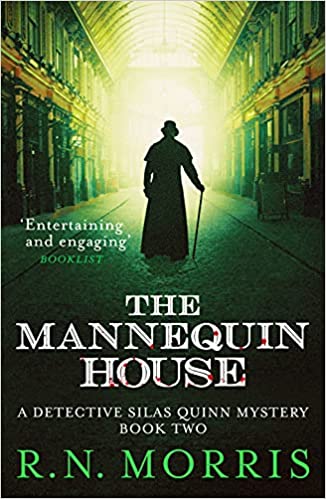
I do love the mysterious world of Detective Inspector Silas Quinn, RN Morris’s rather distinctive London copper from the 1900s. For reviews of earlier novels Summon Up The Blood, The White Feather Killer and The Music Box Enigma click the links. I say “earlier”, but it’s not that simple, as the Silas Quinn books are being reissued by a new publisher, having coming out a few years ago, but since the events they describe are all from a very narrow time frame, the actual chronology doesn’t matter too much.

MannequinQuinn and his sergeants – Inchball and Macadam – are The Special Crimes Department of the Metropolitan Police. This department has a passing resemblance to Christopher Fowler’s Peculiar Crimes Unit (Rest In Peace) insofar as the unit has been constructed around the unique talents of its lead investigator. Like Arthur Bryant, Silas Quinn has strange gifts, and is just as likely to exasperate his superior officers as win their praise, but he is a bloody good copper.
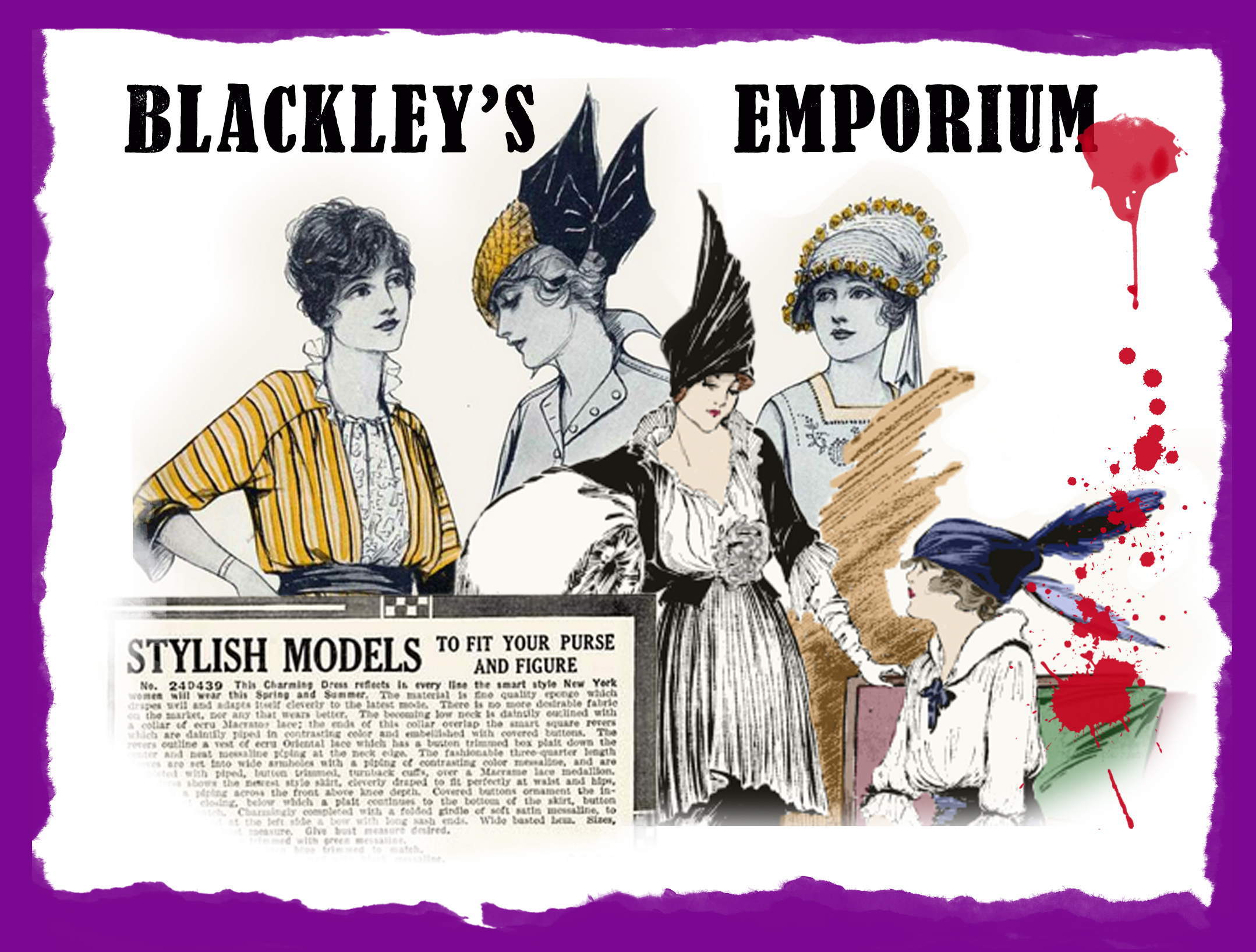
It is March 1914, and most of the citizens of London go about their bustling business oblivious to the gathering storm which would break over their heads in just a few months. Blackley’s Emporium is one of the most successful department stores in the city. You can buy anything and everything that is made, mined or grown on God’s earth, and you may even be greeted by the beaming proprietor himself as you walk through the doors. You can even – should you be minded to take a break from spending money – visit the in-house menagerie which is full of weird and exotic creatures.

One of Benjamin Blackley’s most profitable departments is his haute couture fashion house, where (plus ça change) slender young women wearing must-have gowns and fripperies parade in front of not-so-slender older women. Blackley ‘keeps’ – and I use the word advisedly – his slips of things in a suburban house, presided over by a formidable matron. When the most beautiful of these mannequins – Amélie – doesn’t turn up for work, and her room is found locked from the inside, the police are called. Two things happen when the door is eventually opened. First, an enraged Macaque monkey runs screaming from the room and, second, Amélie has a very good excuse for missing work, as she is dead on her bed, strangled with a silk scarf.The subsequent post-mortem examination reveals that the girl may have been raped, and also that she has maintained her desirability as a fashion model by disastrous self-abuse of her body. 

Morris takes the classic ‘locked room’ trope and has his wicked way with it. There is some knockabout comedy in this book, particularly with Quinn’s wildly contrasting underlings Inchball and Macadam, but there is a vein of darker material running through the narrative. Quinn may be a clever copper, but he is also psychologically damaged from a traumatic childhood. The uneasy personal dynamics between fellow lodgers at the house where Quinn sleeps are a signal that the detective is not at ease with other people. It has to be said, that later (already available) Silas Quinn novels shine a revealing light on this situation. There is great fun to be had within the pages of The Mannequin House, but we are never far away from the evil that men (and women) do, and you must be prepared for a rather shocking and violent end to the story.

As ever, Roger Morris gives us a delicious mystery, a totally authentic background and an absorbing book into which we can escape for a few precious hours. The Mannequin House was first published in 2013, but this new paperback edition from Canelo is out now.

Blackleys

SUMMON UP THE BLOOD . . . Between the covers


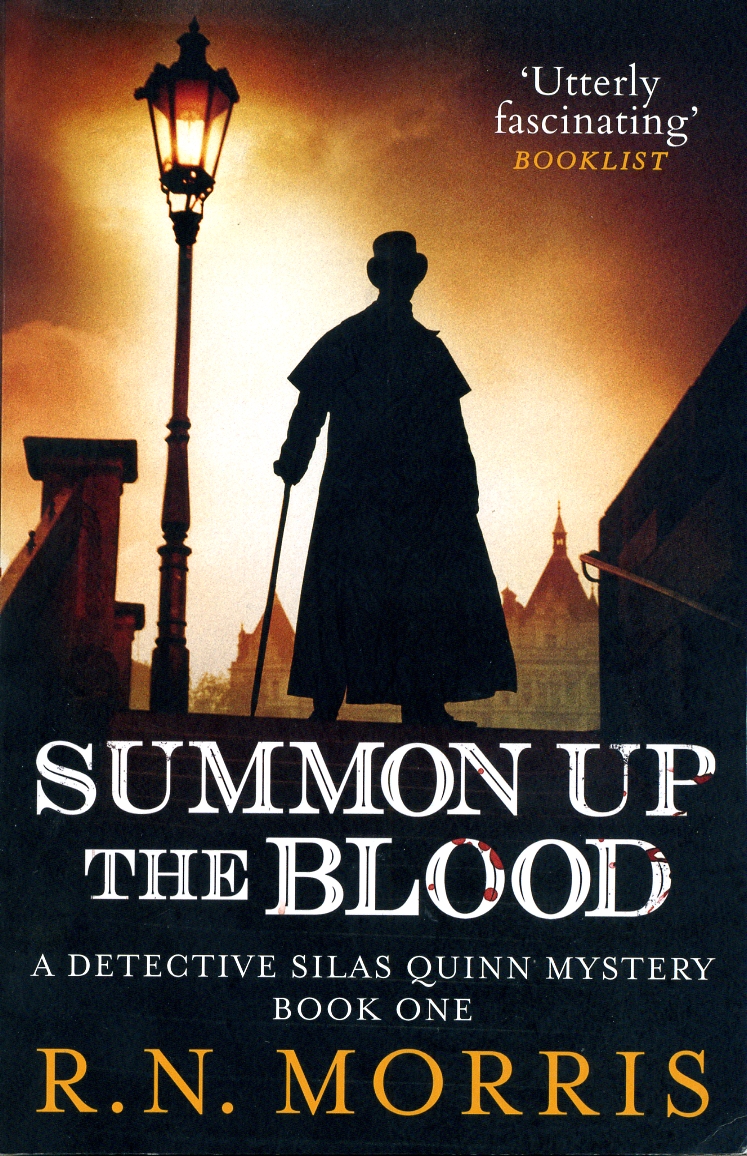
This is a recent edition of a book that was first published by Severn House in 2012, and was the first in a continuing series featuring an unusual Metropolitan Police detective, Inspector Silas Quinn. We are in 1914, a few months before the outbreak of The Great War. I have reviewed two others in the series, and the links are below.

The White Feather Killer (2019
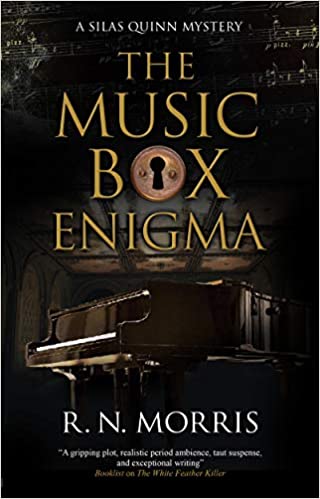
The Music Box Enigma (2020)

Is Summon Up The Blood any good, even if it is a reissue? An absolute and unequivocal “Yes!” from me. Quinn is an intriguing fellow. never at ease socially, particularly with women. He seems driven by his own demons – if demons they are – as he seeks to investigate the crimes that other men on the payroll of The Metropolitan Police can’t fathom (or perhaps can’t be bothered with) His  superior officers realise that Quinn has a certain talent, but one that does not fit well into the the day-to-day operations of the force. So, he has been shunted off into a siding where he can pursue his own lines of investigation, but not make himself an irritant to the establishment. Quinn is The Special Crimes Department of Scotland Yard and with the assistance of his sergeants Inchcape and Macadam he ploughs his own furrow.

When a rent boy is found dead, his throat cut from ear to ear, there is initially little interest by the police, as the lad is just assumed to have paid the price for being in a risky line of business, but when the post mortem reveals that he has had every drop of blood drained from his body, Quinn is summoned and told to investigate. After a droll episode where Quinn decides to pose as a man smitten by “the love that dare not speak its name”, and blunders around in a dodgy bookshop, but he does find out that the dead youngster was called Jimmy, and had links to a ‘gentleman’s club’ where he would find men appreciative of his talents.
After the episode in the bookshop, Quinn decides to take things one step further and, armed with a distinctive brand of cigarettes favoured by the homosexual demi-monde, he sets out to impersonate a potential customer of Jimmy and his friends. Let’s just say that this does not go well, but he manages to emulate the News of The World reporters of later decades, who used to pass themselves off as punters in brothels, strip clubs, drug dens and the rest, and would then close the resultant exposé with the words, “I made an excuse and left.

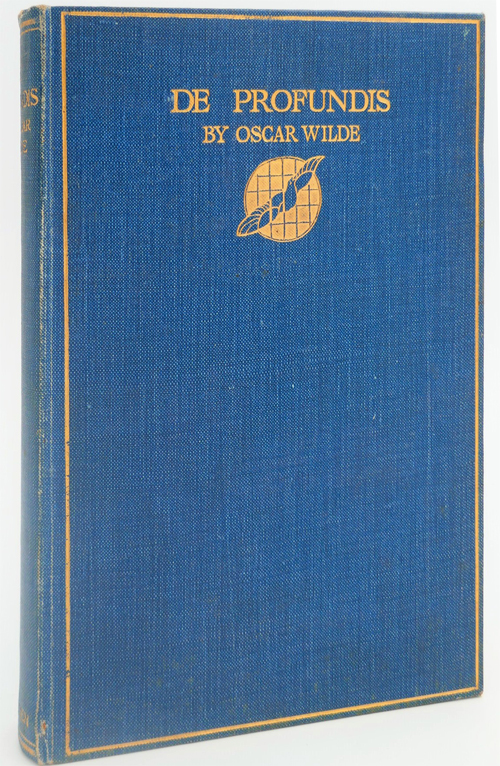
There are more deaths among what were known as renters, and Quinn’s frustration mounts. One of the enigmas is that the victims each possessed a silver cigarette case, inscribed with what appear to be literary quotes: it is not until Quinn learns that they all come from De Profundis, Oscar Wilde’s letter, written in Reading Gaol, to his lover Bosie, and subsequently published, that pieces of the proverbial jigsaw start to fit together.


Thankfully
, Morris makes no attempt to get in the politics of homosexuality and the law: his characters simply inhabit the world in which he puts them, and their thoughts, words and deeds resonate authentically. In 1914, remember, the trial of Oscar Wilde and the Cleveland Street Scandal were still part of folk memory. It’s an astonishing thought that had Morris been writing about similar murders, fifty years later in 1964, virtually nothing would have changed – think of the scandals involving such ‘big names’ as Tom Driberg, Robert Boothby and Ronnie Kray, and how their lives have been written up by such novelists as Jake Arnott, John Lawton and James Barlow.

As ever, Shakespeare said it first, but RN Morris has written a chilling and convincing murder mystery with an impeccably researched historical background. The book is an intriguing – and sometimes unnerving – mixture of grim violence, gallows humour, literary research, sexual degradation – and old fashioned detective work. Silas Quinn’s London of Spring 1914, blithely ignorant of the horrors that were to begin later in the year, is hypnotic and addictive. Summon Up The Blood is published by Canelo, and is out now.

THE MUSIC BOX ENIGMA . . . Between the covers (click for full screen)

TMBE header

Fans of period police procedurals are in for a treat at the end of the month when RN Morris’s distinctive London copper, Chief Superintendent Silas Quinn makes a welcome return. It’s December 1914, and the war that was meant to be over by Christmas is showing only signs of intensifying. DORA – the Defence of The Realm Act – has been enforced, and among the many strictures it imposes on the populace are imprisonment without trial, a ban on publishing any description of war or any news that is likely to cause any conflict between the public and military authorities and, bizarrely, an interdiction on buying rounds in pubs.

MBE coverBut Christmas is coming, and a rather upper-crust choir, The Hampstead Voices, is rehearsing for its seasonal concert, with all proceeds going to Belgian refugees, forced from their homes by the brutal Hun invaders. Directed by Sir Adrian Fonthill, the concert will include not only much-loved carols such as O Little Town of Bethlehem and Adeste Fideles, but choral works by Bizet and Handel. Special guest artistes will include dancers from Ballets Modernes and the distinguished violinist Emile Boland, but the evening will conclude with a performance of Sir Edward Elgar’s A Christmas Greeting, in the presence of the composer himself. It is also believed that Winston Churchill, First Lord of The Admiralty, will be in the audience at University College School on the evening of 24th December.

Silas Quinn may have many qualities, but a musical ear is not one of them, so how does he come to be involved in the doings of The Hampstead Voices? Rehearsals for the concert may not be going too well, perhaps due to the many tenors and basses who have answered the call to arms, but preparations take a distinct downturn when the Director of Music is found dead, slumped at his grand piano, with the sharpened handle of a tuning fork stuck into his ear. As boss of Scotland Yard’s Special Crimes Unit, Quinn is summoned to the scene of this musical murder.

It seems that the late Sir Adrian, despite his musical sensitivities, was not a paragon of virtue. He has a roving eye – and hands – for young sopranos and altos, and has a weakness for gambling which has left him in debt to some very dangerous people. But who stands to benefit from his death? Not those to whom he owes money,surely? A resentful husband, perhaps, who has been cuckolded?

MorrisAs Quinn tries to penetrate the wall of silence thrown up by Fonthill’s widow, his attention is drawn to a mysterious music box sent to Sir Adrian just before his death. When it is wound up and played, however, the resulting tune simply seems – even to Quinn’s tin ear – a haphazard sequence of random notes. But help is at hand. One of the Special Constables from Hampstead Police Station could be said to have an ear for music. He is none other than Sir Edward Elgar, celebrated composer of Salut d’Amour, Variations on an Original Theme and The Dream of Gerontius. Elgar takes the discordant melody and uncovers a message which rveals that Sir Adrian’s death is not to be the last associated with the ill-fated Christmas concert.

RN Morris (above right) gives us an inventive and delightfully improbable conclusion to this very readable novel. If you want something to lose yourself in for a few hours and a diversion to push to one side the misery and discomfort of the lock-down, then you will find nothing better than The Music Box Enigma. It is published by Severn House and will be out in hardback on 30th April.

For a review of an earlier Silas Quinn novel, The White Feather Killer, click here

Blog at WordPress.com.

Up ↑