
Search

fullybooked2017

Tag

12th century

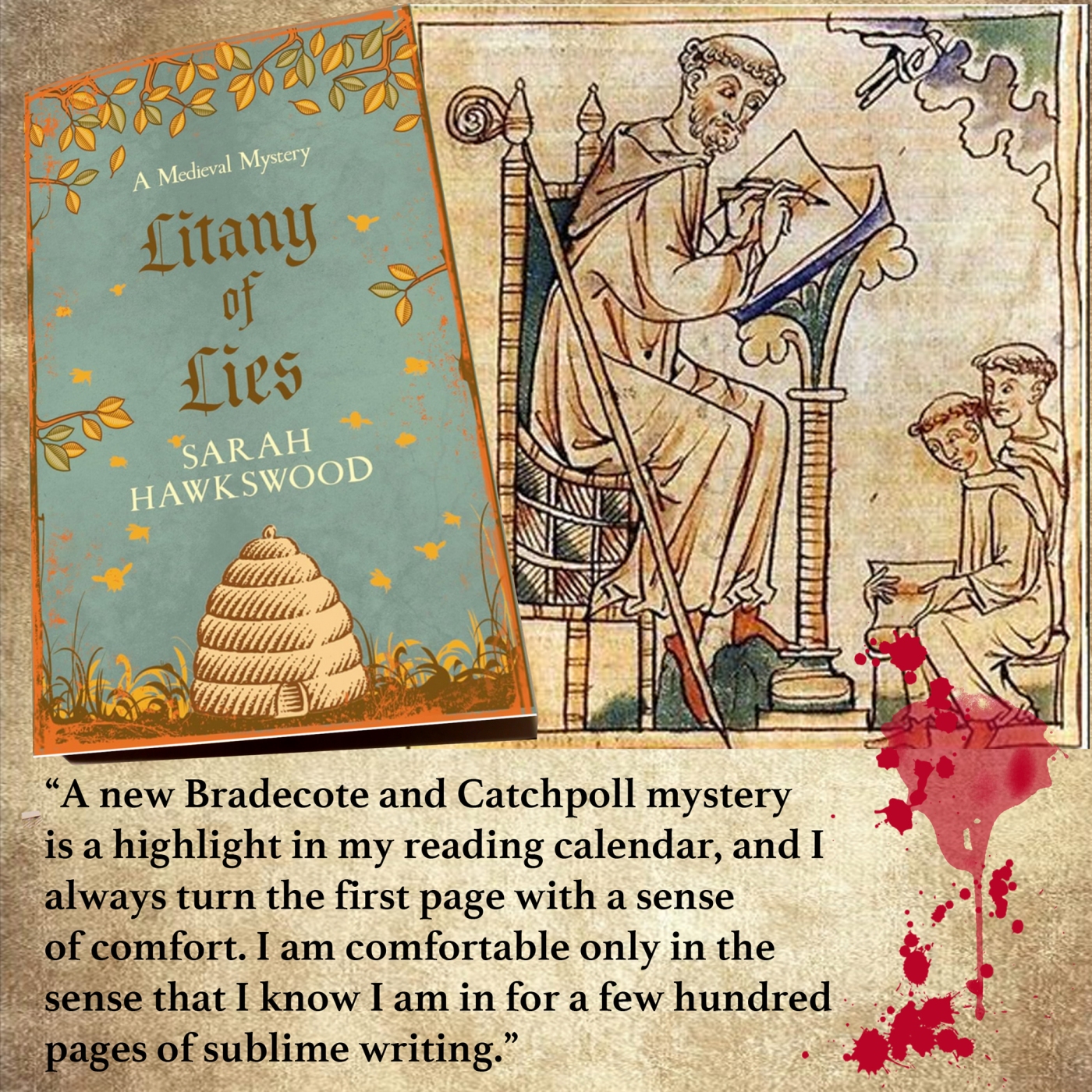
LITANY OF LIES . . . Between the covers

LOL header

We are back in 12th Century Worcestershire, with Undersheriff Hugh Bradecote and Serjeant Catchpoll. Together with Underserjeant Walkelin, they are sent to Evesham to investigate a body found at the bottom of deep shaft being dug for a new well. Evesham sits partly within a deep curve of the River Avon. Its most notable building is the Benedictine Abbey, but on the other side of the river, built to protect the bridge, is Bengeworth Castle. It is not a grand place. Built by the Beauchamp family, High Sheriffs of the county, on an earthen mound and surrounded by a palisade of wooden stakes, it is damp and insanitary.

The man at the bottom of the well pit is discovered to be Walter, Steward of the Abbot of Evesham. The main part of his job was to collect rents on behalf of the religious order, as they own most of land in the town. We know, as readers, that Walter was involved in a scuffle with another townsman, who bested him by cracking his head open with a rock, before rolling his body into the pit. Bradecote soon reaches the correct answer to the question, “how?” But, although learning the “why?”, of Walter’s death, it  some time before “who?” becomes apparent.

Relations between the Abbey authorities and the Bengeworth castellan and his soldiers are anything but cordial, and soldiers from the castle are suspected of stealing barrels of wine from the Abbey cellars, as well as illegally demanding a toll from everyone who enters the town via the bridge. When Bradecote examines documents at the Abbey, they show that Walter has been reporting several tradesman around the town as coming up short with the quarterly rent. This gives Sarah Hawkswood to tell us a little about the tradesmen in the town, and also serve a reminder of the occupational origins of some English surnames. We meet Aelred the Tailor, Baldwin the Dyer, Hubert the Mason and Martin the Fuller. The work of a Fuller was to take rolls of woven wool cloth and – by using some fairly unpleasant substances – remove all traces of grease, dirt (and worse) that remained in the cloth since it was wool on the sheep’s fleece.

Between them, Bradecote, Catchpoll and Walkelin interview the tradesmen, and find that each had paid their rents in full, and on time, to Steward Walter, leading to one conclusion only, and that was that Walter was ‘skimming off’ the rents, and taking a cut for himself. But it seems that none of the tenants knew that they were being cheated, so how could any of them have a motive for murder?

As the investigation seems to be going round in circles, another body is found. It is that of Old Cuthbert a bitter and lonely man. Years ago, he had been a Coppersmith, but found himself accused of murdering a local woman as a result of a love triangle. Taken before the justices, there was little evidence either for against him, and so he was subject to the barbaric Trial by Hot Iron. The accused had to hold a red hot iron bar in his hand and walk nine feet. If, after a few days, the wound healed, it was a sign that God pronounced him ‘not guilty’. If it festered, he was guilty, and would be hanged. Cuthbert was ‘not guilty’, but thereafter, his hand remained clenched as a fist, and so he was unable to carry on his skilled trade. Just about the only occupation left to him was that of a Walker in the fulling process, whereby he walked up and down all day in troughs of urine, treading – and therefore cleansing – the cloth in the liquid.

Of course, Bradecote and Catchpoll solve both murders, as we know they will. What lifts this book above the ordinary is Sarah Hawkswood’s magical recreation of a long lost world. Yes, it was a hard living by modern standards. Yes, medical interventions were scarce and mostly misguided. Yes, justice was rough and frequently random. But the description of the wonderful Worcestershire landscape, now mostly covered in concrete, car parks and convenience stores is sublime. The Avon is still unpolluted, and the Evesham Abbey bees still harvest pollen free of toxic chemicals. How the people in those days spoke to each other, or in what tongue or accent, neither the author nor I can have any real idea, but to me what Sarah Hawkswood has them saying sounds just about right.

A new Bradecote and Catchpoll mystery is a highlight in my reading calendar, and I always turn the first page with a sense of comfort. I am comfortable only in the sense that I know I am in for a few hundred pages of sublime writing. ‘ Comfort’ does not mean ‘ Cosy’, and Sarah Hawkswood continues to show us that greed, malice, vindictiveness and subterfuge were just as common in mid-12thC England as they would prove to be in 1930’s LA, or modern day London. Litany of Lies is published by Allison & Busby and is available now.


THE CHARTER OF OSWY AND LEOFLEDE . . . Between the covers

CHARTER HEADER

We are in the final decade of the twelfth century, in the market town of Wisbech, a place dominated by its Norman castle, and split by two rivers: the smaller, the Wysbeck is little more than a gentle stream, and can be crossed on stepping stones; the larger, the Welle Stream is more significant, and can only be crossed at high tide by ferry.

In the 124 years since England was conquered by the Normans, the old native tongue of the Saxons has become a foreign language, in both written and spoken forms. Sir John of Tilneye, a young man who was schooled in the old language by monks when just a boy, is called upon to translate an old manuscript which appears to be at the centre of a criminal conspiracy. Ostensibly, it is dull and tedious stuff relating transfers of land and property in the days before the Normans came. Someone, however, is convinced that it contains a clue to something extremely valuable.

Wisbech is neither more nor less lawless than other towns in the area, but when a series of fires and break-ins follow one after the other, the Bishop of Ely’s seneschal Sir Nicholas Drenge is determined to discover what is going on. Each of the incidents seems connected to a fatal fire which destroyed a house in the town. Its owner, Aelfric, who perished in the blaze, was Saxon nobility, but like most of his countrymen, all he had left was his memories. His lands and riches had long been appropriated by the descendants of the 7000 men who landed at Pevensey on 28th September 1066. So why burn down his house? What was he hiding? Drenge and his men-at-arms eventually catch the man who they think is the killer, but when he is murdered while in their custody, the mystery deepens.

Insofar as this is just a detective novel, Drenge is the principle character. No genius, perhaps, but steady and unwavering as he slowly unpicks the knot of lies, legends and loose connections that surround the mystery of Aelfric’s death. Diane Calton Smith gives us some fairly innocent romancing between Sir John and Rose de Hueste, the old man’s granddaughter, but above all she describes a place that is, literally, buried beneath the feet of townsfolk of modern Wisbech. The two rivers have traded identities to an extent. The inoffensive Wysbeck is now the deep and powerful tidal River Nene, while The Welle Stream – thanks to major 17thC drainage – shrank to being a canal in the 1800s, but was eventually filled in and is now a dual carriageway. As for the castle, it still carries the name, but is now merely a dilapidated Georgian house which no-one is quite sure what to do with.

Calton Smith weaves her plot this way and that, and doesn’t surrender the answers until the final pages. This is superior story-telling, and a magical glimpse into a world long since gone; that world created echoes, however, and if you listen attentively, they can still be heard. The Charter of Oswy and Leoflede is published by New Generation and is available now. I reviewed an earlier book by this author, and this link will take you there.

TOO GOOD TO HANG . . . Between the covers

TGTHheader

Confession time. I try to be honest and objective in my reviews, but there are certain authors who are so sure-footed that I know their novels will not disappoint, even before I have read the first page. One such is Sarah Hawkswood and her beguiling Bradecote series. They are not complicated. Central figure is Hugh Bradecote, noble of birth and Under-Sheriff of Worcestershire in the middle years of the 12th Century. I suppose he is the early medieval equivalent of a modern Detective Inspector and – like them – he has underlings. Bradecote is supported by the grizzled and worldly Sergeant Catchpoll and the Under Sergeant – a callow but rapidly maturing young man called Walkelin. My earlier reviews of the series can be found by clicking the link below:

https://fullybooked2017.com/tag/sarah-hawkswood/

This story begins in April 1145 with a terrible miscarriage of justice in a tiny hamlet called Ripple, the southernmost parish of Worcestershire. It is a real place, a beautiful village just north of Tewksbury. A young ploughman called Thorgar is about to be hanged for murder. He was found in the village church, crouched over the lifeless body of the priest, Father Edmund. Despite his protestations that he is unscyldig (Middle English – innocent), at the insistence of the Reeve, a man called Selewine, the villagers bear him away and he is hanged from an ancient oak tree. Thorgar’s sister Osgyth makes her way to Worcester and reports what she sees as the murder of her brother, which prompts Bradecote, Catchpoll and Walkelin to ride south to investigate.

They soon discover that Father Edmund’s death is linked to two deadly sins. The first is avarice; Thorgar, while ploughing has unearthed a treasure trove of silver artifacts – a priceless chalice, some coins and ornamental buckles dating back to Saxon times. The second is lust; this is far more sinister, as Father Edmund has been using his priestly influence to abuse young girls in Ripple, thus giving every angry father a motive for striking the ungodly cleric down.

Bradecote and his men eventually expose not one murderer – but two  – and there is a macabre finale when the respective killers are forced to disinter the mortal remains of their victims and take them to be given a Christian burial. Apart from the powerfully evocative atmosphere, this is a bloody good detective novel, but particularly impressive is the way Sara Hawkswood handles the dialogue. I suspect no-one has the faintest idea about how people spoke to each other in the 12th century, but the author establishes a style and sticks to it. As a long-time critic of what I consider to be botched attempts at authentic historical conversation in novels, I found Sarah Hawkswood’s method to be both satisfying and convincing.

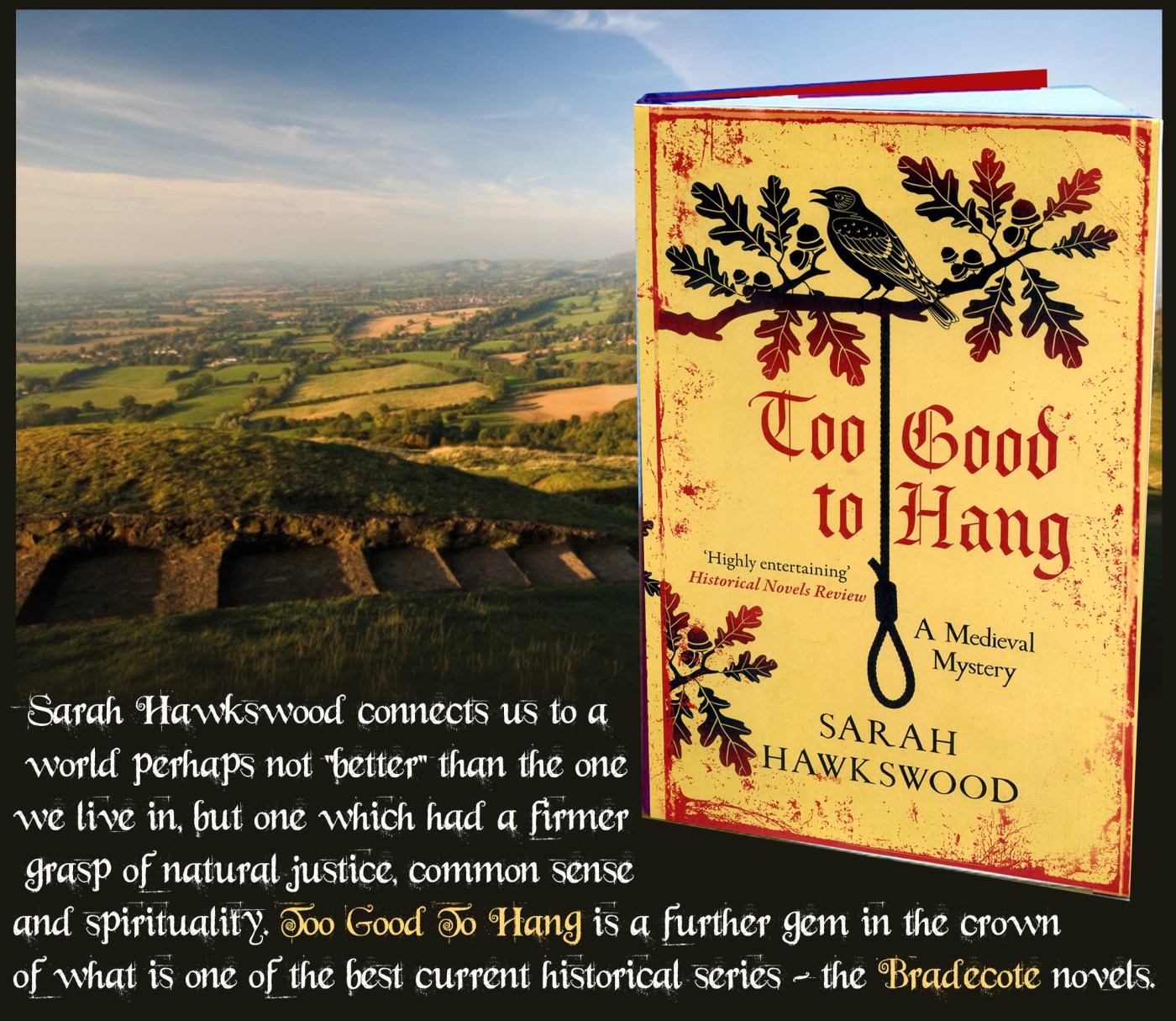
EM Forster’s most celebrated – and enigmatic – dictum was, “Only connect.” Taking him literally, my goodness how Sarah Hawkswood connects. She connects us to the wonderful landscape of the Worcestershire/Gloucestershire borders, overlooked by the golden heights of the Malvern Hills. She connects us to the powerful – and sometimes destructive – presence of the River Severn. She connects us to a time when poor people lived hard-scrabble lives, totally dependent upon the whims of nature and weather and almost umbilically bound to the central focus of every town, village and hamlet – the church. She connects us to a world, perhaps not “better” than the one we live in, but one which had a firmer grasp of natural justice, common sense and spirituality. Too Good To Hang is a further gem in the crown of what is one of the best current historical series – the Bradecote novels. It is published by Allison & Busby and will be out on 18th May.

A TASTE FOR KILLING . . . Between the covers

ATFK spine005

Sarah HawkswoodThose of us who are lucky enough to be sent printed copies of novels for review almost certainly have “keepers” – books which don’t go off to friends, free libraries or charity shops once they are read. Looking across at my shelves, I see books by Jim Kelly, Christopher Fowler, Philip Kerr, John Connolly, Phil Rickman, James Oswald, Peter Bartram – and Sarah Hawkswood (left). I was a late arrival at the ‘Bradecote Ball’, but these superb stories of medieval Worcester have joined my list of favourite books which I will not be parted from. A Taste For Killing is the tenth in this splendid series featuring the 12th century Worcester trio of Hugh Bradecote, Serjeant Catchpoll and Underserjeant Walkelin.

Blurb006

It is a bitter January afternoon in Worcester, 1145. The wells have frozen, the streets are empty, and decent folk are huddled around their fires. In the house of Godfrey Bowyer – remember the origin of many surnames – a skilled, but widely disliked maker of longbows, it is supper time. As Godfrey sups his pottage with his wife Blanche, the servants cower in another room, listening to the customary arguments and smashing of crockery. Godfey and Banche (his second wife) frequently disagree, but they are as one when it comes to the adage about it being better to let it all out than to keep it in. Tonight’s row takes an unexpected – and fatal – turn, as both Godfrey and Blanche collapse with the symptoms of poisoning. Blanche recovers quickly enough, but it is to be Godfrey’s last night on earth.

Catchpoll and Walkelin are summoned and are joined – reluctantly – by Bradecote, who was anxiously at the side of his heavily pregnant wife. She has miscarried before, and he is reluctant to leave her, but  suspected murder is what it is, and he joins his two colleagues. The row between Godfrey and Blanche which culminated in a dish of pottage (a soup thickened with grain, containing vegetables and – when available – meat) being thrown at the wall raises the crucial question – the contents of whose bowl redecorated the wall of the house? Was it Blanche’s, and did Godfrey then sup from the bowl intended for his wife? What was the poison, and who put it in the pottage?

It transpires that the Bowyer ménage is far from simple. Runild the servant girl is pregnant, but by whom? Alwin, Bowyer’s apprentice is out of the frame as he is too shy to even look at a girl, let alone do anything more physical, but there is another suspect. The late Godfrey’s  hands often followed not far behind his roving eye, as more than one Worcester woman can testify. Furthermore, what was Blanche’s relationship with the Steward of Worcester Castle, Simon Furneaux, a pompous individual who has a hate-hate relationship with Hugh Bradecote? There was little love lost between Godfrey Bowyer and his younger brother Herluin the Stringere, also a maker of bows, and a man who has his eyes on his late brother’s business. There is even a rumour that they do not share the same father.

medieval-bow-maker_bowyer

One of the many captivating qualities of this book is the reminder of the potent symbolism of the Yew tree in human history. The traditional home of the Yew tree in England is the village churchyard, and there is a deep irony that its wood was used to produce the fine – and lethal – bows that were to dominate medieval warfare. The Yew is also a more direct cause of death, however, as its wood contains toxins that bow makers had to wash from their hands before eating, and the seeds in the delightful red berries contain a deadly alkaloid.

When there is yet another death in the Bowyer household, a local herbalist and bone-setter called Roger the Healer, who has thus far been on the fringe of events, takes centre stage. He suspects that Yew killed Godfrey Bowyer, but a glance at the cover of the novel will give readers a clue as to what caused the second tragedy.

The chemistry between Bradecote, Catchpoll and Walkelin is a work of alchemy in itself. Bradecote is, I suppose, minor nobility, quick-witted and well educated, while Catchpoll is grizzled, rough round the edges, but wily. Walkelin, in the earlier books, was simply a clever but callow lad. Now, however, he uses his apparent naivety and lack of guile to extract information from people who would otherwise be too deferential to Bradecote, or too fearful of Catchpoll’s reputation as a street fighter.

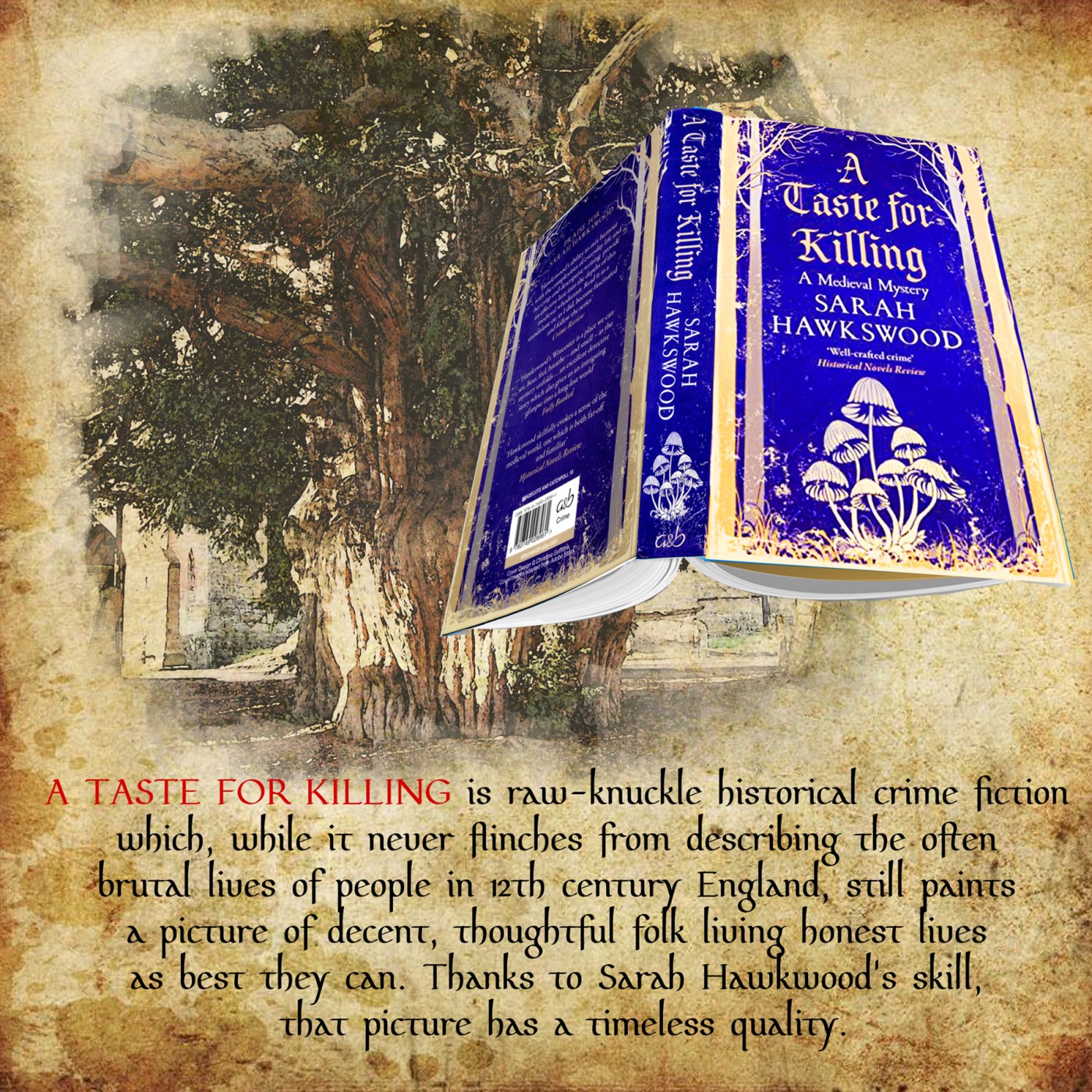
A Taste For Killing is raw-knuckle historical crime fiction which, while it never flinches from describing the often brutal lives of people in 12th century England, still paints a picture of decent, thoughtful folk living honest lives as best they can. Thanks to Sarah Hawkwood’s skill, that picture has a timeless quality. The book is published by Allison & Busby and is out today, 12th May. Click on the images below for my reviews of earlier books in the series.

ROS

BRT

WATD

Blog at WordPress.com.

Up ↑