
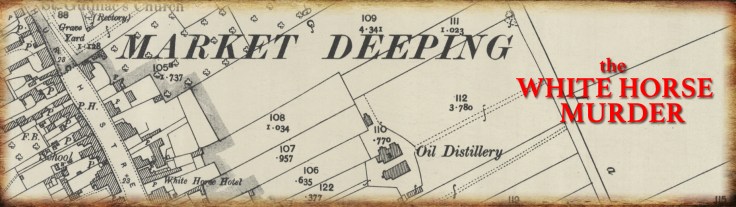
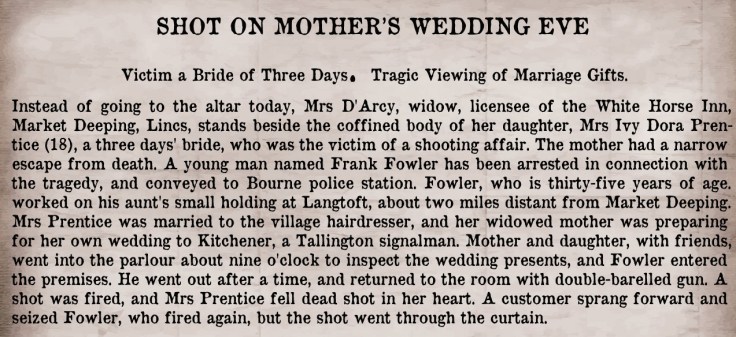
SO FAR – Market Deeping, Lincolnshire. September 1922. On Wednesday 20th, 18 year-old Ivy Dora D’Arcy had married her sweetheart, George Prentice. On the following Monday, her widowed mother Edith – landlady of The White Horse – was to remarry. At around 9.00pm on Saturday 23rd, Edith, Ivy, her sister Gertrude, and Edith’s soon-to-be daughter in law Eva are examining wedding presents in a back parlour, lit only by a candle. As ever, what happened next is vividly described by a local newspaper:
At the coroner’s inquest on Monday 25th September, Edith D’Arcy explained that she was now Mrs Kitchener. Her new husband’s rather hard-hearted employers The Great Northern Railway Company, had refused to extend his leave of absence despite the tragedy, and so they had been married just an hour or so before arriving at the inquest. They are pictured below.
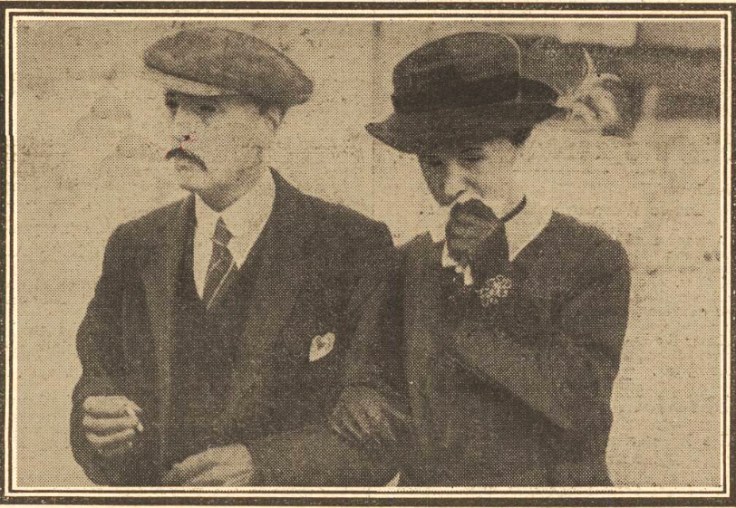
Barely managing to keep her composure, she told the court that in the darkness, no-one realised what had actually happened. She said:
“Gertrude cried, “Bring a light, Ivy has been shot. I got some matches and lit the gas, and I saw them lifting Ivy onto a chair. She was smothered in blood, and a big clot of blood as big as my hand lay on her lap.”
What she saw was described in more chillingly anatomical terms by the doctor who was called to the scene:
“Dr. Benson stated that he was called to The White Horse Hotel soon after 9.20, on Saturday evening. Deceased was dead on his arrival. Her clothing was saturated with blood, and there was a 2½ inches by 3 inches wound on the left breast, whilst several ribs were smashed. A large cavity was formed In the thorax. The full charge from the gun had entered her chest at close range, from close range. Death was instantaneous, and due to haemorrage and shock. The wound was consistent with having been caused by the charge of a sporting gun such as that produced.”
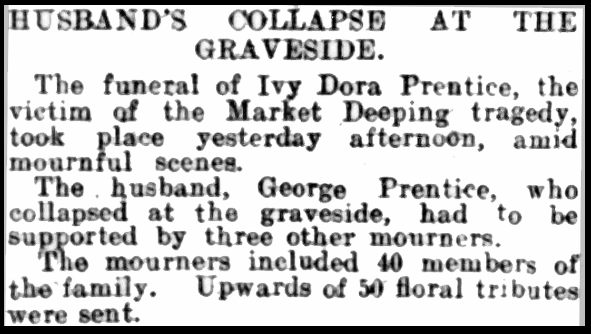
It is almost impossible to imagine the devastating effect this murder would have had on George Prentice. For three days he had a lovely young wife with the promise of children and years of happiness. Because of an instant of jealous rage, those dreams lay in tatters. He is pictured below, the man on the right, supported by a friend, arriving at the inquest.

Worse was to come for George Prentice. He had to watch as his young wife was lowered into the ground on Wednesday 27th September while the solemn words of the burial sentences were intoned.
I am the resurrection and the life, saith the Lord : he that believeth in me, though he were dead, yet Shall He live: and whosoever liveth and believeth in me shall never die.
I know that my Redeemer liveth, and that he shalt stand at the latter day upon the earth.
And though after my skin worms destroy this body, yet in my flesh shall I see God:
Whom I shall see for myself, and mine eyes shall behold, and not another.
It is hardly surprising that the occasion was too much for George Prentice to bear.
Ivy’s grave is very weathered, but can still be found in Market Deeping cemetery.


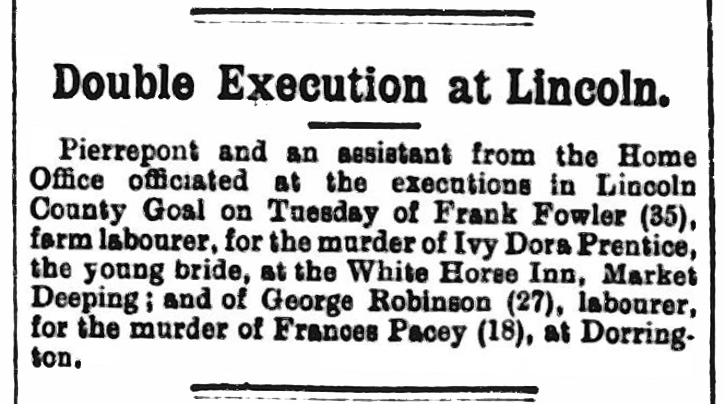
As for Fowler, (pictured left, leaving the inquest) he was clearly as guilty as sin. In his mind he had painted a picture in which he and Ivy D’Arcy were destined to be man and wife, despite the lack of any encouragement on her part. He was sent for trial at the autumn assizes in Lincoln, and it wasn’t until the jury found him guilty of murder, and the death sentence had been imposed by Mr Justice Lush that his defence team decided to ask for a a repeal on the grounds of insanity. This was rejected, and Fowler was booked in for an appointment with the formidable Thomas Pierrepoint, (right). 13th December 1922 was a bad day for Lincolnshire, as the double execution despatched two men of the county, Fowler and a man called George Robinson who had murdered another 18 year-old girl in Dorrington.
As for Fowler’s motivation, one has to accept Edith Kitchener’s statement that there was never anything between Fowler and her late daughter. Whatever relationship there was must have existed purely in his own head. At the time of the shooting he was heard to say, “Now I’ve had my revenge.” He had determined that if he couldn’t have Ivy Dora D’Arcy, then no-one would.
These stories would wander interminably if we followed the future lives of the surviving participants, but thanks to Chris Berry, whose family tree Ivy D’Arcy is part of, I can add that George Prentice married again in 1927, to a woman called Florence Taylor. He died in October 1960, leaving the tidy sum of £20315 which is close on £330000 in today’s money. Edith and William Kitchener were recorded as living in Tallington in the 1939 register. She died in the spring of 1945, aged 75, while William died in the spring of 1951.
FOR MORE TALES OF MURDER AND TRAGEDY IN LINCOLNSHIRE
CLICK THE IMAGE BELOW

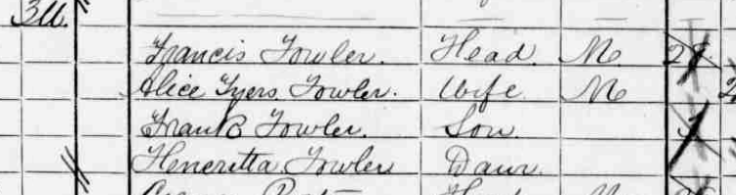
 By 1901, however, he is still living in Langtoft, but with his grandparents Henry and Alice Rosling. His parents, along with daughter Henrietta and a younger son, Robert, had moved to Pickworth, 8 miles east of Grantham. One can only speculate why they left Frank – still only fourteen – behind. It is possible that there was no sinister reason behind this, as by then he may have been working, but it is not mentioned on the census return. In 1911 he is still living with his grandfather – now a widower – and certainly working on a farm. It seems he was either conscripted or joined up to fight in The Great War (pictured left), survived, and returned to Lincolnshire. In 1922 he was managing a farm owned by his aunt, a Mrs Ormer, and was a regular customer at The White Horse. It also seems he had developed an interest in the landlady’s daughter – Ivy Dora D’Arcy.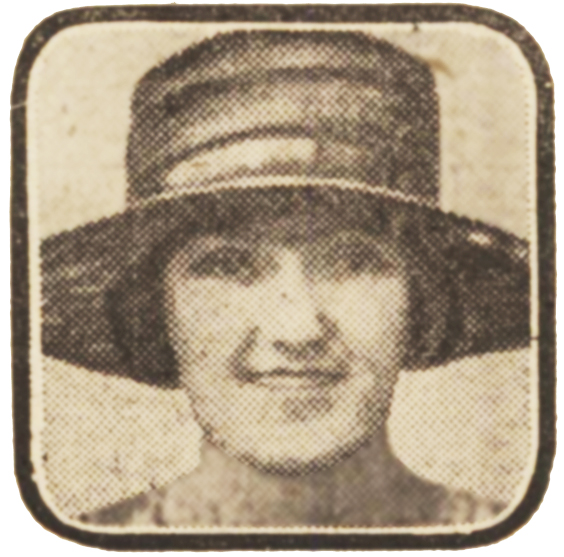


 That is just a quick sample of the whip-crack dialogue in the book, which fizzles and sparks like electricity across terminals. Very soon Mari and Derek realise that the blackmailed judge is also connected to the unsolved murder of a French duel-passport student, Sophie Michaud, and the fate of two women journalists who investigated the case, one of whom is dead and the other missing.
 In the end, the blackmailer of the judge is located, and the killer of Sophie/Sasha is brought to justice, but with literally the last sentence, Lisa Towles poses another puzzle which will presumably be addressed in the next book. Hot House is everything a California PI novel should be. It has pace, great dialogue, totally credible characters and a pass-the-parcel mystery where Lisa Towles (right) has great fun describing how Ellwyn and Abernathy peel back the layers to get to the truth. Sure, the pair might not yet stand shoulder to shoulder with Marlowe, Spade and Archer, or even more modern characters like Bosch and Cole, but they have arrived, and something tells me they are here to stay.


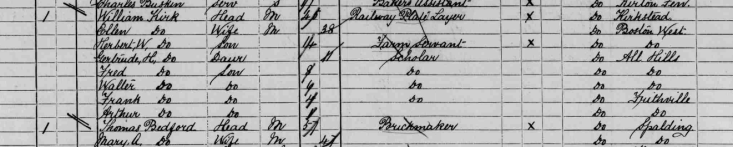
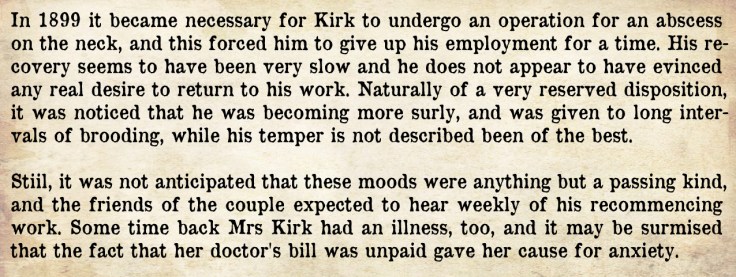
 Inevitably, William Kirk was found guilty of murder, and his case was sent to the July Assizes in Lincoln. The trial, presided over by Mr Justice Wright (left) was a formality, and Kirk was sentenced to be hanged. Just days before he was due to meet James Billington for the first – and only time – the powers that be judged that he was insane at the time of the killed his wife, and he was reprieved, and sent to Broadmoor.




 Late again! My excuse is that I am a one-man-band here at Fully Booked, and notwithstanding the occasional erudite contribution from Stuart Radmore (who has forgotten more about crime fiction than most people will ever know), there are only so many books I can read and review properly. My first experience of Peterborough copper DI Barton is the fifth of the series (written by Ross Greenwood), The Fire Killer. Peterborough is a big place, at least for us Fenland townies, but is rarely featured in CriFi novels. I am pretty sure that Peter Robinson’s DI Banks grew up there (The Summer That Never Was) and Eva Dolan’s Zigic and Ferreira books are certainly set in the city.
 Ross Greenwood (right) has fun inviting us to make out own guesses, but also makes the game a little more interesting by giving us intermittent chapters narrated by The Fire Killer, but he is very wary about giving us too many clues. The dead girl, Jess Craven had been involved with a very rich dentist with links – as a customer – to the London drug trade.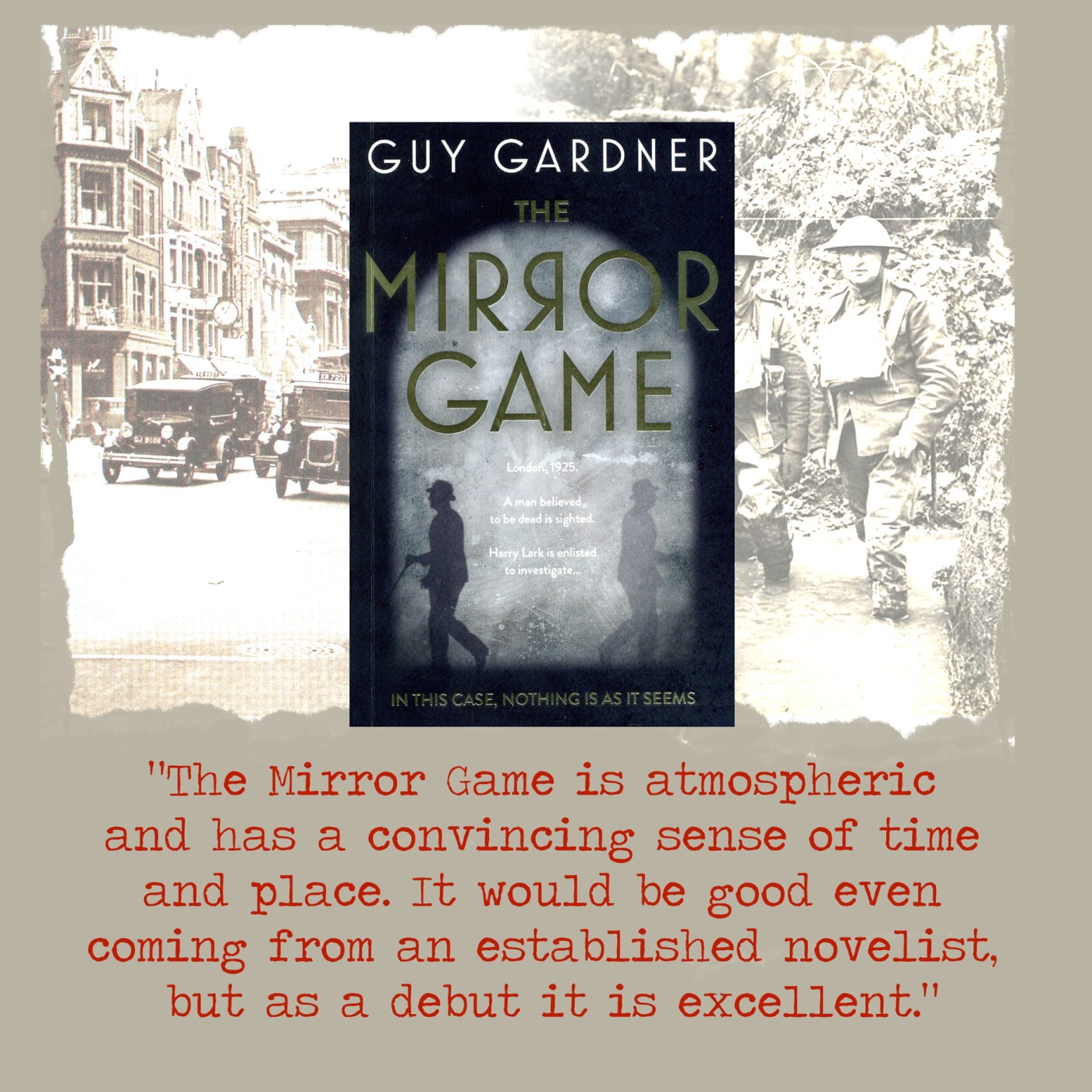

 Investigator and journalist Harry Lark fought for King and Country and emerged relatively unscathed although, like so many other men, the sounds, smells and images of the trenches are ever present at the back of his mind and he has also become addicted to laudanum – a tincture of opium and alcohol. When he is contacted by a friend and benefactor, Lady Charlotte Carlisle, she tells him that she thinks she has seen a ghost. Sitting in Mayfair’s Café Boheme, she has seen a man who is the image of Captain Adrian Harcourt, a pre-war politician who was killed on the Western Front in 1918, and was engaged to be married to her daughter Ferderica. But this man is no phantom who can fade into the wallpaper. Other customers notice him. He is flesh and blood, and approaches Lady Charlotte’s table, stares into her eyes, but then leaves without saying a word. She asks Lark to investigate.
 company, and that some seriously well-connected people have ensured that the truth about their demise has been successfully covered up. Iver’s son has been committed to an institution for mentally and physically damaged WW1 soldiers, and Filton Hall is Harry’s next port of call.


 Lesley Kara (left) specialises in creating tension between ordinary people in humdrum surroundings – in other words, normal circumstances experienced by the vast majority of us. I reviewed her excellent debut novel The Rumour, and her new book is centred around – as the name suggests – a murder that took place above Scarlett’s flat. The victim was her aunt, and as Scarlett tries to live as normal a life as possible with such a terrible event – almost literally – hanging over her head, it is up to her to make the funeral arrangements for her relative. As she does so, she meets Dee, the funeral director. Dee has problems of her own, but an unexpected link binds the two women together, and both are now in terrible danger.
  For the uninitiated, Merrily Watkins is a single mum, and vicar of a village in Herefordshire. She also serves as Diocesan Deliverance Consultant – aka an exorcist. The series began in 1998 with The Wine of Angels, and seemed to have terminated rather abruptly with All of a Winter’s Night in 2017. A new book titled For The Hell of It was billed to come out in 2020, but this seems to have been reimagined as The Fever of the World. Here, Merrily becomes involved in a murder investigation led by local copper David Vaynor who, in a previous life, was an expert in the poetry of William Wordsworth. Aficionados of the work of Wordsworth may well recognise the provenance of the book’s title, taken from the poem composed on the banks of the River Wye near Tintern Abbey:





 fullybooked2017