Search

fullybooked2017

DON’T LOOK BACK . . . Between the covers

DLB header
Having had the pleasure of meeting Jo Spain
, I can tell you that she is a delightful person. That said, when she is in writing mode, don’t believe a word she says. Away from her superb police procedural series featuring Dublin copper Tom Reynolds, she has written several stand-alone thrillers, in which she practices to deceive. In The Perfect Lie, she bowled us a Googly or, for American readers, threw us a massive curve-ball:

THE PERFECT LIE . . . Between the covers

In Don’t Look Back she runs through the complete repertoire of her trickery. She tells us the main characters are:
Luke Miller: A decent – but driven – investment banker who fall in love with, and marries –
Rose Miller: An Irish lass, née Gillespie, now a teacher in London and married to Luke, Has an abusive ex boyfriend called:
Kevin Davidson: A member of a rich and powerful Donegal family, whose wealth may not have been acquired entirely legally.
Mickey Sheils: A former lawyer, and onetime lover of Luke Miller. Originally from Ireland, now working in London to protect abused women from their abusive former partners. Able to act mostly pro-bono, thanks to her marriage to:
Nathan Sheils: A big man in The City, formerly Luke’s boss.

Be prepared, however, for some of these people to be –  how best to put it? –  not entirely who they appear to be. The story starts off in a fairly straightforward manner. Rose and Luke are married, but due to Rose’s trauma at the hands of Kevin Davidson, their courtship had been a case of two steps forward, one step back. Rose turns up at Luke’s workplace, complete with airline tickets and packed bags, and announces that she has arranged a super surprise – a delayed honeymoon on the idyllic Caribbean island of Saint-Thérèse. Their stay is blissful, but on the last night, Luke senses that Rose has become agitated and distracted. Then, she blurts out that they cannot possibly be on their return flight to London the next day.

The reason? Because on the floor of their bedroom in Luke’s flat, lying there since the day they left for Saint-Thérèse, is a corpse. It is the mortal remains of Kevin Davidson, who had been stalking Rose for weeks, and finally made his big appearance. They had fought, Rose had pushed him, he lost his footing and cracked his skull – with fatal consequences – on the sharp edger of a very solid  piece of Edwardian furniture. Rose’s initial panic had metamorphosed into a plan. A desperate one, yes, but a temporary solution. Luke’s flat is the only one occupied on that floor, and its remoteness would give them at least a few days’ grace.

Screen Shot 2023-05-03 at 20.06.33

Luke books them out of their hotel and, despite having had a fairly frosty relationship with Mickey Sheils since he ended their affair, he calls her and asks her to go to his flat and investigate. Reluctantly, she does, but when she gets there, guess what? There is plenty of dried blood – but no body.

What follows is classic Jo Spain (left). One block at a time, she kicks away the supports of what we think we know about what is going on. I read the book on my Kindle, and even when it said 99%, there was time for one more surprise. This is wonderfully inventive stuff, and shows that one of Ireland’s finest writers is at the top of her game. As a footnote, I enjoyed the dramatic contrast in settings, with the tropical tourist paradise of Saint-Thérèse starkly juxtaposed against the bleak Donegal coast, where the icy horizontal rain takes no prisoners. Don’t Look Back is published by Quercus, and will be available on 11th May.

THE POSTMAN DELIVERS . . . Fox & Parks

TPD HEADER NEW

THE FASCINATION by Essie Fox

Victorians loved a freak. Think of Joseph Merrick. Think of The Bearded Lady and The Crocodile Woman at traveling funfairs. Are we any better today? Think of Dylan Mulvaney, and I guess not. However, to the book. Twin sisters Keziah and Tilly Lovell are far from identical. They are both fifteen years old, but Tilly hasn’t grown an inch since she was five. Their father uses the pair to promote a fake elixir at his traveling show, but then he sells them to a mysterious Italian impresario, known as ‘Captain’, who senses an opportunity to make money. All roads lead to London, where within Dr Summerwell’s Museum of Anatomy, the twins meet a young man called Theo, and are drawn into a web of intrigue, deceit and criminality. This is published by Orenda Books, and will be out on 22nd June.

TO DIE IN JUNE by Alan Parks

The blurb says, “ONE LOST CHILD. TWO MEN DEAD. A MIDSUMMER NIGHTMARE. This is the sixth in the Harry McCoy series, which is new to me, but the book sounds a cracker. A word-association test using the word ‘Glasgow’ would, certainly among crime fiction fans, produce obvious results. Hashtags might include:

#grit #violence #deprivation #noir #murder #drugs #gangs #extortion #hardman

McCoy investigates the disappearance of a boy, whose parents are devotees of a a bizarre cult, The Church of Christ’s Sufferings. At the same time, reports come in of unexplained poisonings among the city’s down-and-out community. McCoy has a dog in this fight. His own father is one of the dispossed. Throw into this toxic mix a case of police corruption which McCoy cannot ignore, and you have a spellbinding police thriller. Published by Canongate Books, this will be available from 25th May.

KILLING THE INVISIBLE . . . Between the covers

KTI header

KTI cover014 copyKeith Dixon’s Porthaven is a fictional town on England’s south coast. It doesn’t seem woke or disfunctional enough to be Brighton, maybe neither big nor rough enough to be Portsmouth or Southampton, so it’s maybe a mix of all three, seasoned with a dash of Newhaven and Peacehaven. Inspector Walter Watts is a Porthaven copper. He is middle-aged, deeply cynical, overweight, and a man certainly not at ease with himself – or many others – but a very good policeman. When a young woman, later identified as Cheryl Harris, is found murdered on a piece of waste ground, the only thing Watts accomplishes on his visit to the scene is that his sarcastic exchanges with a female CSI officer result in in an official complaint, and  him being moved off the case. From the sidelines, Watts knows that whoever killed the young woman was definitely trying to pass on a message. The woman’s face has been obliterated by a concrete slab, with her mobile ‘phone  jammed into what was left of her mouth.

His new job is to liaise with Porthaven council over the security aspects for a proposed housing development. This is where Keith Dixon throws in the first of several delightful plot devices. Superintendent Tony ‘Frog’ French is Watts’ boss and the man who gave the order for the sideways move. Watts happens to be having an affair with Frog’s wife Felicity – and guess who is the council executive in charge of the building project? None other than Felicity (using her maiden name) Gable.

When the officer brought in to head up the murder enquiry is himself sidelined (due to some clever calling-in of old favours by Watts) our man is back in business. He senses that the murder of Cheryl Harris is somehow connected to the business dealings of Kurt Swanpool, a millionaire property developer (with a criminal record) who is working with Porthaven Council on the housing development with which Watts was – briefly – involved.

Screen Shot 2023-04-23 at 19.30.47Watts was brought up by his father – and in boarding schools – after his mother left the home. There has been no contact with her from that day to this, until he receives a message from the desk sergeant at Porthaven ‘nick’ simply saying that his mother had ‘phoned, and would he call her back on the number provided. This thread provides an interesting and complex counterpoint to the police investigation into the killing of Cheryl Harris. It also allows Keith Dixon (right) to better define Watts as a person; on the one hand he is aloof, selfish, socially abrasive and enjoys showing his mental superiority; on the other, he is vulnerable, unsure, and shaped by a childhood lacking conventional affection.

Kurt Swanpool may be modeled on a real life notorious Sussex millionaire landlord and part-time criminal with connections to southern Africa. Who knows? Swanpool retains dirty connections, even as he tries to establish his philanthropic credentials. Did anyone – or anything – decent ever come out of the Balkans? The jury is out, and two villains name Milo and Drago appear in the story, and don’t advance the cause of Serbia or Montenegro being nominated for an international human rights award one little bit.

Watts gets his murderer. That’s not me being intentionally oblique, but a rather gentle suggestion that you read a famous 1911 poem by Rudyard Kipling, which begins:

“When the Himalayan peasant meets the he-bear in his pride,
He shouts to scare the monster, who will often turn aside. “

Killing The Invisible – the second in the Porthaven Trilogy – is superior crime fiction. By turn intense, dark, literate and sardonic, it is published by Spellbound Books, and is available now.

MOSCOW EXILE . . . Between the covers

ME header

MESome writers who have authored different series occasionally allow the main characters to meet each other, provided that they are contemporaries, of course. I’m pretty sure that Michael Connolly has allowed Micky Haller to bump into Harry Bosch, while Sunny Randall and Jesse Stone certainly knew each other in their respective series by Robert J Parker. Did Spenser ever join them in a (chaste) threesome? I don’t remember. John Lawton’s magnificent Fred Troy series ended with Friends and Traitors (2017), and since then he has been writing the Joe Wilderness books, of which this is the fourth. I can report, with some delight, that in the first few pages we not only meet Fred, but also Meret Voytek, the tragic heroine of A Lily of the Field, and her saviour – Fred’s sometime lover and former wife, Larissa Tosca. As an aside, for me A Lily of the Field is not only the best book John Lawton has ever written, but the most harrowing and heartbreaking account of Auschwitz ever penned. Click the link below to read more.

WW2 HISTORICAL CRIME FICTION (1) A Lily of the Field

The notional central character in this novel is Joe Wilderness, although he does not appear until the half way point of the book. For readers new to Joe, a bit of background. First, his real surname is Holderness – his nickname rather cleverly reflects a character who is beyond the pale of conventional loyalty and morality. His WW2 service career was marked by insubordination and bootlegging, and his eye for the main chance found him operating various scams in post war Berlin, where his deviousness brought him to the attention of the British intelligence agencies. Since then, he has been involved in various covert operations on behalf the government – and himself.

The background action in Moscow Exile begins with the activities and subsequent shock-waves caused by the scandal of The Cambridge Five – Burgess, Maclean, Philby, Cairncross and Blunt – pillars of the British establishment who were actively working for Moscow in the 1950s, but the novel has a wide timespan – from the late 1940s to 1969. Charlie Leigh-Hunt, a British toff with a distinguished WW2 record carries the story for a while, as he is sent to be chief spook in Washington after the hurried departure of Harold Adrian Russell “Kim” Philby. Charlie has an affair with Charlotte ‘Coky’ Shumaker a British socialiter, whose husband is Senator Bob Redmaine – a thinly disguised version of Joe McCarthy, he of the notorious anti communist witch hunts. Ironically, Coky is in the pay of Russia, as is Charlie, who eventually ends up as a Moscow resident.

Joe Wilderness has also, since a disastrous attempted prisoner exchange on a Berlin bridge between the East and West sectors, been a guest of the KGB, and Lawton sets up a delicious plot twist when Fred Troy – now a Lord, and a British diplomat – is persuaded to be ‘Our Man In Moscow.’ Again, readers new to Lawton’s books might welcome some background on Fred (see below)

THE TROY DOSSIER . . .

The plotting, by this stage, in terms of bluff and double-bluff, makes John le Carré look like Enid Blyton but, to cut to the chase, HM government decides that it is too dangerous to allow Joe to remain in Moscow, and so he has to be ‘extracted’. It doesn’t hurt that Joe’s father in law, Colonel Burne-Jones is a senior figure in MI5, and his boss – Roderick Troy – is both Home Secretary and Fred’s brother. Normally, spies are only released in exchange for other spies, but the woman handling the Russian end of things, General Volga Vasilievna Zolotukhina is just as big a crook as Joe, and she wants money – £25,000 in the proverbial used notes.

Publicists and other book people who make lists might dub this the fourth Joe Wilderness novel but, for me, it’s the latest saga in Fred Troy’s career – and all the better for it. It is a dazzling and erudite journey down the complex back roads of Cold War diplomacy and skullduggery. Lawton is one of our finest writers, and every page he writes is pure pleasure. Moscow Exile is published by Grove Press and will be available on 4th May.

THE POSTMAN DELIVERS . . . Lawton and Macmillan

TPD HEADER

Two beguiling new books have arrived in the last couple of days, one by an author with who is new to me, and one by a writer whose novels have held me spellbound since I borrowed his first novel from the local library in 1995.

MOSCOW EXILE by John Lawton

MEI believe that John Lawton’s novels are every bit as significant as Anthony Powell’s A Dance to the Music of Time sequence. Lawton’s books were never marketed in the same way – as a developing saga –  but from start to finish, they all interconnect. Not all the characters appear in every book, but they are all there in the background. Moscow Exile is, notionally, one of the Joe Wilderness books, but within the first few pages we become reacquainted with familiar characters from the Fred Troy novels. The actions focuses on the spy game from the outbreak of WW2 to the Cold War in 1960s Berlin. I will post a full review soon, but for now, this is published by Grove Press and will be out on 4th May.

THE FALL by Gilly Macmillan

The FallThe Bristol-based author is a former art historian and photographer who studied at Bristol University and the Courtauld Institute of Art in London. She now has a strict of bestselling psychological thrillers to her name, including What She Knew, The Perfect Girl and The Long Weekend. Her latest novel tells the tale of a couple who win a fortune on the lottery, and move into what they hope will be a dream home. When the husband – Tom – is found dead in their state-of-the-art pool – the police have no option but to focus their attention on his wife – Nicole – and thus her nightmare begins. The Fall is published by Century/Penguin Random House and will be on the shelves from 25th May.

THE MONK . . . Between the covers

Monk header010

The idea of an investigating detective having what some people see as a disability is an interesting one. Jeffrey Deaver’s Lincoln Rhyme is a tetraplegic who, effectively, cannot do ‘normal detective things’; Nero Wolfe is morbidly obese and rarely leaves his apartment – his cases are solved by his brain power and Archie Goodwin‘s leg-work; more recently, Harry Bingham’s Fiona Griffiths suffers from Cotard’s Delusion, aka Walking Corpse Syndrome, which gives her telling insights into murder investigations. Tim Sullivan introduced us to Detective Sergeant George Cross in The Dentist (2021). Cross has Asperger’s Syndrome* I will say now that this was one of those rare book that I simply didn’t want to end. I noted the advance of my bookmark through the pages with definite sadness.

*Symptoms include an inability to understand figurative speech, obsession with detail, difficulty with recognising emotional responses and lack of social awareness and empathy.

Author Tim Sullivan, very cleverly, pairs George Cross with fellow DS Josie Ottey, a married woman who is as ‘normal’ as Cross is ‘odd’. She acts as a kind of buffer between Cross and the people he must question as part of the job. What Cross brings to the party, however, is a kind of cold objectivity which, to counteract his inability to read a facial expression or tone of voice, gives him a laser-like clarity regarding the truth and logic of what witnesses or suspects tell him. The Monk is set in the Bristol area, and a body is found in the intriguingly named Goblin Combe*, a rural beauty spot beloved of hikers and tourists.

*A small dry valley beneath a hill. Commonly used in southern and south western England.

The  body, brutally beaten, is found strapped to chair and abandoned in a ditch. It turns out to be that of a Benedictine monk, Brother Dominic, who had only recently been reported missing from a nearby monastic community, St Eustace’s Abbey. The victim was killed elsewhere and the corpse dumped. There only a dozen members of the order, all men who, for whatever reason, have chosen to reject the modern world in favour of a life of prayer and contemplation. George Cross rapidly sees that there are two obvious lines of enquiry; was Brother Dominic killed because of something that happened within the walls of the monastery, or did his murder relate to something in his previous life, where he was a very successful investment banker?

Screen Shot 2023-04-05 at 18.42.44Without giving the game away, it is in Brother Dominic’s previous life where the clues are to be found, but answers don’t come easy for Cross and Ottey. Although there was a very clever plot twist involving the identity of the killer, I was far more involved with George Cross as a person than wondering who murdered Brother Dominic.The relationship between Cross and his father, the discombobulating effect of the re-emergence of his mother – lost to him since she left the family home when he was five – and his attraction to the unambiguous world of order, silence and simplicity of Dominic’s fellow monks,  all contribute to the power of this compelling read.

The book is full of little treats and bonuses. Rather in the same way that The Nine Tailors doubled as a treatise on the arcane art of bell ringing, we learn that George Cross is an accomplished church organist, despite the concept of religious faith being totally alien to him. He spends his spare time by pushing the murder case to a corner compartment of his mind, and patiently dismantling the dysfunctional abbey pipe organ, then cleaning and re-assembling the separate parts so that the instrument can once again play a part in the liturgy. Sullivan (above left) also gives the staple of police procedural novels – the recorded interview – a new twist; Cross’s ‘disability’ is a blessing when it comes to his interview technique, as neither the suspect nor the duty lawyer can make head nor tail of his literal approach to everything that is said. Mistaking him for an idiot, however, becomes a serious error of judgment.

Sullivan’s experience as a film director and screenwriter gives the narrative an intensely visual feel, but he wisely lets us picture George Cross in our own way, providing little or no physical description of him.  The Monk is a brilliant police procedural with an engaging central character and a clever plot. Published by Head of Zeus, it will be out on 27th April.

I WILL FIND YOU . . . Between the covers

COBEN header007

Sometimes, the best writers set themselves challenges by posing a plot problem that appears to deny a plausible solution. One such was back in 2021 when, in The Perfect Lie, Jo Spain pulled the wool over our eyes. There, the deception hinged on a few words – and our (wrong) assumptions.

https://fullybooked2017.com/2021/05/13/the-perfect-lie-between-the-covers/

In his latest novel, Harlan Coben – to use the metaphor of Houdini – has wrapped himself in so many chains and padlocks that it seems impossible that he can set himself free. Why? Try this. Five years ago, David Burroughs was jailed for life for murdering his three year-old son, Matthew, with a baseball bat. He now languishes in the protected section of a high security jail, alongside child rapists, cannibals, and other monsters. After refusing to see any visitors for five years he is finally forced to see one – because he omitted to fill in the annual paperwork. It is his former sister-in-law Rachel; his wife, Cheryl has, inevitably, divorced him. Rachel shows David a photo (taken by a friend) of a family group at an amusement park. On the edge of the picture is a little boy, clutching the hand of an adult, otherwise out of picture. It is Matthew.

Coben gives us a drive-through account of the back story. David Burroughs was home-alone with Matthew that night. Cheryl, a surgeon,  was at work. David was in a bad mood, put his son to bed without a bedtime story, and proceeded to get outside of the best part of a bottle of Bourbon. Somehow awakened by a sixth sense that something was wrong, or perhaps by the smell of blood, David staggered to his son’s bedroom only to find a mangled and unrecognisable corpse on the bed.

The first key to the mystery is, of course, that the shattered boy’s corpse was just that – unrecognisable. It was, however, in Matthew’s bed, wearing Matthew’s pyjamas. When, a little while later a baseball bat, with David’s fingerprints all over it, is found buried in the garden, David’s status changes from bereaved father, through suspect, to convicted killer.

The next key has to be putting David in a situation – i.e. no longer behind bars – where he can investigate the possibility that the child in the photograph is Matthew, and prove that the murdered boy in Matthew’s bed was someone else. The Governor of Briggs Penitentiary is Philip Mackenzie, and he has history with David Burroughs. David’s dad, Lenny, was, long ago, a grunt in Vietnam with Phil. The pair survived and went on to become partners in crime prevention as precinct cops. Now, Phil is just months away from retirement and a double pension, while Lenny is in the advanced stages of dementia. Suffice it to say there is a fairly improbable break-out from Briggs but this is, after all, crime-fiction.

Coben then throws a fairly heavy spanner into the works by revealing that at a rough stage in their marriage, when Cheryl and David were unable to conceive, Cheryl booked an appointment at a sperm donor clinic. This cleverly opens up all manner of potential twists and questions, which the author exploits to the maximum. It certainly had me guessing right up to the final few pages. If I say this a typically American slick thriller, it is meant as an entirely positive description. Somehow – and I won’t say they are better than British writers – American novelists such as Coben, Connolly, Baldacci and Kellerman produce a polished and gleaming product which has, to extend the automobile metaphor, a distinctive ‘new car smell’. I Will Find You is published by Century and is out now.

THE DEAD WILL RISE . . . Between the covers

TDWR header

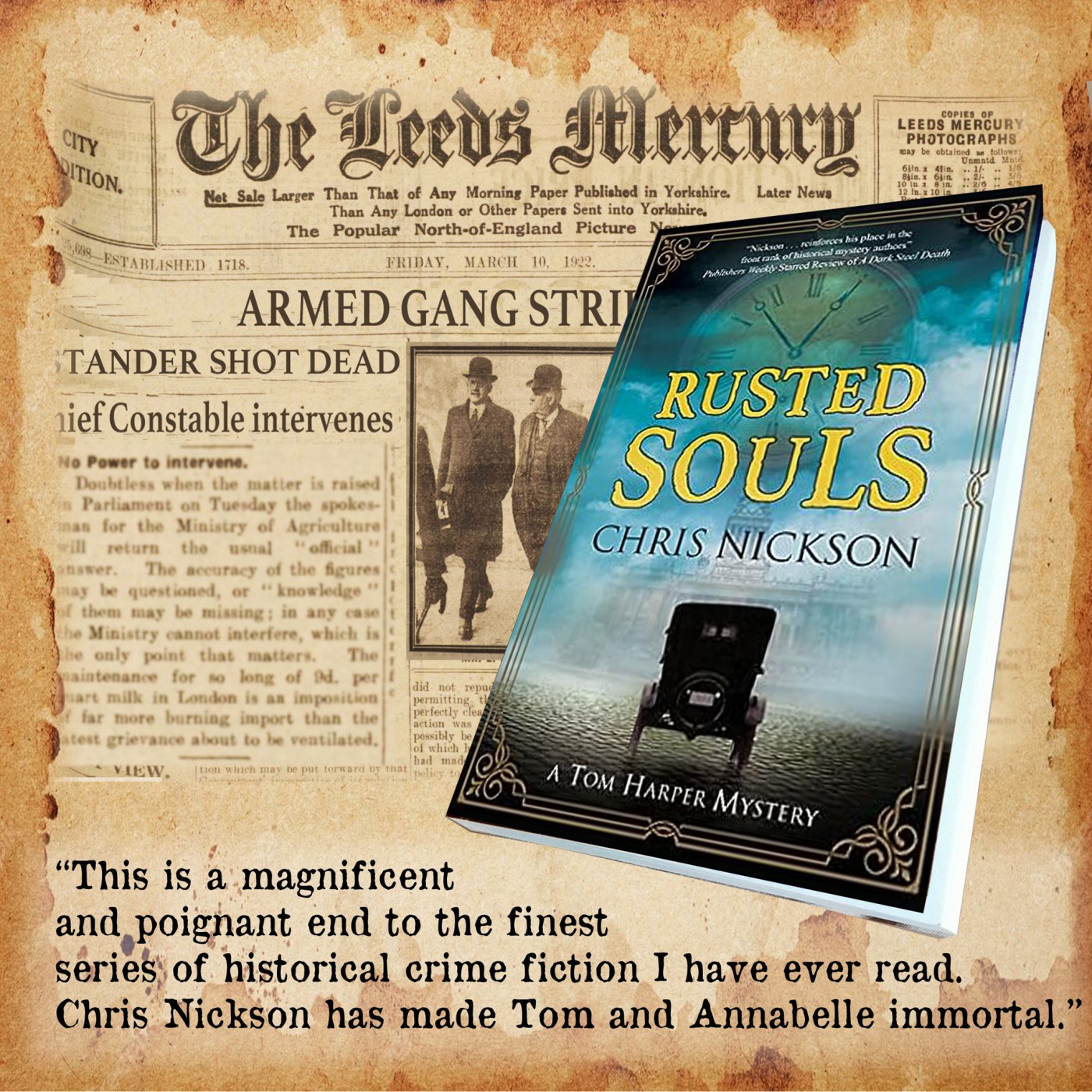
Chris Nickson is a former music journalist, and has rubbed shoulders with the Great and The Good across the history of rock music, but in these latter days he has earned a considerable reputation as a historical novelist. His books are mostly centred on Leeds, and they cover different historical periods from the 1730s to the 1950s. His latest book features Georgian thief-taker Simon Westow. Back then, there was no organised police force; the only legal officials were parish constables, who tended to be elderly, infirm and incompetent. Westow is more like the 20th century concept of a Private Eye; he recovers stolen property and catches criminals – for a fee.

Here, he has an unusual assignment; Local factory boss Joseph Clark asks him to find the men who stole the buried corpse of Gwendolyn Jordan, the daughter of Harmony Jordan, one of his employees. The crime of body snatching is unique in that it involved acts of criminality carried out in the name – some might argue – of a greater good, that being anatomical and medical research. Westow wastes no time on moral philosophy, and with his assistant Jane he sets out to find the Resurrection Men.
RESMEN

Jane is, for me, the most compelling character in any of Nickson’s novels. Raped by her father, disowned by her mother, the teenager has made her living on the streets. Not in the conventional sense by selling her body, but by employing preternatural skills of awareness of danger, cunning and speed of thought; most fearsome of all is the fact that she will use her knife without a moment of compassion or hesitation. She is a stone-cold killer, as many men – now dead and buried – would testify, were they still able to.

Westow’s case load becomes more complex when he and Jane are summoned to the elegant mansion of the infamous Mrs Parker – infamous because she is renowned in Leeds for  marrying a series of wealthy men, who then die, leaving her with an ever expanding fortune. Just for once, she has been bested. A lover has swindled her out of £50 – over £5000 in today’s money – and she wants recompense.

When the usually invulnerable Jane is bested by one of the thugs involved in the corpse trade, and is hurled from a bridge, she is lucky to escape with cuts and bruises. Her pride is hurt more, though, and she vows vengeance. Eventually the elusive Resurrection Men are tracked down, but Westow and his wife Rosie are convinced that there is one big player in the racket left to catch, and this leads to a thrilling – and unexpected –  end to the case,

Nickson’s narrative voice is totally authentic: Simon Westow, his family, and others in his world live and breathe as if they are they were standing with us in the same room. He makes the Leeds of April 1824 as real and vivid as if we had just stepped down from the York stagecoach. The Dead Will Rise is published by Severn House and is out now.

Nickson footer

ON MY SHELF . . . March 2023

OMS MARCH

 I WILL FIND YOU by Harlan Coben

It’s the mark of a fine crime writer that they can produce excellent series (in this case my favourite is those books featuring Myron Bolitar) but also create standalone novels, such as this one. Five years ago, David Burroughs began a life sentence for murdering his son Matthew. Burroughs,  wrongly accused and convicted of the murder is rotting away in a maximum-security prison. The world has moved on without him. Then his sister in law, makes a surprise appearance during visiting hours bearing a strange photograph. It’s a holiday shot of a busy amusement park a friend shared with her, and in the background,  is a boy bearing an uncanny resemblance to David’s son. Even though it can’t be, David just knows: Matthew is still alive. Shaken out of his institutional depression, David plans to escape, determined to achieve the impossible – save his son, clear his own name, and discover the real story of what happened. From Grand Central Publishing, this is out now. Click the link below for the Amazon page:


EVERYONE HERE IS LYING by Shari Lapena

Screen Shot 2023-03-20 at 19.55.05Back in 2020 I was thoroughly gripped by Shari Lapena’s The End of Her  and I remember using the term ‘anxiety porn’. It looks as if there is more of the same here.Welcome to Stanhope is regarded as a safe neighbourhood,  and a place for families to live out the American Dream. William Wooler should fit right in there, at least on the surface. But he’s been having an affair, an affair that ends horribly one afternoon at a motel up the road. He returns to his house, devastated and angry, only to find his difficult nine-year-old daughter Avery  home from school unexpectedly. William loses his temper. Hours later, Avery’s family declare her missing. Suddenly Stanhope’s reputation as being a suburban idyll takes a sever hit. William isn’t the only one on his street who’s hiding a lie. As witnesses come forward with information that may or may not be true, the neighbourly and trusting atmosphere starts to fragment, and then disintegrates completely. Everyone Is Lying is published by Bantam and will be available in July.

NO ONE SAW A THING by Andrea Mara

Dublin author Andrea Mara certainly has a thing for those awful parental moments when you think your child may have gone missing. She takes things one stage further here with a chilling account of an apparent abduction. A woman stands on a crowded tube platform in London. Her two little girls jump on the train ahead of her. As she tries to join them, the doors slide shut and the train moves away, leaving her behind. By the time she gets to the next stop, she has convinced herself that everything will be fine. But she soon starts to panic, because there aren’t two children waiting for her on the platform. There’s only one.Has her other daughter got lost? Been taken by a passing stranger? Or perhaps the culprit is closer to home than she thinks? No one is telling the truth, and the longer the search continues, the harder the missing child will be to find. Out in May, this is published by Bantam.

THE TRAP by Catharine Ryan Howard

There seems to be an abundance of fine women crime writers from Ireland at the moment, but they aren’t all from Dublin. It’s a long time since I read a novel by Cork-based author Catherine Ryan Howard but, inspired by a series of still-unsolved disappearances, The Trap looks to be a winner.A young woman uses herself as bait to try to track down the man who took her sister. The blurb says:

“Stranded on a dark road in the middle of the night, a young woman accepts a lift from a passing stranger. It’s the nightmare scenario that every girl is warned about, and she knows the dangers all too well – but what other choice does she have? As they drive, she alternates between fear and relief – one moment thinking he is just a good man doing a good thing, the next convinced he’s a monster. But when he delivers her safely to her destination, she realizes her fears were unfounded. And her heart sinks. Because a monster is what she’s looking for.”

Published by Bantam, The Trap will be out in August

THE LAST SONGBIRD by Daniel Weizman

Back to America for the final novel in this selection, and we are in California. A struggling songwriter and Lyft driver, Adam Zantz’s life changes when he accepts a ride request in Malibu and  he picks up Annie Linden – a fabled 1970s music icon. During that initial ride, the two quickly strike a bond, and  over the next three years, Adam becomes her exclusive driver and Annie listens to his music, encouraging Adam even as he finds himself driving more often than songwriting. When Annie disappears, and her body washes up under a pier – a heartbroken Adam plays detective, only for the cops to believe he was somehow responsible. Desperate to clear his name and discover who killed the one person who believed in his music , Adam digs into Annie’s past. As he spends his days driving around the labyrinth of LA highways, Adam comes to question how well he, or anyone else, knew Annie – if at all. This is published by Melville House and will be out in May.

Blog at WordPress.com.

Up ↑