Search

fullybooked2017

CALICO . . . Between the covers

calico spine063 copy

Lee Goldberg baits the hook irresistibly within the first few pages of this novel. Disgraced former LAPD cop Beth McDade has been exiled to the desert wastes of Barstow, on edge of the Mojave Desert. She attends what seems to be a routine road death- pedestrian collides with motor home, only one winner – but the autopsy on the victim is astonishing. He was wearing jeans that hadn’t been made that way since the 1880s. What remains of his dental fillings reveal an amalgam not used in decades. His tobacco tin isn’t just repro. It is original, and contains tobacco not produced commercially since the end of the nineteenth century.

Things become even more baffling when a construction company doing groundwork for a new development unearth an old coffin containing equally old bones. Beth finds her ultra rational mindset severely challenged when the bones are dated to the early 20th century, but contain titanium implants only available to surgeons in more recent times. She then receives a visit from a former LA colleague (and lover) who is  on a missing persons case. He is looking for Owen Slader, a very 21st century social media personality and chef,who was last seen filling up his car with gas on the way to visit his daughter.

There are two parallel narratives, one being that of present day Beth McDade, and the other being the views and experiences of Owen Slader. On that February night he was engulfed by what appears to be a lightning storm and, when he recovers his senses, the freeway no longer exists, and he is stranded near the primitive and rumbustious silver mining settlement of Calico. And it is 1882. Slader hides his hired Mercedes in a cave, rigs up a solar battery charger to power his iPhone and, using his 21st century culinary skills, caries out a profitable life for himself cooking up delicacies for the hungry miners of Calico. He meets – and marries another refugee from another time, a woman called Wendy, but she was ‘taken’ by the Time Gods a couple of decades earlier than Slader. This is when the complexities and total unknowables of the time travel concept begin to cause brain hurt, and the obvious questions like the one below, can never be answered:
“If stamps on the titanium implants found in the bones within the ancient coffin identify the recipient as Owen Slader who, identifying as Ben Cartwright (1960s TV Western reference!), died in the early 1900s, how did he then father a daughter in the early decades of the 21st century?”

The author certainly has fun with some of the more bizarre aspects of being a time traveller. He has Ben Cartwright buying copies of new novels by writers like Mark Twain and Robert Louis Stevenson knowing that (as first editions) they will become immensely valuable decades ahead. When a cholera epidemic hits Calico, Cartwright, nursing the town judge in what seems to be his final fevered moments, takes out his iPhone and plays the dying man some music. Problem is, the judge doesn’t die, and when he recovers he goes around loudly humming ‘Somewhere Over The Rainbow.’

Meanwhile, Beth McDade struggles to reconcile facts that are, at the same time, impossible but also incontrovertible. She even finds, boarded up in a cave, the 2019 rental that Owen Slader was driving when he disappeared. It is, needless to say, improbably decayed and weathered given that it can only have been there a matter of months. Eventually, our heroine tackles – and bests –  the FBI and the implacable American military machine.

Lee Goldberg’s audacious plot and premise will not be for everyone, particularly those who think that Hamlet’s famous remark to Horatio was just the rambling of a confused and conflicted young man. Of course, time travel novels are nothing new, and Goldberg does nod in homage to the grand-daddy of the genre, Herbert George Wells, but also develops the ‘stepping on a butterfly’ trope that began with Ray Bradbury’s 1952 short story ‘A Sound of Thunder’. Key question, though. Does Lee Goldberg’s book work? Of course it does. The writer is also an experienced screenwriter, producer and TV executive, far too well versed in his trade to stretch  the credulity of his readers and viewers to beyond breaking point. Calico is immensely entertaining, with a runaway-train narrative drive. Published by Severn House, it came out in hardback and Kindlle in November 2023 and this paperback edition was published on 4th July.

Screen Shot 2024-06-28 at 21.01.23

INTO THE FLAMES . . . Between the covers

itf spine061 copy

I lived and worked in Australia for a while, but being a city lad, I never came close to a bush fire. From speaking to people who had, and reading about them, they seem to be the very worst kind of natural disaster. Perhaps it is invidious to compare tornadoes, tsunamis, landslips and volcanlc eruptions, but bush fires seem to have an almost animal intensity. They devour people, buildings and forests like some kind of raging beast. Here, Aussie cop Alex Kennard has been bounced out of his job in a Sydney suburb for, as his bosses saw it, making the wrong call when he was forced to deal with a hostage situation. He is now more or less twiddling his thumbs dealing with drunks, petty thieving and the odd traffic incident in the town of Katoomba, in the heart of The Blue Mountains.

The little nearby town of Rislake is threatened by a serious bush fire, and Kennard drives across to help with crowd management in the event of a major evacuation. The local cops and fire service are basically taking a roll call, and it is soon apparent that one woman is missing. Tracey Hilmeyer is the wife of one of the firefighters and, against orders, Kennard and the woman’s husband, Russell, head out to the Hilmeyer property which is in danger of being engulfed. They find Tracey, but she is dead at the foot of the stairs, battered with a heavy implement. Russell Hilmeyer is distraught and wants to move the body of his wife, but Kennard insists that she stay in place and he attempts to preserve and record the crime scene as best he can.

Russell Hilmeyer is a local lad who didn’t quite make the big time on the football field, due to a career-ending injury. It has no bearing on the plot, but I am pretty sure Hilmeyer played Aussie Rules rather than what Americans call Soccer, or the major Sydney code of Rugby League. His wife Tracey was a glamorous prom-queen type in her teens, and had ambitions to be an artist. The gallery she ran in town has had to close, and she had become depressed, and only got through her days and nights with the help of prescription items like co-codomol. She had an abrasive relationship with her sister Karen who, with her husband, runs the farm that used to belong to their late parents. It is hard scrabble land, and they barely make ends meet. Did Karen and her Pacific Islander husband Alvin hate Tracey enough to kill her? The post mortem reveals that Tracey Hilmeyer was pregnant. Given that the couple had been trying for years to have children, does this add yet another dimension to the search for the killer and their possible motive?

The author has great fun making Kennard and his temporary partner DS Layton jump to one false assumption after another, while the fire grows steadily worse, a little like Satan as described in the office of Compline:

“Be sober, be vigilant, because your adversary the devil, as a roaring lion, walketh about, seeking whom he may devour:”

The conclusion comes with Layton temporarily out of action due to the fire having triggered her asthma, and we have Kennard, almost immobilised by the weight of his protective clothing, pursuing the killer in a Dante’s Inferno of blazing eucalyptus trees and showering sparks. Only one small problem. The person he is following isn’t the killer of Tracey Hilmayer. To say any more would clearly spoil your fun, but this is as exciting an end to a crime novel as I have read in many moons.

We lost the two modern giants of Australian crime fiction, the two Peters – Corris and Temple – within six months of each other in 2018 but, along with Jane Harper, James Delargy – although he now lives in England – taps into to the great tradition established by those writers. Into the Flames is seriously good CriFi and it got its teeth into me and wouldn’t let go until I had finished the novel in just a few sessions. Published by Simon and Schuster, it is available now.

RESOLUTION . . . Between the covers

iresolution spine062 copy

Edinburgh copper Ray Lennox last appeared a couple of years ago in The Long Knives. Now, he has quit the  force and, given his predilections, is in a strange place on what might be thought foreign soil – England’s south coast, a partner in a security firm based in Horsham, with his customer base ranging from the gay green madness of Brighton, to the villas of Eastbourne, where the silence is only punctuated by the quiet hum of wheelchair tyres and the creak of zimmer frames.

His business partner is  George Marsden, in some ways the antithesis of Lennox, in that he is English public school, suave, urbane, and speaks the esoteric language of the English middle classes. He is no man’s dupe, however, as we are given hints that he once served with the Special Boat Service.

Lennox is deeply in lust with a local chemistry lecturer, Carmel Devereux, some years his junior, and it is at a meet and greet party with potential wealthy sponsors of her research, that he is staggered to see the face of Mathew Cardingworth, a character from wounding nightmares. In an Edinburgh underpass, all those years ago, Cardingworth was one of a gang that captured Lennox and his teenage mate Les Brodie, and subjected them to grim sexual and physical abuse.

Fantasising about getting even with Cardingworth, Lennox actually meets him socially and then makes the error of accepting Cardingworth’s offer of a couple of tickets for the executive box at Brighton’s next Premiership home game against Liverpool. An even worse mistake is inviting Les Brodie down from Scotland, standing him the air fare as a treat. Whereas Lennox’s vengeance against his abuser have stayed firmly inside his head, Les Brodie is more volatile. He catches sight of Cardingworth as they drink their pints and graze at the buffet; it only takes seconds for Brodie to recognise his abuser, and he is just as quick to smash his glass on the bar counter and thrust it into Cardingworth’a face.

As his obsession with Cardingworth deepens, Lennox discovers that there is a tenuous – but intriguing link between the businessman and several youngsters who disappeared from the ‘care’ of Sussex Children’s Services. The fact that all local and national newspaper references to those years – print, microfiche and digital – have all disappeared. In another puzzle, at least for the reader, one of the non-Brighton, non-now narratives in the book is in the voice of an Englishman, perhaps a merchant seaman, who has killed a man in a Shanghai bar fight and been incarcerated sine die in a vile Chinese prison. He is clearly a deeply damaged and dangerous man, and he appears to be directing his story at Lennox, but who is he?

Lennox, as he peels back the layers of the recent past, all too late realises he is in way over his head, but with almost suicidal and terrier-like tenacity, he presses on regardless, perhaps echoing the thoughts of his famous fictional countryman, who mused:

I am in blood
Stepped in so far, that, should I wade no more,
Returning were as tedious as go o’er”

Fans of Welsh will love this, and feel at home with how the story darts back and forth between various characters, the Scottish conversational vernacular, the violence, the sex – and the grim humour. There is one wonderful example of the latter when contractors installing a new security system in a retirement home fall foul of a particularly demented resident, and all hell breaks loose. The titular resolution does not happen until the final pages of the book and it occurs, ironically, in the same care home where the contractors came so comically to grief. The violence is gloriously excessive, and none of it – despite the cover image – involves anything so clean and crisp as a handgun. You can take your pick from acid attacks, being dismembered by a sabre, facial surgery via a beer glass, poisoned wine, inhalation of liquid concrete and being hurled through a a high window. Resolution is published by Jonathan Cape and will be out on 11th July.

Screen Shot 2024-06-25 at 19.13.06

ONE FALSE STEP . . . Between the covers

OFS SPINE060 copy

We haven’t had a resounding cad in popular fiction since George MacDonald Fraser took Harry Flashman, a relatively minor character in a little-read Victorian school novel, and had him bestride the 19th century like a colossus, meeting (and cheating) pretty much everyone from Abraham Lincoln to Otto von Bismarck. Now, Clive Woolliscroft introduces Lieutenant William Dunbar, an impoverished younger son of a Scottish nobleman – and utter bounder*.

* Bounder (noun, archaic): a man who behaves badly or in a way that is not moral, especially in his relationships with women.

Unlike Flashman, Dunbar doesn’t lack physical courage, and he fights with his regiment against Bonnie Prince Charlie’s highlanders at Culloden, so this places the events of the novel somewhere in the years after 1746. Dunbar, however, has neither the skills nor the family fortune to lead the rich man’s life he so desperately craves, and so he is on the look-out for wealth  by marriage. Can he find a suitable young woman, with a sizeable *tocher and generous annual allowance from her wealthy parents?

* Tocher (Scots, archaic): A dowry: a marriage settlement given to the groom by the bride or her family.

For the first 120 pages or so, we view events through the eyes of William Dunbar. Thereafter, the narrative switches between that of Mercy Grundy and Dunbar. Quite early in the book, Dunbar had secretly married a Scottish heiress, Ann Macclesfield, (for her money of course) and she had borne him a daughter. The financial part of his plan had collapsed, due to religious complications after the battle of Culloden, but Anne now refuses to dissolve the marriage, thus putting a major impediment in the way of Dunbar’s plans to marry Mercy, and get his hands on her family’s wealth.

Dunbar leaves the army, and begins to make something of a living in the world of finance, managing to build up cash reserves, thus lessening the necessity of marriage. He then sees a chance to become very rich indeed by buying a share in a ship engaged in what was known, euphemistically, as the African Trade. This worked in a brutally simple fashion. The ship leaves Britain loaded with manufactured goods which could range from bolts of cloth to firearms and anything in between. These were then bartered for human cargo – slaves – on the coast of West Africa, which were then taken and sold in the slave markets of the Americas. In theory, the ship would then return to Britain, laden with cash.

Unfortunately for him, Dunbar’s ship, The Archer, is destroyed by fire after a mutiny of the slaves and he is, once again, left with nothing. He decides to try his luck once more with Mercy Grundy, but finding her father totally in opposition to his plans, he dupes Mercy into a course of action which will end disastrously for her. This mirrors the real life tragedy the book is based on – the case of Mary Blandy who, in 1752, was put on trial for poisoning her father.

The author served as an Army Officer in Germany, worked as an international money market trader in London, was a Management Consultant in Prague and Riga and practised as a solicitor in London, Hertfordshire, and Staffordshire. This is his second novel. ‘Less Dreadful With Every Step’ was published in May 2023.

Clive Woolliscroft’s attention to period detail is immaculate, and the mid-eighteenth century England of the wealthy middle class is beautifully recreated. William Dunbar is an out and out villain, with none of the dubious charm possessed by Harry Flashman.  The book’s title is extremely apposite for poor Mercy Grundy. One False Step is published by The Book Guild, and is available now.
THE LOST VICTIM . . . Between the covers

TLV header

The search for the killer of a child long dead is a recurring trope in crime fiction, and it carries with it all manner of similar plot strands. There will be dusty police files, parents – probably elderly by now – and still clinging to the faint hope that there might be answers; almost certainly we will meet police officers who made mistakes, made the wrong call, or took crucial short-cuts; there will be intriguing glimpses into what life was like twenty, thirty years earlier, and a sense of the truth being buried under too many lies, too many errors, too little police time, and – perhaps – a victim who was not attractive enough to the media.

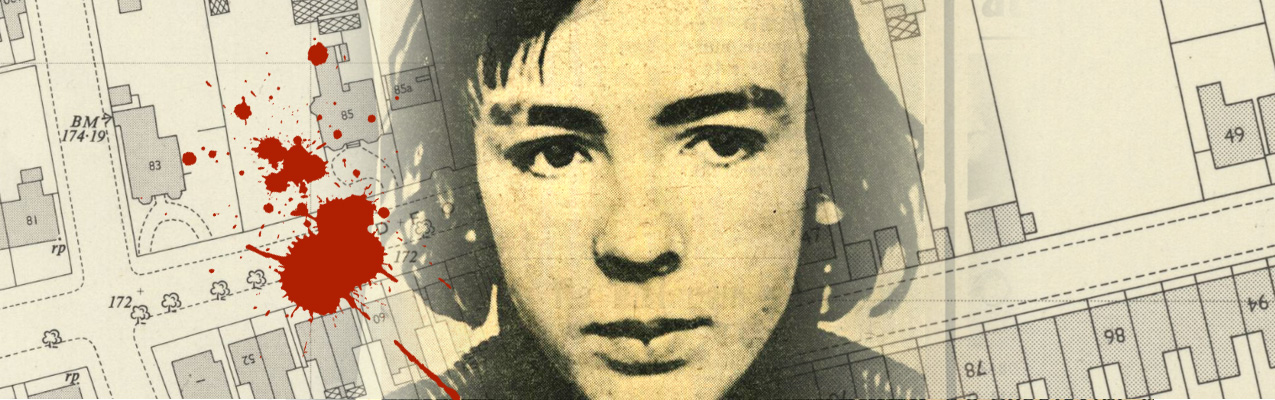
We get all this – and more – from Robert Bryndza’s The Lost Victim. Three decades earlier, before King’s Cross in London was a dazzling hub of boutique restaurants, state-of-the-art apartments and conference venues, a teenage girl named Janey Macklin was sent by her mum to buy a packet of fags from a newsagent’s shop, which sat among the grim streets, derelict warehouses, dark railway arches, smoke-filled pubs and knocking shops that made up London N1C 4AX in 1988. Janey never returned to the pub with her mum’s cigarettes. Her body was never found, despite traces of her blood being recorded in and around the places where she was last seen.

On the balance of probability, Robert Driscoll was convicted of her murder, but after a decade in jail, his case was reviewed and with a much smarter barrister than he was given at his first trial, Driscoll was released. Contemporary with Janey’s disappearance, a series of girls were being abducted and savaged by a man the press dubbed ‘ The Nine Elms Cannibal’. This time , there was no miscarriage of justice, and Peter Conway was caught, tried and convicted. He was a police officer, and married to Kate Marshall. Kate, also a copper, survived a bout of alcoholism brought about by the trauma, left the force, but has now reinvented herself as a private investigator, partnered by Tristan Harper, and based in Devon.

When she is contacted by a media agency who say they are preparing a True Crime series based on Janet’s disappearance, and need her to provide material, she reluctantly agrees. Since the case overlaps the story of her murderous husband, she senses that she might be about to be exploited, but it is the middle of winter, and her case load is not so heavy that she can afford to refuse.It does not take long for Kate Marshall to realise that she is being played by these media spivs. Not only that, a man in a relationship with one the agency’s employees was, almost certainly, a person of interest in the original investigation into Janey Macklin’s disappearance.

With awful scenes from her own past flitting in and out of her mind, Kate digs deeper and deeper into what happened on that chilly December evening, all those years ago. She is working for nothing, and running on fumes. Robert Bryndza doesn’t spare us from the numbing sense of loss felt by the people who knew and loved Janey, and when her remains are eventually found, we are left with an almost tangible sense of loss. We know her as a person; the girl who liked a bag of chips on a Friday night; the girl who went to ballet classes, perhaps dreaming of a future that could never have been realised.

I first encountered Kate Marshall in Nine Elms, which goes some way to putting her life into perspective. Click this link to read my review of that novel. In The Lost Victim we come face to face with truly vile human beings, thankfully behind bars for desecrating the lives of young people. Kate Marshall is a spirited and determined woman – a flawed, but believable heroine. The Lost Victim is published by Raven Street Publishing, and will be available on 11th July.

THE BEDLAM CADAVER . . . Between the covers

tbc spine058 copy

The book starts in spectacular fashion. We are in London, in the summer of 1681. At Gresham College, the home of The Royal Society, senior scientist Robert Hooke (he of Hooke’s Law) has summoned the Great and the Good, including His Majesty King Charles II, and Harry Hunt, who we met in The Poison Machine and The Bloodless Boy (click the links to read reviews) to a public dissection. Wielding the blades and saws will be none other than the great polymath Sir Christopher Wren. The unfortunate corpse is an unknown woman who recently committed suicide at Bethlehem Hospital, the recently built refuge for the insane. Sir Christopher is hoping to show that the muscles of the cadaver can be made to twitch by manipulating various parts of the brain. The macabre experiment is well underway when the woman’s face is revealed. All hell breaks loose when Harry Hunt cries out:

“You must stop! She is no suicide from Bethlehem Hospital. Her name is Miss Diana Cantley. She was my neighbour in Bloomsbury Square.”

Sir John Reresby, Justice of The Peace for Westminster is called in, and he and Harry Hunt try to ascertain just when and how the body of Diana Cantley came to be substituted for the expected cadaver – that of a woman who took her own life in Bethlehem Hospital. Soon, a second aristocratic woman, Mrs Elizabeth Thynne, is reported missing but before her disappearance can be investigated, Harry is himself arrested. The body of the Bedlam Cadaver, Sebiliah Barton, is planted in his laboratory and Reresby, using Occam’s Razor*, assumed Harry is responsible for both deaths.

*A principle often attributed to. 14th–century friar William of Ockham that says that if you have two competing ideas to explain the same phenomenon, you should prefer the simpler one.

Harry, more by luck than judgment, escapes captivity, and after a life threatening encounter with the unforgiving waters of the Thames, struggles ashore in Rotherhithe, where he is sheltered by two women tailors. He finds the younger, Rachel – a Lithuanian – strangely attractive and they have a brief but passionate encounter. Thanks to a bizarre signaling mechanism invented by Robert Hooke, he is smuggled back to central London, where he faces a race against time to establish his own innocence and find the killer of Diana Cantley.

King Charles II features here, as in the previous novels, and Robert Lloyd paints a picture of a calm and decent man, at ease with himself, with a benign and generous soul. Be that as it may, Charles was no slave to marital loyalty, and he fathered many children by different lovers, hence the political problem, a simmering issue in this book, but one which was to boil over not many years down the line. Charles had no legitimate heir, and it was accepted that his brother James, would succeed him. This would pose a problem, as James was a devout Roman Catholic. Charles had a much favoured illegitimate son, James Scott Duke of Monmouth. A Protestant, he also appears in this novel, and readers who know their history will be aware that when Charles died in 1685, he was succeeded by James, and not long after, Monmouth was leader of an unsuccessful invasion force, which was defeated at the Battle of Sedgemoor, and its surviving followers brutally dealt with.

In addition to clearing his own name, finding out who murdered Diana Cantley and tracing Elizabeth Thynne, Harry is caught up in the search for a mysterious black box, said to contain evidence that King Charles was secretly married to the Duke of Monmouth’s mother, thus making Monmouth the rightful heir to the throne.

Harry Hunt is an unusual – but engaging – hero. His main quality is intelligence. Although no coward, he rarely comes off best in fisticuffs or swordplay. His ambition to marry Grace, Robert Hooke’s niece, is paramount, mainly for social reasons, but he is a man with needs, as shown by his brief dalliance with the enigmatic Rachel. The Bedlam Cadaver is impeccably researched, and its anchor points are the real life characters like Hooke, Wren, The King and Monmouth; above that, however, Robert Lloyd gives us a sparkling narrative, and the real sense that – nearly 350 years later – we are in the same room as his characters. The Bedlam Cadaver is published by Melville House, and is out now.

REDEMPTION . . . Between the covers

Redemption header

Young Joshua Moore loved rabbits and hares. He had pestered his mom and dad – Evelyn and Tobias – for a pet, and so they bought him a white rabbit. The family had only just moved from London to San Diego, and the rabbit in its hutch mesmerised the nine year old boy. Reluctantly, because they were only just finding their USA feet, Evelyn and Tobias allowed Joshua to go away on a school camp in the nearby desert. On arriving, Joshua had seen a desert hare and, as darkness fell, it appeared again in the moonlight. Chasing it to get a closer look, and running across the highway, Joshua was struck by a car and killed instantly. The driver of the car didn’t stop.

Evelyn spends the next eleven years brooding over her son’s death, and plotting revenge. We get an early indicator which reveals her mindset:

“I spent a whole month in bed after the funeral, listening to the rabbit we’d bought for him hopping around in its hutch on the other side of the window. The rustling of the sawdust. The chomping and crunching of the vegetables. I lay there for a month loathing it, it’s mere existence feeding my rage until it was a living, breathing thing, for bigger and stronger than me. When I finally got out of bed, the first the thing I did was stride towards that hutch and snap the rabbits neck. It never did get a name.”

Driving the car was Aaron Alexander. a young, gay, drug-addicted drifter. He was traced, tried, and jailed. Now, eleven years later, he is out of prison, and scratching a living as a pump attendant at a gas station in Beatty, Nevada. Evelyn, with Tobias a reluctant passenger, gets in the car and heads for Nevada. Among minimal clothes changes and toiletries in her bag are a handgun, boxes of ammunition, rope, duct tape and a black canvas roll containing every variety of butchers’ knife. The relationship between Evelyn and Tobias has long since soured. She cannot bear his touch, and yet he clings on desperately, hoping she will someday emerge from her frozen state.

At the motel where they rest up for that first night, Evelyn does what she had obviously been planning for ages. While Tobias sleeps, she takes his wallet, cards, phone and shoes, and drives off into the early dawn. The remainder of the book is a hypnotic dance of death that plays out in cockroach infested motels, desolate gas stations miles from anywhere and the endless Nevada desert, where rapidly encroaching wildfires make the air sting. Very simply, Tobias is trying to get to Aaron before Evelyn can kill him, and it becomes a very bloody affair. Fans of dentist torture à la Laurence Olivier in Marathon Man mustn’t miss the scene where Evelyn, driven mad with toothache, removes the offending molar herself, with the help of a hammer, chisel and pair of pliers.

There is an ironic problem with the premise that Tobias’s main aim is to save Evelyn from herself, by stopping her from killing Aaron, because by the time they are grimly reunited,in a desolate former auto repair shop, she has already done enough damage to ensure that – always assuming that she survives – she will be put away for a very long time.

Redemption – noun, the action of saving or being saved from sin, error, or evil.

How apposite, then, is the book’s title for the three main characters? Perhaps it is for Aaron and Tobias. For sure, Aaron’s upbringing was tough, but his brother Chris survived, and it was Aaron being open about his sexual preferences which precipitated a slide into self pity and woeful lifestyle choices. By the end of the book, he has come through the firestorm of events with something akin to self-respect and moral courage. Tobias is more complex. He is the Hamlet of the piece, beset by doubt, a reluctance to act decisively and timidity in the face of Evelyn’s white hot anger. But he survives, and no-one comes out the other side of the horrific violence towards the end of the story a weaker person. Evelyn? For me, her ever increasing derangement puts her beyond any sense of redemption, but you must make up your own minds.

There was a termGrand Guignol – applied, retrospectively, to the blood-stained stage dramas of the Jacobean period and, in the twentieth century there was, in Paris, Le Théâtre du Grand-Guignol, which specialised in acting out scenes of horrific violence with spectacular special effects. Redemption certainly has elements of Grand Guignol, but it is a powerful novel which lays bare the dreadful things people will do to each other when they are – physically and emotionally – pushed beyond the limit. Published by Simon and Schuster, it is out today, 20th June.

THE TRIAL . . . Between the covers

TRIAL HEADER

First up, this novel isn’t a courtroom drama. Literally, it is about a big pharma multinational testing out what could be a game-changing drug to combat the effects of dementia. Metaphorically, though, Jo Spain’s latest thriller sees the lives of several individuals put under intense scrutiny, as if being questioned by a hard-nosed barrister in a court of law. Serious questions are asked, and some people fall after being challenged.

I am not normally a fan of split-time narratives, as they are all too often distracting short cuts, but Jo Spain is too good a writer to be accused of that, and in her hands it works well. There are three time zones. In 2014 we are in a prestigious Irish university college, St Edmunds, and we meet Dani. She is asleep, but her lover – Theo Laurent, French, and a fellow student – is about to make a very serious decision. He carefully climbs down from their shared bed and leaves. Not ‘leaves’ as in just going back to his own room, but ‘leaves’ as in disappears. Totally. Completely. From the face of the earth. Anxious and baffled hours for Dani turn into days and weeks. The police are not interested. Theo’s estranged and autocratic father reluctantly tells Dani over the ‘phone that he has received an email from his son stating that he has left the academic world to go travelling.

The two other time frames are 2023 and the present day. More so than in her excellent Tom Reynolds police procedural series, Jo Spain, in her standalone novels, likes to sucker punch her readers with astonishing plot twists, none more breathtaking than in The Perfect Lie ( click the link to read my review) These literary magic tricks are usually saved until the final pages of the novel, but here she does her stuff about half way through, when she lets us know that Dani is not who or what we think she is. To say more would be to spoil the fun. Suffice it to say that Jo Spain simply encourages us to make assumptions, which she then delights in shattering.

We learn that Dani, as far as the new ‘wonder drug’ is concerned, certainly has a dog in this particular fight. Her widowed mother is slowly succumbing to the inexorable death sentence known as Alzheimer’s. What if the new wonder drug could arrest her mother’s decline, and restore her memory, and make her sit up in bed with delight when her daughter comes to visit?

Academic impartiality seems to be a things of the past, certainly in the United Kingdom, and in Ireland, where this novel is set. In England, many universities – and even some independent school – have been bought and sold with Chinese money, but in the case of St Edmunds, it is not Xi’s millions that is paying the salaries of lecturers and professors, but the big dollars of the pharmaceutical industry. A convincing report from the medical researchers at St Edmunds, stating that the new drug poses no side-effect risks means that Turner Pharma can go ahead and mass produce the tablets, and ensuring massive world-wide profits. In trying to solve the mystery of Theo’s disappearance, Dani learns that pharmaceutical companies, just like their illegal counterparts in Mexico and Columbia, employ clever but crooked lawyers, use physical enforcers, and have limitless budgets to buy off politicians and law enforcement

The Trial works brilliantly on many different levels. There is the human anguish as Dani attempts to come to terms with Theo’s inexplicable departure. Jo Spain then invites us to be disgusted at the many ways in which academic institutions can become a simple market place commodity, and sold to the highest bidder. Above all, though, is the satisfaction derived from reading something written by a natural born story teller. There is not a word out of place, not a scene that wouldn’t work as a TV screenplay and – best of all – human characters of whom we might say, “Yes – I know someone like that.” The Trial is published by Quercus and is available now.

WHEN THE BOUGH BREAKS . . . Between the covers

WTBB header

David Mark has taken a temporary break from his excellent Aector McAvoy series (click the link to find out more) and his latest novel has a prologue that is as violent and visceral as any of the disturbing scenes in Derek Raymond’s I Was Dora Suarez. If you have read that masterpiece, you will know what I am talking about. If you haven’t, then you should. Here, copper Wulfric Hagman wakes up in a charnel house, apparently of his own creation. His former lover, Trina Delany lies butchered on the bed, while he seems to have tried to hang himself with a length of baler twine.

That was then, but now, Hagman has served a prison sentence, been released, and is now living in a moorland farmhouse he gifted by Jarod, one of Trina’s children. His twin sister, Salome is also living there. She is a traffic cop, formally known,in today’s jargon, as Collision Investigation Officer. At Hagman’s original trial, both Sal and Jarod gave chilling evidence testifying to the abuse they – and the other children – received at Trina’s hands.

Against this unusual human background and with the Northumbrian hills carpeted in deep snow, David Mark weaves his magic. The plot is complex, but this is a breakdown of the main characters.

Salome Delaney, police officer.
Jarod Delaney, Sal’s twin. Now a farmer, living in a house signed over to him by …
Wulfric Hagman, former policeman, served a long prison term for the murder of Trina Delaney. He now lodges with the Delaneys.
Dagmara Scrowther, charismatic Children’s Services officer. Worked with the Delaney family.
Lewis Beecher, senior police officer, divorced. Has recently ended a long term relationship with Sal Delaney.
Barry Ford. Once a child tearaway, now relatively respectable. Former lover of Trina Delaney.
Detective Superintendent Magda Quinn. Has re-opened the Hagman case, believing him to be guilty of more murders.

With transport paralysed by deep snow, Salome – although on leave – receives a call from a fellow officer asking her to go and investigate a car that has come off the road just a couple of miles away. She clings on grimly as Jarod’s quad-bike makes light work of the snow drifts. She finds the wrecked car, but the macabre feeding habits of local crows lead her to a man’s body. Some of the crows who have fed on the corpse are collapsing and dying. The reason? The body has had acid poured into his throat.

This grim discovery sets off a train of events that are as violent and disturbing as anything I have read in recent crime fiction. I am a great admirer of David Mark’s writing, and I make no apology for frequently comparing his style to that of Derek Raymond. Like Raymond, Mark takes us into dark places where monsters – in human form – ply their trade. Like Raymond’s nameless Sergeant in the five Factory novels, Mark’s heroes are often gravely damaged, but have a depth of compassion that always brings about a sense of redemption at the end of the journey, no matter how hellish the road.

The body in the snow is eventually identified as being that of Barry Ford, a man who was a troubled youngster but, thanks to the perseverance of Dagmara Scrowther, seems to have turned himself into something of a decent citizen. However, when Salome, hastily drafted back to work as a Family Liaison Officer, has to break the news of Ford’s demise to his current girlfriend, she opens a Pandora’s Box from which fly demons of cruelty and bestial abuse. Also in the mix is the fate of Lewis Beecher’s divorced wife. She and her two daughters – Nola and Lottie – have a new ‘dad’. He seems jolly and full of jokes, but is he genuine?

In this superb novel we cross paths with many human monsters. Trina Delaney is one, certainly, and Barry Ford is not far behind. But a third monster lurks in plain sight. Its identity is known to me, but you will have to find out for yourselves. When The Bough Breaks is published by Severn House and is available now.

Blog at WordPress.com.

Up ↑