Search

fullybooked2017

Category

REVIEWS

SCARRED . . . Between the covers

Scarred header

If ever there were an appropriate title for a Henry Christie novel, it is this. For newcomers, former Lancashire copper Nick Oldham created Christie in 1996 with A Time For Justice. Scarred is, I believe the 28th in the series, and while Christie hasn’t quite aged the full twenty five years since we first met him, he is rather like Tennyson’s Ulysses:

“Tho’ much is taken, much abides; and tho’
We are not now that strength which in old days
Moved earth and heaven, that which we are, we are;”

Sticking with the Bard of Somersby, Christie is also;

“Made weak by time and fate, but strong in will
To strive, to seek, to find, and not to yield.”

Back in the day, Henry Christie was a senior detective with the Lancashire Constabulary. He is now long since retired, running a moorland pub, but unable to resist the call to arms when he is asked to operate as a civilian consultant with his old force. Back to the title, though. Christie has endured many a beating at the hands of his criminal adversaries. He carries scars which are both physical and mental from his days battling bad men – and equally malignant women. Without giving too much away, I can say the word ‘scarred’ has a wider connotation than Henry’s war wounds.

I have become weary in recent years of what I call the “four years earlier – six months later” school of narrative, and I raised the tiniest hair of an eyebrow when I saw that this book starts in 1985, when Christie was (I almost said “nobbut a lad” but then remembered that they say that on the other side of the Pennines, not in Lancashire) a young Detective Constable, trying to nab shoplifters. One particular pursuit ends in Christie being severely beaten, and ending up in intensive care. Wisely, Nick Oldham stays with this period of his man’s career for some considerable time, and doesn’t follow the irritating (to me) pattern of lurching between time slots every three or four pages.
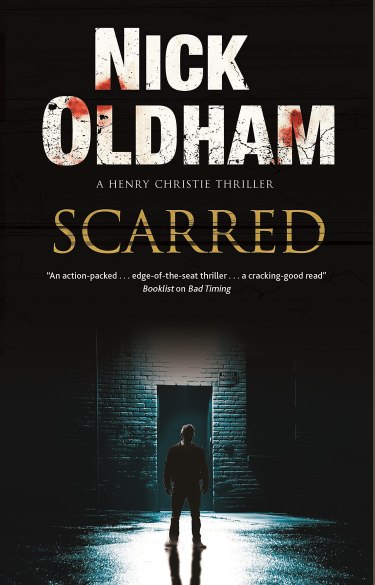
81RhPuniszSThe 1985 episode links crucially with the second part of the book which is firmly in present day Covid-restricted Lancashire, complete with masks and elbow bumps. A teenage boy who was the object of Christie’s near fatal pursuit – but then disappeared off the face of the earth – turns up again, but in an unexpected and deeply disturbing way.

A word or two about the places where the book is set. I have spoken of this in previous reviews of Henry Christie stories, but don’t make the mistake of thinking that because some of the action centres on the Blackpool area, there is any sense of sun and fun, saucy postcards and kiss-me-quick hats. The ubiquitous Google provides a statement from Lancashire Country Council:

“Blackpool (20.9%), in the Lancashire-14 area, has the largest proportion of its working age population employment deprived in England, and the third largest percentage income deprived (24.7%). Blackpool has the largest number of people employment deprived and income deprived in the Lancashire-14 area.

Where you have the ‘D’ word you always have crime, meanness of spirit and Oldham doesn’t shy away from describing the littered streets, the drug-ridden estates, the human desert speckled with steel-grilled convenience stores and tattoo shops, the youngsters who have turned feral by the age of twelve, and the desperate single mothers, endlessly betrayed by the absent fathers of their children, and whose only solace is tobacco and cheap alcohol. It doesn’t make the Henry Christie novels Noir, exactly, mainly because HC is such a decent fellow. He is a man who remains optimistic in spite of everything, and perhaps he is a soulmate of the man so superbly described by Raymond Chandler:

“Down these mean streets a man must go who is not himself mean, who is neither tarnished nor afraid. He is the hero; he is everything. He must be a complete man and a common man and yet an unusual man.”

Back to the book. Mr Civilian Christie has been partnered with  firebrand DS Debbie Blackstone who is fixated on the fact that there has been systematic collusion between the police and criminals in Lancashire over a long period of time. Because of this, she has been shunted sideways into investigating cold case crime, an operation which may make for good police procedurals on TV, but is probably frustrating for officers who want to be at the sharp end of investigation and law enforcement. What starts as a hunt for man who raped a young girl many months ago morphs into the discovery of a huge child abuse scandal, and ends with one of the most ferocious finales you could want to read. Scarred is published by Severn House and is out now. To read my reviews of earlier Nick Oldham novels, click the image below.

 

Nick


SILESIAN STATION . . Between the covers

spines028

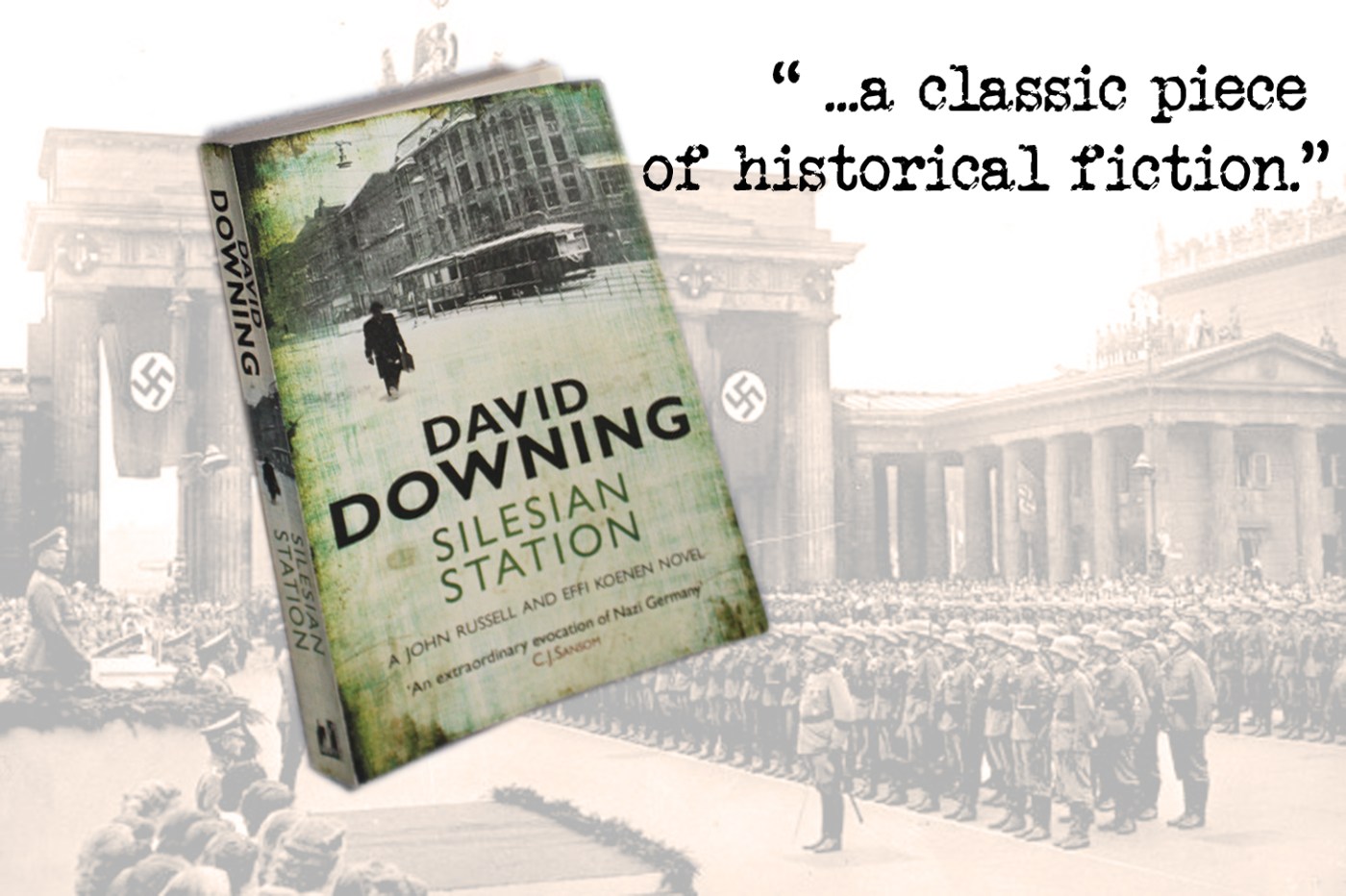
Followers of this website will, hopefully, have read my 1st May review of David Downing’s Wedding Station (click link to visit). It is actually the seventh book in the series, but is a prequel, being set in 1933. I was so impressed by it that I have raided my piggy bank and bought several others. This review, then, is of a book I have bought for pleasure, rather than a freebie from a publisher. Silesian Station was first published in 2008, and is the second in the series. The central character is John Russell, an Anglo-American political journalist. He married (but later divorced) a German woman, and as their son Paul is a German citizen, Russell is allowed to make his home in Berlin. We are in the late summer of 1939. Six years into the Thousand Year Reich. Six months since Hitler invaded Czechoslovakia. Just days away, maybe, from an invasion of Poland?

spines029Russell is a survivor, a man who can usually talk his way out of trouble. Multilingual, and with that all-important American passport, he keeps a wary eye on the features he wires back to his newspaper in the states, but has – more or less – managed to stay out of trouble with the various arms of the Nazi state  – principally the Gestapo, the SS and their nasty little brother the Sicherheitsdienst. Russell fought in the British Army in The Great War, but in its wake became a committed Communist. Although he has now ‘left the faith’ he still maintains discreet contacts with the remaining ‘comrades’ in Berlin. With that in mind, it is unsurprising, perhaps, that he has been manoeuvred into the sticky position where both the German and Russian intelligence services believe that he is working uniquely for them, and he is being used to pass on false information from one to the other.
It’s probably not a bad idea at this stage to do a brief political and strategic summary of how the land lay in the late summer of 1939. Germany and the Soviet Union were – in theory – the best of friends, but divided both geographically and in terms of future intent by Poland. Hitler still smarted from the loss of previously German territory after the Treaty of Versailles, while both he and Stalin had eyes on encroachment, to the east in Hitler’s case and to the west for Stalin. Hitler knows that Britain and France are treaty-bound to protect Poland, but is more worried about the reaction from the Kremlin should he try to retake the former German lands of Prussia.

Back to the more human and personal elements of Silesia Station. Russell has agreed to do a favour for his brother-in-law, and investigate the disappearance of a  Jewish girl, Miriam Rosenfeld, who has been sent by her parents – who own a small farm near Breslau (modern day Wrocław) to live with her uncle in Berlin, for the chillingly ironic reason that the family are among the few Jews left in the area, and they feel threatened. Russell – aided by his film star girlfriend Effie Koenen – start their search, but Miriam seems to have vanished into thin air. Effie is integral to the story. Very beautiful, and a fine actress, it doesn’t hurt that Hitler’s minister for propaganda, Joseph Goebbels, is an avid film buff, and has rubbed shoulders with Effie at premieres of her films, and is apparently a great admirer.

Months later, of course, all these ambiguities were wiped out by the fury of war, but John Russell has one other contradiction to deal with. Another acquaintance, Sarah Grostein is ‘walking out’ with a prominent SS officer who is – clearly – unaware that she is Jewish. When their relationship goes disastrously wrong, Russell feels obliged to pick up the pieces.

Aside from the human dramas, Downing describes with great clarity the fateful days before the Soviets and the Nazis – via the short-lived Molotov-Ribbentrop Pact – agreed to allow each other to live and let live, and how that fateful decision gave Hitler the green light to invade Poland, thus triggering six years of death, terror and mayhem.

Is Miriam Rosenfeld found? Where did she go? Can John Russell and Effie Koenen keep one step ahead of both the SS and the NKVD? Well, the fact that they appear in later books will answer the last question, at least, but you will have a few hours of tense reading a classic piece of historical fiction while you find out how. Silesian Station is published by Old Street Publishing Ltd and is available now.
 

SWORD OF BONE . . . Between the covers

SOB header

Some critics have compared Anthony Rhodes (1916-2004) with his more illustrious near contemporary, Evelyn Waugh. They were both Roman Catholics, although Rhodes converted late in life. Both wrote novels, biographies and travel books. Both – and this is most relevant here – wrote fictionalised accounts of their service in WW2. Waugh’s Sword of Honour trilogy – Men at Arms, Officers and Gentlemen & Unconditional Surrender – was a much more substantial achievement, but both wrote from the view of public school educated men who had gone on to higher education, in Waugh’s case Oxford, and in Rhodes’s case Royal Military College Sandhurst. The latter, of course, makes Rhodes a professional soldier, but they both wrote with a certain sardonic detachment about the war and the soldiers who served in it.

Sword of Bone begins in the early autumn of 1939 when Rhodes becomes a liaison officer for his army division. He is a gifted linguist, and he is a member of the advance party sent to France. They assemble in Southampton, then:

At three o’clock that afternoon we embarked on a miserable grimy little cross-channel boat called The Duchess of Atholl, which had been painted a dirty grey and which, except for what appeared to be an inexplicable pair of blue knickers drying on the bridge, had little enough connection with her eponymous aristocrat.”

SOB cover014His party work their way at a leisurely pace from Brittany up to the grim and grey slag heaps and factory chimneys in the region of Lille, Lens and  La Bassée. His role eventually settles into that of commissioning supplies of engineering materials – principally those needed to meet a sudden demand for concrete pill boxes.

It is worth spelling out at this stage what exactly was going on in the war in Western Europe. On 3rd September 1939, Britain and France declared war on Germany as a result of Hitler’s invasion of Poland. All through that autumn, until the winter became spring, there was little or no military action on the ground. In December, British warships had engaged the German Battleship Graf von Spee, and forced it to seek refuge in the neutral port of Montivideo, where it was eventually scuttled. Back in France, the French had the largest army in Europe, the best tanks, and were convinced that the complex of fortifications known as The Maginot Line made its eastern border with Germany impregnable.

Not so secure, as Rhodes finds when he is billeted near Lille, is the border with Belgium – little more than a few strands of barbed wire and sentry boxes manned by a handful of bored soldiers. The first half of the book is a series of entertaining encounters with village Mayors, profiteering restaurateurs, blimpish Colonels and the complex hierarchies that exist between different parts of the British Army. In Rhodes’s entourage are other officers, of contrasting temperament and character. There is Stimpson, intellectual, effete, almost, and politically rather ‘unsound’.

When the last politician has been strangled with the entrails of the last general, then, and only then, shall we have peace“, he says one evening in the Mess.

The Padre is emphatically different. He is “a man whose views on the treatment of Indians did more credit to Kipling than to his cloth.

Rhodes catches sight of his first German (through binoculars) when he and other officers visit a Maginot fort near Veckering, in the Moselle region. Rhodes’s Major wants action:

Quick, ” said Major Cairns, turning to a Guardsman with a rifle, “Pick him off. Quickly, man.
Please, ” said the subaltern, without moving, “do no such thing. Our business is to obtain information. We want prisoners, not dead men. Besides, if we fire from here, it will only give our own position away. I am afraid I must ask you not to think of firing, sir. It will only mean an immediate reply from the Boche with mortar fire.
Major Cairns sadly put down the rifle which he had taken from the Guardsman, and we all stood by the trees looking out over the valley.”

Of course, the fun has to end sometime, and after a foray into Norway, Hitler’s forces invade Holland Belgium and France on 10th May. The citizens of Louvain and Brussels, remembering the heroics of two decades earlier, are convinced that the ‘Tommies’ will, once again, give the Boche a bloody nose. As we all know, it was not to be. The Germans have ignored the Maginot Line and are storming down through Belgium. Arras falls, and the French army – on paper, numerically and technically superior – are in headlong retreat along with their British allies. It is very much a case of “our revels now are ended” for Rhodes and his colleagues.

Sword of Bone is a little masterpiece. As it follows the fortunes of a small group of British Army officers in the early days of WW2, it records their journey from champagne and lobster lunches and a seemingly absent enemy, to the terrifying and bloodstained beaches of Dunkirk. Rhodes writes with great charm, gentle satire, pinpoint observation but with total authenticity. The book is published by the Imperial War Museum and is out now.

You can read my reviews of the other books in this excellent series by clicking the image below.

Print

THE DISTANT DEAD . . . Between the covers

DD header

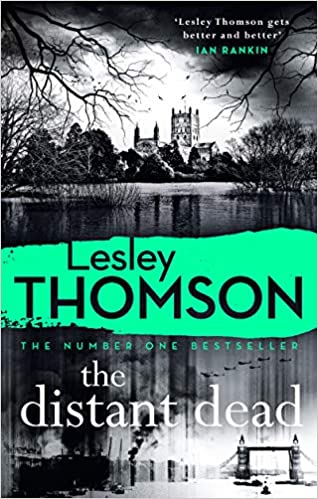
I was gifted this to review by Head of Zeus, so huge thanks to them. The Distant Dead is the eighth in a series by Lesley Thomson, so I am coming late to the party. What attracted me to the book? Two things, really. Firstly there was a mention of a WW2 element, and I am a sucker for anything war-related. Secondly, some of the action takes place in the Gloucestershire town of Tewksbury. Years ago now, a very dear friend of mine, Miles Amherst – long since gone,sadly – founded a choir school at Tewksbury Abbey. I had taught with him in Ely, but we had gone our separate ways. When the choir school was running, I was teaching in a Shropshire prep school, and I always had a half day on Mondays. It was a bit of a drive, but sometimes I used to motor down to Tewksbury, rehearse with the choir and help them sing Evensong. Afterwards was always beer, food – and an small-hours drive back to Salop.

So, happy memories, but what of the book? I am not the biggest fan of split time narratives, but many authors are, so it is what it is. In this case, at least, the connection between the narratives is clear. In Blitz-torn London, a young woman is found dead – strangled in an abandoned house. The pathologist called to the scene, and who later carries out the post mortem, is a man called Aleck Northcote. He tells the police investigating the case that the woman, Maple Greenhill was a common prostitute.

TDDYears later, Northcote has retired to Tewksbury, but is found dead. His wastrel son is convicted of his murder. Pretty much present day, Stella Darnell, the daughter of a policeman, now working as a contract cleaner in Tewksbury, meets a man named Roddy March who has produced a podcast about the 1963 murder of Northcote. Roddy investigates cases where he thinks the wrong person went to prison – or, in this case, the gallows. When Roddy is found murdered next to an ancient tomb in Tewksbury Abbey, Stella feels connected enough to find out the truth about how past and present have merged – with fatal consequences.

So, what exactly happened in 1940?. We know – from the prologue – that Maple Greenhill has gone into an empty house with a man friend, and that he strangles her. When her body is found, London copper George Cotton is called, but his investigation leads nowhere until a cigarette lighter is found at the scene. It is engraved with the initials AXN. Cotton puts two and two together, and assumes that the pathologist – Aleck Xavier Northcote – must have dropped it when he was called to look at the body. Then, in a separate breakthrough, a garment repair ticket is found in Maple’s coat. When Cotton visits the tailor, he is astonished to be joined by a woman who says she has lost the self-same ticket. The woman is Mrs Aleck Northcote.

Lesley Thomson switches the narratives very cleverly and poses important questions as the book progresses. Was Northcote Maple’s man-friend, and did he kill her? If he did, how then did he avoid prosecution and survive to be murdered in his own house twenty three years later? And if Giles Northcote – who had visited his father on than fateful evening to ask for money to pay off a gambling debt – didn’t kill his father, then who did? And was the killer somehow connected to the death of Maple Greenhill.

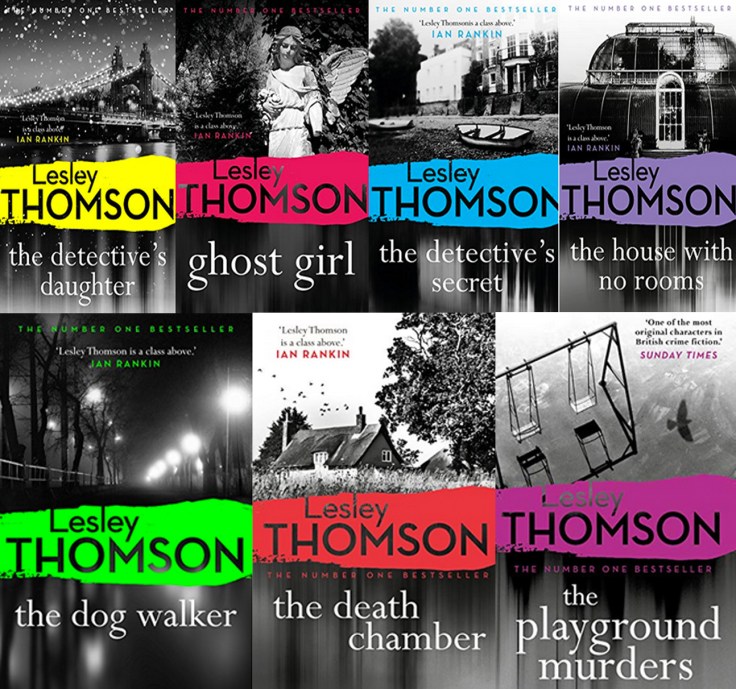
Obviously, I am not about to reveal the answer to the conundrum, but you will enjoy – as I did – how Lesley Thomson has Stella Darnell – and her companions –  searching for, and then finding, the truth. The actual solution to what turns out to be multiple murders is breathtakingly complex, but this a clever, literate and totally convincing murder mystery – and thoroughly, thoroughly English. People who follow the news know that Tewksbury is notoriously susceptible to flooding, standing as it does at the confluence of the rivers Severn and Warwickshire Avon, and Lesley Thomson uses the power of the river as it hurtles over weirs and beneath bridges as a very effective metaphor for the violence in human souls. The Distant Dead is available now, and the previous books in the series are pictured below. If you click the image, you will be taken to Lesley Thomson’s website.

DD series

PATHFINDERS . . . Between the covers

Wellington
I can’t think of a publishing event
over the last few years which has been more impressive than the republishing of WW2 novels by the Imperial War Museum. It has become an axiom that The Great War was identified with the poets, but what was the literary legacy of the war against Hitler? This series has confirmed that the dreadful six years of global conflict inspired some superb novels. I was born just after the war ended. My father served in the British Army throughout, and had many a tale to tell but, until recently, I had no idea of the breadth of novels written by men and women who took part in the conflict. Yes, I had read Waugh’s superb Sword of Honour trilogy and Len Deighton’s magisterial Bomber, but beyond those, very little. I have reviewed all the previous books in this series, and you can find my thoughts by clicking this link. The latest in the series is Pathfinders, first published in 1944.

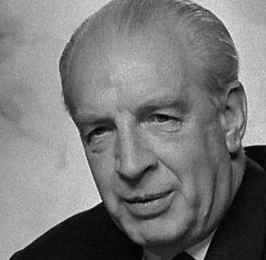
screen-shot-2021-05-10-at-10.46.53Cecil Lewis (left) was a combat pilot in the Great War, but returned to the colours as both an instructor and an active flier in WW2. Pathfinders tells the tale of the crew of a Wellington aircraft. Perhaps unjustly, the Wellington has not captured the public imagination as much as its big sister, the Lancaster, but the Wellington was a durable workhorse that played a vital role in the work of Bomber Command. The six men who flew the aircraft in this novel each have a specific job as the aircraft goes in ahead of a bombing raid to drop incendiary flares on the ground targets so that the following planes can see when and where to unload their bombs.

A Pathfinder crew comprised pilot, co-pilot, navigator, wireless operator, front gunner and rear-gunner. Lewis structures his book around a detailed examination of each of these men, and tells us what kind of people they are. He shows us their backgrounds, their history, their loves, their losses – and their relationship to one another. Relatively little of the text deals with the actual raid the men are involved in. Instead, we have six chapters which deal with, in turn:

Screen Shot 2021-05-10 at 10.45.35Peter Morelli, co-pilot. The American-Italian is suave, debonnaire, but is aware of the struggles and prejudice faced by immigrants in a new country.

Sam Dollar, front gunner. Raised in the brutish and fundamental wilderness of the Canadian forests, Dollar has little to say, but is determined and resolute.

Benjy Lukin, wireless operator. From a Jewish family, Lukin is well-read and erudite, In a former life he was a well-respected theatre critic.

Tom Cookson
, navigator. Born into a disfunctional English family, he was sent to live with relatives in New Zealand. In his late teens he built a sea-going yacht with his best friend, and survived hurricanes while sailing Dolphin from New Zealand to Suva.

‘Nobby’ Bligh, tail gunner. A London lad, he resolve to fight back against the Nazis after a Luftwaffe bomb demolished his father’s bakery, trapping and killing the older man beneath tons of collapsed masonry. At home, his wife is dying of leukemia.

Hugh Thornly, pilot. An Oxbridge man of genteel birth, he was determined to become either a philosopher or a politician, but then the war intervened. His wife Helen – the daughter of a distinguished General, is expecting their second child.

Pathfinders spine

After the biographies, though, Lewis returns – with devastating effect – to the matter in hand. The night raid on Kiel starts well, but then the German defences on the ground and in the air take their toll, and the final stages of the Wellington’s mission are as terrifying a description of the price of war as you will ever read.

Many will have read Lewis’s Sagittarius Rising, his classic account of the war in the air between 1914 and 1918. This wasn’t published until 1936, so there had been a considerable time lapse between his experiences and the book’s publication. Pathfinders is, by contrast, nearly contemporary. How do the two books compare? Does the unusual narrative structure of the later book work? I have to say that for the sheer white knuckle terror of flying flimsy and totally vulnerable aircraft, nothing could beat Sagittarius Rising for its sense of immediacy. As for the structure of Pathfinders, military history buffs may find the central section a rather long diversion from the matter in hand. Personally, I stuck with it, and felt that knowing the six men in person, as it were, made the eventual outcome even more poignant.

In the bitterest of ironies, the military part of Pathfinders begins and ends not in the air or on the runway from which P for Pathfinder took off and landed, but in the sea. To say more would be a spoiler, but I can say that this is a deeply moving and memorable account of brave men having to find a resolution between the horrific carnage their weapons were creating – and the greater long-term good. The only consolation, in human terms, that one can draw from this book, is that in the last few pages, we have a reversal of the solemn words of the Anglican burial sentences:

“In the midst of death we are in life”

Pathfinders is published by the Imperial War Museum and is out now.

THE PERFECT LIE . . . Between the covers

When you read a Jo Spain stand-alone novel, you know you are going to be misled, made a fool of, and led up the garden path – all in the nicest possible way. Her Tom Reynolds police procedurals (see some reviews here are more straightforward and stick to the conventions of the genre, but when she spins a yarn outside of those confines, you learn to trust her narrators about as far as you can throw a grand piano.

Such is the case in The Perfect Lie. Erin Kennedy – an Irish lass – works in publishing in New York, is married to American cop Danny Ryan, and they live in Newport, Rhode Island. No, Danny is not a fellow Celt, despite his surname, but beautifully black, at least in Erin’s eyes. One morning, she answers the doorbell to their apartment and admits Danny’s cop colleague Ben – stern of face –  and a couple of fellow officers. Within seconds Danny, freshly showered and shaved for the day’s shift has walked to the  balcony and jumped to his death on the concrete four floors below.

What follows is a journey into a labyrinth of blind alleys and false assumptions. Erin learns that Danny was the subject of an internal police inquiry, and was about to be arrested for corruption. She later discovers that he had secret bank accounts containing tens of thousands of dollars. Two other significant characters are introduced; Cal Hawley,  the scion of a wealthy local family who has some connection with what Danny Ryan was involved in before his death, and Karla Delgado, a feisty lawyer who agrees to work for Erin pro-bono.

The split narratives of the book are not for complacent or inattentive readers. A couple of times I had to check back and make sure that I knew exactly what was going on. The viewpoints are these:

  • Erin on the morning of Danny’s death, and the weeks following.
  • The retrospective account of a young woman called Ally, a proctor at Harvard University.
  • Erin, over a year after Danny’s death, when she is in custody and in court being tried for her husband’s murder.

Bullet points one and three seem to be incompatible, so you might think that the obvious solution is that Danny did not die as we are told in the first few pages. The fact that Erin is not allowed to ID her husbands body, and that he is cremated in a closed casket suggests that something strange is going on, but what, exactly – and why? Eventually, the link between Ally, her mentee Lauren Gregory, and the Danny Ryan/ Erin Kennedy story is revealed. And Jo Spain has tricked us – well, I certainly fell for it –  into making a huge assumption.

Jo Spain has has created her own version of the classic locked room mystery. It happened, yet it is impossible that it could have happened. She is The Queen of The Night in terms of misdirection and she entices us into a  spider’s web where we thrash helplessly until she puts us out of our misery. In the end, however, she can put on her best innocent face and say’ “who…me?’ because when the penny drops we realise we have misled ourselves.This is another masterpiece from, in my opinion, Ireland’s finest contemporary writer. The Perfect Lie is published by Quercus, and is out today, 13th May.

My reviews of other books by Jo Spain can be found HERE

THE WAITER . . . Between the covers

Waiter header008

Kamil Rahman is a Bengali Muslim, but in name only. He enjoys a beer, and his job as a detective with the Kolkata Police Force gives him little time for religious observance. His father was a distinguished cop before him, and he tries hard to live up to that reputation. When a famous Bollywood film star is found dead in a plush hotel, Kamil is astonished to be given the job of finding the killer of Asif Khan.

We are getting ahead of ourselves. The killing of Asif Khan was in July, but the book opens in the October of the same year, and we find Kamil not heading up a crack team of investigators in the capital city of West Bengal, but waiting tables in a curry house in London’s Brick Lane.

Waiter cover007The restaurant is run by his relatives Saibal and Maya, with help from their daughter Anjali. At this point is worth  reminding people that families are the big thing in the sub-continent, and most of the characters in the book are related in one way or another. The story starts on the evening that the restaurant has been booked to provide the food for the lavish 60th birthday party of rich entrepreneur Rakesh Sharma. He and his new wife Neha – half his age – are installed in a lavish mansion on Billionaire’s Row near Hampstead Heath. It’s also worth mentioning at this point that Sharma’s first wife (and son by that union) are still very much on the scene.


As the party gets into its stride, Sharma shocks his audience when he announces that he is going to sell all his holdings and divert the rest of his life to charitable works, dedicated to his young wife. As Kamil and the other functionaries are driving home in the small hours, they receive a chilling ‘phone call. Sharma has been found dead – apparently battered about the head with a heavy object. They return to the mansion, slightly ahead of the police.

The big question with which Ajay Chowdhury teases us is, of course, why has Kamil ended up in a walk-on part in one of London’s innumerable Indian restaurants, rather than being an important detective in Kolkata. Chowdhury uses a ‘then-and-now’ narrative. It’s not my favourite literary device, but at least we have only two time slots to keep track of. We are deep into the book before we discover why Kamil is bowing and scraping in London, rather than advancing his career – and his marriage prospects to his smart and beautiful lawyer fiancée Maliha – back in West Bengal. The answer comes in the form of a terrible betrayal.

This is just a crime novel, albeit a very good one, but it does raise questions about probity in public life. People of my age have had a lifetime of reading about the depth of corruption in India and Pakistan, and Chowdhury paints an unflattering picture of the wheels-within-wheels in the Kolkata Police Force. Are we any better here? Is the corruption just more subtle, and more in people’s peripheral vision rather than in full view? I write this review at a time when news bulletins remind us of the awful, unbridgeable gulf between the haves and have-nots in present day Covid-blighted India.

Eventually, Kamil’s Kalkota downfall is explained, and we also learn who killed Rakesh Sharma. There is much entertainment on the way to the finale. The Met Police copper’s last words suggest that we haven’t heard the last of Kamil Rahman.

We are always looking for skilled detectives from diverse backgrounds.”

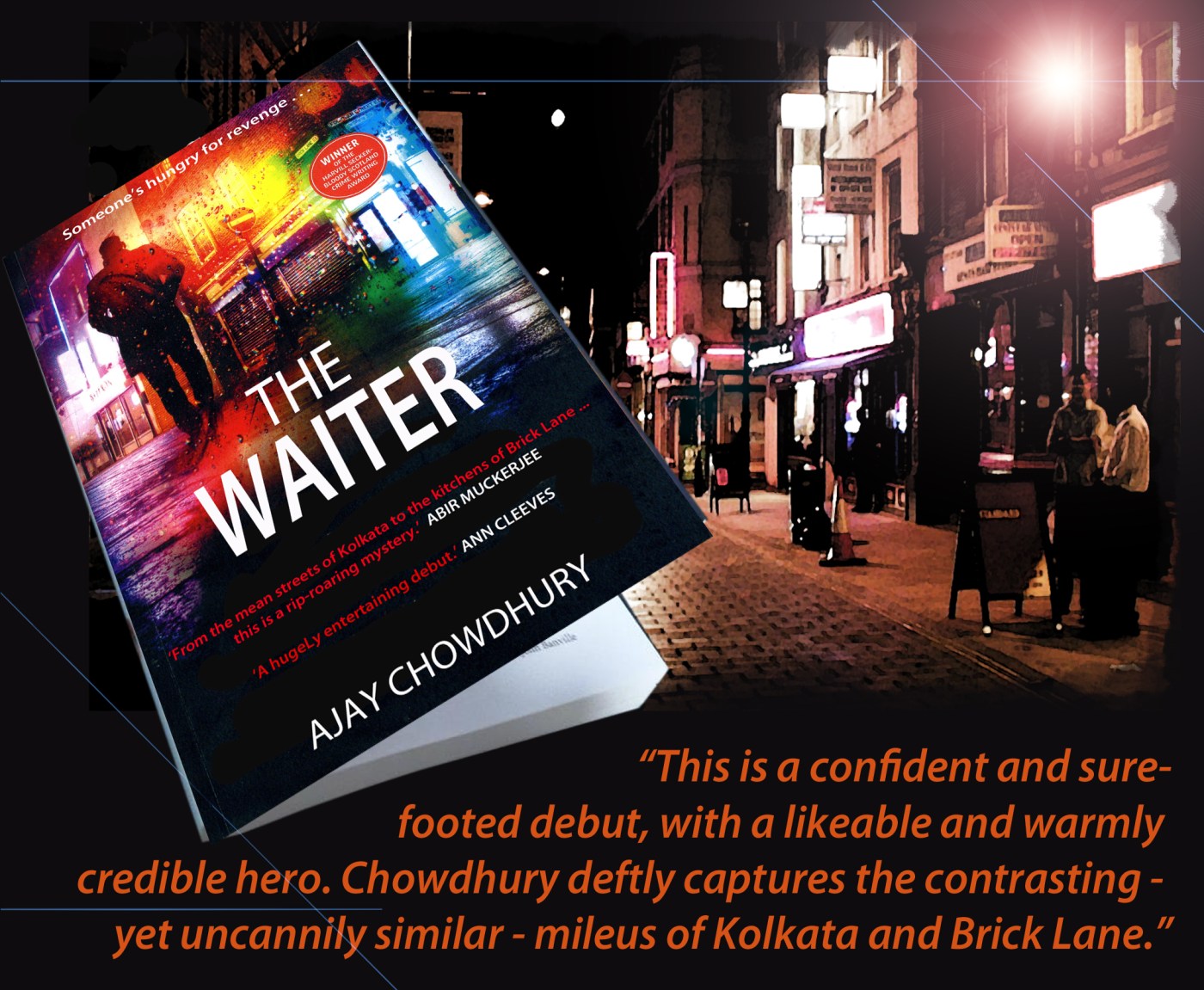
This is a confident and sure-footed debut, with a likeable and warmly credible hero. Chowdhury deftly captures the contrasting – yet uncannily similar – mileus of Kolkata and Brick Lane. The Waiter is published by Harvill Secker, and will be out on 27th May.

Waiter blurb009

THE BULLET TRAIN . . . Between the covers

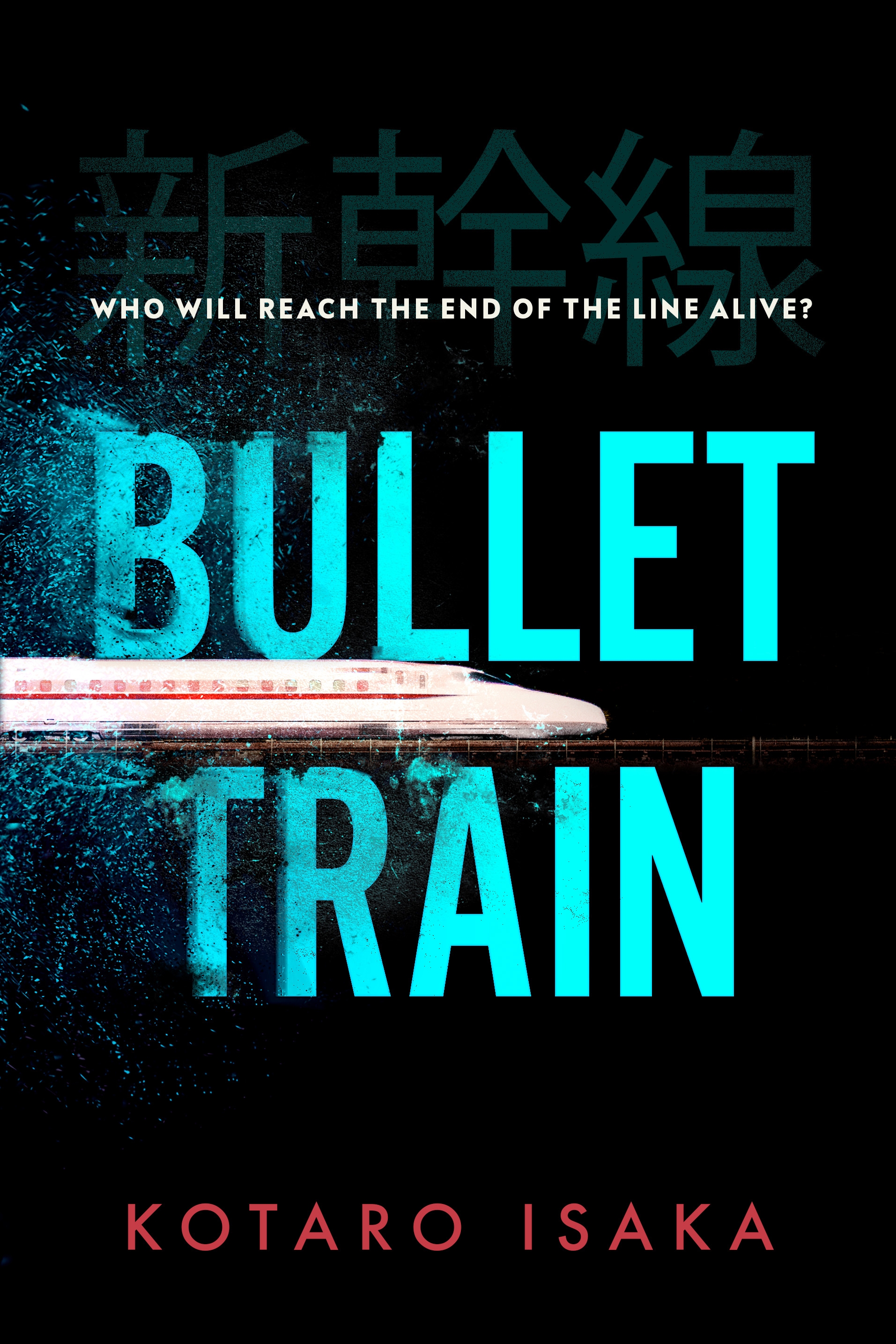
Kōtarō Isaka (and his translator Sam Malissa) have created an story that is totally improbable, manic – but quite wonderful. Five killers board the Shikansen (Bullet Train to us) which goes from Tokyo to Morioka. I use the word ‘manic’ because the journey only takes just over two and a half hours, and this is a book of over four hundred pages, so you immediately know we are pretty much operating in real time. The five passengers are:

  • Kimura. He is a drunk, a former gangster, and his six year old son lies in a coma after being pushed from the roof of a department store by –
  • Satoshi ‘The Prince’ Oji, a teenage psychopath.
  • Lemon and Tangerine, two villains who are working for Mr Minegishi, a crime boss. They have rescued his kidnapped son and have retained the intended ransom money, which is packed in a suitcase. Incidentally, Lemon is obsessed with Thomas the Tank Engine and its different characters.
  • Nanao, a hapless minor gangster, and a walking example of Murphy’s Law, but still a killer. His job is to relieve Lemon and Tangerine of the suitcase full of cash.

By page fifty, it’s all happening, and it is all about the suitcase full of cash. Satoshi is expecting Kimura, stuns him with a home made taser, and has him trussed up with tape in the seat next to him. Nanao has stolen the suitcase, but is prevented from leaving at the first stop, Ueno, by the arrival of another gangster called Wolf who has a score to settle with Nanao. Wolf barges him back into the train before he can leave, but Nanao kills him in a struggle. Lemon and Tangerine have discovered that the cash is missing, but return to their seats to find Minegishi Junior has, inexplicably, expired.

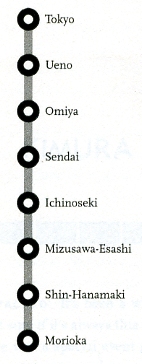
Two simple graphics add to the fun. The first (left) is a schematic of the stations on the journey itself. Though simple, this is a very clever device, because it allows the author to have the characters – albeit briefly – engage with the world outside the confines of the ten coach train. The second is of the coaches in the train (below) and is used as chapter headings as events play out.
BTSatoshi ‘The Prince’ Oji is the darkest character of the five. He is utterly without compassion. Other human beings – school teachers, teenage friends, other adults – only have value to him in the sense that they can be used for his entertainment. He is highly intelligent, but one of the more malevolent fictional villains I have encountered in recent times. Everything is thought through and planned in the minutest detail, such as his grip on Kamura. The grizzled gangster could, physically, chew up Satoshi and spit out the bones, but the teenager convinces Kamura that he has an insider in the hospital where the man’s son is lying in a coma, and should Satoshi fail to answer periodic calls to his mobile ‘phone, then this insider will find a way to disconnect the little boy’s life support system.


There is a thread of darker-than-dark comedy running through the chapters. Nanao’s attempts to rearrange Wolf’s corpse to make it look as if he was just taking a nap put me in mind of Basil Fawlty in The Kipper and the Corpse, while Lemon’s obsessive knowledge of Percy, Gordon, and James the Red Engine is like something that Flann O’Brien might have dreamt up given that, with Tangerine, Lemon has just left a crime scene where, between them, they have shot dead at least fifteen men. Add to the mix a couple of random cross-dressers, a stolen wig – and an escaped snake – and you have two and a half hours of mayhem. As passengers become corpses, one by one, the unlikely intervention of a pair of grandparents brings matters to a bloody conclusion.

I don’t doubt that other reviewers have used this analogy, but it is still worth saying that Bullet Train is something of a cross between a Tarantino movie and a Manga comic. There is the same implausible detachment from reality found in both, but also the same joyful sense of anarchy. The train itself, hurtling onwards at 200 mph, echoes the sense of high speed forward movement and drive in the narrative. The internet tells me that Hollywood have snapped up the book, and a film is being produced starring Brad Pitt. As whom? – I have genuinely no idea, but this brilliant and daring novel is published in Britain by Harvill Secker, and is available now.

WEDDING STATION . . . Between the covers

ws header018

Coming late to a well-established series can pose problems for a reviewer but, happily, this book is a prequel to the six published previously. The series is known as the Station Series, written by David Downing, and featuring the investigative crime reporter John Russell. The titles all take their names from railway stations around Berlin. They are Zoo Station (2007), Silesian Station (2008), Stettin Station (2009), Potsdam Station (2010), Lehrter Station (2012), and Masaryk Station (2013).

Fans of the books will have to excuse me while I paint a quick background picture. It is early 1933, and Hitler has been Chancellor for just a few weeks. We begin just hours after the Reichstag fire, and the SA – Sturmabteilung – are going about their grisly business with renewed vigour. Russell is English, a veteran of WW1 – and a former communist – but due to his marriage (now failed) to a German woman, he can happily say, “Ich bin ein Berliner.

WS coverWhile reporting on the death and mutilation of a young rent boy, Russell is asked by a friend to take on another case, this time on behalf of a senior army officer whose daughter is missing. It is a delicate business, because there is a strong suspicion that Lili Zollitsch has run off with a boyfriend who is an active member of the Kommunistische Partei Deutschlands.

Russell seems to collect mysterious deaths and disappearances like some men collect stamps. Hard on the heels of the Colonel’s missing daughter, he hears that a prominent genealogist has been killed in what seems to be a case of hit-and-run. One of Herr Mommsen’s most popular services had been producing evidence of racial purity – as in no trace of Jewish blood – for his clients. Had he made a rather unfortunate discovery and signed his own death warrant? If this weren’t enough, a well-known astrologer has gone missing – believed permanently – and when Russell investigates via one of Harri Haum’s customers he is astonished when she tells him that in a crystal ball-reading session a few days before the event, the seer had predicting the burning of the Reichstag.

But there is yet more for Russell to deal with. One of the friends of the murdered rent boy contacts the journalist and hands him the dead lad’s diary, in which he has faithfully recorded the names of his clients, as well as intimate physical descriptions. As Russell turns the pages, he finds the names of prominent members of the SA. Now while homosexuality is – along with communism, and being Jewish – a big no-no in the eyes of the Schutzstaffel (SS) it is a different matter in the rival organisation, the SA. The SA’s head, Ernst Röhm along with a good number fellow brownshirts are, as coy newspaper obituaries used to say, “confirmed bachelors.”

The final straw for Russelland one that very nearly breaks the back of the proverbial desert beast of burden – is when a knock on the door of his apartment reveals a young woman called Evchen who, years earlier, was a communist comrade. Not only is she still a party member, she has just shot dead one SA trooper and seriously injured another. And now she seeks shelter. How Russell gets himself out of these various pickles is gripping stuff. Some of the tension is obviously diminished by the fact that we know that the journalist survives to feature in six further books, but it is still a very good read.

We are clearly in Bernie Gunther territory here, and comparisons are inevitable, but in no way negative. This is a compelling read and a chill reminder – if any were necessary – of the gathering storm facing Germany and the wider world in the 1930s. Wedding Station is published by Old Street Publishing. The hardback is available now, and the paperback version will be out on 4th May.

Blog at WordPress.com.

Up ↑