Search

fullybooked2017

Category

REVIEWS

TO DIE IN JUNE . . . Between the covers

TDIJ header

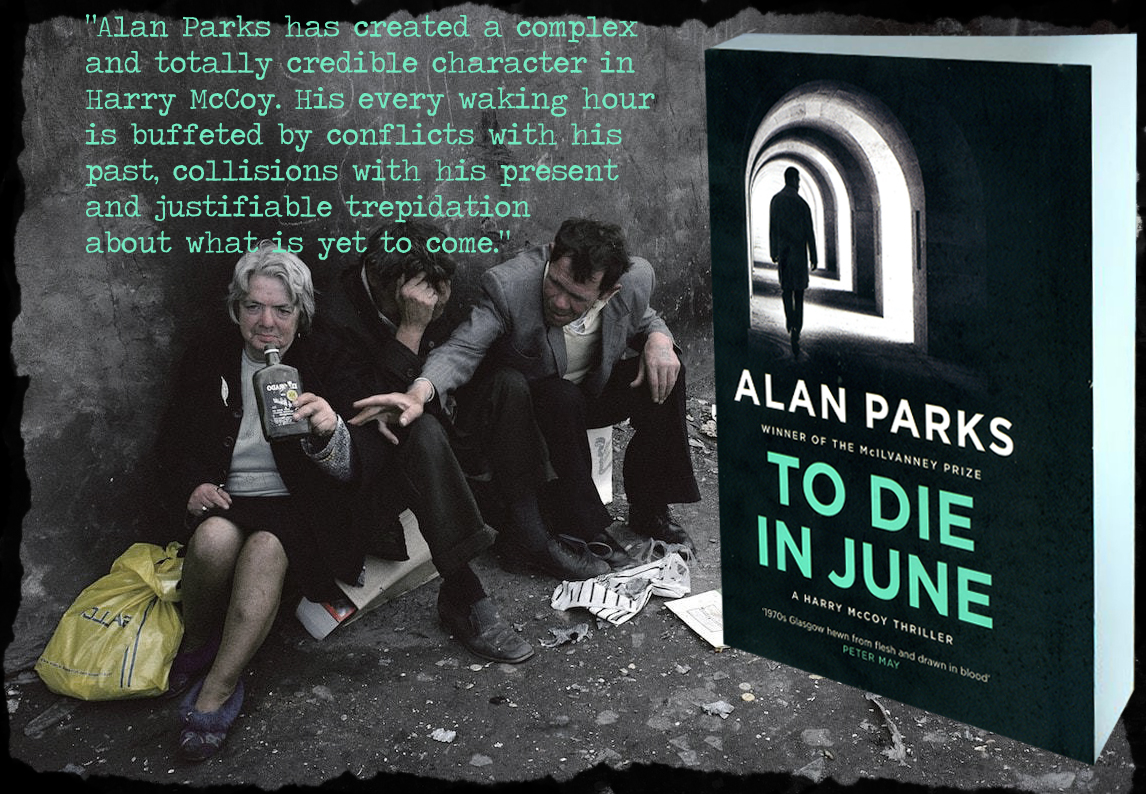
Screen Shot 2023-06-05 at 07.43.52Alan Parks (left) introduced us to Glasgow cop Harry McCoy in 2018 with Bloody January, and he has been resolutely working through the months with succeeding novels. Fictional Detective Inspectors in British crime fiction are many and varied. You would certainly need a fair sized village hall to seat them comfortably were they all to meet, so what about Harry McCoy? He has a fairly dark back-story. He was in and out of care institutions as a child. His mother is long dead, and his father – never the most consistent of parents – has now abandoned any sense of normality and is a homeless alcoholic. Through childhood connections – both were in care – he is connected to underworld boss Stevie Cooper. While not exactly in his pay, McCoy owes his old friend big-time, due to incidents in their shared past.

We are in the summer of 1975 so, in one sense this a historical novel, with many little period features that the author has to get right. No internet, computers or mobile phones, obviously, but early on in the story Parks sets the scene beautifully. McCoy has a celebrity girlfriend – a famous actress – and they are together at an showbiz awards function in the company of a young Billy Connolly, Stanley Baxter, Marie McDonald McLaughlin Lawrie (Google her) and Hamish Imlach. For those not versed in Scottish entertainers, Parks has Michael Aspel overseeing the evening.

McCoy has been transferred from his usual base to the insalubrious district of Possil, an area renowned for crime and deprivation. There is a purpose behind the move. McCoy’s boss, Chief Inspector Murray, believes that a group of detectives at the Possil station are corrupt, and he wants McCoy to infiltrate the cabal. Before McCoy can get close to the bent coppers, two urgent cases demand his attention. First, a vagrant is found dead, foaming at the mouth from having imbibed some kind of toxic drink. McCoy attends the scene, praying that the victim is not his dad. It isn’t, but the blasé dismissal of the case by the ‘experts’ as “just another alkie drank himself into an early grave” annoys him, and he senses something more sinister.

Then, a distraught woman presents herself at the station telling him that her young son has been abducted. Understandably, McCoy takes the woman at her word, and hits the panic button, with ensuing door-to-door, enquiries, blue lights flashing everywhere, and all leave cancelled. The woman then has some kind of fit and is hospitalised. When McCoy visits the home, and talks to the woman’s husband, the Reverend West, he is told that there is no son – never was – and that his wife has been  suffering with sever mental health issues for some years. West is the pastor at an obscure fundamentalist church, The Church of Christ’s Suffering.

When Mrs West throws herself to her death from a bridge, and more homeless men are found dead, McCoy hardly knows which way to turn. Added into the mix of his misery is that his old chum Stevie Cooper is about to initiate a turf war with a rival gangster, and expects McCoy to play his part. The plot twists this way and that, and there is a final hairpin bend which runs off the road anyone who is hoping for a warm and comfortable outcome to to this case for Harry McCoy.

lan Parks has created a complex and totally credible character in Harry McCoy. His every waking hour is buffeted by conflicts with his past, collisions with his present and justifiable trepidation about what is yet to come. To Die In June was published by Canongate on 25th May.

FLESH AND BLOOD . . . Between the covers

FABheader

This is book number eleven in the series, so a quick heads-up for new readers.
Time: the present
Place: Humberside
Main characters: Detective Inspector (recently promoted from DS) Aector McAvoy. He is a Scot, huge and bear-like, a gentle soul but a formidable copper. His wife Roisin; she is of Irish Gypsy stock, romantic but fiercely protective of Aector and their children – Fin and Lilah. Detective Superintendent Patricia ‘Trish’ Pharoah, thirty years in the force, and as tough as nails. Trish and Aector worship each other, but it is a purely platonic relationship. McAvoy is on holiday with his family in the Lake District, living in a traditional Romany Vardo.

In this book:
Reuben Hollow, a serial killer, serving several life sentences for murdering people he judged as having escaped justice. He was captured by McAvoy. Detective Chief Superintendent George Earl. Promoted because Trish Pharoah turned down the job. Earl is the very model of a modern media friendly senior police officer:

Trish is not immune to the pleasures of the flesh, and she is in bed with an Icelandic copper she met on a course. Their post coital bliss is disturbed by Trish’s car alarm going off, and Thor Ingolfsson runs downstairs to investigate. He is attacked with an adze and left for dead. Thor happens to be a dead ringer for Aector, and when the local police arrive to find the man face down in the road, they put two and two together, and make seventeen. Aector is very much alive and well, however and, despite being told to stay well away by Earl, he is determined to find out what is going on. David Mark’s description of Earl will ring horribly true to anyone who has experienced senior management in corporate services in recent years:

“George Earl is a tall, slim, straight-backed careerist who exudes the gentle earnestness and Anglican-priest sincerity of a Tony Blair. He has a habit of clasping his hands together when he talks, and makes a great show of telling his staff that his door is always open, and there’s no such thing as a stupid question.”

David Mark spent years as a crime reporter for a regional newspaper, and so he is well aware of the depths of villainy which are regularly plumbed by apparently ordinary and innocuous men and women. He also knows that – despite graduate entry – some of the people who are accepted as police officers are not “the brightest and best of the sons of the morning.” (Activists – please feel free to substitute the gender of your choice)

“The three uniformed constables milling around at the rear….he’s noticed that none of them seem to be able to breathe through their nose. All in their twenties and look as though they would be more comfortable working in a phone shop or flogging gloriously chavtastic trainers in a sports shop.”

What follows is pure mayhem. A former police colleague of Trish Pharoah meets an elaborate death by wood-carving chisels, McAvoy narrowly escapes death by hanging, in an execution house probably last used by Albert Pierrepoint, the chaos of Trish Pharoah’s previous life is laid bare to the world, and our man emerges – not unscathed – but able to fight another day.

Flesh and Blood veers violently between the darkest noir imaginable and a simple – but affecting – poetry. It is published by Severn House and will be available on 6th June. The final sentence sums up this brilliant series:

“And inside McAvoy’s head, another voice joins the chorus of the dead.”

https://fullybooked2017.com/tag/david-mark/

THE FALL . . . Between the covers

FALL spine035

The Lancaut peninsula is a real place. It was created back in geological time when the River Wye made a spectacular loop on its way south to merge with the Severn. On the eastern bank is Gloucestershire, and to the west lies Monmouthshire and Wales. Gilly Macmillan has taken taken this rather special and ancient place, and used it as a backdrop for this intriguing thriller. The houses she describes – The Manor and The Barn –  do not exist, but the beautiful landscape certainly does.

Screen Shot 2023-05-22 at 19.59.40

The Barn is an ultra-modern glass and steel construction, something from a modern architect’s wildest dream. Rarely do building designers have a free reign, but when Tom and Nicole Booth won millions on the lottery, they were happy for the brutalist architects to let rip. In contrast, a couple of fields away, is The Manor. A crumbling jumble of genuine styles dating back to Tudor times, it is owned by Olly Palmer and his partner Sasha Dempsey. Olly is an aspiring novelist, perhaps the next literary ‘big thing’, while Sasha runs yoga classes in the The Manor’s former Great Hall. Aspiring (and perspiring) middle-class ladies are happy to pay over the odds to work on their Asana, Bandha and Chakra in such a historic environment.

Nicole returns to The Barn after a day out at a local agricultural show to find Tom dead, floating in their creatively designed swimming pool. The police are called, and Nicole seeks temporary refuge with Olly and Sasha while the emergency services do their thing. The obvious question is, ‘Who killed Tom Booth?”, but the answer to that is saved until very late in the book. Meanwhile we enjoy the frisson of each of the central characters unraveling, one strand at a time.

In addition to all the lies and gaslighting going on between the occupants of The Barn and The Manor, the modern house takes on a demonic life of its own, as Tom and Nicole were persuaded to install a complex AI system where everything – windows, doors, blinds, the sound system and security – all operate by voice command. Except (of course) they don’t, and this allows Gilly Macmillan licence to create all manner of horrors for Nicole, who is very much low-tech.

As with all good psychological thrillers set in domestic situations, no-one – save the two investigating coppers Hal Steen and Jen Walsh – is quite who they appear to be, particularly The Manor’s much put upon housekeeper Kitty, aka – well, that’s for you to discover, but her real identity is central to the story. I have to be honest and say that when I turn a page and see the chapter heading ‘Five Years Earlier’, I am tempted to throw the book down and consign it to the charity shop. I hate split time narratives, but I confess that Gilly Macmillan makes it work here, probably because she uses the device sparingly.

There are enough ironic twists in this story of deception and violent death to earn a benevolent smile from Thomas Hardy as he gazes down from his seat with The Immortals, and I particularly liked the way the pesky voice controlled system in The Barn is used to commit a rather clever murder. The Fall is published by Century and is out on 25th May.

TOO GOOD TO HANG . . . Between the covers

TGTHheader

Confession time. I try to be honest and objective in my reviews, but there are certain authors who are so sure-footed that I know their novels will not disappoint, even before I have read the first page. One such is Sarah Hawkswood and her beguiling Bradecote series. They are not complicated. Central figure is Hugh Bradecote, noble of birth and Under-Sheriff of Worcestershire in the middle years of the 12th Century. I suppose he is the early medieval equivalent of a modern Detective Inspector and – like them – he has underlings. Bradecote is supported by the grizzled and worldly Sergeant Catchpoll and the Under Sergeant – a callow but rapidly maturing young man called Walkelin. My earlier reviews of the series can be found by clicking the link below:

https://fullybooked2017.com/tag/sarah-hawkswood/

This story begins in April 1145 with a terrible miscarriage of justice in a tiny hamlet called Ripple, the southernmost parish of Worcestershire. It is a real place, a beautiful village just north of Tewksbury. A young ploughman called Thorgar is about to be hanged for murder. He was found in the village church, crouched over the lifeless body of the priest, Father Edmund. Despite his protestations that he is unscyldig (Middle English – innocent), at the insistence of the Reeve, a man called Selewine, the villagers bear him away and he is hanged from an ancient oak tree. Thorgar’s sister Osgyth makes her way to Worcester and reports what she sees as the murder of her brother, which prompts Bradecote, Catchpoll and Walkelin to ride south to investigate.

They soon discover that Father Edmund’s death is linked to two deadly sins. The first is avarice; Thorgar, while ploughing has unearthed a treasure trove of silver artifacts – a priceless chalice, some coins and ornamental buckles dating back to Saxon times. The second is lust; this is far more sinister, as Father Edmund has been using his priestly influence to abuse young girls in Ripple, thus giving every angry father a motive for striking the ungodly cleric down.

Bradecote and his men eventually expose not one murderer – but two  – and there is a macabre finale when the respective killers are forced to disinter the mortal remains of their victims and take them to be given a Christian burial. Apart from the powerfully evocative atmosphere, this is a bloody good detective novel, but particularly impressive is the way Sara Hawkswood handles the dialogue. I suspect no-one has the faintest idea about how people spoke to each other in the 12th century, but the author establishes a style and sticks to it. As a long-time critic of what I consider to be botched attempts at authentic historical conversation in novels, I found Sarah Hawkswood’s method to be both satisfying and convincing.

EM Forster’s most celebrated – and enigmatic – dictum was, “Only connect.” Taking him literally, my goodness how Sarah Hawkswood connects. She connects us to the wonderful landscape of the Worcestershire/Gloucestershire borders, overlooked by the golden heights of the Malvern Hills. She connects us to the powerful – and sometimes destructive – presence of the River Severn. She connects us to a time when poor people lived hard-scrabble lives, totally dependent upon the whims of nature and weather and almost umbilically bound to the central focus of every town, village and hamlet – the church. She connects us to a world, perhaps not “better” than the one we live in, but one which had a firmer grasp of natural justice, common sense and spirituality. Too Good To Hang is a further gem in the crown of what is one of the best current historical series – the Bradecote novels. It is published by Allison & Busby and will be out on 18th May.

DON’T LOOK BACK . . . Between the covers

DLB header
Having had the pleasure of meeting Jo Spain
, I can tell you that she is a delightful person. That said, when she is in writing mode, don’t believe a word she says. Away from her superb police procedural series featuring Dublin copper Tom Reynolds, she has written several stand-alone thrillers, in which she practices to deceive. In The Perfect Lie, she bowled us a Googly or, for American readers, threw us a massive curve-ball:

THE PERFECT LIE . . . Between the covers

In Don’t Look Back she runs through the complete repertoire of her trickery. She tells us the main characters are:
Luke Miller: A decent – but driven – investment banker who fall in love with, and marries –
Rose Miller: An Irish lass, née Gillespie, now a teacher in London and married to Luke, Has an abusive ex boyfriend called:
Kevin Davidson: A member of a rich and powerful Donegal family, whose wealth may not have been acquired entirely legally.
Mickey Sheils: A former lawyer, and onetime lover of Luke Miller. Originally from Ireland, now working in London to protect abused women from their abusive former partners. Able to act mostly pro-bono, thanks to her marriage to:
Nathan Sheils: A big man in The City, formerly Luke’s boss.

Be prepared, however, for some of these people to be –  how best to put it? –  not entirely who they appear to be. The story starts off in a fairly straightforward manner. Rose and Luke are married, but due to Rose’s trauma at the hands of Kevin Davidson, their courtship had been a case of two steps forward, one step back. Rose turns up at Luke’s workplace, complete with airline tickets and packed bags, and announces that she has arranged a super surprise – a delayed honeymoon on the idyllic Caribbean island of Saint-Thérèse. Their stay is blissful, but on the last night, Luke senses that Rose has become agitated and distracted. Then, she blurts out that they cannot possibly be on their return flight to London the next day.

The reason? Because on the floor of their bedroom in Luke’s flat, lying there since the day they left for Saint-Thérèse, is a corpse. It is the mortal remains of Kevin Davidson, who had been stalking Rose for weeks, and finally made his big appearance. They had fought, Rose had pushed him, he lost his footing and cracked his skull – with fatal consequences – on the sharp edger of a very solid  piece of Edwardian furniture. Rose’s initial panic had metamorphosed into a plan. A desperate one, yes, but a temporary solution. Luke’s flat is the only one occupied on that floor, and its remoteness would give them at least a few days’ grace.

Screen Shot 2023-05-03 at 20.06.33

Luke books them out of their hotel and, despite having had a fairly frosty relationship with Mickey Sheils since he ended their affair, he calls her and asks her to go to his flat and investigate. Reluctantly, she does, but when she gets there, guess what? There is plenty of dried blood – but no body.

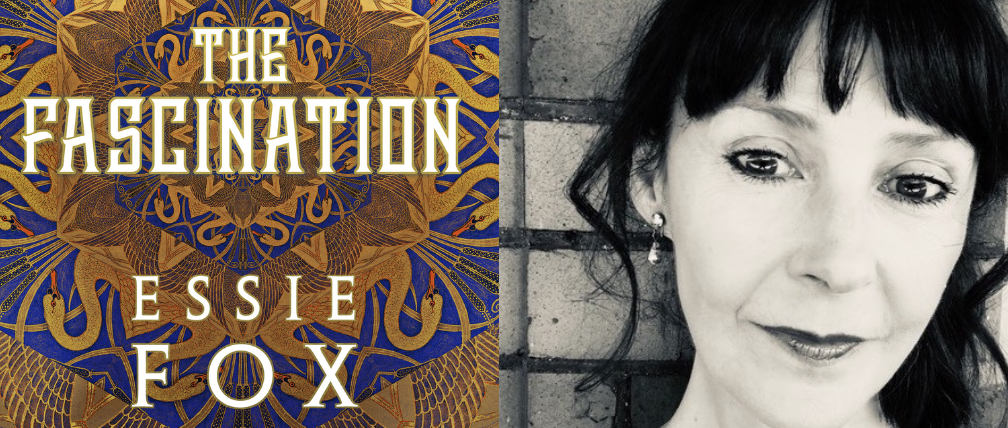
What follows is classic Jo Spain (left). One block at a time, she kicks away the supports of what we think we know about what is going on. I read the book on my Kindle, and even when it said 99%, there was time for one more surprise. This is wonderfully inventive stuff, and shows that one of Ireland’s finest writers is at the top of her game. As a footnote, I enjoyed the dramatic contrast in settings, with the tropical tourist paradise of Saint-Thérèse starkly juxtaposed against the bleak Donegal coast, where the icy horizontal rain takes no prisoners. Don’t Look Back is published by Quercus, and will be available on 11th May.

KILLING THE INVISIBLE . . . Between the covers

KTI header

KTI cover014 copyKeith Dixon’s Porthaven is a fictional town on England’s south coast. It doesn’t seem woke or disfunctional enough to be Brighton, maybe neither big nor rough enough to be Portsmouth or Southampton, so it’s maybe a mix of all three, seasoned with a dash of Newhaven and Peacehaven. Inspector Walter Watts is a Porthaven copper. He is middle-aged, deeply cynical, overweight, and a man certainly not at ease with himself – or many others – but a very good policeman. When a young woman, later identified as Cheryl Harris, is found murdered on a piece of waste ground, the only thing Watts accomplishes on his visit to the scene is that his sarcastic exchanges with a female CSI officer result in in an official complaint, and  him being moved off the case. From the sidelines, Watts knows that whoever killed the young woman was definitely trying to pass on a message. The woman’s face has been obliterated by a concrete slab, with her mobile ‘phone  jammed into what was left of her mouth.

His new job is to liaise with Porthaven council over the security aspects for a proposed housing development. This is where Keith Dixon throws in the first of several delightful plot devices. Superintendent Tony ‘Frog’ French is Watts’ boss and the man who gave the order for the sideways move. Watts happens to be having an affair with Frog’s wife Felicity – and guess who is the council executive in charge of the building project? None other than Felicity (using her maiden name) Gable.

When the officer brought in to head up the murder enquiry is himself sidelined (due to some clever calling-in of old favours by Watts) our man is back in business. He senses that the murder of Cheryl Harris is somehow connected to the business dealings of Kurt Swanpool, a millionaire property developer (with a criminal record) who is working with Porthaven Council on the housing development with which Watts was – briefly – involved.

Screen Shot 2023-04-23 at 19.30.47Watts was brought up by his father – and in boarding schools – after his mother left the home. There has been no contact with her from that day to this, until he receives a message from the desk sergeant at Porthaven ‘nick’ simply saying that his mother had ‘phoned, and would he call her back on the number provided. This thread provides an interesting and complex counterpoint to the police investigation into the killing of Cheryl Harris. It also allows Keith Dixon (right) to better define Watts as a person; on the one hand he is aloof, selfish, socially abrasive and enjoys showing his mental superiority; on the other, he is vulnerable, unsure, and shaped by a childhood lacking conventional affection.

Kurt Swanpool may be modeled on a real life notorious Sussex millionaire landlord and part-time criminal with connections to southern Africa. Who knows? Swanpool retains dirty connections, even as he tries to establish his philanthropic credentials. Did anyone – or anything – decent ever come out of the Balkans? The jury is out, and two villains name Milo and Drago appear in the story, and don’t advance the cause of Serbia or Montenegro being nominated for an international human rights award one little bit.

Watts gets his murderer. That’s not me being intentionally oblique, but a rather gentle suggestion that you read a famous 1911 poem by Rudyard Kipling, which begins:

“When the Himalayan peasant meets the he-bear in his pride,
He shouts to scare the monster, who will often turn aside. “

Killing The Invisible – the second in the Porthaven Trilogy – is superior crime fiction. By turn intense, dark, literate and sardonic, it is published by Spellbound Books, and is available now.

MOSCOW EXILE . . . Between the covers

ME header

MESome writers who have authored different series occasionally allow the main characters to meet each other, provided that they are contemporaries, of course. I’m pretty sure that Michael Connolly has allowed Micky Haller to bump into Harry Bosch, while Sunny Randall and Jesse Stone certainly knew each other in their respective series by Robert J Parker. Did Spenser ever join them in a (chaste) threesome? I don’t remember. John Lawton’s magnificent Fred Troy series ended with Friends and Traitors (2017), and since then he has been writing the Joe Wilderness books, of which this is the fourth. I can report, with some delight, that in the first few pages we not only meet Fred, but also Meret Voytek, the tragic heroine of A Lily of the Field, and her saviour – Fred’s sometime lover and former wife, Larissa Tosca. As an aside, for me A Lily of the Field is not only the best book John Lawton has ever written, but the most harrowing and heartbreaking account of Auschwitz ever penned. Click the link below to read more.

WW2 HISTORICAL CRIME FICTION (1) A Lily of the Field

The notional central character in this novel is Joe Wilderness, although he does not appear until the half way point of the book. For readers new to Joe, a bit of background. First, his real surname is Holderness – his nickname rather cleverly reflects a character who is beyond the pale of conventional loyalty and morality. His WW2 service career was marked by insubordination and bootlegging, and his eye for the main chance found him operating various scams in post war Berlin, where his deviousness brought him to the attention of the British intelligence agencies. Since then, he has been involved in various covert operations on behalf the government – and himself.

The background action in Moscow Exile begins with the activities and subsequent shock-waves caused by the scandal of The Cambridge Five – Burgess, Maclean, Philby, Cairncross and Blunt – pillars of the British establishment who were actively working for Moscow in the 1950s, but the novel has a wide timespan – from the late 1940s to 1969. Charlie Leigh-Hunt, a British toff with a distinguished WW2 record carries the story for a while, as he is sent to be chief spook in Washington after the hurried departure of Harold Adrian Russell “Kim” Philby. Charlie has an affair with Charlotte ‘Coky’ Shumaker a British socialiter, whose husband is Senator Bob Redmaine – a thinly disguised version of Joe McCarthy, he of the notorious anti communist witch hunts. Ironically, Coky is in the pay of Russia, as is Charlie, who eventually ends up as a Moscow resident.

Joe Wilderness has also, since a disastrous attempted prisoner exchange on a Berlin bridge between the East and West sectors, been a guest of the KGB, and Lawton sets up a delicious plot twist when Fred Troy – now a Lord, and a British diplomat – is persuaded to be ‘Our Man In Moscow.’ Again, readers new to Lawton’s books might welcome some background on Fred (see below)

THE TROY DOSSIER . . .

The plotting, by this stage, in terms of bluff and double-bluff, makes John le Carré look like Enid Blyton but, to cut to the chase, HM government decides that it is too dangerous to allow Joe to remain in Moscow, and so he has to be ‘extracted’. It doesn’t hurt that Joe’s father in law, Colonel Burne-Jones is a senior figure in MI5, and his boss – Roderick Troy – is both Home Secretary and Fred’s brother. Normally, spies are only released in exchange for other spies, but the woman handling the Russian end of things, General Volga Vasilievna Zolotukhina is just as big a crook as Joe, and she wants money – £25,000 in the proverbial used notes.

Publicists and other book people who make lists might dub this the fourth Joe Wilderness novel but, for me, it’s the latest saga in Fred Troy’s career – and all the better for it. It is a dazzling and erudite journey down the complex back roads of Cold War diplomacy and skullduggery. Lawton is one of our finest writers, and every page he writes is pure pleasure. Moscow Exile is published by Grove Press and will be available on 4th May.

THE MONK . . . Between the covers

Monk header010

The idea of an investigating detective having what some people see as a disability is an interesting one. Jeffrey Deaver’s Lincoln Rhyme is a tetraplegic who, effectively, cannot do ‘normal detective things’; Nero Wolfe is morbidly obese and rarely leaves his apartment – his cases are solved by his brain power and Archie Goodwin‘s leg-work; more recently, Harry Bingham’s Fiona Griffiths suffers from Cotard’s Delusion, aka Walking Corpse Syndrome, which gives her telling insights into murder investigations. Tim Sullivan introduced us to Detective Sergeant George Cross in The Dentist (2021). Cross has Asperger’s Syndrome* I will say now that this was one of those rare book that I simply didn’t want to end. I noted the advance of my bookmark through the pages with definite sadness.

*Symptoms include an inability to understand figurative speech, obsession with detail, difficulty with recognising emotional responses and lack of social awareness and empathy.

Author Tim Sullivan, very cleverly, pairs George Cross with fellow DS Josie Ottey, a married woman who is as ‘normal’ as Cross is ‘odd’. She acts as a kind of buffer between Cross and the people he must question as part of the job. What Cross brings to the party, however, is a kind of cold objectivity which, to counteract his inability to read a facial expression or tone of voice, gives him a laser-like clarity regarding the truth and logic of what witnesses or suspects tell him. The Monk is set in the Bristol area, and a body is found in the intriguingly named Goblin Combe*, a rural beauty spot beloved of hikers and tourists.

*A small dry valley beneath a hill. Commonly used in southern and south western England.

The  body, brutally beaten, is found strapped to chair and abandoned in a ditch. It turns out to be that of a Benedictine monk, Brother Dominic, who had only recently been reported missing from a nearby monastic community, St Eustace’s Abbey. The victim was killed elsewhere and the corpse dumped. There only a dozen members of the order, all men who, for whatever reason, have chosen to reject the modern world in favour of a life of prayer and contemplation. George Cross rapidly sees that there are two obvious lines of enquiry; was Brother Dominic killed because of something that happened within the walls of the monastery, or did his murder relate to something in his previous life, where he was a very successful investment banker?

Screen Shot 2023-04-05 at 18.42.44Without giving the game away, it is in Brother Dominic’s previous life where the clues are to be found, but answers don’t come easy for Cross and Ottey. Although there was a very clever plot twist involving the identity of the killer, I was far more involved with George Cross as a person than wondering who murdered Brother Dominic.The relationship between Cross and his father, the discombobulating effect of the re-emergence of his mother – lost to him since she left the family home when he was five – and his attraction to the unambiguous world of order, silence and simplicity of Dominic’s fellow monks,  all contribute to the power of this compelling read.

The book is full of little treats and bonuses. Rather in the same way that The Nine Tailors doubled as a treatise on the arcane art of bell ringing, we learn that George Cross is an accomplished church organist, despite the concept of religious faith being totally alien to him. He spends his spare time by pushing the murder case to a corner compartment of his mind, and patiently dismantling the dysfunctional abbey pipe organ, then cleaning and re-assembling the separate parts so that the instrument can once again play a part in the liturgy. Sullivan (above left) also gives the staple of police procedural novels – the recorded interview – a new twist; Cross’s ‘disability’ is a blessing when it comes to his interview technique, as neither the suspect nor the duty lawyer can make head nor tail of his literal approach to everything that is said. Mistaking him for an idiot, however, becomes a serious error of judgment.

Sullivan’s experience as a film director and screenwriter gives the narrative an intensely visual feel, but he wisely lets us picture George Cross in our own way, providing little or no physical description of him.  The Monk is a brilliant police procedural with an engaging central character and a clever plot. Published by Head of Zeus, it will be out on 27th April.

I WILL FIND YOU . . . Between the covers

COBEN header007

Sometimes, the best writers set themselves challenges by posing a plot problem that appears to deny a plausible solution. One such was back in 2021 when, in The Perfect Lie, Jo Spain pulled the wool over our eyes. There, the deception hinged on a few words – and our (wrong) assumptions.

https://fullybooked2017.com/2021/05/13/the-perfect-lie-between-the-covers/

In his latest novel, Harlan Coben – to use the metaphor of Houdini – has wrapped himself in so many chains and padlocks that it seems impossible that he can set himself free. Why? Try this. Five years ago, David Burroughs was jailed for life for murdering his three year-old son, Matthew, with a baseball bat. He now languishes in the protected section of a high security jail, alongside child rapists, cannibals, and other monsters. After refusing to see any visitors for five years he is finally forced to see one – because he omitted to fill in the annual paperwork. It is his former sister-in-law Rachel; his wife, Cheryl has, inevitably, divorced him. Rachel shows David a photo (taken by a friend) of a family group at an amusement park. On the edge of the picture is a little boy, clutching the hand of an adult, otherwise out of picture. It is Matthew.

Coben gives us a drive-through account of the back story. David Burroughs was home-alone with Matthew that night. Cheryl, a surgeon,  was at work. David was in a bad mood, put his son to bed without a bedtime story, and proceeded to get outside of the best part of a bottle of Bourbon. Somehow awakened by a sixth sense that something was wrong, or perhaps by the smell of blood, David staggered to his son’s bedroom only to find a mangled and unrecognisable corpse on the bed.

The first key to the mystery is, of course, that the shattered boy’s corpse was just that – unrecognisable. It was, however, in Matthew’s bed, wearing Matthew’s pyjamas. When, a little while later a baseball bat, with David’s fingerprints all over it, is found buried in the garden, David’s status changes from bereaved father, through suspect, to convicted killer.

The next key has to be putting David in a situation – i.e. no longer behind bars – where he can investigate the possibility that the child in the photograph is Matthew, and prove that the murdered boy in Matthew’s bed was someone else. The Governor of Briggs Penitentiary is Philip Mackenzie, and he has history with David Burroughs. David’s dad, Lenny, was, long ago, a grunt in Vietnam with Phil. The pair survived and went on to become partners in crime prevention as precinct cops. Now, Phil is just months away from retirement and a double pension, while Lenny is in the advanced stages of dementia. Suffice it to say there is a fairly improbable break-out from Briggs but this is, after all, crime-fiction.

Coben then throws a fairly heavy spanner into the works by revealing that at a rough stage in their marriage, when Cheryl and David were unable to conceive, Cheryl booked an appointment at a sperm donor clinic. This cleverly opens up all manner of potential twists and questions, which the author exploits to the maximum. It certainly had me guessing right up to the final few pages. If I say this a typically American slick thriller, it is meant as an entirely positive description. Somehow – and I won’t say they are better than British writers – American novelists such as Coben, Connolly, Baldacci and Kellerman produce a polished and gleaming product which has, to extend the automobile metaphor, a distinctive ‘new car smell’. I Will Find You is published by Century and is out now.

Blog at WordPress.com.

Up ↑