David Fennell introduced us to London copper DI Grace Archer in The Art of Death (2021) Now, she returns in a complex new case which involves cold case crime and the murders of sex workers, decades apart. The investigation becomes very here-and-now when the body of a young Croatian woman called Elena Zoric is found. She died from a puncture wound to her chest, but whatever killed her, it wasn’t a bullet.
The best police procedurals always give us a fly-on-the-wall account of the personalities and tensions that exist inside a police station. Because her previous superior has been sideline and has to care for her husband, struck down with Long Covid, Grace Archer has a new boss, Chief Inspector Les Fletcher, He is described as a “gammon-faced Yorkshireman” with more than a trace of the toxic masculinity common to that breed. Archer’s wing man is Belfast born DS Harry Quinn – reliable and intuitive. Less helpful is DI Lee Parry, nephew of the Metropolitan Police Commissioner, but about as much use as a chocolate fireguard. He is lazy, venal and prepared to cut corners for an easy life.
I have often observed that Detective Inspectors in British crime novels are, perhaps, overused. There are very sound reasons for this, however. DIs are perfectly placed to be both at the centre of investigations bureaucratically, while able to be out on the street, at the crime scene, and in the faces of the bad guys. Much more rare is the novel where a humble DC is the locus of activity. I can think of only one series, and that was written by Alison Bruce, and featured Cambridge Detective Constable Gary Goodhew. My review of The Silence is here. That being said DI Grace Archer is a welcome guest at a party held in a very crowded room.
We have here something of a whirling dervish of a plot, which spins this way and that and incorporates apparently disconnected events. We have a bizarre (but sadly all-too-credible) social ‘influencer’ called Calvin ‘Dixy’ Dixon whose latest Tik-Tok sensation shows him talking to the dessicated corpse of a woman sitting in a wheelchair in an abandoned house. There is also something that might become a ‘love interest’ angle, when Liam, a builder friend of Harry Quinn, is booked to renovate Archer’s house. He also happens to be extremely handsome, and brings with him freshly baked croissants to share before he starts work each day.
Then there is Mallory Jones, the guiding light in a successful podcast called Mallory Jones Investigates. She alternately helps and hinders Archer’s search for a man whose weapon of choice appears to be some kind of bolt gun. Finally, in far-off Berwick on Tweed, we have the Mercer family. Barry and Isla, and Isla’s brother Simon. Barry and Isla are both ex-coppers, but their teenage daughter Lily has fallen in with a bad crowd, and makes fistfuls of cash by appearing in amateur porn videos with her bestie, Gemma.
Archer is concerned to discover that, back in the day, her new boss Les Fletcher was, as a young PC, involved in the older murder investigations, and her informants tell her that he was rude and unsympathetic, strongly showing his prejudice that as ‘working girls’, getting assaulted by clients just went with the job.
As you might expect, David Fennell seizes the frayed ends of these plot strands and weaves them together to make for a highly satisfying conclusion. There is a savage and sanguinary denouement in, most appropriately, a disused abattoir. Not everyone survives the carnage, but as the emergency vehicles trundle off into the night, we have catharsis. Grace Archer certainly has her own demons to torment her, but she is a courageous and resourceful copper with a fierce determination to pursue the truth. A Violent Heart is published by Zaffre and is available now.




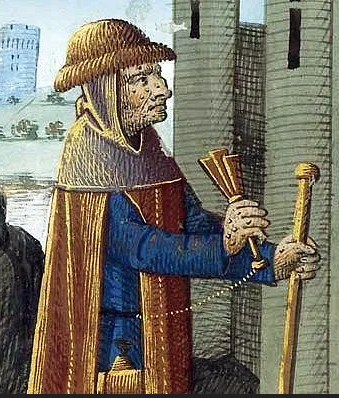 When Lady Frideswide is found dead beside the footpath between The Lazar House and the brewery, the Bishop’s Seneschal, Sir John Bosse is sent for and he begins his investigation. His first conclusion is that Frideswide was poisoned, by deadly hemlock being added to flask of ale, found empty and discarded on the nearby river bank. He has the method. Now he must discover means and motive. Bosse is a shrewd investigator, and he realises that Frideswide was not, by nature, a charitable woman, therefore was the valuable gift of ale a penance for a previous sin? Pondering what her crime may have been, he rules out acts of violence, as they would have been dealt with by the authorities. Robbery? Hardly, as the de Banlon family are wealthy. He has what we would call a ‘light-bulb moment’, although that metaphor is hardly appropriate for the 14th century. Frideswide, despite her unpleasant manner, was still extremely beautiful, so Bosse settles for the Seventh Commandment. But with whom did she commit adultery?