
Search

fullybooked2017

Category

REVIEWS

THE PARIS PEACEMAKERS . . . Between the covers

TPP SPINE041 copy

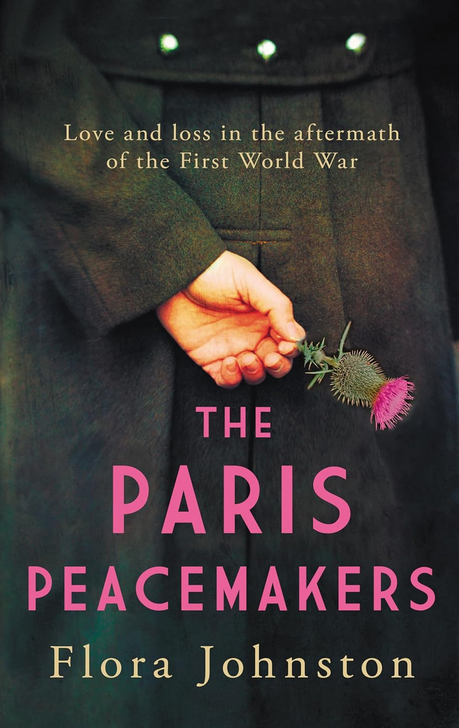
The guns that began their incessant thunder in August 1914 are, at last, silent. The German field army has surrendered, the Kaiser’s High Seas Fleet lies at anchor in Scapa Flow, and Wilhelm himself has abdicated. In Paris, the great, the good – but more importantly, the victorious –  are assembling to pick the bones out of five years of carnage. Meanwhile, we meet the Rutherford family. Their home is in Thurso, on the stormy north eastern coast of Scotland. Jack is just one of nearly 900,000 British men to have paid what was poetically called ‘the supreme sacrifice’. His sisters are both now in France: Corran is with a charity in Dieppe, bringing some sort of education to young soldiers who have had academic opportunities denied them for the last five years. Stella is in Paris, having been engaged as one of the hundreds of typists needed to record the decisions and arguments in the drama shortly to be played out at Versailles. Alex is still on Royal Navy duties, with his ship keeping a watchful eye on a war that is still being fought between Russian Bolsheviks and the Tsarists they overthrew.The novel follows the lives and loves of the Rutherford girls.

Flora Johnston handles the historical background well. It is now widely acknowledged that the Treaty of Versailles did not end the war between Germany and her enemies. It merely put it in on hold for twenty years. There was not to be a new world, or anything remotely like the ‘land fit for heroes’ that optimists imagined, either in Britain or France,and certainly not in Germany. In vain did US President Wilson strive for some kind of settlement that would be for all time. Who can blame France – with 1.4 million dead, thousands of villages reduced to rubble, its industry shattered and a priceless architectural heritage destroyed – for wanting to make Germany pay?

We see 1919 through many different eyes, and this is a story skillfully told. Arthur, Corran’s teacher colleague is embittered by the sacrifices his own parents made to educate him, and white-knuckled with anger that, back home, his own family, protesting against the lack of jobs, are faced with baton charges by police. Rob Campbell, once Corran’s intended fiancée, is worn down and traumatised by his work as a battlefield surgeon. His fondest hope is purely escapist, and it is that one day he might be able to relive his glory days on the rugby pitch. But with so many of his fellow players rotting under the French and Belgian soil, what hope does he have?

The game of rugby is a powerful motif in this story. in an England-Scotland game in March 1914 the thirty young men are at the peak of fitness, chests bursting with pride. Too many of those chests would, in the coming turmoil, simply become targets for German bullets and shell fragments. On New Year’s Day 1920, the first game of any consequence to follow the war was played, between France and Scotland. It is a small and hesitant step forward, but there are too many missing names of the teamsheets.

The story is a remarkable blend of history, romance and social observation. Flora Johnston is a fly on the wall at a bitter ceremony in a young man’s bedroom that must have been repeated countless times across Britain and, indeed, France, and Germany:

She felt again the overwhelming sadness of sorting through Jack’s possessions yesterday. All over the country there were houses like this, filled with the ephemera of hundreds of thousands of lives that had unexpectedly ceased to exist. Clothes and footballs, bicycles and egg collections, razors and comics and diaries and gramophone records. So much of it: surely far too much for the nations attics or rubbish heaps or junk shops to absorb.”

The Peacemakers of Paris reaches out to so many different readers. WW1 buffs who appreciated Birdsong and Pat Barker’s trilogy will find something here. Those who like romance, a hint of heartbreak, but an optimistic ending will also be happy. Most importantly, anyone who enjoys a novel which is well researched with convincing characters will not be disappointed. Published by Allison & Busby, the book is available now.

Screen Shot 2024-04-17 at 17.30.01

THE KITCHEN . . . Between the covers

kitchen spine039 copy

As her name suggests, Hamburg State Prosecutor Chastity Riley has American antecedents, but her work and life are both firmly centred in the German city that sits astride the River Elbe. Author Simone Buchholz leaves us pretty much to our own devices to imagine what she looks like, but we know she smokes, enjoys a drink or three, can be foul-mouthed, and has an on-off relationship with a chap called Klatsche.

From the word go, Buchholz drops a broad hint about what is going on, but Riley only finds out much later. Her immediate problem is that two packages of body parts have been recovered from the Elbe, disturbed by dredging. The men have – literally – been expertly butchered and the parts neatly wrapped up in plastic and duct tape. It turns out that the dead men have a history of serious abuse towards women, and a witness report suggests that two women are linked to the killings.

A third body is found, this one being intact, but Riley has another problem to solve. She has a friend named Carla, who runs a coffee shop and is a very important part of Riley’s life, fulfilling the dual function of sister and mother. When Carla is attacked and raped by two men, Riley becomes angry with the police’s apparent lack of urgency, but is powerless to intervene. As well as trying to solve the mystery of the Elbe packages she is central in a current court case where two people traffickers are on trial. Their business model was to travel to rural areas in places like Romania, and persuade young women that a glamorous lifestyle awaits them in Germany. The reverse is true, of course, and the girls are soon put to work in Hamburg’s notorious sex trade.

Events in Riley’s personal and professional life seek to be spinning out of control. First, thanks to the defence lawyers in the trafficking case successfully making out that their clients are really nice chaps who had traumatic childhoods, and who’ve just had a bit of bad luck recently, the smirking criminals get the lightest sentence possible. Then, she and Klatsche discover that Carla – with the assistance of a shady friend called Rocco – have done what the police failed to do, and have captured the two rapists. It is only with the greatest reluctance that Riley realises she must persuade Carla to hand the two men over to the police.

Screen Shot 2024-04-05 at 18.48.52

When, with a mixture of instinct and sheer luck, Riley identifies the two women responsible for the three earlier murders, her professional integrity is put to its sternest test. In some ways this is a very angry book and is centred on the evil that men do, particularly to women. It is obviously entirely appropriate to the tone of the book that much of it is set in the St Pauli district of Hamburg, an area that began its notoriety centuries ago as a place that provided entertainment for sailors. Its infamous Reeperbahn remains a living – and sadly prosperous – example of women being made into a commodity to please men. Despite her obvious anger, however, Buchholz (left) doesn’t moralise. Chastity Riley realises that Hamburg is what it is, and  if the needle of her moral compass occasionally swings in an unexpected direction, then so be it.

The Kitchen proves that a book doesn’t have to be 400 pages long to be effective. The prose is precise, spare, icy cool and as dark as ink. Simone Buchholz has serious style – in spades. The book was translated by Rachel Ward, published by  Orenda Books and is available now.

Screen Shot 2024-04-17 at 17.27.08

THE GRAND ILLUSION . . . Between the covers

TGU spine036 copy

London. The early summer of 1940. British military leaders, politicians and the general public are wondering quite what to make of Dunkirk. Yes, over three hundred thousand allied servicemen have been rescued from the jaws of Hitler’s Blitzkrieg, but they have left behind them their weapons, millions of rounds of ammunition and countless thousands of gallons of fuel. The British Expeditionary Force might still exist, but it has few rifles, artillery pieces or tanks (even if their were any fuel to propel them).

Against this gloomy backdrop, we meet Daphne Devine and Jonty Trevelyan. They are busy entertaining audiences at London theatres with their conjuring act. Daphne is, of course, the archetypal ‘glamorous assistant’, flashing her shapely legs before the climax of their act, where she apparently gets sawn in half by The Grand Mystique. In much more secret places than the Metropolitan Edgware Road, intelligence officers are wondering just how they can remove the gloves from the British establishment who don’t yet realise that their Nazi opponents have torn up the rules of war and are fighting a very dirty fight. Just as Daphne and Jonty are enlisted as unlikely secret weapons, news comes that the  SS Arandora Star, taking hundreds of internees and prisoners of war to Canada has been  torpedoed and sunk by a German U-boat with the loss of more than 800 lives. Daphne’s Italian uncle is one of those lost.

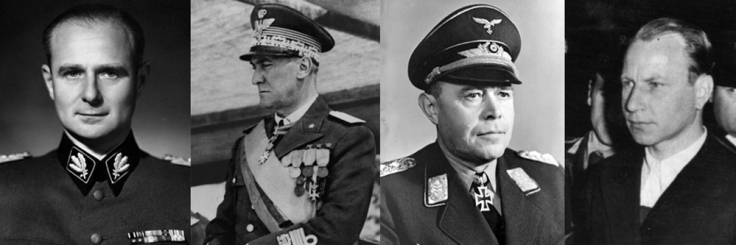
Unsure of what is to be asked of them, Daphne and Jonty say goodbye to normal life, and are whisked off to a high security unit which seems to specialise in camouflage, pretence and making German aircraft make as many mistakes as possible in identifying targets on the ground. Then, events make another lurch in the direction of the unexpected. The ‘behind-the-scenes’ directors of this unlikely drama have become aware that the Nazi high command are, to a man, deeply susceptible to the occult and the power of astrology.  This is the list. The initials are fairly obvious, although I admit to wondering what Reinhardt Heydrich was doing their, as this was only 1940. Then I remembered Hitler’s deputy, that strange who flew a plane to Scotland, and spent the last years of his life in Spandau Prison.

TGI quote

Then, Syd Moore introduces us to the delightful fulcrum on which the rest of the novel pivots. In a briefing Daphne and Jonty are astonished to learn that they are required not just to create an illusion of some astral phenomenon which will deter Hitler and his cohort from invading Britain, but to actually dabble in the Black Arts and recreate the demonic force which – so they are told – wreaked hell and destruction on The Spanish Armada in 1588, thus enabling Sir Francis Drake to continue his game of bowls, safe in the knowledge that the spell has already been cast.

On 31st July 1940, In the full knowledge that there are German spies nearby, observing their every move, Daphne and the other specialists create an elaborate and dramatic psychic event. It is a spectacular illusion. Or is it just an illusion? That is the enigma with which Syd Moore leaves us. Of course, conventional history tells us that the reason Hitler abandoned Operation Sealion was the Luftwaffe’s failure to gain air superiority over the RAF, but this delightful fantasy has other ideas.

TGU quote038 copy

The Grand Illusion is published by Magpie Books and is available now.

THE BROTHERS . . . Between the covers

brothers spine031

Screen Shot 2024-04-10 at 10.34.23Every schoolboy of my generation was taught the history of Britain’s great social reformers of the 19th century, and we were able to rattle off their names – Elizabeth Fry for prisons, Florence Nightingale for nursing, Cobbett for agriculture and Wilberforce for slavery. I have to confess that until I moved to Wisbech in the early 1990s, I hadn’t heard of Thomas Clarkson. Now, as I pass his imposing memorial every time I walk into town it is a constant reminder of a man who has been called ‘the moral steam engine’ of the movement to end Britain’s connection to the  slave trade.

The slave trade from Britain was a brutally simple triangle. Ships left port carrying British made goods such as cloth, muskets, ball and powder, plus such humdrum items as pots and pans. The ships were mostly crewed by human flotsam and jetsam, men often forced to make the journey due to debt or coercion. They sailed to what was known as The Guinea Coast, as shown on this contemporary map.

Screen Shot 2024-03-19 at 19.54.14

Once docked in West Africa, the ships’ captains would trade with slavers, almost always Africans themselves, usually members of dominant tribes. Their currency was human lives, often captured in battle, or simply raided from villages. A typical trade might be one healthy man for two muskets. The slaves were then stowed in unspeakable conditions as the ships set sail for places like the American South or Jamaica. A captain’s ambition was to reach his destination with as many of his captives – sometimes in excess of three hundred – as saleable as possible. The surviving slaves would then be sold mostly for raw cotton, tobacco, loaf sugar and molasses – highly valued in the brewing trade and the burgeoning popularity of coffee houses – plus ça change, plus c’est la même chose.

The ship would then complete the third side of the triangle, sailing back, usually to Bristol or Liverpool, with a relatively smaller number returning to London or ports on the River Clyde.. The slaves were not the only victims. The journey back to Britain would only need a few crew members, and the fewer that were left on board as the ship entered home waters, the fewer that needed paying, thus increasing the profit for the investors who backed the enterprise.

Thomas Clarkson cuts a distinctive figure. A gangling man, over six feet tall, with a shock of unruly red hair he has the courage of a zealot. He begins gathering his evidence about the sheer inhumanity of the slave trade by visiting Bristol, where he speaks to men who have witnessed the barbarity of the triangular voyages. He makes the acquaintance of Dr Gardner, forced by fate and circumstance to enlist as physician on board the soon-to-depart ship, The Brothers.

Busy as Bristol is, it is nothing compared to Liverpool, where slave ships are moored row on row in the docks. Clarkson travels north, and goes about his fearless business despite death threats, and focuses his attention on one English sailor, Peter Green, whose death typifies the inhuman treatment of members of the ships’ crew. The irony is, of course, that the countless Africans who die on these voyages have no names. But Green was born and baptised an Englishman. He had kith and kin. His miserable death is a powerful weapon in Clarkson’s campaign.

TC plaqueClarkson narrowly avoids becoming the victim of a mob in Liverpool. Meanwhile, as readers, we are privy to Dr Gardner’s diary written during the voyage of The Brothers. The two narratives become parallel: at sea, once the slaves have been offloaded, the voyage of the vessel – in theory a relatively safe and simple return home – is blighted by what seems to be a malignant spirit at work in the depths of the ship. The crew members disappear, one by one, and the barbarous Captain Howlett is driven mad.

Back in England, we share the frustrations of Clarkson and fellow campaigner Granville Sharp, as – to stay with a nautical analogy – the good ship Abolition founders on the rocks of vested interests and parliamentary procedure. This story is set in the late 1780s and it wasn’t until 1807 that the British involvement in the slave trade was ended by parliamentary decree. For the record, Wilberforce’s part in the campaign was not inconsiderable but, as MP for Hull, he was able to fire the bullets that Clarkson had made for him.

Readers will glean a solid historical background to more recent events, like the statue-toppling in Bristol, and demands for reparations for the descendants of historical crimes. It is worth pointing out that the loan taken out by the British government to compensate those whose wealth was diminished by abolition, was only paid off in 2015.

The Brothers is a tale of an unspeakable and barbarous trade, and of the physical and moral courage of one man who fought to end it. The novel is available now.

CLOSE TO DEATH . . . Between the covers

ctd spine021 copy

This series of novels has a unique concept. The author appears, more or less, as himself. We briefly meet his agent, his wife and his editor, while we learn about his hits and misses, both as a screenwriter, playwright and with his re-imagining of James Bond. When fiction appears, it is in the shape of an enigmatic former Metropolitan Police officer, Daniel Hawthorne. He was dismissed from the force after an ‘unfortunate accident’ happened to a deeply malevolent paedophile who was in police custody. Since then he has gone freelance, and has been instrumental in solving several high profile murder cases, working as an ‘advisor’ to the police. The four previous books in the series have Hawthorne investigating crimes, with Horowitz chronicling the events. I reviewed The Sentence is Death, and The Word Is Murder.  Click the links to read what I thought.

This time things are slightly different. Horowitz has a deadline for a fifth book, is all out of ideas, and he hasn’t seen Hawthorne for ages. When he does find him, the former copper will only play ball by allowing a past case to be used, and he will co-operate by giving Horowitz the case notes – but just one packet at a time.

The murder was that of a hedge fund manager who was found dead in his house with a crossbow bolt through his throat. The house was one of six in Riverview Close (hence the novel’s title) in Richmond, South London. The little estate is self contained and with just the one security gate, so what we have here is not a locked room mystery, but a locked estate mystery. The residents are:

Adam Strauss and his wife Teri. Strauss is a former TV personality, but is now a professional chess player. Their house is called The Stables.

In Well House lives Andrew Pennington. He is retires, a widower and was once a well respected barrister.

May Winslow and Phyllis Moore are elderly ladies who share The Gables. They were both once nuns, and they run a little bookshop that specialises in Golden Age crime fiction.

Woodlands is the home of Roderick and Felicity Browne. He is a wealthy dentist, known as ‘dentist to the stars’ for his clientele of showbiz celebrities. Felicity has a degenerative disease and is mostly housebound.

Tom and Gemma Beresford live in Gardener’s Cottage. He is a local GP, while she has a high profile business making designer jewellery.

Finally, at Riverview Lodge we have the man on whose death this book centres. Giles Kenworthy is an old Etonian who, apparently makes a great deal of money in the city. He met his wife Lynda when she was an flight attendant on one of his overseas trips. They have two very boisterous boys, and several cars, which they tend to park with little consideration for the other people in the Close.

Kenworthy has also put in for planning position for a swimming pool and changing facility which the other residents believe will completely devalue the Close. Quiet words, along the lines of, “I say old chap, would you mind ….?” have had no effect whatever, and so a ‘clear the air’ meeting is called for everyone, but the Kenworthys don’t show up.

When Kenworthy is found murdered, it is quickly established by the Metropolitan Police, led by Detective Superintendent Tariq Khan, that the murder weapon was a crossbow belonging to Roderick Browne who, however, is mystified by how anyone could have broken into his garage and stolen the weapon. Khan is persuaded to engage the services of Hawthorne and his assistant, a man called John Dudley.

At this point, I should step away slightly and explain the complex structure of the story. It operates with different time frames and narrators. There is the author’s ‘now’ (actually 2019) where he describes his increasingly difficult relationship with Hawthorne, and the pressure he is under to complete the book. The main events in Riverview Close take place in the summer of 2014, and we observe these through the eyes of the inhabitants, but we are also a fly on the wall during the police investigation, and some of the subsequent work, independently, of Hawthorne and Dudley.

If this sounds complicated, it’s because it is. One of the little ironies is that at one point during the book Horowitz describes how he is not drawn to the fantastical nature of many classic locked room mysteries, but he has Hawthorn deliver a splendid speech when he, Dudley and Khan believe they are about the unmask the killer:

What I’ve realised, since I arrived at Riverview close, is that nothing here is what it seems. Nothing! Every clue, every suspect, every question, every answer … It’s all been carefully worked out. Everyone who lives here has been manipulated too. So have you. So have. Something happens and you think that it somehow connects with the murder – but you’re wrong. it’s been designed to trick you. Smoke and bloody mirrors. I’ve never seen anything like it.”

Bottom line. For all its complexity and elaborate narrative framework, does Close to Death work? Yes, of course. Horowitz is too good a writer to trip up, and – as ever – he delivers a delightful and immersive mystery. The book is published by Century and will be out on 11th April.

THE RABBITS . . . Between the covers

rabbits spine029 copy

Most writers welcome commercial success, film and TV tie-ins and celebrity. I can’t think that it has happened in my lifetime, but just occasionally, a writer has come close to cursing the character or series of books which made them famous. One such was Sir Arthur Conan Doyle, who came to hate his most inspired creation and had to be persuaded, after killing him off, to engineer a miraculous escape. Another was AA Milne. Winnie The Pooh has probably made even money – and continues to do so – than the great Consulting Detective, but the little bear and its owner Christoper Robin, became not just an irritant, but the cause of family strife and bitterness.

Like Conan Doyle, Milne wanted to be known for much more than creating a whimsical children’s character but, sadly, most of his other work is now largely forgotten or ignored. I, for one, am delighted that some of his work, originally published as sketches in Punch, has been revived by Farrago, which is an imprint of Duckworth Books. These pieces are, as you might imagine, relatively short, as befits something to be read in a weekly magazine. They are an account of the social life of a group of young people who call themselves The Rabbits. The group comprises Archie Mannering, his sister Myra, a chap only known as Thomas from The Admiralty, Dahlia Blair and the narrator himself. There is also a chap called Simpson (who writes for The Spectator) and  ‘walk-on’ parts for various other characters.

What we have, is basically a group of twenty-somethings, each from an impeccable upper middle-class background, with time – and money – on their hands. The time span is from summer 1909 to the spring of 1914, and we follow ‘The Lop-Eared Ones’ as they and enjoy themselves in a villa between Mentone and Monte Carlo, play cricket, golf, and become involved in amateur dramatics:

“Thomas, I will be frank with you. I am no less a person then the Emperor Bong’s hereditary (it had been in the family for years) Grand Rat-catcher. The real rush, however, comes in the afternoon. My speciality is young ones.”
“I am his executioner!”
“And he has a conjurer too. What a staff!
Hail, good morning, Simpson. are you anything lofty?”
“I am the emperor bong” said Simpson gaily;
“I am beautiful clever and strong,
‘Tis my daily delight to carouse and to fight
And at moments I burst into song.”

They ski in Switzerland:

It was a day of colour straight from heaven. On either side the dazzling whiteness of the snow; above, the deep blue of the skies; in front of me the glorious apricot of Simpson’s winter suiting. London seemed 100 years away. It was impossible to work up the least interest in the Home Rule Bill, the billiards tournament, or the state of Saint Paul’s Cathedral.”

Our narrator does his best to be interested in someone else’s baby:

“I turned and saw Archie.
“Yours, I  believe”, I said, and I waved him to the cradle.
Archie bent down and tickled  the baby’s chin, making appropriate noises – one of the things a father has to learn to do.
“Who do you think he’s like?”, he asked proudly.
“The late Mr Gladstone”, I said, after deep thought.”

Screen Shot 2024-03-15 at 17.59.38The humour is very gentle, and the mood is as light as a feather. The stories are more or less contemporary with early PG Wodehouse creations like Stanley Featherstonehaugh Ukridge and Psmith, but the humour is very different. Put it this way; I read Wodehouse and sometimes laugh out loud, while the doings of The Rabbits evoke more of a fond smile. Incidentally, later in their lives, relations between Milne (left) and Wodehouse were distinctly frosty. Milne was a genuine patriot. He served with The Royal Warwickshire Regiment on the Somme in 1916, and after a spell recuperating from trench fever he worked in military intelligence. During WW2 he served with The Home Guard, and it was during this period that he became one of the harshest critics of Wodehouse, who had been interned by the Nazis in France, but made a series of very controversial broadcasts.

It is worth spending a moment or two considering the nature of humour. Is cruelty essential? Near contemporaries of Milne were George and Weedon Grossmith. Their Diary of a Nobody is one of the funniest books ever written and, for page after page, we laugh (and, perhaps, sneer) at the pomposity and misfortunes of Mr Pooter; it is worth remembering though that, at the end, Pooter is acclaimed by his boss as one of the most decent and loyal employees he has ever had. Milne’s book has not a single ounce of cruelty in it; the foibles of Archie, Simpson and others are observed gently and with affection.

Edward VII died in May 1910, but his passing goes unmentioned by The Rabbits. It’s not that kind of book. We still have in our minds, though, the notion that the events of late August 1914, just four months after the last episode in this book, saw that last glorious summer left over from the Edwardian era as a golden light which was to be snuffed out by the horrors of The Great War. We know that Milne himself survived, but it is inevitable that many of the real young men typified in The Rabbits did not. Those celebrated four words of Philip Larkins have never sounded more appropriate – Never Such Innocence Again.

REVENGE KILLING . . . Between the covers

RK spine036 copy

I reviewed an earlier book in this series, Final Term, in January 2023 and thoroughly enjoyed it, so it was good to become reacquainted with York copper, DI Geraldine Steel. Revenge Killing is a little bit different in that DI Steel is off on maternity leave. As much as she loves baby Tom, she is feeling very much out of the loop in terms of her police career. When her friend and colleague DI Ariadne Moralis asks for her advice, she leaps at the chance to help.

Moralis has a complete puzzle of a case on her hands. Initially, her husband – Greek, like Ariadne – has been visited by a friend and compatriot called Yiannis Karalis. Yiannis owns a property where one of the tenants – a small time drug dealer called Jay Roper – has been found dead at the foot of the stairs leading up to his flat. Ariadne assures him that he has nothing to worry about, but when the post mortem examination reveals that Jay was suffocated, things become more complicated.

Ariadne discovers that Yiannis is something of a fugitive, as he fled Greece during the fallout from the murder of his older brother and a subsequent vengeance death. Did he visit Jay to remonstrate with him about the drug dealing? Did the visit turn violent. One of Jay’s girlfriends, Lauren Shaw, has gone missing. What does she know? Another girlfriend, Carly, who works in what is euphemistically known as a gentleman’s club, is located, and she is completely antagonistic towards the police. Despite claiming that she and Jay had an ‘open’ relationship, was jealousy simmering just below the surface, and did she kill Jay on the grounds that if she couldn’t have him, no-one else would?

Leigh Russell cleverly lets us spend some time with Lauren, who has panicked. We know. from the early pages of the book that she and Jay had a blazing row which ended in him falling down the stairs. Now, terrified that the police will blame her for his death, she goes on the run, and we share her misery as she her meagre savings run out, and she discovers that life on the streets is miserable and dangerous.

Revenge Killing is, at its heart, an excellent and engaging police procedural, but Leigh Russell has an intriguing little subtext ticking away in the background, and it centres on Geraldine’s misgivings about her life trajectory. She dutifully attends a mothers and toddlers group, but feels only alienation:

“But the other mothers at the toddler group had never dealt with murder investigations in the real world. None of them had watched a post-mortem, knowing the cold flesh on the slab had once been a living breathing human being, whose life had been snatched away by someone in the grip of an evil passion. The other mothers had never learned to close their minds to the horrors of every day human brutality, so shock couldn’t prevent them from doing the job. Gazing at the cheerful faces around her, she regretted her choice of career and wished her life could be as simple as it was for the other women in the room. But her experience had cut her adrift from these chattering young women, with their sheltered upbringing and cosseted lives. They discussed their various tribulations as the infants crawled or toddled around the room, or sat propped up watching warily, like Tom.”

As with all good whodunnits, we are presented with just the right blend of surprise at the identity of the killer, and a few helpful nudges to point us in the right direction. Revenge Killing is published by No Exit Press and is available now.


CITY ON FIRE . . . Between the covers

COF spine

In all my 76 years, I have never visited Brighton. Nothing personal, but I have never had a reason to go there. As a locus for crime novels it is certainly up there with its not-so-near northern neighbour, London. It probably all started with the evil doings of Charles ‘Pinky’ Hale in Graham Greene’s classic 1938 novel. In more recent times Peter James, with his Roy Grace series, has dispelled any notion that the resort is a happy and cheerful place of innocent fun, handkerchief hats, deck chairs and donkey rides. In a totally different vein, the Colin Crampton novels written by another Peter – this time Bartram – have hinted at a less malevolent Brighton in the 1960s.

Graham Bartlett’s Brighton is simply foul. Drug addicts from all over the country huddle in their rancid blankets in shop doorways. In summer, the warm breezes from the south still entice Londoners to take the trains from Victoria, and the shingle beaches still remain attractive. Walk just a hundred yards or so from the promenade, however, and you come face to face with the unique dangers generated by shattered human lives colliding with the vicious criminals who provide the drugs on which their victims have become reliant.

When Ged, a Liverpudlian undercover cop briefed to penetrate the Brighton drug scene announces that, after this current job, he is looking forward to a spell of paternity leave to welcome his firstborn, it is an obvious ‘tell’. You don’t need to have a PhD in contemporary crime fiction to know that this means he is not long for this world. He gets on the wrong side of Sir Ben Parsons, a Brighton legend, and a man who has worked his way from the metaphorical barrow boy to be CEO of an international pharmaceutical giant. Parsons’ latest money spinner is Synthopate, a drug that replicates the peaceful oblivion of heroin, but has no need of drug cartels, murderous enforcers, and street trash addicts.

Chief Superintendent Jo Howe has a dog in this fight. Her sister Caroline is not long dead, a victim of her opiate addiction. She is spearheading an initiative to get as many addicts as possible off the street , cleaned up, and into rehab. It is working well, but it is the last thing that Parsons wants, as it will hit the sales of Synthopate. Parsons has powerful friends everywhere – in politics, business, the media – and even the police. Together with Brighton crime boss Tony Evans, he starts to target the police officers themselves, and their families. All of a sudden, officers are calling in sick, becoming unavailable for court cases and showing a marked reluctance to volunteer for extra duties. Howe is furious but then it hits her world, too. Her journalist husband Darren is arrested by the Metropolitan Police for alleged corruption, and he looks to be facing serious jail time.

Things get even worse. Service companies employed by Sussex police – court staff, mortuaries, vehicle maintenance – all suddenly become unavailable – and there is a killer blow. Jo Howe’s two young sons go into convulsions after eating their school packed lunches and are on life support. There is a trope which suggests that there is no more dangerous being in creation than a mother when she realises her children’s lives are threatened. So it is here. Jo Howe becomes a blistering force of nature, and in a literally explosive finale she saves her sons, her own career – and ends the malevolent reign of Ben Parsons and Tony Evans.

One of the trademarks of the great film director Roger Corman (and he is still with us, aged 97) was to end his Hammer films with a fire – mansion, castle, cottage, it didn’t matter. Graham Bartlett makes a nod in his direction at the end of this book. Good prevails in the end, but the author paints a picture of a police force and justice system that is just a few malign keystrokes away from dystopia – and we should all be very worried. City On Fire is published by Allison & Busby and is available now.

THE BEST POSTBOY IN ENGLAND . . . Between the covers

postboy spine

The novel is mostly set in Kent during 1916 and 1917, but there is a prologue – and epilogue – which take place in 1940. The title character is a fourteen year old lad called Freddie Lovegrove. He is, for someone living in a rural village, well educated, but he lives with his nearly blind mother and, with no father and no money coming into the house, he gets the job of village postboy.

The grandest property in Eagley is Tendring, a house occupied by Suhina and Stephen Harkness. Suhina is Indian, and Stephen is manager of a local munitions factory. He was badly wounded in the Boer War, and lives in constant pain. They had three sons, but the elder, Arthur was killed in 1915 in the Batlle of Aubers Ridge. The two other boys – Edward and Tristan – are both fighting in France. Tendring has two housemaids, Harriet and Phoebe. We soon learn that Phoebe is pregnant, but the deeper significance of this is not revealed until near the end of the book.

Tendring becomes a temporary convalescent home for wounded soldiers, and the first three arrive. Jack merely has an injured foot and is a possible malingerer. Gabriel is physically sound, but has extreme shell shock. Christopher Ellis, the third man, is hideously wounded. He has lost both his hands, and has a terrible facial wound.

Suhina Harkness has befriended Freddie and he, in turn, is fascinated by her. The attraction is not sexual, but he finds her exotic and is drawn to her deep emotional intelligence, and spends as much time as he can at Tendring.

There are pivotal points in the book, and the first is when Freddie agrees to be amanuensis to Christopher. He writes a letter addressed to Christopher’s wife Anne in their Nova Scotia home. The letter is loving, but makes no mention of Christopher’s injuries. Freddie takes the letter back to the post office, fully intending to post it later. Next, Freddie is working late, and he intercepts a motorcycle despatch rider who has a telegram addressed to Major and Mrs Harkness. When he takes it to Tendring and hands it to Suhani, she learns that Edward Harkness was killed in the fighting for High Wood, on the Somme.

Freddie’s fortunes have become inextricably mingled with those who live at Tendring. While on a woodland path to the house Freddie discovers the horrifying sight of Christoper Ellis’s body, hanging from a tree. After the dreadful discovery, Freddie is in the depths of depression, but is dramatically brought out of his reverie:

“First his face filled with hot blood when he suddenly remembered he hadn’t posted Christopher’s original letter; it was still under the blotter, waiting. Second, it had not occurred to him until now that it was impossible for a man with no hands to hang himself.”

The police have already reached that conclusion and, after a witness at Tendring said they saw a man with a limp out in the dark on the night Christopher died, Stephen Harkness is arrested on suspicion of murder, but is released when Suhani lies that he was with her, in her bed, all night.

Freddie is ever more conscious that his job has transformed him into The Angel of Death, and when another letter from the military arrives for Tendring, he takes it home with him. When, after much agonising, he steams it open, his worst fears are confirmed. The private memorial in Eagley churchyard to Arthur Harkness must now be altered to include the names of his two brothers. He makes the fateful decision not to deliver the letter, and the consequences are immense.

This book bears the hallmarks of tragedy, whether  believe that what happens Is the result of personal flaws, or intervention from ‘The President of The Immortals, in Aeschylean phrase’ that Hardy referred to at the end of Tess of The D’Urbervilles. For Suhani comes redemption and – although much later, and only partly – Freddie too, but for Stephen Harkness the downfall is absolute, and Stephen Frost leaves the truth of the death of Christopher Ellis as an enigma.

This is a book which dwells on physical pain caused by battle, but also the mental pain of a marriage disintegrating, the agonising dilemma of a teenager trying to be kind but, in doing so, inflicting cruelty. Sometimes it is unbearably poignant, but riven through with a deep vein of compassion.

The Best Postboy In England deserves to sit on the shelf alongside other epic accounts of The Great War and its consequences. Books such as as Covenant With Death (John Harris,1961), Regeneration (Pat Barker,1991) Birdsong ( Sebastian Faulkes,1993) and The Photographer of The Lost (Caroline Scott, 2019). It is published by Burnt Orchid Press and is available now.

Blog at WordPress.com.

Up ↑