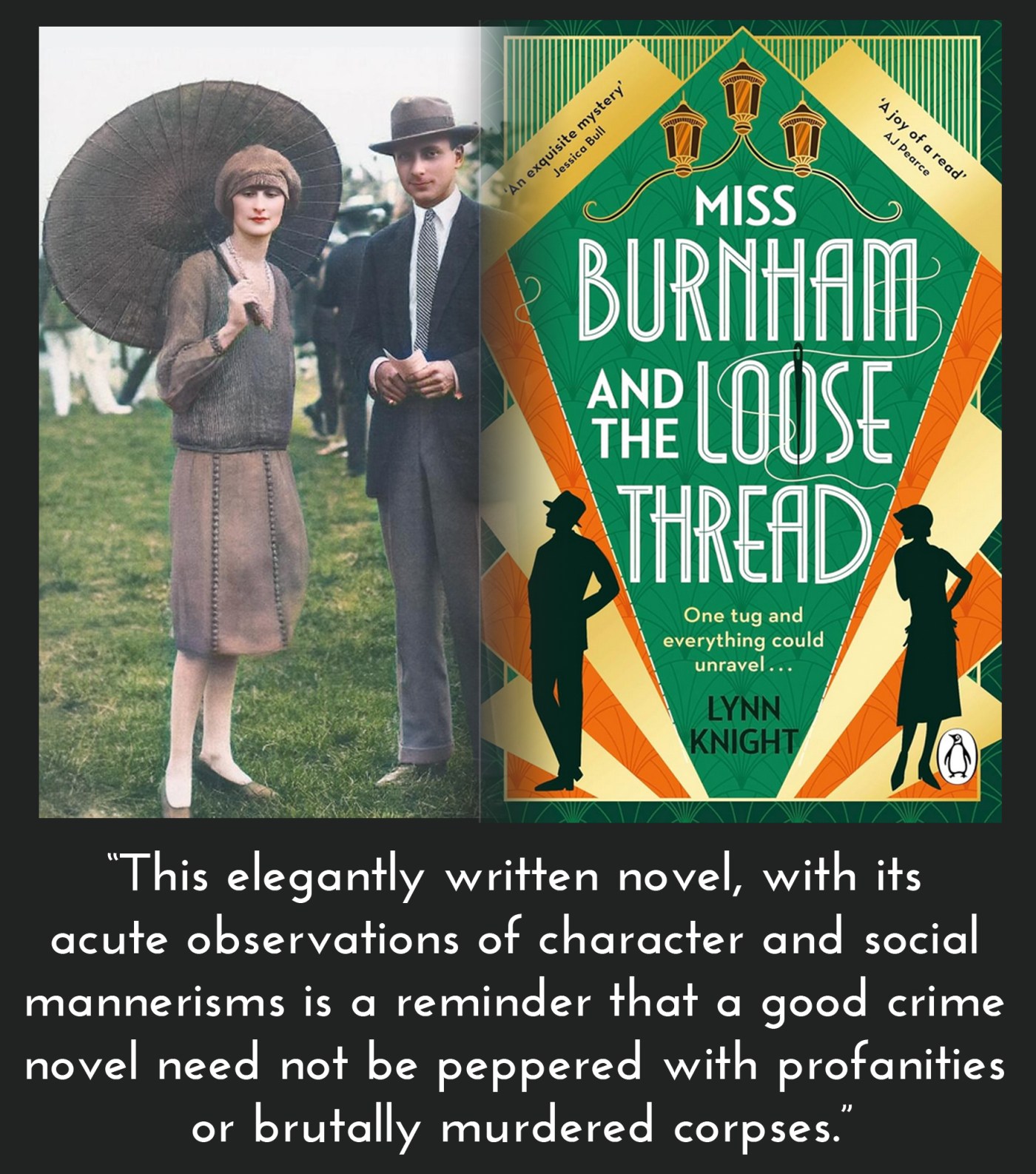

It is the spring of 1925 and we are in suburban London. Rose Burnham is a talented designer-dressmaker, and has set herself up in business with her sisters. She isn’t making a fortune, but she hopes that the improving weather will bring in new orders. One of her regular customers is Phyllis Holmes, whose late father has left her relatively well off, even though she is basically a handmaiden to her demanding mother. In an attempt to broaden her social life, the shy and sheltered Phyllis has fallen into the clutches of a man – recommended by Cupid’s Arrows, a matrimonial agency – who is, to use the epithets of the time, both a bounder and a cad. Lynn Knight may have had these wonderful lines by Sir John Betjeman in mind:
“Let us not speak, for the love we bear one another—
Let us hold hands and look.”
She such a very ordinary little woman;
He such a thumping crook;
But both, for a moment, little lower than the angels
In the teashop’s ingle-nook.”
The so-called War To End All Wars has been over, at least in Europe, for seven years, but it casts a long shadow:
“Here was Mrs. Carlton, an optimistic bride when Rose first saw her at Webb and Maskry in the spring of 1914. But now a desperate wife seeking refuge in clothes. If she could fill her days with dress fittings and like distractions, she would be able to spend less time looking at her husband’s disfigured face.”
When Miss Holmes visits Rose’s workshop and tearfully confesses that she can neither pay her existing bills nor commission any new dresses because she has been swindled, Rose must act. Yes, she is sympathetic to her client’s dilemma, but if she cannot track down the man who has appropriated Phyllis’s fortune – around £40,000 in today’s money – she knows that she and her sisters will be unemployed, and probably be forced to return to their previous lives as shop assistants. Rose decides to present herself at Cupid’s Arrows as an anxious spinster, in the hope that she will be pointed in the direction of the man who stole the heart of Phyllis Holmes – not to mention her money. Lynn Knight has a wonderful eye – and ear – for the 1920s. Invited to a soirée, Rose observes her fellow guests: “
“Three men in their own larger circle, feet spread firmly apart, like a Gilbert and Sullivan chorus, were broadcasting their views to the room. Single emphatic words; coal – taxes – prices – punctuated their talk. Except for a side parting, a watch chain and a Ramsay McDonald mustache, there was little to distinguish one man from the next.”
This elegantly written novel, with its acute observations of character and social mannerisms is a reminder that a good crime novel need not be peppered with profanities or brutally murdered corpses. Finally, a word to readers whose interests tend to lie in the dark streets and lurid neon of Noir, or those who like their crime novels red in tooth and claw, with a high corpse count. Yes, this story may seem soufflé light and lacking in high drama, but it is a beautifully observed study of social mores and expectations in a society that was still trying to find its feet after an international cataclysm. The focus is almost entirely on the female characters, and the underlying theme is that of women – tens of thousands of whom took on men’s roles during the war – who are determined not to return to pre-1914 status quo.
Parallel to this world of emerging female emancipation, Lynn Knight also highlights a society where men over the age of 25 are shaped by – and judged on – what they did and where they were between 1914 and 1919. Some (literally) limped back into their pre-war world. Some struggled to survive in a land Lloyd George egregiously promised would be “fit for heroes to live in.” Others, like the tricksters of Cupid’s Arrow, turned to more reprehensible methods to make a living. This novel is published by Bantam, and is available now.











 I have come to the novels of William Faulkner (left) late in life. Perhaps that is just as well. I am not sure how, as a younger man, I would have dealt with his baleful accounts of one or two truly awful human beings. Having just read Sanctuary, my first reaction is a sense of having been exposed to the very worst of us. The psychotic little gangster Popeye is an embodiment of genuine evil. He is warped both physically and mentally but seems invulnerable, echoing Shakespeare’s description of Julius Caesar ‘