
Search

fullybooked2017

Category

REVIEWS

SERAPHIM . . . Between the covers

SERAPHIM HEADER

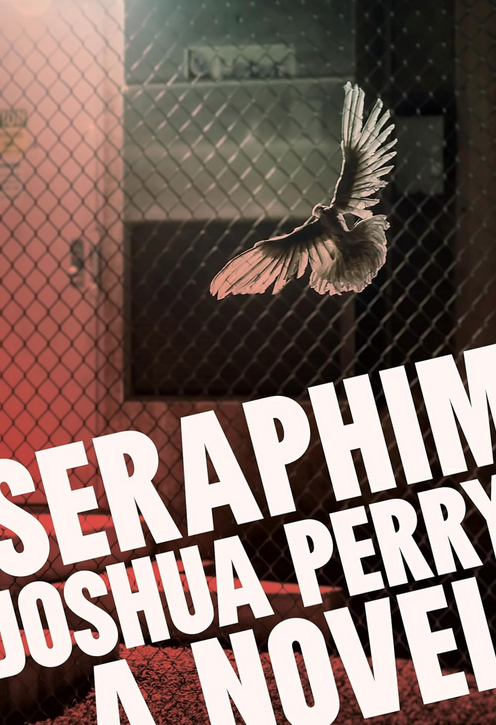
Seraphimred-winged angels which, with Cherubim, are among the first hierarchy of angels next to the throne of God. According to the Book of Isaiah in the Old Testament, they had six wings, one pair for flying, another covering the face and the third pair covering the feet.

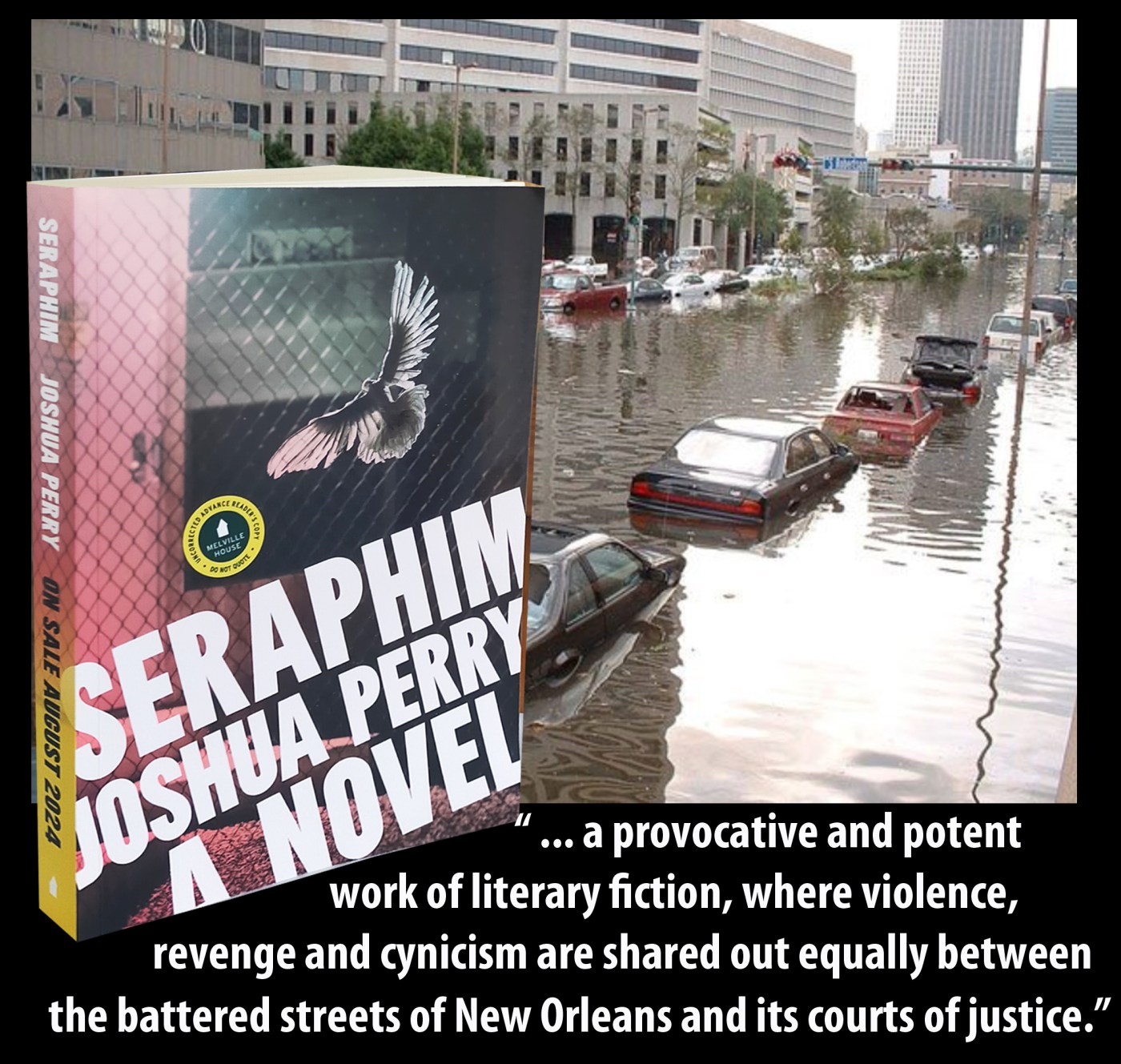
Ben Alder is a Jewish lawyer from Massachusetts, but currently working, with his partner Boris, in post Katrina New Orleans. The pair work for the Public Defender’s Office, meaning they pick  up what we in the UK call Legal Aid work. It is badly paid and they deal with people who are at the very bottom end of society. The novel deals with Ben’s attempts to save a father and son from a lifetime in jail. The father, Robert McTell is accused of burglary by going equipped with tools to steal copper pipe from a school abandoned after the destruction of Storm Katrina. His son, Robert Johnson is in much more serious trouble. He has admitted shooting dead a much loved community figure, Lillie Scott, who has been a leading light in the attempts to rehabilitate and rebuild the city after the devastation of the storm. Another savage murder, where four youngsters, were gunned down while they were listening to music in a stationary car, works its way into the story

Reviewers  of crime fiction like to put books in genre pigeon holes. If nothing else, it gives potential readers a heads-up about the content and style of a novel. After all, there are thousands of new CriFi books published every year and, for many readers, leisure time is a valuable commodity. I have to say that Seraphim refuses to be categorised. The closest I can get is to call it literary crime fiction. Despite the blurbs, it certainly isn’t a legal thriller. There are no tense courtroom exchanges between defenders and prosecutors. The world Ben Alder inhabits is a dystopia of broken lives, broken homes and broken promises, fogged in a miasma of disillusionment, cynicism and expediency.

One commodity that is notable for its absence in the criminal justice world of New Orleans is truth. Everyone, from the judge down, through legal counsel to the men shackled in cells –  lies. Habitually and constantly. The prisoners don’t deal in truth, because experience tells them it will bring only pain. The lawyers’ version of truth is to put a story together that a jury might possibly believe, and this tale can be many miles away from what actually happened.

The timeline of the novel needs you to pay attention. Some sections are the here and now, while others are pre-Katrina. Other events take place far away from New Orleans in places like Memphis, where the homeless are temporarily re-homed. Neither Ben nor readers of this powerful novel ever do find out who shot Lillie Scott. There was certainly another boy, Willard, present on that fateful evening, but in spite of Ben’s elaborate narrative – designed to be told in court – that Willard was smaller and much more clever, and Robert was clinging to him as his only friend, the ‘truth’ never emerges. This, of course, is entirely in keeping with the premise of the novel, which is basically that there is no such thing as truth. Ben, shyly homosexual, even invents two mythical sons so that he can throw them into conversations to boost rapport with his clients.

The narrative is shot through with grim poetry, sonnets of death, rejection and betrayal. Despite not being a devoted Jew, Ben’s upbringing and education make the symbolism of the Hebrew bible very important to him, hence the title of the book. Seraphim is a provocative and potent work of literary fiction, where violence, revenge and cynicism are shared out equally between the battered streets of New Orleans and its courts of justice. Published by Melville House, it is available now.
Screen Shot 2024-08-01 at 20.03.46

BACK TO THE FLOOD . . . Between the covers

flood SPINE071 copy

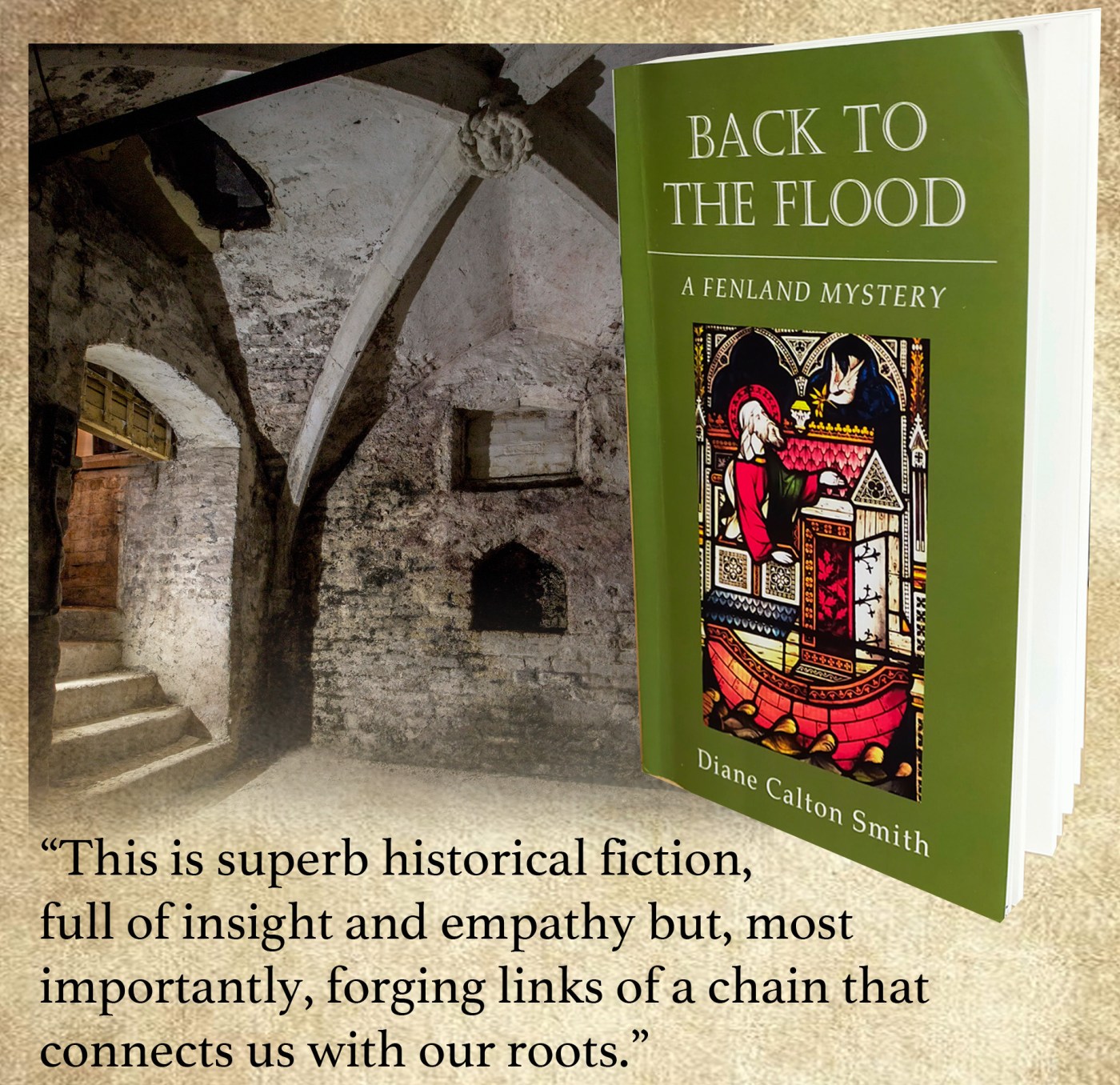
It is March 1249, and England is ruled by Henry Plantagenet (Henry III) son of the unfortunate KIng John, who featured in an early tale of medieval Wisbech by this author, In The Wash (click to read the review). For Wisbech people, the King and his court are far away and unknown. Their immediate overlord is Hugh of Northwold, Bishop of Ely, for who much of Wisbech is his manorial property, meaning that residents must pay him annual rent. In November 1236, however, a disastrous tide (what we would now call a North Sea Surge), devastated the flimsier properties of the town, and when, thirteen years later, the Bishop’s Seneschal*. Roger of Abynton arrives to make an audit of rents and repairs, he finds that many of the Bishop’s buildings have not been rebuilt and remain unoccupied, thus providing no income stream.

*Seneschalan agent or steward in charge of a lord’s estate in feudal times.

When Alured, a local baker, is found dead in the reeds at the edge of The Wysbeck (then a sluggish stream, but now the tidal River Nene) most people assume that he drunkenly fell into the water after one two many ales in one of the inns he frequented. Sir Roger, after examining the body, is not so sure. Scratches on the torso suggest that the man was dragged to the river bank. Finding people with a motive to kill Alured is the easy part. He was a cheat, drunk, foul of mouth and temper and seemed to live his life with one aim only – to antagonise and goad everyone he meets.

Sir Roger is, by modern standards, a decent detective. He comes to realise that Alured was not murdered because he baked contaminated bread, or because he was an argumentative drunk who enjoyed starting fights in pubs. The book’s title is completely apposite. Everything that happens is a result of what happened – or didn’t happen – on that fateful night when the North Sea surge crashed through the banks and defences of Wisbech and changed lives for ever.

So deeply does Diane Calton Smith immerse us in 13th century England that we are not in the least surprised to learn that the New Year began on 25th March, or that there was an extensive calendar of Saints’ Days, very few of which would be celebrated by feasts, at least in the modern sense of the word. There is also a sense of how big the world was in those days. A journey from Wisbech to Leverington, two minutes in the car these days, took hours on treacherous and often impassable tracks. We are also reminded of the sanctity of Lent. Meat was seldom a regular item on the tables of most poor townspeople, but during the Holy observance, the daily ‘pottage’ would contain only root vegetables, perhaps made more palatable with ‘ransom’ – not a criminal demand for payment, but something akin to what we call Wild Garlic. Ale was ubiquitous, because there was little or no safe drinking water. It would have tasted very different to modern beer, as the use of hops in the brew would not come for another three hundred years.

Hand in hand with the astonishing historical detail we have a very clever whodunnit. Wisbech these days is not much of a place, but at least we have our history. I am acutely aware, thanks to this superb novel (and its predecessors) that every time I walk into town, there is a palimpsest beneath my feet, a resonant reminder that these very streets were walked on by our ancestors, and that we tread in their footsteps. This is superb historical fiction, full of insight and empathy but, most importantly, forging links of a chain that connects us with our roots. Back To The Flood is published by New Generation Publishing and is available now.

PREY . . . Between the covers

prey SPINE070 copy

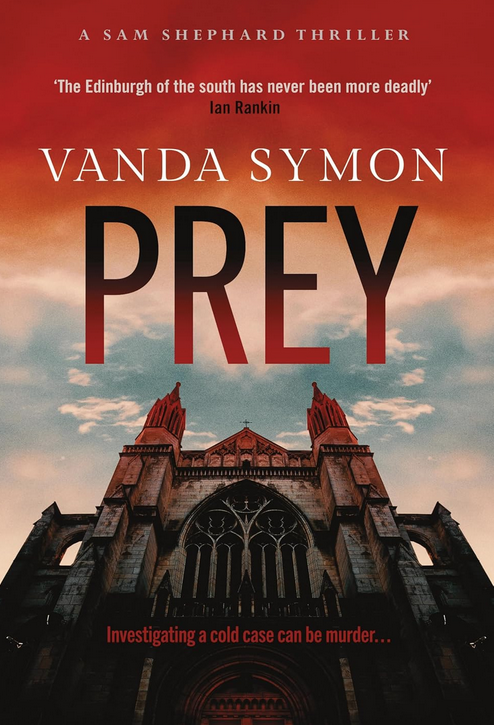
I have to confess that I haven’t read a crime novel written by a New Zealand writer since, years ago, I blitzed the Inspector Alleyn stories by Ngaio Marsh. Although she was born and died in Christchurch, those stories are quintessentially English. Vanda Symon, by contrast, has written a successful series featuring Dunedin cop Sam Shephard, and Prey is the latest of these. Sam has returned from maternity leave, and almost immediately  the state of open war between herself and boss, DI Greg Johns, resumes. He immediately gives her a cold case to work on. Twenty five years earlier, a priest at St Paul’s Cathedral, was found dead at the foot of some stone stairs. He had been stabbed, but also had a broken neck. Despite every best effort, no-one was ever arrested for the murder. And there is a problem. The Reverend Mark Freeman had a teenage daughter, Felicity. And now she is married to DI Johns.

As Sam  struggles to adjust being back at work, and worries about ‘abandoning’ baby daughter Amelia (for those who like that sort of thing the author spares us no detail of the baby’s rather spectacular digestive system) she realises she has been handed a poison chalice. The crime scene has since been walked over by tens of thousands of pairs of feet, and there are a mere handful of people alive now who were connected to the case at the time. These are, in no particular order:
Yvonne Freeman, the murdered man’s widow. She has terminal cancer.
Felicity Johns, née Freeman, now married to DI Greg Johns.
DI Johns himself was on the investigating team as a young police constable.
Brendan Freeman, Felicity’s brother.
Mel Smythe, a young youth worker at the time of the killing. She has since become estranged from the church, and has fallen on hard times.
Aaron Cox, of Maori origin, and a former criminal. Mark Freeman had worked hard to put him on the straight and narrow path.

When Sam goes to interview Mel Smythe (for the second time) she finds her dead – stabbed with a kitchen knife, which makes the case very much a current murder investigation. But is it – and if so, how – connected to the death of Mark Freeman? It has to be said that in the first few pages of the book, a female witness watches, from behind a church pillar, a struggle between two people, one of whom is the Reverend Mark Freeman. Make of that what you will.

Sam Shephard is a very human creation with none of the foibles and weaknesses that many British writers love to give their police detectives. She is a proud mum and loyal partner to little Amelia’s father, fellow copper Paul Frost. She has a keen brain and a healthy sense of humour, and it is her intuition that allows her to finally realise she has been lied to, and thus crack the case open. This only happens, however, in the final pages of the novel, and not before we are led up many a garden path. The connections to the case of DI Johns and his wife only make more hot coals for Sam to walk over, and she faces an unenviable task of doing her job without becoming badly burned.

Vanda Symon creates a convincingly clammy picture of a wet and wintry Dunedin, and at the centre of it all, glowering over the wrongdoings of its congregation, is the  menacing Victorian Gothic bulk of St Paul’s Cathedral. In addition to the gripping plot, Symon explores those eternal ingredients of all good crime novels – money, greed, shame, blackmail, hypocrisy and family secrets. Prey is published by Orenda Books and is available now.

Screen Shot 2024-07-28 at 20.20.53

WHISPERS OF THE DEAD . . . Between the covers

WOTD SPINE067

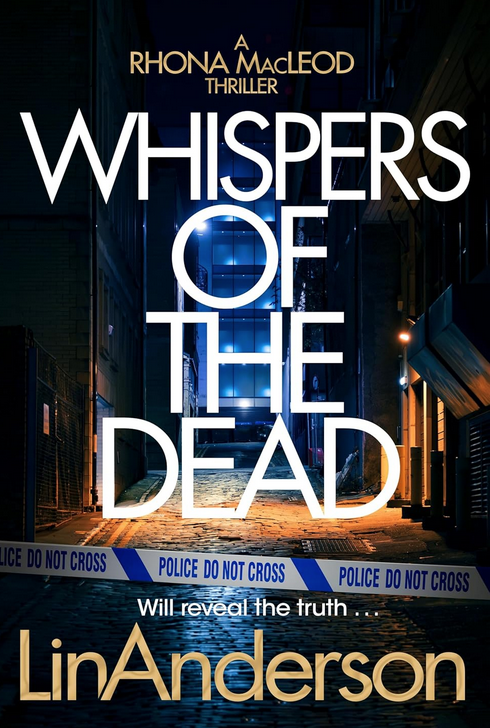
Lin Anderson’s battle-hardened forensic investigator Dr Rhona MacLeod returns to make another journey through the grisly physical mayhem that some human beings inflict on others. In a disused and vandalised farmhouse in Glasgow’s Elder Park, a man’s body has been found. His eyes and mouth have been sewn shut and, strapped to a metal chair, he has been thrown through an upstairs window. A trio of teenage scallies have been using the old building as a base for their minor law-breaking, and they are the first people to see the body,

In another part of the city, an American film crew have informed the police that their leading man is missing. With the assistance of DS McNab, who has interviewed the movie-makers, Rhona MacLeod becomes involved, and wonders if the missing actor is the mutilated corpse found in the park.

At the very beginning of the book Lin Anderson introduces what develops into a parallel plot thread. A woman called Marnie Aitken has served six years in prison for the murder of her four year-old daughter, Tizzy, despite the fact that no trace of Tizzy, dead or alive, has ever been found. Marnie is known to Rhona MacLeod, and to her colleague, psychiatrist Professor Magnus Pirie. On her release, Marnie – abused as a child and as a young woman – is placed in sheltered accommodation. She goes missing. but not before sending a bizarre gift to Rhona. It is a beautifully sewn and knitted doll, in the likeness of a young Highland dancer. Rhona realises its significance, as Tizzy Aitken was a promising dancer, but she is also appalled to see that the doll’s lips have been sewn shut with black thread. What message is Marnie sending?

Marnie is located at her old cottage on the Rosneath Peninsula, and but she returns to Glasgow, where the police find that she is linked – albeit at a tangent – the the killing of the man in Elder Park. Meanwhile, DS McNab – who was involved in the original investigation into Tizzy’s disappearance, but kicked off the case – has realised that the script and screenplay of the film – now abandoned after the disappearance of its star – is inextricably tangled up with the murder.

Right from the beginning of the novel, we know that Marnie still talks to Tizzy, and Tizzy still talks to her. Is this merely, as Magnus Pirie suggests, a grieving woman’s way of coping with her loss? Or is it something else? On the first page of the book, Marnie looks out of the window:

“It was at that moment the figure of a girl, dressed in a kilt and blue velvet jacket, arrived to tramp across the snow in front of the main gate. As though sensing someone watching, the girl stopped and turned to look over at her. Marnie stood transfixed, then shut her eyes, her heart hammering. ‘She’s not real. It’s a waking nightmare. When I look again, she won’t be there.’
And she was right.
When Marnie forced her eyes open, the figure had gone, or more likely, it had never been there in the first place except there were footprints in the snow to prove otherwise.”

When Rhona visits Marnie’s seaside cottage, she walks down to the beach where Tizzy used to go with her mother:

“The snow at sea level had gone and the muddy ruts were studded with puddles and the shape of footsteps leading both ways. Her forensic eye noted three in particular, ranging in size: a small childlike print, a medium one and a large one, going in both directions.”

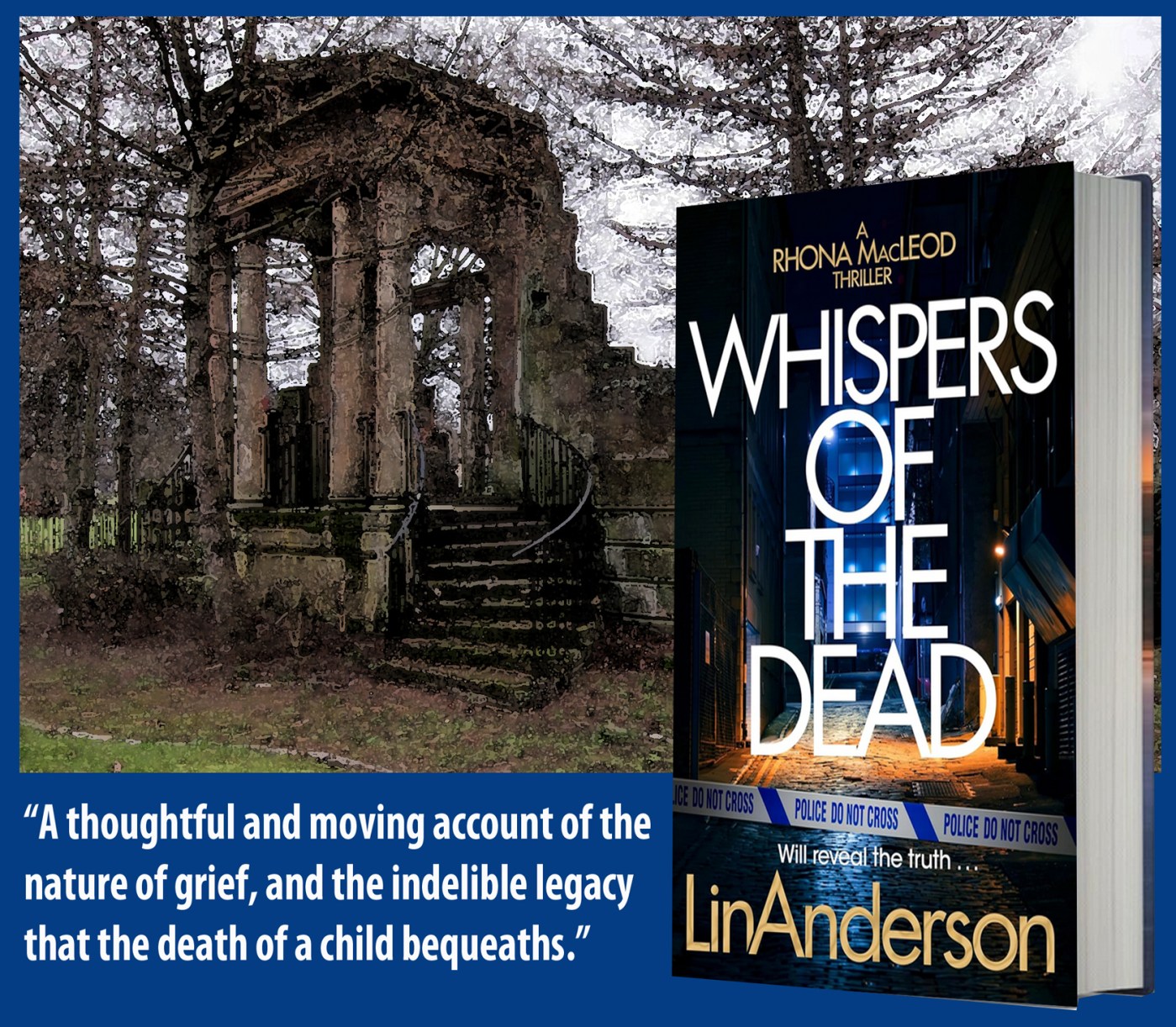
Lin Anderson doesn’t resolve this for us. She leaves us to draw our conclusions, and I suppose it depends on how feel about Hamlet’s oft-quoted words to Horatio in Act 1 Scene 5 of the celebrated play. The police procedural part of this novel plays out in the favour of the good guys, but aside from this, Lin Anderson has written a thoughtful and moving account of the nature of grief, and the indelible legacy that the death of a child bequeaths. Whispers of The Dead was published by Macmillan on 1st August.

Screen Shot 2024-07-17 at 20.19.00

COGNIZANCE … Between the covers

cognizance SPINE069 copy

Guy Portman created a brilliantly psychotic serial killer called Dyson Devereux, and over the three books in the series, Necropolis, Sepultura and Golgotha, Portman took aim at every sacred cow in modern British society. Nothing – and no-one – escaped unscathed, from lavishly tasteless funerals, ‘woke’ human resources officials, earnest (and useless) social workers, gender-identity professionals right through to so-called ‘community leaders’. Devereux was killed off in Golgotha, but in Sepultura we learned that Mr D had fathered a son, Horatio, the mother being a borderline hapless Antiguan lady called Rakesha. In Emergence, we discovered that the teenage Horatio is a case of ‘like father, like son’, as he murders his mum’s boyfriend Brendan, a man he calls Fool’s Gold. The murder was cleverly disguised to make it seem that the unfortunate chap died as a result of a sexual experiment gone wrong.

In Arcadia, Horatio enjoys a brief (but violent) sojourn in Antigua, but Cognizance sees him back in London, and attending a particularly awful high school. Horatio is about to upset some of his classmates in his gang-infested school, but he has a much older enemy, the man he nicknames ‘Rat’. ‘Rat’, properly known as Roland Barstow was best mates with the late Brendan, and is convinced (rightly) that Horatio killed him. ‘Rat’ seems to be around every corner, and waiting at every bus stop, but Horatio manages – for a while –  to keep him at arms length.

In school, Horatio makes a serious error when he mocks a very large – and very stupid – fellow pupil. Unfortunately for our hero, this lad is gang-connected, and they take their revenge on Horatio in a rather smelly fashion in the boys’ toilets. Horatio vows revenge, and achieves this after a fashion when two rival gangs have a set-to in a particularly loathsome tower block of flats. Our hero has other worries, though, when he is attacked with a hammer, and left in a life – threatening condition.

Horatio’s sense of humour is suitably disturbed – and disturbing. While at his aunt’s funeral he remembers the fun he had when his mum’s boyfriend was laid to rest:
When the casket was carried in at the start of Fools Gold’s funeral, the music was supposed to be Never Say Goodbye by Bon Jovi. However, I sneaked into the room where the music system was and changed it. Because everyone thought he had died from auto erotic asphyxiation gone wrong, I chose the theme tune for Top Gun. Take My Breath Away. Fools Gold’s father went beserk, as did Rat. It was hilarious.”

The running joke in the series is that literally no-one (with the exception of Rat) sees Horatio for what he is. He fools everyone else, including his mother, his delightful girlfriend Serena, and his teachers. What to make of a teenage killer, obsessed with algebra and trigonometry, a boy whose favourite book is Bleak House, and someone who, as his aunt lies dying of cancer, imagines her in hell, perishing in the flames, suffering the torments of Tantalus as a family size bag of Maltesers is dangled just in front of her, but forever out of reach?

What Guy Portman does is to merge merge domestic disaster with caustic comedy, and he turns our normal, family-orientated sense of decency on its head, and has us cheering for the devious Horatio. The more malign his misdeeds, the more we laugh. Of course, this book will not appeal to everyone, but for those of us with a dark sense of humour it is pure gold. Lovers of dystopian comedy, this is for you – I dare you not to laugh. Cognizance is published by Pugnacious Publishing and is available now.

Screen Shot 2024-07-21 at 19.43.52

BEYOND CLOSED DOORS . . . Between the covers

BCD SPINE065 copy

This enjoyable police procedural novel is the sixth in the series (to read reviews of the previous two, click this link) following the career of Norfolk copper Detective Chief Inspector Greg Geldard, his girlfriend Detective Sergeant Chris Mathews, and the rest of their team. These novels pretty much follow on from each other, and in the previous book Geldard battled a violent Lithuanian gangster called Constantin Gabrys. Now, it’s March 2020, Gabrys is serving a long prison sentence and his psychotic son is dead. However, all is not well, because a key figure in the case, now under witness protection has been attacked. He survived, but a police officer has been seriously injured, and it is obvious that the leak of information can only have come from within the police forced itself.

Despite the Gabrys empire having been apparently dismantled, their poisonous legacy hangs over Norfolk like a miasma. Norfolk, I hear you ask? Surely not that wonderful holiday destination with its abundant wildlife, historic homes and beautiful coastline? While the entire county might not be a wretched hive of scum and villainy, there are places – like Yarmouth and Gorleston – which suffer deep deprivation, and are consequently ripe feeding grounds for organised criminals, whether imported from Eastern Europe or of the home-grown variety.

Geldard traces the leak to a civilian police secretarial worker, but is dismayed to learn that part of the conspiracy involves Helen Gabrys, a member of the family he thought to have been as innocent of wrong doing as she was disgusted at her father’s career.

You will notice in the first paragraph that the story is set in March 2020. Remember that? As the country begins to shut down against the ravages of Covid, life just gets more difficult for Geldard and his team. Right across the criminal justice system things are starting to unravel. Court backlogs become years rather than months, prisons are struggling with absent staff, and the police themselves have to try to hold important conversations yards apart from each other. As the cover blurb suggests, however, the streets may be nearly empty, but evil is just as happy within four walls as out in public places.

There is a parallel thread in the story, which I found unsettling and hard to read. In Yarmouth live the Mirren family. Children Karen and Jake don’t have the happiest lives. Their mum is well-meaning, but weak, and browbeaten by her brutish husband. Karen has a place where she feels valued, can be herself and feel comfortable with trusted adults. It is her primary school, and when it shuts, forcing all the children to stay at home, it is a life sentence for the little girl. The reason this part of the novel affected me is that I taught in Norfolk for over thirty years, and for the latter part of that I led Safeguarding, and the scenes that Heather Peck describes were uncomfortably familiar.

When tragedy strikes in the Mirren house, the subsequent events become very much the concern of Greg Geldard, and he has to add a significant missing persons search to his mounting caseload. In the best traditions of great Victorian writers like Dickens and Hardy, who serialised their novels in popular magazines prior to publishing them in their entirety, Heather Peck leaves us on a knife edge, eagerly awaiting the next novel in this impressive series. Beyond Closed Doors was published by Ormesby Publishing on 22nd June.

Screen Shot 2024-07-08 at 19.11.05

IMPOSTER SYNDROME . . . Between the covers

imposter spine064 copy

Joseph Knox made his name with a deadly dark trilogy of police procedural novels featuring Manchester copper Aidan Waits (click to read the reviews) and followed these with the standalone True Crime Story. His latest novel takes a leaf out of the book of Josephine Tey, whose novel  Brat Farrar (1949) many consider to be her finest work. That novel was inspired by a real case, known as The Tichborne Claimant, where a New South Wales butcher claimed that he was Roger Tichborne, heir to a huge fortune, but who  was supposed to have perished in a shipwreck. The butcher, Arthur Orton, was eventually found guilty of fraud in 1874 and given a long jail sentence.

Here, we meet Lynch, a young English conman. He flies out of Paris, with only the cheap suit he is standing up in, with no money, no prospects and only the bitter memory of his latest failed venture on his mind. En route, he meets a milfy heiress called Bobbie Pierce who mistakes him for her long lost brother, Heydon. Lynch immediately corrects her mistake, but is intrigued. Heydon is assumed to be dead. No trace of him has been found since his abandoned car was found on a Thames bridge five years earlier. Bobbie is something a ship foundering on storm tossed rocks, as she is on her way to yet another expensive bout of rehab in the States. She sends him a text message which contains the key codes to her parents’ house, and suggests that, as he is broke and pretty much down and out, he might find plenty of valuable items in the house to relieve his immediate Micawberish state.

Lynch, as much out of curiosity as anything else, goes to the house but, once inside, he is detained by security men. He then meets Miranda Pierce, the family matriarch and former film star, and Bobbie’s sister Reagan. Lynch makes no claim to be the missing Heydon, but Miranda has a use for him. Just before he disappeared, Heydon Lynch borrowed money from a loan shark called Bagwan, and left a case containing family items as security. Badwan has contacted the family, calling in the loan – now greatly inflated. Miranda and Reagan want Lynch, posing as  Heydon, to meet Badwan, pay him off, and recover the  case.

The case is recovered, and one of the things it contains is Heydon’s phone. Through what it contains, Lynch learns two things: one, Heydon Pierce was convinced he was being targeted by some shadowy organisation; two, he had become involved with a man calling himself Vincent Control, basically a conman trying to lure gullible people into a crypto currency scam. Lynch confronts Control and learns that there was, indeed, some dark security agency involved, but their conversation is interrupted by a masked gunman. Control is shot dead, but Lynch escapes.

At this point, half way through the book, I did ask myself why Lynch didn’t just disappear. He now has plenty of money, having being richly rewarded by Miranda Pierce, so why not simply get away, maybe fly back to Paris on his forged passport, and use his new-found wealth to fund another project designed to separate fools from their money? He then sets out his reasons. He has discovered that he is dealing with some very powerful and resourceful people who, he figures, will be able to find him and settle scores wherever he goes, and however long it takes.

The plot is of Chandleresque complexity, as Lynch ducks and dives  between various encounters which prove fatal for some of the characters. He suspects first one person, and then another, as he tries to find exactly why he was hired in the first place, and what actually happened to Haydon Pierce. The truth is only revealed to him (and us) in the final pages of the book.

This is a clever, tense and nervy thriller, which dwells on betrayal and the pernicious effect that the misuse of digital communications and media can have on human lives. Lynch is a long way from being an admirable character, but his street-smarts and survivalist instincts are straight out of the How To Be A Conman instruction manual.. Imposter Syndrome was published by Doubleday on 11th July.

CALICO . . . Between the covers

calico spine063 copy

Lee Goldberg baits the hook irresistibly within the first few pages of this novel. Disgraced former LAPD cop Beth McDade has been exiled to the desert wastes of Barstow, on edge of the Mojave Desert. She attends what seems to be a routine road death- pedestrian collides with motor home, only one winner – but the autopsy on the victim is astonishing. He was wearing jeans that hadn’t been made that way since the 1880s. What remains of his dental fillings reveal an amalgam not used in decades. His tobacco tin isn’t just repro. It is original, and contains tobacco not produced commercially since the end of the nineteenth century.

Things become even more baffling when a construction company doing groundwork for a new development unearth an old coffin containing equally old bones. Beth finds her ultra rational mindset severely challenged when the bones are dated to the early 20th century, but contain titanium implants only available to surgeons in more recent times. She then receives a visit from a former LA colleague (and lover) who is  on a missing persons case. He is looking for Owen Slader, a very 21st century social media personality and chef,who was last seen filling up his car with gas on the way to visit his daughter.

There are two parallel narratives, one being that of present day Beth McDade, and the other being the views and experiences of Owen Slader. On that February night he was engulfed by what appears to be a lightning storm and, when he recovers his senses, the freeway no longer exists, and he is stranded near the primitive and rumbustious silver mining settlement of Calico. And it is 1882. Slader hides his hired Mercedes in a cave, rigs up a solar battery charger to power his iPhone and, using his 21st century culinary skills, caries out a profitable life for himself cooking up delicacies for the hungry miners of Calico. He meets – and marries another refugee from another time, a woman called Wendy, but she was ‘taken’ by the Time Gods a couple of decades earlier than Slader. This is when the complexities and total unknowables of the time travel concept begin to cause brain hurt, and the obvious questions like the one below, can never be answered:
“If stamps on the titanium implants found in the bones within the ancient coffin identify the recipient as Owen Slader who, identifying as Ben Cartwright (1960s TV Western reference!), died in the early 1900s, how did he then father a daughter in the early decades of the 21st century?”

The author certainly has fun with some of the more bizarre aspects of being a time traveller. He has Ben Cartwright buying copies of new novels by writers like Mark Twain and Robert Louis Stevenson knowing that (as first editions) they will become immensely valuable decades ahead. When a cholera epidemic hits Calico, Cartwright, nursing the town judge in what seems to be his final fevered moments, takes out his iPhone and plays the dying man some music. Problem is, the judge doesn’t die, and when he recovers he goes around loudly humming ‘Somewhere Over The Rainbow.’

Meanwhile, Beth McDade struggles to reconcile facts that are, at the same time, impossible but also incontrovertible. She even finds, boarded up in a cave, the 2019 rental that Owen Slader was driving when he disappeared. It is, needless to say, improbably decayed and weathered given that it can only have been there a matter of months. Eventually, our heroine tackles – and bests –  the FBI and the implacable American military machine.

Lee Goldberg’s audacious plot and premise will not be for everyone, particularly those who think that Hamlet’s famous remark to Horatio was just the rambling of a confused and conflicted young man. Of course, time travel novels are nothing new, and Goldberg does nod in homage to the grand-daddy of the genre, Herbert George Wells, but also develops the ‘stepping on a butterfly’ trope that began with Ray Bradbury’s 1952 short story ‘A Sound of Thunder’. Key question, though. Does Lee Goldberg’s book work? Of course it does. The writer is also an experienced screenwriter, producer and TV executive, far too well versed in his trade to stretch  the credulity of his readers and viewers to beyond breaking point. Calico is immensely entertaining, with a runaway-train narrative drive. Published by Severn House, it came out in hardback and Kindlle in November 2023 and this paperback edition was published on 4th July.

Screen Shot 2024-06-28 at 21.01.23

INTO THE FLAMES . . . Between the covers

itf spine061 copy

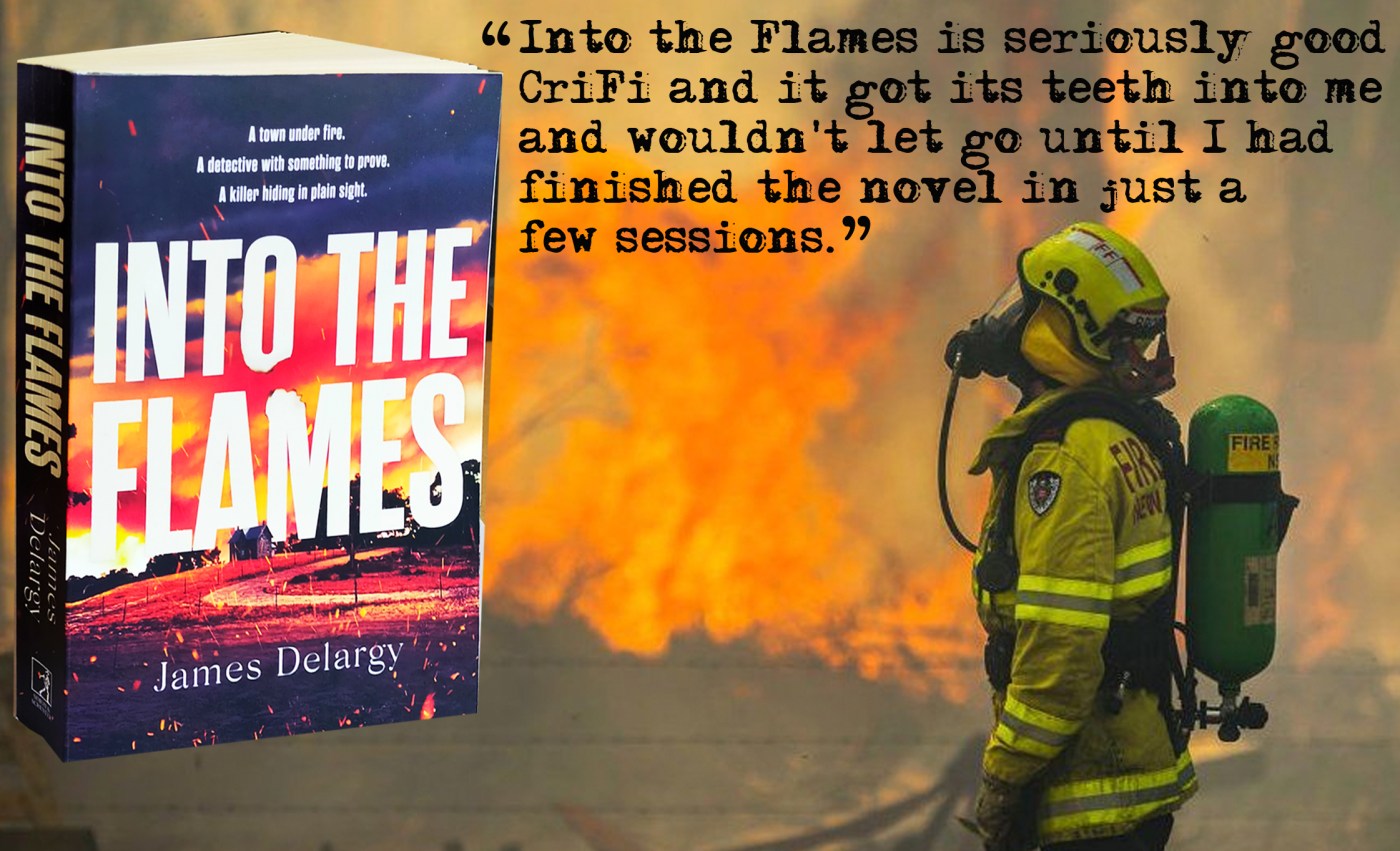
I lived and worked in Australia for a while, but being a city lad, I never came close to a bush fire. From speaking to people who had, and reading about them, they seem to be the very worst kind of natural disaster. Perhaps it is invidious to compare tornadoes, tsunamis, landslips and volcanlc eruptions, but bush fires seem to have an almost animal intensity. They devour people, buildings and forests like some kind of raging beast. Here, Aussie cop Alex Kennard has been bounced out of his job in a Sydney suburb for, as his bosses saw it, making the wrong call when he was forced to deal with a hostage situation. He is now more or less twiddling his thumbs dealing with drunks, petty thieving and the odd traffic incident in the town of Katoomba, in the heart of The Blue Mountains.

The little nearby town of Rislake is threatened by a serious bush fire, and Kennard drives across to help with crowd management in the event of a major evacuation. The local cops and fire service are basically taking a roll call, and it is soon apparent that one woman is missing. Tracey Hilmeyer is the wife of one of the firefighters and, against orders, Kennard and the woman’s husband, Russell, head out to the Hilmeyer property which is in danger of being engulfed. They find Tracey, but she is dead at the foot of the stairs, battered with a heavy implement. Russell Hilmeyer is distraught and wants to move the body of his wife, but Kennard insists that she stay in place and he attempts to preserve and record the crime scene as best he can.

Russell Hilmeyer is a local lad who didn’t quite make the big time on the football field, due to a career-ending injury. It has no bearing on the plot, but I am pretty sure Hilmeyer played Aussie Rules rather than what Americans call Soccer, or the major Sydney code of Rugby League. His wife Tracey was a glamorous prom-queen type in her teens, and had ambitions to be an artist. The gallery she ran in town has had to close, and she had become depressed, and only got through her days and nights with the help of prescription items like co-codomol. She had an abrasive relationship with her sister Karen who, with her husband, runs the farm that used to belong to their late parents. It is hard scrabble land, and they barely make ends meet. Did Karen and her Pacific Islander husband Alvin hate Tracey enough to kill her? The post mortem reveals that Tracey Hilmeyer was pregnant. Given that the couple had been trying for years to have children, does this add yet another dimension to the search for the killer and their possible motive?

The author has great fun making Kennard and his temporary partner DS Layton jump to one false assumption after another, while the fire grows steadily worse, a little like Satan as described in the office of Compline:

“Be sober, be vigilant, because your adversary the devil, as a roaring lion, walketh about, seeking whom he may devour:”

The conclusion comes with Layton temporarily out of action due to the fire having triggered her asthma, and we have Kennard, almost immobilised by the weight of his protective clothing, pursuing the killer in a Dante’s Inferno of blazing eucalyptus trees and showering sparks. Only one small problem. The person he is following isn’t the killer of Tracey Hilmayer. To say any more would clearly spoil your fun, but this is as exciting an end to a crime novel as I have read in many moons.

We lost the two modern giants of Australian crime fiction, the two Peters – Corris and Temple – within six months of each other in 2018 but, along with Jane Harper, James Delargy – although he now lives in England – taps into to the great tradition established by those writers. Into the Flames is seriously good CriFi and it got its teeth into me and wouldn’t let go until I had finished the novel in just a few sessions. Published by Simon and Schuster, it is available now.

Blog at WordPress.com.

Up ↑