
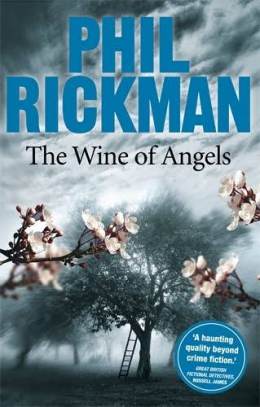
 The Reverend Merrily Watkins, who was first brought to life by Phil Rickman in The Wine of Angels in 1998, is, on one level, your average workaday Anglican parish priest. For starters she is a woman, and the Church’s own website tells us that while male ordinations are declining, those of women are increasing rapidly. Secondly, Merrily faces a declining congregation in her Herefordshire village – just like hundreds of other parishes up and down the country. Thirdly, she observes – at a distance, admittedly – the continuing friction between modernising progressives and the traditionalists in the hierarchy of the Church of England.
But the Reverend Mrs Watkins is crucially different from most of her fellow vicars. Some of them may also be single parents, but not many would have had a husband who was a crooked lawyer, and fewer still would have lost him in a fatal car crash. While Merrily is very far from a Merry Widow – she is much too introspective and self-examining for that – she does have a love life. The object of her affection is a talented but tormented singer-songwriter called Lol Robinson. His career as a latter day Nick Drake has been blighted by stage fright and self doubt but, so far at least, unlike the late and lamented Drake, he is still in the land of the living. Rickman’s own love of music and guitars shines through in his portrayal of Robinson, and if you want a slightly left-field novel involving musicians and the supernatural, you could do far worse than to read Rickman’s December (1994), a chilling retake on the impact of the death of John Lennon.
While Merrily’s relationship with Lol is, despite her attempts to be subtle, the worst kept secret in the village, her secondary occupation is known to very few of her remaining parishioners outside of her churchwardens. Merrily is, to use her official title, the diocesan Deliverance Consultant. That is Deliverance as in the words of the Litany of The Church of England:
From all evil and wickedness; from sin;
from the crafts and assaults of the devil;
and from everlasting damnation,
Good Lord, deliver us.
Merrily Watkins does not like to use the ‘E’ word when talking about her work, as that tends to bring into people’s minds swiveling heads, the projectile vomiting of green slime and teenage girls with a rather gruff and inventive turn of phrase. Instead, she tries to offer solace and the comfort of The Holy Spirit; sometimes to people, but more often to places where the presence of the dead is disturbing those who live within the four walls. She is never sure whether she is trusted by her boss – the Bishop of Hereford – or simply tolerated. Bishops come and go, however, and in the most recent novel, Friends Of The Dusk (2015) a new incumbent brings with him the proverbial new broom, and Merrily has to put herself in personal danger if she is not to be swept away.
So, when Merrily encounters ‘the crafts and assaults of the devil’, does she believe what she is seeing and feeling? She is certainly susceptible to atmosphere, and Rickman is clever enough to keep things subtle; there are no movie special effects here, but the temperature might drop a degree or two, a weathered stone carving might take on a sinister aspect in the fading light of dusk, and a creaking floorboard is usually enough to have us reaching for the crucifix.
One of Rickman’s many skills is the way he allows real life characters to inhabit Merrily’s world. Over the series, he has brought in a star-studded cast of people who have had a real connection with the Welsh border country. In The Remains of An Altar (2007) the shades of Sir Edward Elgar and Alfred Watkins (The Old Straight Path) pay a visit, and The Magus of Hay (2013) we meet The Hay on Wye entrepreneur Richard Booth and, slightly at a tangent, Eric Gill and Beryl Bainbridge. Sir Arthur Conan Doyle puts in a retrospective appearance in The Prayer Of The Night Shepherd (2004) when Merrily’s teenage daughter Jane has a holiday job in a hotel every bit as spooky as The Shining’s Overlook Hotel, and which is the place that perhaps inspired ACD to write his masterly The Hound of The Baskervilles. The sinister presence of Fred West lurks in the corner of The Lamp of The Wicked (2003) and in The Wine of Angels (1998) the life and words of the 17th century mystical poet Thomas Traherne echo throughout the plot.
Jane Watkins, dear, dear Jane. Rickman shamelessly uses daughter Jane to scare the pants off us on a regular basis, in that she goes where angels – and her mother – fear to tread. Jane seems to age on a slightly different timescale to the adult characters, but we basically see her through sixth form and away to university. She might be what older and less charitable folk call a ‘snowflake’. She is environmentally aware, probably quite left wing, and very much the feminist. Fortunately, we have yet to hear her demand Safe Spaces or clamour for the No Platforming of some speaker with whose views she disagrees, but her vehement defence of archaeological sites has led her into conflict with some pretty unpleasant corporate types, and she is forever wandering off – usually while mum is preoccupied – into situations where she makes herself a prime target for the bad guys.
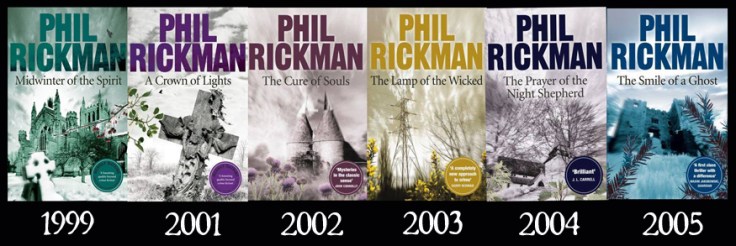
There are several regular members of the Phil Rickman Repertory Company. Gomer Parry is a roll-up smoking drainage contractor who is intensely supportive of Merrily, and acts as a kind of Greek Chorus offering commonsense views on distinctly unusual situations. Franny Bliss is Merrily’s point of contact with the police. We mustn’t lose sight of the fact that these novels are, albeit with a decided twist, crime fiction novels, and so the Liverpudlian copper, based in Hereford, is an essential player. If Parry and Bliss sit on the Profane benches, then two occupants of the Sacred side of The House must be mentioned. Huw Owen is a bluntly spoken northern priest who has seen more of The Devil’s works than he cares to mention, but he is the closest Merrily has to a spiritual advisor, even though he spends most of his time in an obscure retreat away in the Welsh hills. Sophie Hill is the Bishop’s secretary, and she ought, by rights, with her severe manner and unimpeachable Anglican pedigree, to be very sniffy about the Vicar of Ledwardine, but she is one of Merrily’s most subtle – and caring – allies.
We have talked about Merrily’s metaphorical and spiritual landscape, but the physical landscape of Worcestershire, Herefordshire and the Welsh borders is a constant and sometimes sinister presence. The dark little valleys with their decaying Victorian chapels, the remote manor houses with their fragments of medieval and Tudor stonework and the isolated, hard-scrabble farms where lonely men might – and sometimes do – become quite mad, provide enough chills of the earthly kind even before the unquiet dead need to put in an appearance.
Phil Rickman is a fine writer and his earlier stand-alone novels and his John Dee series are proof enough of that, were any needed. It is in the Merrily Watkins novels, however, that Rickman interweaves the threads of murder, police procedure, the power of landscape and faint but potent wisps of the supernatural to produce a literary cloth of gold which is little short of miraculous. Merrily Watkins is a brilliant creation. She is brave, vulnerable, demure yet sexy and, above all, completely believable.

 Philip Kerr’s Bernie Gunther novels bestride the 20th century, from the rise of the Nazis in 1930s Germany to the post war period when many countries still sheltered mysterious German gentlemen whose collective past has been, of necessity, reinvented. Gunther is a smart talking, smart thinking policeman who has kept his sanity intact – but his conscience rather less so – by dealing with such elemental forces as Reinhardt Heydrich, Joseph Goebbels, Juan and Evita Peron, and Adolf Eichmann.
 A Man Without Breath (2013) sees Gunther is working for an organisation whose very existence may seem improbable, given the historical context, but Die Wehrmacht Untersuchungsstelle (Wehrmacht Bureau of War Crimes) was set up in 1939 and continued its work until 1945. In 1943, on a mission from the Minister for Propaganda, Joseph Goebbels, Gunther is sent to Smolensk and entrusted with proving that the thousands of corpses lying frozen beneath the trees of the nearby Katyn Forest are those of Polish army officers and intellectuals murdered by the Russian NKVD, and not those of Jews murdered by the SS.
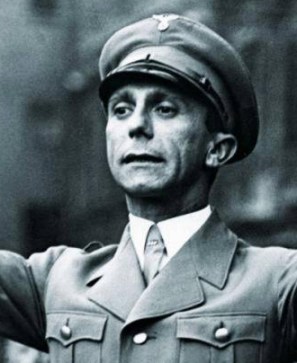 the German military that Hitler is a dangerous upstart who has already damaged the country beyond repair, and must be stopped. Adrift on a sea of violent corruption, Gunther constantly plays the role of the decent man, but in the end, he follows one theology, and one theology only. If he wakes up the next day with his head firmly attached to his shoulders, and has feeling in his extremities, then he has done the right thing. His conscience has not died, but it is far from well; it competes a whole chorale of competing voices in his head, each wishing to be heard. As he is left helpless by the world of spin and disinformation orchestrated by Dr Goebbels, (right) he must resort to his basic copper’s instincts to protect himself and uncover the truth.

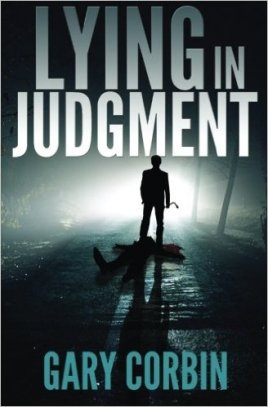 In his debut novel, Lying In Judgment, he has created both a cunning title and a positively perverse plot. Peter Robertson has left his youth behind but, having become a ‘thirty-something’, he is appalled to find out that his wife is being actively – very actively – unfaithful. He becomes obsessed with his wife’s betrayal and decides to confront her lover. The confrontation turns violent, and Robinson exacts a terrible kind of justice on the man who has broken up his marriage. Except – and it is as big an except as you could imagine – Robertson has made a stupid mistake, and battered to death a completely innocent stranger.
 Corbin opts for a slightly lighter atmosphere in his second book, The Mountain Man’s Dog. I guess that’s obvious, as dogs, being such cheery souls for the most part, don’t do Noir and psychological intensity. We are still in the wilds of the North West, Clarksville Oregon, to be precise, and we are introduced to one of its more rugged citizens, the delightfully named Lehigh Carter. Mr C is far more at home working under a stand of timber than he ever is in polite company, but his innocent love for a feisty girl, Stacy McBride, has him in all sorts of bother. The dog? Well, Stacey McBride, Carter’s former fiancee, persuades him to adopt the stray, and she only has to flutter her eyelashes for him to agree.
 A Ghostly Shade of Pale (2013)
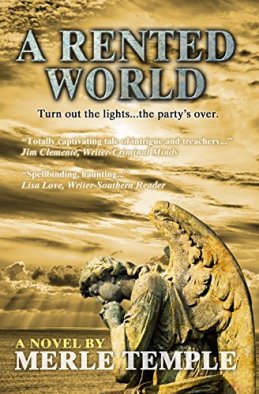 A Rented World (2014)
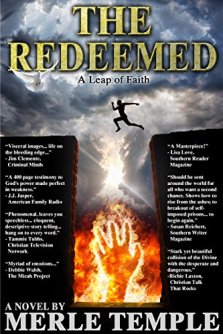 The Redeemed – A Leap of Faith (2016)

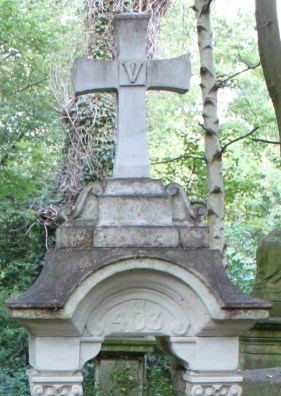
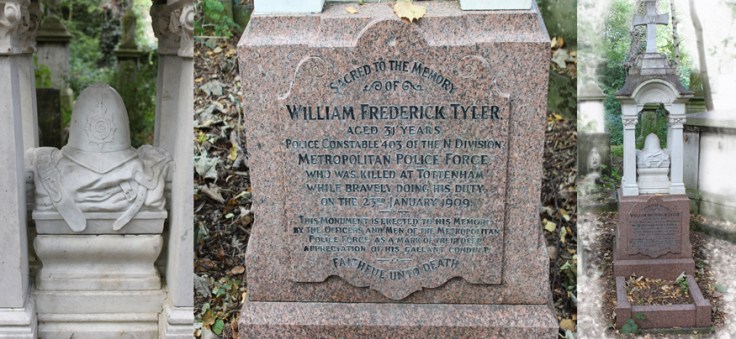


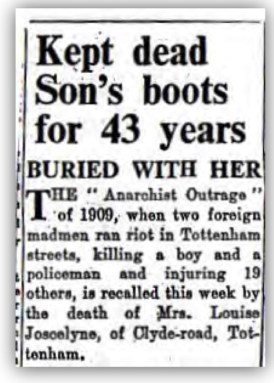 Ralph Joscelyne’s mother, Louise, was to raise another seven children, but she kept the pair of boots Ralph was wearing on the day he was killed. When she died in 1952, the boots were buried with her. In more recent times, both Joscelyne and Tyler have been commemorated. WIlliam Tyler has a plaque on the wall of Tottenham police station, while Ralph Joscelyne is remembered in a memorial outside a church in Mitchley Road. There is an abiding irony that the corner of Tottenham where the robbery occurred and the resultant chase began is exactly where the catastrophic riots of 2011 started. An initially peaceful protest by relatives of Mark Duggan, a gangster shot by police, did not get the required response from officers within the police station. It then, as they say, “all kicked off.”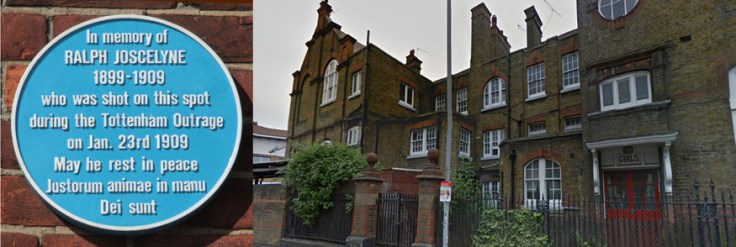

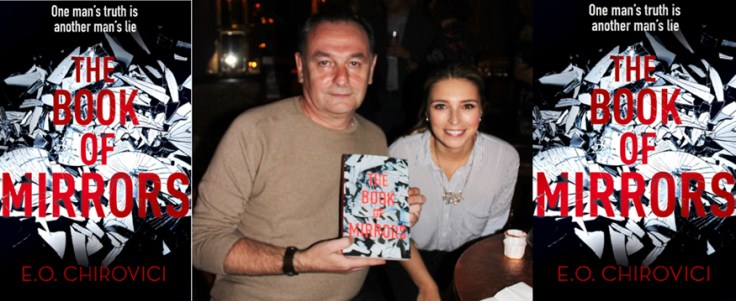

 So, in a spookily lit upper room we met the writer, who is not only an award winning economist and has penned best-sellers in his native Romania, but also the author of a stunningly good new novel – the first he has written in English. The book is set partly in the present and partly in 1987, and it tells the story of the murder of a controversial professor of psychology at New Jersey’s Princeton University. His death is observed by different narrators, and Chirovici (left) has constructed an ingenious literary version of the old fairground attraction of distorting mirrors, so that we reach the final pages still not really sure who is giving us the correct image of events on the fateful night.
 We are in the weeks leading up to Christmas 1944, deep in what would prove to be the last winter of a war which, thanks to the Luftwaffe, had brought death and destruction to the doorsteps of ordinary people in towns and cities up and down the country. German aircraft no longer drone over the streets of London; instead, the Dorniers and Heinkels have been replaced by an even more demoralising menace – the seemingly random strikes by V1 and V2 rockets. Despite the fact that the rockets need no visible target to aim at, the ubiquitous blackout is still in force. An Air Raid Precaution Warden, whose job has become as redundant as that of those manning anti-aircraft batteries, makes a chilling discovery. He stumbles – literally – on the body of a young woman. Her neck has been broken by someone clearly well-versed in killing, and the only clue is a number of spent matches lying by the body.
 There is more than a touch of The Golden Age about this novel, but it is much more than a pastiche. Although the killing of Rosa Nowak is eventually solved, with a regulation dramatic climax in a snow-bound country house, Rennie Airth allows us to breathe, smell and taste the air of an England almost – but not quite – beaten down by the privations of war. Many of the characters have menfolk away at the war, including Madden himself and his wife Helen. Their son is in the Royal Navy, on the rough winter seas escorting convoys. The contrast between life in the city and in the country is etched deep. In the city, restaurant meals are frequently inedible, the black market thrives unchecked due to depleted police manpower, and even the newsprint bearing cheering propaganda from the government is subject to rationing. Travelling anywhere, unless you are fiddling your petrol coupons, is arduous and unpleasant.
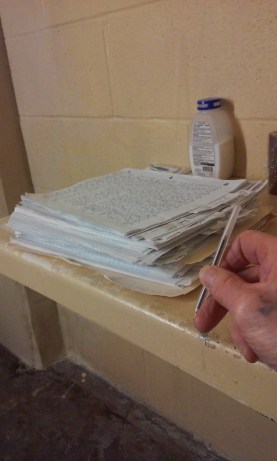 Roy’s workspace was adequate for writing. But the inadequacies far surmounted any conveniences: No computers, word processors or typewriters were available. Paper was hard to get, and because of the high-security, regular ink pens were banned. Every page, 1,162 in total, was handwritten multiple times to render a final clean draft with a “flex-pen”, a plastic ink cartridge with a soft, flexible rubber shroud. These sub-par ink dispensers are immensely taxing on the hand.
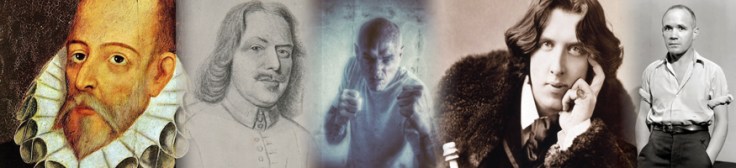 There have been several examples of literature being written by imprisoned authors. Described as the first modern novel, Don Quixote, was conceived while Miguel de Cervantes was in jail for debt, although it was finished and published after the author was freed. Oscar Wilde’s De Profundis was a poignant letter to his fickle lover, Lord Alfred Douglas, and was composed while the author was serving his sentence for indecency. The powerful Ballad of Reading Gaol was, however, written after Wilde’s release.
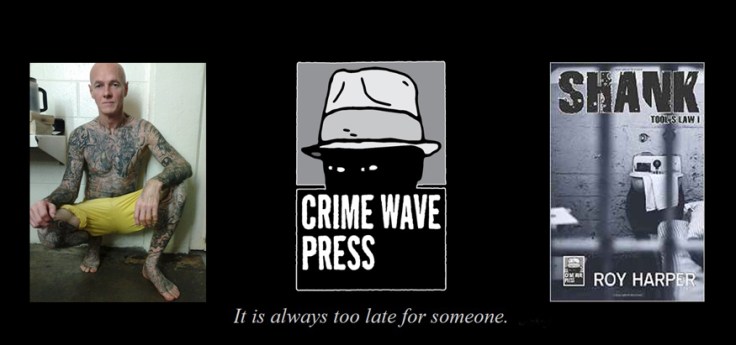
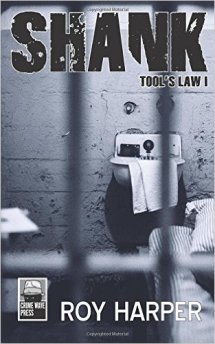 Roy Harper would not claim literary kinship with Cervantes, Wilde and Genet, yet he shares the unique kinship of living a life behind bars. He also writes, and after an exercise in smuggling manuscripts out of prison that merits a novel all by itself, his first book – Shank (Tool’s Law 1) – was published in May 2016. Let Henry Roi, of Crimewave Press, take up the story.
 Roy Harper (right) never murdered anyone, and the worst that ever befell those he encountered while on the run was to be shocked, and then accosted and harassed by reporters looking to sell the news as entertainment. Raised in Tempe, Arizona, Roy enjoyed exploring the desert and playing at gun fighting, and was fascinated by outlaw cowboys, the most infamous being Public Enemy No.1, John Dillinger.


 fullybooked2017