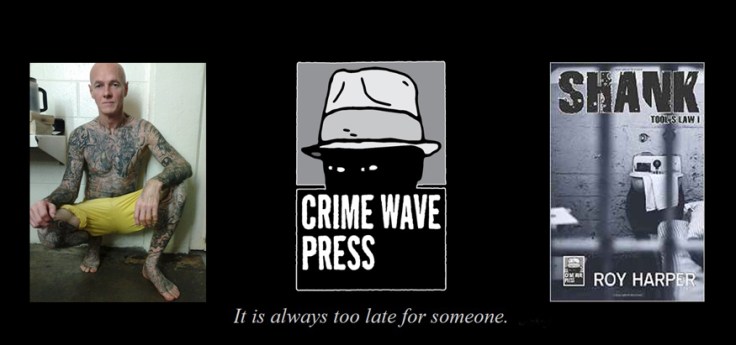
This is the second part of the extraordinary saga of a real life inmate of America’s toughest correctional facilities, and his struggle to get his story into print. You can read Part One here. Henry Roi is the PR Manager for Crime Wave Press, and here he tells of just what it took to get Roy Harper’s work from inside a jail cell onto bookshelves and e-readers.
The Tribulations Of An Author Convict
Tool’s Law was written in a hostile environment, a Mississippi Supermax, where the strongest of minds deteriorated from incessant chaos, government oppression, and inhumane treatment condoned by local culture.
Roy Harper has been many things in his life. A thief, bank robber, car-jacker, kidnapper, an armed and dangerous fugitive. He doesn’t brag about these things, though he is unapologetic as well. He accomplished his proudest endeavors as a convict, spending over a decade advocating prisoner rights and was instrumental in the civil suits that ultimately closed down Unit 32 Supermax, starting a ripple-effect that changed correctional philosophy around the country.
After 40 years of an intense criminal life, Roy can now add “Published Author” to his timeline. In 2004 Roy decided to write a book. A novel that would, hopefully, sell enough copies to pay for a pardon. Money was the original motivator for penning Tool’s Law, though as the process developed, it became an outlet, an escape from a harsh reality. As the characters took on a life of their own the project became far more than just a way to make money; the project became a great source of PRIDE, a real self-motivator, and the first legit hard work Roy had ever embarked on without grinding his teeth in reluctance. Hard work – years of it – in a hard environment. How could he possibly look forward to that? Because every completed chapter elevated his sense of accomplishment.
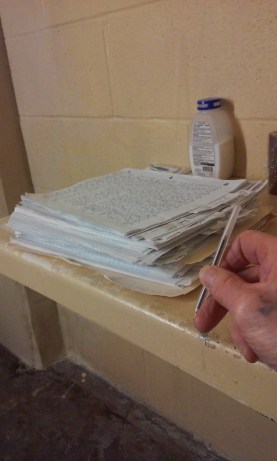 Roy’s workspace was adequate for writing. But the inadequacies far surmounted any conveniences: No computers, word processors or typewriters were available. Paper was hard to get, and because of the high-security, regular ink pens were banned. Every page, 1,162 in total, was handwritten multiple times to render a final clean draft with a “flex-pen”, a plastic ink cartridge with a soft, flexible rubber shroud. These sub-par ink dispensers are immensely taxing on the hand.
Outside of his cell was an endless dissonance. Unit 32 was filled with the worst-behaved prisoners in the state. Mentally ill or terribly disruptive, the psychotic, violent and juvenile actions pervaded the buildings without interruption, exacerbated by policies and staff that offered no incentives for good behavior – no T.V., radio, fans, or even shoes. They acted like animals because they were treated as such.
For High Risk inmates like Roy, shakedowns were a weekly treat, as were movement to different cells. Officers routinely trashed property, out of spite or under orders, and did not care about the perceived value of a prisoner’s property. Family photos, artwork, cherished letters from loved ones, legal work, poems, and manuscripts like Roy’s were commonly trashed or taken during these movements and shakedowns.
It took several days to get mentally adjusted to a new cell, with new neighbors, noises, smells, critters, floods, fires, and fears of who must be watched to avoid being scalded, stabbed, or assaulted with excrement. After acclimating to a new cell, Roy would work on Tool’s law during lulls in the chaos.
In 2006, the American Civil Liberties Union took interest in several lawsuits filed about inhumane treatment in Unit 32. Roy worked closely with the Associate Director of the ACLU National Prison Project, Miss Margaret Winter, who used a 5th Circuit ruling filed by Roy in previous years to supplement the class-action that eventually closed down Unit 32. A federal judge issued a court decree ordering the Mississippi Department Of Corrections to provide Long-Term Segregation inmates, including High-Risk, incentive programs that allowed well-behaved prisoners a chance to earn more privileges and freedom of movement.
In 2008, Deputy Commissioner E.L. Sparkman created the High-Risk Incentive Program. Roy was the poster-man Mr. Sparkman used to promote the program, “selling” it to other states and even the federal system. Mr. Sparkman’s change of correctional philosophy – from take everything and lock ‘em down to providing them incentives for good behavior – was a national success, and the Supermax facilities around the country began closing as other states took note.
Out of appreciation for Roy’s help and good behavior during the development of the High-Risk Incentive Programs, Mr. Sparkman helped Roy with Tool’s Law, appointing a deputy warden to have the manuscript scanned and burned onto DVDs.
No further progress was made on Tool’s Law until 2012, when RAW T.V. producer Jenny Evans contacted Roy to interview him for a feature in National Geographic’s Breakout! series. RAW T.V. wanted to do a documentary about Roy’s May, 2000, escape from Unit 32 Supermax. Miss Evans could not pay Roy for the story (that is illegal), but offered to help with Tool’s Law. She had the brilliant idea of recruiting Facebook friends to help type it, and over the next six months the entire manuscript was typed by more than a dozen awesome, caring people Roy had never met and would never know.
Three more years went by before any more progress was made. The handwritten pages were typed, but they needed to be edited, proofread, and submitted to publishers. The Incentive Program had more privileges, but Internet access was off-limits. And Roy had no help on the outside…but he had help on the inside.
Roy’s friend and fellow outlaw, Chris, is a self-published author who had access to the Internet via a Galaxy Android smartphone (which, after possessing for several years, was confiscated from Chris after a gangbanger snitched on him). Chris had no experience with writing apps, but learned quickly, working closely with Roy to edit and proof – read Tool’s Law. Roy drew his own cover art, which Chris took pictures of and used his image editing apps to create the book covers. Together they published Tool’s Law in a four-book series on Lulu.com, a self-publishing service.
A couple of months later, Roy and Chris had sold only a few books. After constant research about creating online platforms, they learned how limited they were, lacking money for data, and the online time needed to successfully grow an Internet presence as authors. They changed tactics, using what they could do very effectively: submitting queries.
After studying numerous examples of queries in books about writing, they started a query campaign that lasted over a month, submitting to publishing houses, big and small, around the world. During this period there was a constant fear of the phone being discovered. They were, after all, escape risks housed in maximum security and the Incentive Program did not lessen the frequency of shakedowns. The manuscripts, queries, sample chapters – every file created for submitting to publishers and agents – was at stake.
Success! When Roy read the first email from Crime Wave Press the relief on his face and in his body language was profound. All the years of hard work and stress to get Tool’s Law to this point was vindicated. It wasn’t all for nothing, as he had feared often. Crime Wave Press was highly interested, having read and loved the first two books. Roy knew they’d like books three and four as well. He was right.
The contract was drafted, negotiated, and signed. The final product, a leaner and meaner version of Tool’s Law, edited by Tom Vater, will be released in two volumes this Spring/Summer, 2016, as Tool’s Law Book I: SHANK and Tool’s Law Book II: HEIST.
Roy is currently working on another novel, inspired and enjoying the feeling of having a real purpose in life: entertaining people with his unique crime fiction stories.
No-one who has ever tried to write a novel – and get it published – will claim the process is easy, or without heartbreak or moments of despair, but Roy Harper’s struggle is something else altogether. In the final part of this stranger-than-fiction story there will be more from Harper himself, and also a transcript of his interview with Henry Roi (pictured below)

Shank is available on Amazon
 Philip Kerr’s Bernie Gunther novels bestride the 20th century, from the rise of the Nazis in 1930s Germany to the post war period when many countries still sheltered mysterious German gentlemen whose collective past has been, of necessity, reinvented. Gunther is a smart talking, smart thinking policeman who has kept his sanity intact – but his conscience rather less so – by dealing with such elemental forces as Reinhardt Heydrich, Joseph Goebbels, Juan and Evita Peron, and Adolf Eichmann.
 A Man Without Breath (2013) sees Gunther is working for an organisation whose very existence may seem improbable, given the historical context, but Die Wehrmacht Untersuchungsstelle (Wehrmacht Bureau of War Crimes) was set up in 1939 and continued its work until 1945. In 1943, on a mission from the Minister for Propaganda, Joseph Goebbels, Gunther is sent to Smolensk and entrusted with proving that the thousands of corpses lying frozen beneath the trees of the nearby Katyn Forest are those of Polish army officers and intellectuals murdered by the Russian NKVD, and not those of Jews murdered by the SS.
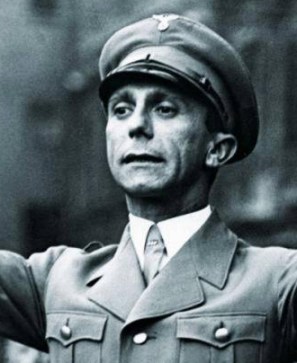 the German military that Hitler is a dangerous upstart who has already damaged the country beyond repair, and must be stopped. Adrift on a sea of violent corruption, Gunther constantly plays the role of the decent man, but in the end, he follows one theology, and one theology only. If he wakes up the next day with his head firmly attached to his shoulders, and has feeling in his extremities, then he has done the right thing. His conscience has not died, but it is far from well; it competes a whole chorale of competing voices in his head, each wishing to be heard. As he is left helpless by the world of spin and disinformation orchestrated by Dr Goebbels, (right) he must resort to his basic copper’s instincts to protect himself and uncover the truth.

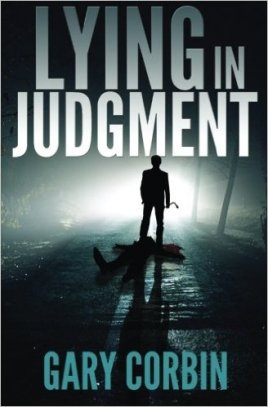 In his debut novel, Lying In Judgment, he has created both a cunning title and a positively perverse plot. Peter Robertson has left his youth behind but, having become a ‘thirty-something’, he is appalled to find out that his wife is being actively – very actively – unfaithful. He becomes obsessed with his wife’s betrayal and decides to confront her lover. The confrontation turns violent, and Robinson exacts a terrible kind of justice on the man who has broken up his marriage. Except – and it is as big an except as you could imagine – Robertson has made a stupid mistake, and battered to death a completely innocent stranger.
 Corbin opts for a slightly lighter atmosphere in his second book, The Mountain Man’s Dog. I guess that’s obvious, as dogs, being such cheery souls for the most part, don’t do Noir and psychological intensity. We are still in the wilds of the North West, Clarksville Oregon, to be precise, and we are introduced to one of its more rugged citizens, the delightfully named Lehigh Carter. Mr C is far more at home working under a stand of timber than he ever is in polite company, but his innocent love for a feisty girl, Stacy McBride, has him in all sorts of bother. The dog? Well, Stacey McBride, Carter’s former fiancee, persuades him to adopt the stray, and she only has to flutter her eyelashes for him to agree.
 A Ghostly Shade of Pale (2013)
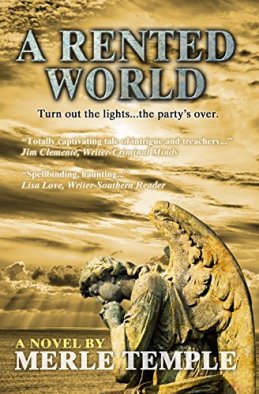 A Rented World (2014)
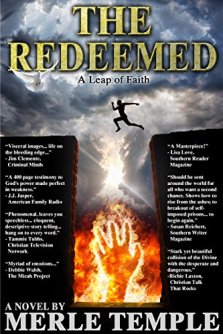 The Redeemed – A Leap of Faith (2016)


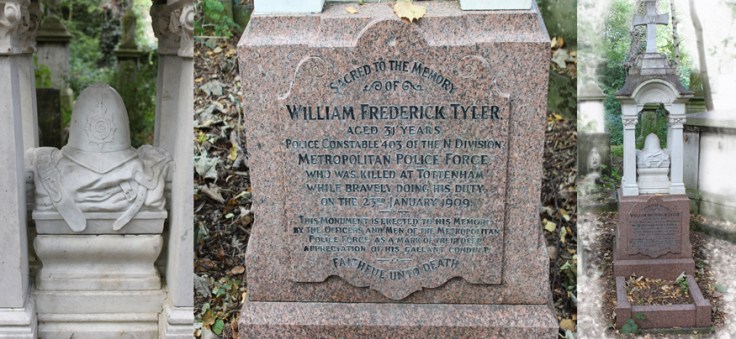


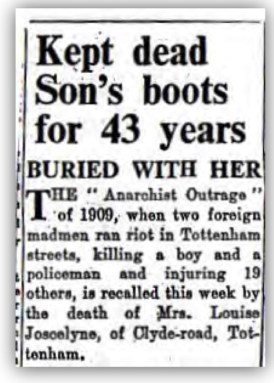 Ralph Joscelyne’s mother, Louise, was to raise another seven children, but she kept the pair of boots Ralph was wearing on the day he was killed. When she died in 1952, the boots were buried with her. In more recent times, both Joscelyne and Tyler have been commemorated. WIlliam Tyler has a plaque on the wall of Tottenham police station, while Ralph Joscelyne is remembered in a memorial outside a church in Mitchley Road. There is an abiding irony that the corner of Tottenham where the robbery occurred and the resultant chase began is exactly where the catastrophic riots of 2011 started. An initially peaceful protest by relatives of Mark Duggan, a gangster shot by police, did not get the required response from officers within the police station. It then, as they say, “all kicked off.”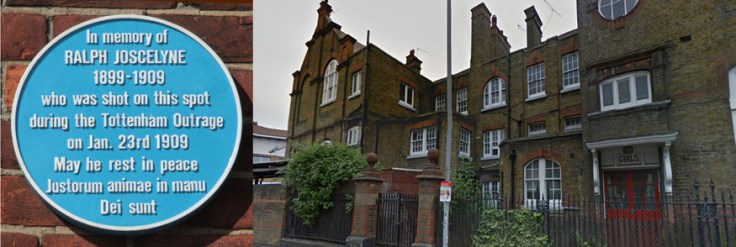

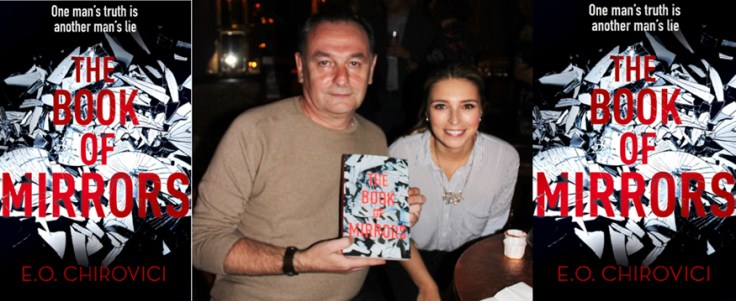

 So, in a spookily lit upper room we met the writer, who is not only an award winning economist and has penned best-sellers in his native Romania, but also the author of a stunningly good new novel – the first he has written in English. The book is set partly in the present and partly in 1987, and it tells the story of the murder of a controversial professor of psychology at New Jersey’s Princeton University. His death is observed by different narrators, and Chirovici (left) has constructed an ingenious literary version of the old fairground attraction of distorting mirrors, so that we reach the final pages still not really sure who is giving us the correct image of events on the fateful night.
 We are in the weeks leading up to Christmas 1944, deep in what would prove to be the last winter of a war which, thanks to the Luftwaffe, had brought death and destruction to the doorsteps of ordinary people in towns and cities up and down the country. German aircraft no longer drone over the streets of London; instead, the Dorniers and Heinkels have been replaced by an even more demoralising menace – the seemingly random strikes by V1 and V2 rockets. Despite the fact that the rockets need no visible target to aim at, the ubiquitous blackout is still in force. An Air Raid Precaution Warden, whose job has become as redundant as that of those manning anti-aircraft batteries, makes a chilling discovery. He stumbles – literally – on the body of a young woman. Her neck has been broken by someone clearly well-versed in killing, and the only clue is a number of spent matches lying by the body.
 There is more than a touch of The Golden Age about this novel, but it is much more than a pastiche. Although the killing of Rosa Nowak is eventually solved, with a regulation dramatic climax in a snow-bound country house, Rennie Airth allows us to breathe, smell and taste the air of an England almost – but not quite – beaten down by the privations of war. Many of the characters have menfolk away at the war, including Madden himself and his wife Helen. Their son is in the Royal Navy, on the rough winter seas escorting convoys. The contrast between life in the city and in the country is etched deep. In the city, restaurant meals are frequently inedible, the black market thrives unchecked due to depleted police manpower, and even the newsprint bearing cheering propaganda from the government is subject to rationing. Travelling anywhere, unless you are fiddling your petrol coupons, is arduous and unpleasant.
 There have been several examples of literature being written by imprisoned authors. Described as the first modern novel, Don Quixote, was conceived while Miguel de Cervantes was in jail for debt, although it was finished and published after the author was freed. Oscar Wilde’s De Profundis was a poignant letter to his fickle lover, Lord Alfred Douglas, and was composed while the author was serving his sentence for indecency. The powerful Ballad of Reading Gaol was, however, written after Wilde’s release.
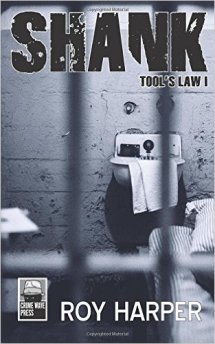 Roy Harper would not claim literary kinship with Cervantes, Wilde and Genet, yet he shares the unique kinship of living a life behind bars. He also writes, and after an exercise in smuggling manuscripts out of prison that merits a novel all by itself, his first book – Shank (Tool’s Law 1) – was published in May 2016. Let Henry Roi, of Crimewave Press, take up the story.
 Roy Harper (right) never murdered anyone, and the worst that ever befell those he encountered while on the run was to be shocked, and then accosted and harassed by reporters looking to sell the news as entertainment. Raised in Tempe, Arizona, Roy enjoyed exploring the desert and playing at gun fighting, and was fascinated by outlaw cowboys, the most infamous being Public Enemy No.1, John Dillinger.

 Here on the coast of The Wash we can, if we wish, still measure the seasons by produce. I say “if we wish”, because supermarkets have no seasons – everything is available all the year round. But in the old fashioned world of buying food when it is fresh and local, the year has its own rhythm. Early summer gives us asparagus, followed by strawberries. In autumn and winter Brancaster mussels and native oysters are delicious, but for me, the true treasure of the summer months is samphire. This plant of the coastal marshes, Crithmum maritimum, allegedly gets its name from a corruption of the French “St Pierre”, but whatever its etymology, it is utterly delicious. Lightly boiled or steamed, it is best eaten with the fingers. Running the stems through your teeth to strip off the flesh is a completely sybaritic sensation. Local folk love it with vinegar, but with butter and coarsely ground pepper it is little short of heavenly.
 Shaw and George Valentine series with At Death’s Window. In addition to solving a series of burglaries at properties along the Norfolk coast owned by wealthy out-of-towners, Shaw and Valentine become involved in a turf war between product dealers. These are not your common-or-garden drug barons, or even owners of ice cream vans, but dealers in samphire! As I have illustrated, with a 300% mark-up available for an item that can be had for nothing, why bother with something as illegal and potentially lethal as narcotics? The problem in At Death’s Window comes when local folk are muscled off their home territory by criminal gangs using illegal immigrants as pickers. Think cockles and the Morecambe Bay tragedy, and you can see how it all might go pear-shaped.


 fullybooked2017