
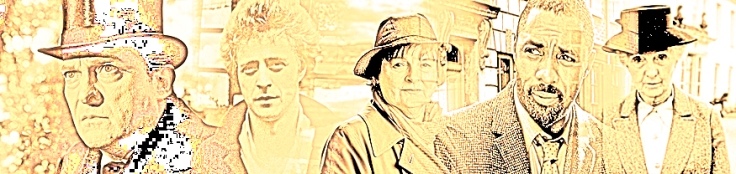
While nothing beats a good book, detectives on TV come a close second. At the age of 72 I have seen a fair few of these small screen sleuths, and I’ve made a purely subjective list of the best twenty five. My shortlist ran to well over sixty, and if some who didn’t make the cut are your personal favourites, then please accept my commiserations. It’s also worth saying that of my twenty five, the majority are adaptations of books.
First, my criteria for inclusion. My choices are all British productions featuring British actors and, with two exceptions, mostly British settings. I’ve excluded ensemble police procedurals such as Z Cars, The Bill and Waking The Dead. I have, regretfully, left out my all time classic TV crime drama Callan, because dear old David wasn’t so much a detective as an enforcer or a cleaner-up of the messes created by his shadowy employers. Each of my choices has a readily identifiable – and sometimes eponymous – leading character, to the extent that were the man or woman on the proverbial omnibus shown a photograph of, for example, George Baker, they would say, “Ah yes – Wexford!” Please feel free to vent your outrage at omissions or inclusions via the usual social media networks, but here goes:
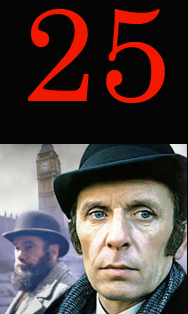 Victorian coppers were not new to TV when this Sergeant Cribb, based on the excellent Peter Lovesey novels, first aired. There had already been several attempts at the Holmes canon, and way back in 1963 John Barrie starred as Sergeant Cork. Although a serial, rather than a series, the 1959 version of The Moonstone featured the great Patrick Cargill as Sergeant Cuff, possibly the first fictional detective. Where Sergeant Cribb came to life was through the superbly dry and acerbic characterisation of Alan Dobie, aided and abetted by the ever-dependable William Simons. Neither did it hurt that most of the episodes were written by Peter Lovesey himself. (1980 – 1981)
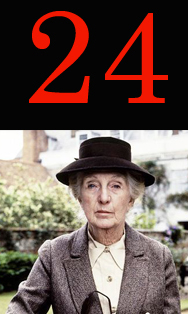 I am sure the loss is all mine, but of the Golden Age female crime writers I have found Agatha Christie the least interesting, despite her ingenious plotting and ability to create atmosphere. Mea Culpa, I suppose, but it would be reckless not to include Miss Marple in this list. Geraldine McEwan and Julia McKenzie have their admirers, but Joan Hickson is, surely, the Miss Marple? Her series (1984 – 1992) was certainly the most canonical and, if the anecdote is to be believed, Agatha Christie herself once sent a note to the younger Hickson hoping that she would, one day, play the Divine Miss M.
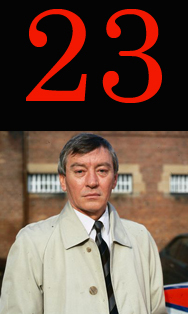 Small, aggressive, punchy and with hard earned bags under his eyes, Mark McManus was Taggart. Before he drank himself to death, McManus drove the Glasgow cop show, repaired its engine and polished its bodywork to perfection. It was Scottish Noir before the term had come into common parlance. Bleak, abrasive, unforgiving and with a killer theme song, Taggart was a one-off. The series limped on after McManus died but it was never the same again. (1983 – 1995)
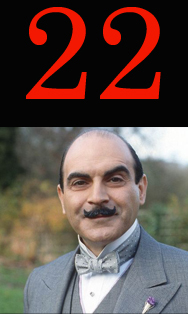 Who knows what the lady herself would have made of David Suchet’s Poirot? Her family are said to have approved, and for sheer over-the-top bravura, Suchet’s mincing and mannered portrayal has to be admired. The production values were always immense from day one in 1989 and by the time the series finished in 2013, every major work by Agatha Christie which featured Poirot had made its way onto the screen. The supporting cast was every bit as good, with Hugh Fraser as Hastings and Philip Jackson as the permanently one-step-behind Inspector Japp.
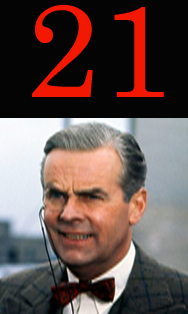 For me, the Golden Age Queen was Dorothy L Sayers and my permanent Best Ever Crime Novel is The Nine Tailors, so it is a relatively brief series (1972 – 1975) featuring Lord Peter Wimsey that makes its way into this list. Some DLS buffs refer the slightly more cerebral Edward Petherbridge version, but my vote goes to Ian Carmichael. He played up the more foppish and scatty side of Wimsey’s nature, but he also managed to convey, underneath the gaiety, the fact that Wimsey was something of a war hero, and his recovery from wounds and shell shock was due in no small part to his relationship with his former Sergeant, Mervyn Bunter.
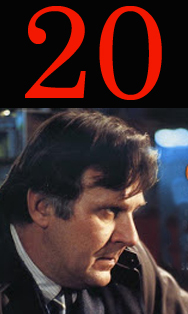 Just as on the printed page, TV crime series have more Detective Inspectors than you can shake a retractable police baton at. The first to make it into my selection is, perhaps, not so well known to the general reading public, but a firm favourite with those of us who kid ourselves that we are connoisseurs. Charlie Resnick is a creation of that most cerebral of crime novelists, John Harvey. He is distinctly downbeat and his ‘patch’ is the resolutely unfashionable midlands town of Nottingham. There were eleven novels featuring the jazz loving detective, but only two of them were televised. Lonely Hearts screened in three parts in 1992, while Rough Treatment had two parts, and was broadcast a year later. Both screenplays were written by John Harvey himelf, and Tom Wilkinson brought a lonely and troubled complexity to the main role.
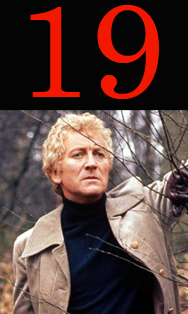 Van der Valk took us to Amsterdam for an impressive five series, based on the novels by Nicolas Freeling. Freeling tired of his creation, and killed him off after eleven novels. He resisted the clamour to resurrect him, but did write two more books featuring the late cop’s widow. The TV series was, by way of contrast, milked for all it was worth, and Barry Foster played Commissaris Piet van der Valk against authentic Dutch settings. Amsterdam’s reputation for sleaze, sex and substances did the series no harm at all in the eyes of British sofa-dwellers. Theme tunes are an integral part of any successful series and Eye Level took on a life of its own, improbably reaching No. 1 in the British pop charts in 1973. Noel Edmunds’ barnet is irresistible, is it not?https://www.youtube.com/watch?v=zvesdlGe-EI
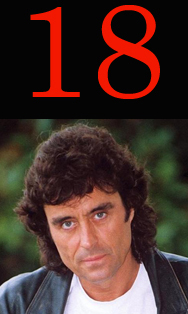 Most of my TV detectives are upright beings, not to say moral and public spirited. The East Anglian antique dealer Lovejoy was, by contrast, one of life’s chancers and, to borrow a phrase much used by local newspapers when some petty criminal has met a bad end, ‘a lovable rogue.’ Ian McShane and his impeccable mullet brought much joy to British homes on many a Sunday evening between 1986 and 1994. Lovejoy was always out for a quick quid, but like an Arthur Daley with a conscience, he always had an eye out for ‘the little guy’. McShane was excellent, but he had brilliant back-up in the persons of Phyllis Logan as the ‘did-they-didn’t-they’ posh totty Lady Jane Felsham, and the incomparable and much missed Dudley Sutton as Tinker Dill.
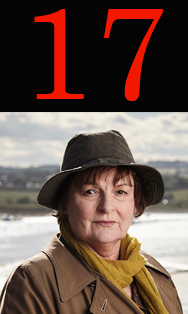 The TV version of the Vera books by Ann Cleeves is now into its quite astonishing tenth series and the demand for stories has long since outstripped the original novels. Close-to-retirement Northumbrian copper Vera Stanhope is still played by Brenda Blethyn, but her fictional police colleagues – as well as the screenwriters – have seen wholesale changes since it first aired in 2011. Why does the series do so well? Speaking cynically, there are several important contemporary boxes that it ticks. Principally, its star is a woman and it is set in the paradoxically fashionable North of England.The potential for scenic atmosphere is limitless, of course, but the core reason for its enduring popularity is the superb acting of Blethyn, and the fact that Cleeves has put together a toolkit of very clever and marketable elements. Vera will probably outlast me, and a new series is already commissioned for 2021.
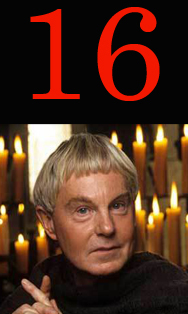 The creation of Cadfael was an act of pure genius by scholar and linguist Edith Pargetter, better known as Ellis Peters. Not only was the 12th century sleuth a devout Benedictine monk, but he had come to the cloisters only after a career as a soldier, sailor and – with a brilliant twist – a lover, as we learned that he has a son, conceived while he was fighting as a Crusader in Antioch. In the TV series which ran from 1994 until 1998, Derek Jacobi brought to the screen a superb blend of inquisitiveness, saintliness and a worldly wisdom which his fellow monks lacked, due to their entering the monastery before they had lived any kind of life. Modern times prevented the productions from being filmed in Cadfael’s native Shropshire, and they opted instead for Hungary!
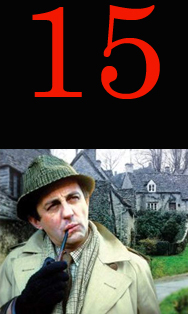 When my next series choice was aired in 1977, the producers had no confidence that either the name of its author, or that of its central character, would be a crowd puller, and so they called it Murder Most English. The four-part series consisted of adaptations of novels written by Colin Watson, and in print they were part of his Flaxborough Chronicles, twelve novels in total. Inspector Purbright, played by Anton Rodgers, is an apparently placid small town policeman, but a man who sees more than he says, and someone who has a sharp eye for the corruption and scheming endemic among the councillors and prominent citizens of Flaxborough – a fictional town loosely based on Boston, Lincolnshire, where Watson worked as a journalist for many years. The TV Purbright was perhaps rather more Holmesian – with his pipe and tweeds – than Watson had intended, but the original novels Hopjoy Was Here, Lonelyheart 4122, The Flaxborough Crab and Coffin Scarcely Used, were lovingly treated. Unusually, for a TV production, the filming was done in a location not too far from the fictional Flaxborough – the Lincolnshire market town of Alford, just 25 miles from Watson’s Boston workplace. Click this link to learn more about Colin Watson and his books.
The next ten choices in my survey of the best TV detectives
follows soon – keep an eye out on TWITTER
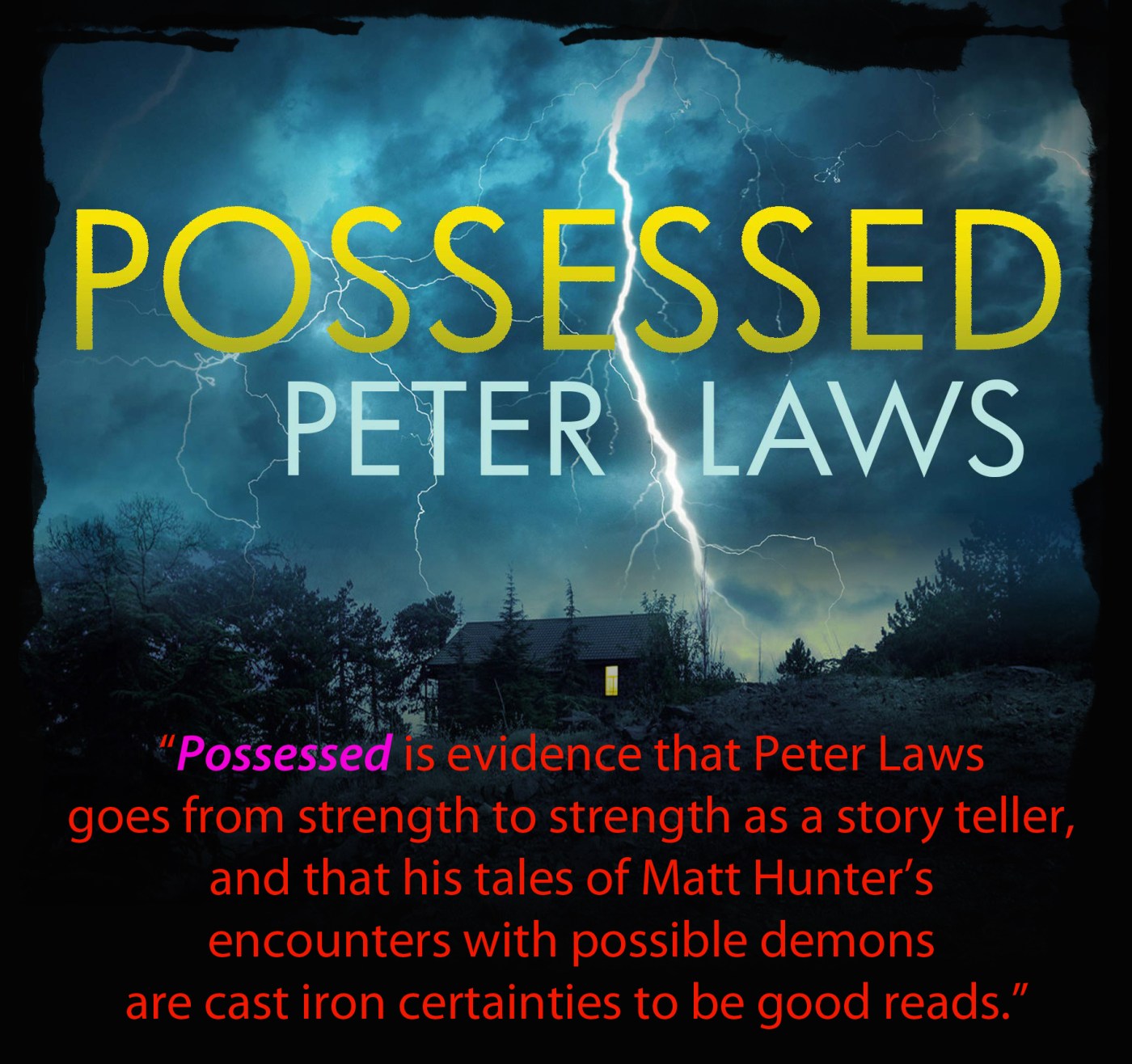
 Peter Laws introduced us to Matt Hunter in Purged (2017) and we learned that he is a former priest whose total loss of faith coincided with tragic personal events. Now, he lectures in the sociology of religion and belief systems, and has a reputation (one which does not sit lightly with him) for being the go-to guy when the police have a case which is ‘not dream’t of in our philosophy’.
 unter discovers that Riley is a devotee of a local church, one which, depending on your view might be termed either ‘charismatic’ or ‘a bunch of eyeball-rollers’. Things take a dramatic turn for the worse when Riley’s wife is discovered, horribly mutilated, in one of the customer chairs of her home hairdressing salon.
 hat happens next is violent, bloody, improbable – but totally gripping. Of course, Matt Hunter survives to return to his delightful wife and children, but not before he is forced to question his firmly-held disbelief in ‘ghoulies and ghosties, and long-leggedy beasties, and things that go bump in the night.’
 Laws (right) doesn’t exactly play it for laughs, but amid the knockabout spookery and Hunter’s own predilection for making wisecracks, there is serious stuff going on. It is worth comparing Matt Hunter with another fictional investigator of strange things – Phil Rickman’s Merrily Watkins. Like the real life Peter Laws, Merrily Watkins is a priest. Like Matt Hunter, merrily doesn’t necessarily believe in the supernatural, but she is totally convinced that some folk do.


 ames Oswald’s Edinburgh copper Tony McLean is something of a fixture in the crime fiction firmament these days, and Bury Them Deep is the tenth in the series. For those readers picking up one of his cases for the first time, a little of his back story might be helpful. He is based in Edinburgh and now, of course, works for Police Scotland. He was (unhappily) educated in English independent schools thanks to his wealthy family, some of whose riches he has inherited, thus making him ‘a man of means’. He lives in an old and impossibly roomy house, left to him by his grandmother. He has a fragile relationship with partner Emma, and it is fair to say that their life together has been punctuated by both drama and tragedy. McLean drives a very plush Alfa Romeo, enjoys an occasional glass of cask-strength single malt whisky and, aside from his instinct for police work, has been known to be susceptible to stimuli and influences that are not, as Hamlet remarked, “dreamt of in your philosophy.” After many successful cases, he is now Detective Chief Inspector McLean, but if his superiors imagine he will settle for a life behind a desk, they are very much mistaken.
 Anya Renfrew is a rather dowdy and dull police civilian worker who seems devoted to her job, which is mastering the many databases which keep investigations fed with information. She has never had a day off in her life, and so when she goes missing it is considered rather unusual. Her mother is a former – and legendary – police superintendent, but Grace Ramsay is now old and infirm, living in a care home. Police are never more active than when investigating actual or possible harm to one of their own, and when McLean searches Anya’s house, what he finds hidden in her wardrobe indicates that Ms Renfrew’s private life was more exotic – and dangerous – than colleagues might have imagined.
 cLean’s professional life already has one big complication. A five-times serial killer called Norman Bale is in a secure mental hospital, thanks to McLean’s diligence and bravery. Now, he asks to speak to McLean, and what he has to say is both shocking and improbable. Are his words just the ramblings of a psychological disturbed killer, or does his suggestion – that Anya Renfrew’s disappearance and the moorland bone-pit are linked to a sinister piece of folklore – have any substance?
 t takes a bloody good writer to mix crime investigation with touches of the supernatural. John Connolly, with his Charlie Parker books is one such, but James Oswald (right) makes it work equally as well. The finale of this novel is as deeply frightening as anything I have read for a long time. Despite the drama, Oswald can use a lighter touch on occasions. There is dark humour in the way McLean sometimes needs to ingratiate himself with Edinburgh’s smart set. At an art gallery opening night he listens politely as two guests discuss one of the objets d’art: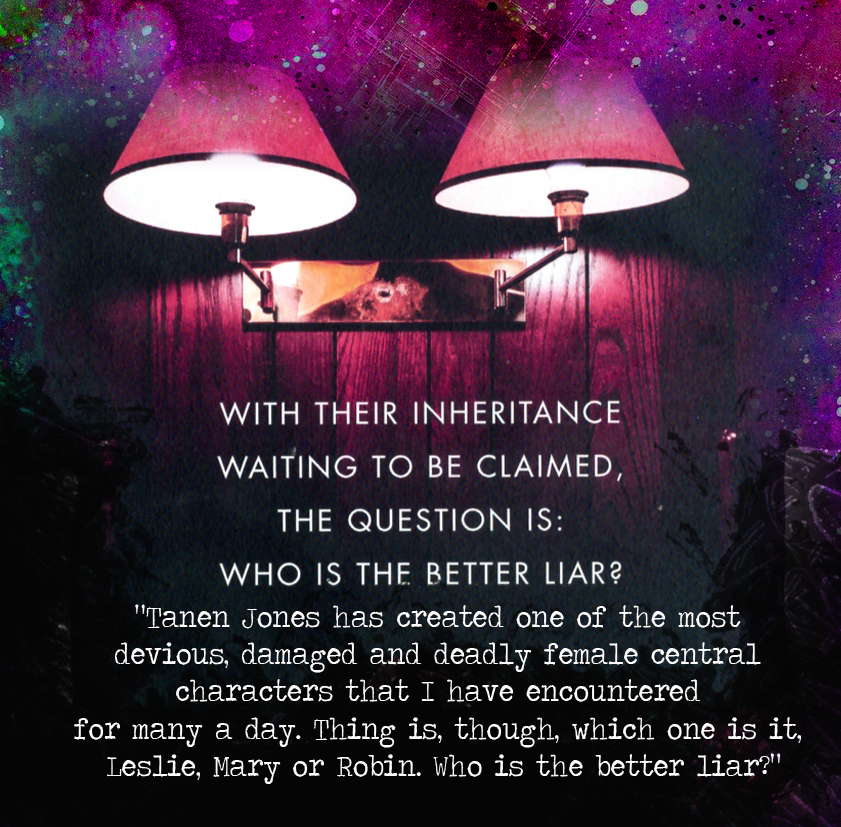

 When their father dies after a long illness, Leslie sets out to find Robin and eventually tracks her down to a seedy apartment block in Las Vegas.One slight problem. Robin is face down on the bed in the cockroach infested room, dead of a drug overdose.
 Alert readers may well figure out what is actually going on well before we get the big reveal, but even if you do, it won’t spoil the enjoyment. Tanen Jones (right) takes a wry look at modern obsessions, including a single mom who earns a living for herself and two little boys by posting stuff on Instagram, the debilitating half life lived by relative strangers messaging each other on social media, and the grim reality of women hooked into relationships with parasitic and abusive men.
 eing a middle class British father and grandfather, the concept of abandoning a newly born baby is totally beyond my experience of life and (the fault is perhaps mine) my comprehension. The fact is, however, that since Adam had his way with Eve, biology has trumped human intention, and babies have come into the world unloved and unwanted. Thankfully, there have been charitable institutions over the centuries which have done their best to provide some kind of home for foundlings. Abandoning babies is not something consigned to history: modern Germany has its Babyklappe, and Russia its Колыбель надежды – literally hatches – rather like an old fashioned bank deposit box – built into buildings where babies can be left. Back in time, Paris had its Maison de la Couche pour les Enfants Trouvés while in Florence the Ospedale degli Innocenti is one of the gems of early Renaissance architecture. London had its Foundling Hospital, and it is the centre of The Foundling, the new novel by Stacey Halls.
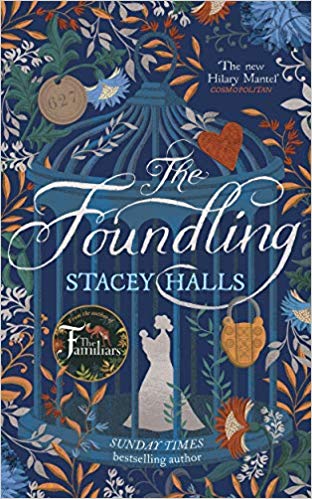 Bess Bright is a Shrimp Girl. Her father gets up at the crack of dawn to buy Essex shrimps from Billingsgate Market, and Bess puts the seafood in the brim of a broad hat and, clutching a tiny tankard to measure them out, she walks the streets of
  elling shrimps from the brim of your hat is not an occupation destined to provide sufficient funds to keep a growing child, and so Bess presents herself and baby Clara at
 ow – and where – Bess finds her missing daughter is for you to discover, but I promise that The Foundling is ingenious, delightful, and the author’s skills as a storyteller are magnetic. The attention to detail and the period authenticity are things to be wondered at, but what elevates this novel above the humdrum is how Stacey Halls conjures up our sheer emotional investment in the characters, each one beautifully observed. Art lovers will recognise the painter – and the title – of the picture below and, were he alive to read it, the great observer of London life would thoroughly approve of The Foundling, which is published by Manilla Press and is out on
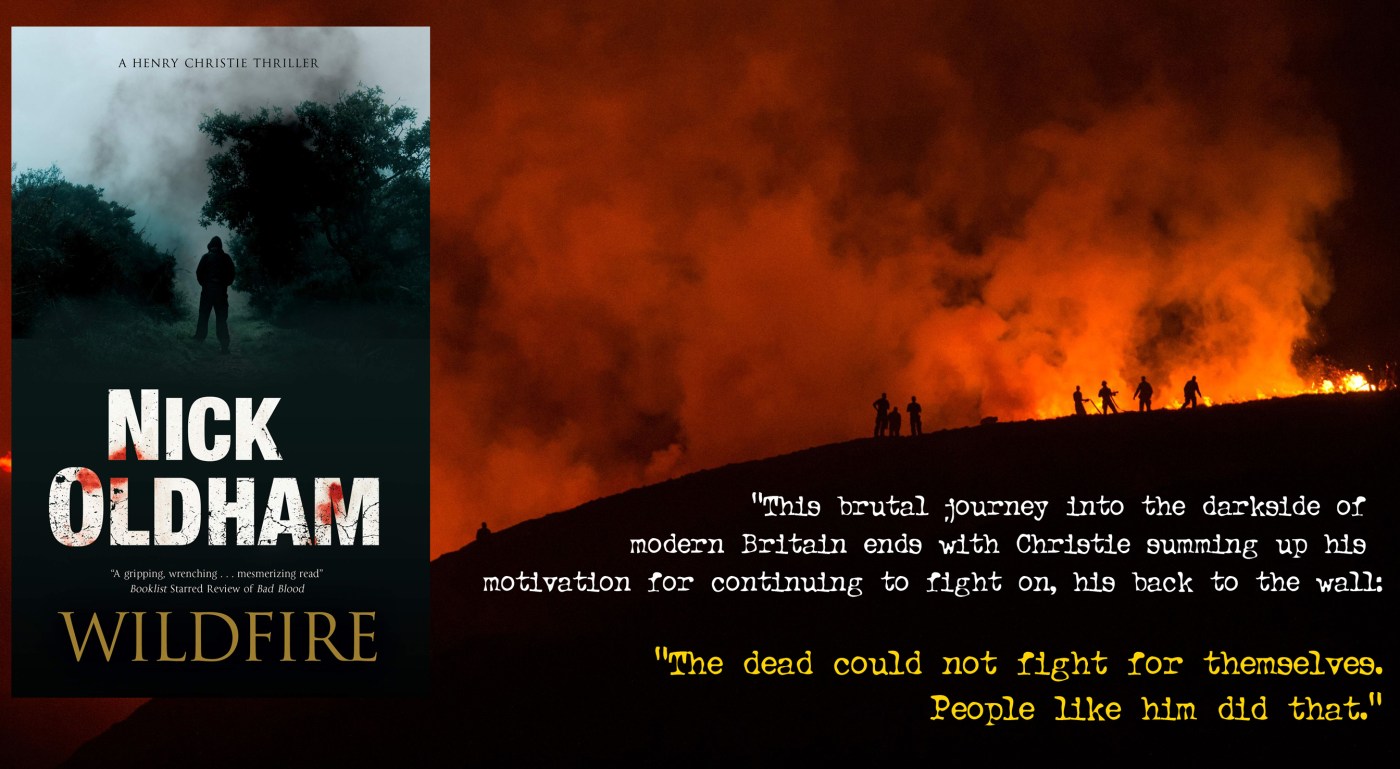

 ack in the day, before authors and their publishers trusted me with reviewing novels, I did what the vast majority of the reading public did – I either bought books when I could afford them or I went to the local library. I had a list of authors whose latest works I would grab eagerly, or take my place in the queue of library members who had reserved copies. In no particular order, anything by John Connolly, Jim Kelly, Phil Rickman, Frank Tallis, Philip Kerr, Mark Billingham, Christopher Fowler and Nick Oldham would be like gold dust.
 Oldham’s Henry Christie was a particular favourite, as his adventures mixed excellent police procedure – thanks to Oldham’s career as a copper – a vulnerable and likeable hero, and an unflinching look at the mean and vicious streets of the Blackpool area in England’s north-west. Wildfire is the latest outing for Henry Christie, who has retired from the police and now runs a pleasant village pub set in the Lancashire hills.
 ventually, the wildfires of both kinds are extinguished, at least temporarily, but not before Henry Christie is forced, yet again, to take a long hard look at himself in the mirror, and question if it was all worth the effort.
 his brutal journey into the darkside of modern Britain ends with Christie summing up his motivation for continuing to fight on, his back to the wall:

 The idea of the female spy has attracted writers and dramatists over the years with its unbeatable combination of danger and sexual allure. Pete Langman comes to the party with his enjoyable new novel, Killing Beauties set in the England of 1655. Remember those old historical movies that began with a dramatic piece of text scrolling over the opening titles, giving us a lurid and enticing potted background to whatever we were about to watch? The blurb for Killing Beauties might say something like,
  he beautiful woman is Susan Hyde, whose brother Sir Edward Hyde, Earl of Clarendon is principle advisor to the King in exile. With the aid of another young woman, Diane Jennings, Susan – and other members of the secret society known as Les Filles d’Ophelie – work with The Sealed Knot, coordinating underground Royalist activity in England and preparing for a general uprising against the Protectorate. Readers may be aware that the modern version of The Sealed Knot is a popular organisation of English Civil War re-enactors, but their historical namesakes were in deadly earnest, and organised two major rebellions before Charles II was finally crowned in 1661.
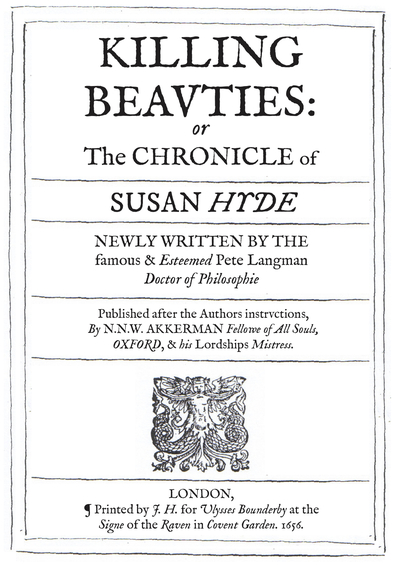 In order to succeed in her mission, Susan must use the deadliest weapon at her disposal – her sexuality. The beneficiary of her attention is none other than John Thurloe himself. Thurloe is a fascinating historical figure, and has featured in several other novels, most notably in the Thomas Challoner series by Susanna Gregory, and in the SG MacLean’s Seeker stories. I reviewed MacLean’s
  ne of the problems facing writers of historical fiction is how to handle dialogue. We know how they wrote to each other in letters, but what were conversations like? Despite one or two of his characters occasionally lapsing into more recent vernacular, Langman negotiates this particular minefield successfully. Killing Beauties is an engaging and well researched piece of costume drama acted out on a turbulent and dangerous stage. It is published by Unbound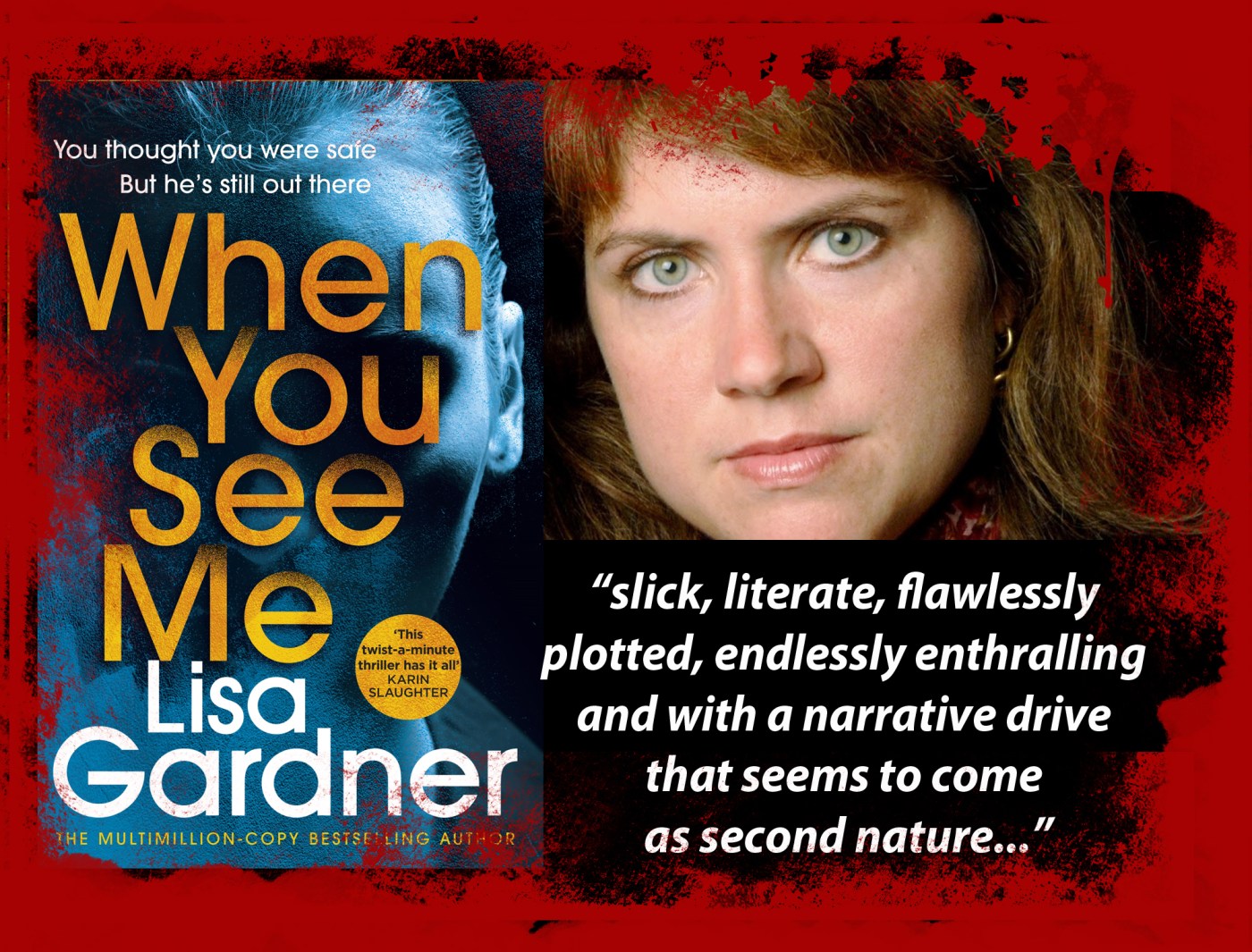

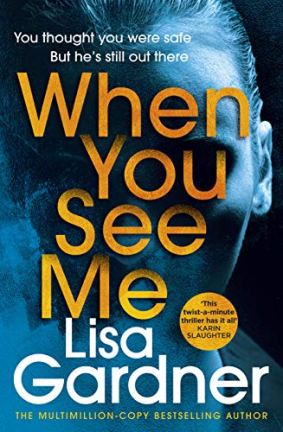 I first encountered Lisa Gardner’s entertaining ensemble of law enforcers just over a year ago in
  he storytelling technique which uses multiple narrators is much used and, it must be said, often abused, but Kisa Gardner nails it here, particularly through the eyes of Bonita, a Mexican girl maimed in childhood, unable to speak and used as a maid-of-all-work in an ostensibly respectable Victorian mansion, now an upmarket Bed & Breakfast facility in Niche, Georgia – the nearest settlement to where the human remains have been uncovered. Bonita is not her real name. Only her late mother knows what it is, but when D.D. Warren meets her during the investigation, she says:
 Almost inevitably, the dreadful goings on in the mountains surrounding Niche must involve some of the locals, but Lisa Gardner (right) lays out several enticing red herrings before revealing precisely which of the eminent townsfolk are involved in a dreadful conspiracy, a toxic cocktail of abduction, sexual slavery and-ultimately-murder. Flora, D.D. and the other members of the team eventually corner the evil genius at the centre of Niche’s darkest secret, but not before we are treated to a spectacularly violent finale involving secret tunnels, torture and, intriguingly, death-by-dishwasher.
 merican crime fiction is a huge, diverse and somewhat unwieldy beast, but at its best it is slick, literate, flawlessly plotted, endlessly enthralling and with a narrative drive that seems to come as second nature to such writers as Lisa Gardner. When You See Me will be out in Kindle,
 aomi is a feature writer of some sort, while Charlie is an entrepreneur designer in the tech industry. While a succession of sharp-intake-of-breath builders and carpenters transform the neglected house into a Sunday supplement paradise, Naomi is desperate to conceive a second child. Naturally, both she and Charlie have smartphone apps which track her fertility cycle and give the couple vital windows when hurried coupling should produce little Prue’s sibling. Sadly, none of the digital wizardry seems to work. Charlie is all-too-often not up-to-snuff, and Naomi’s obsessive quest is becoming counter productive.
 While on her daily run there and back to Prue’s nursery school, Naomi meets a stunningly attractive alpha male called Sean, and his bluff insouciance is such a contrast with Charlie’s needy self-absorption that she is smitten. One thing leads to another – the ‘another’ being hurried stand-up sex in the shower cubicle at a local leisure centre – and guess what? Sean’s urgent thirty seconds has done the job, and Naomi is, at last, pregnant, but possibly by the wrong man.
 Any sense of lifestyle mockery, gentle or otherwise, dissipates once we reach the final quarter of the book. Naomi discovers that whoever Sean really is, his plans for her and her family involve much than a few moments of lust. I certainly didn’t see the plot twist coming, and MacDonald (right) springs one surprise after another, right up to the final paragraphs. If you can’t make sense of the brief chapter interludes which consist of MSN messages (remember them?) between some bitchy schoolgirls, don’t fret – you will.


 fullybooked2017