Search

fullybooked2017

Author

fullybooked2017

A retired Assistant Head Teacher, mad keen on guitars. Four grown-up sons, two delightful grandchildren. Enjoys shooting at targets, not living things. Determined not to go gently into that good night.

DEATH RIDE . . . Between the covers

Death Ride header

I can’t think of another modern crime writer who does truly despicable villains quite like Nick Oldham. His years policing the semi-derelict housing estates behind the candy-floss, donkey rides and silly hat persona of Blackpool’s seafront taught him that the feral inhabitants thrown up by these estates are not victims of social injustice or poverty; neither are they the product of years of exploitation by cruel capitalists. No. In short, they are absolute bastards, and no amount of hugging by wet-behind-the-ears social workers will make them anything else. In Death Ride, Oldham introduces us to as vile a group of criminals as he has ever created. Led by Lenny Lennox, they are ruthless predators; pickpocketing, catalytic converters, dog-napping, abduction, sexual assault – and murder – frame their lives.

We meet them at a country fair in retired copper Henry Christie’s home village, Kendleton – high on the Lancashire moors – where he runs the local pub. While Lenny Lennox serves burgers from his catering van, his son and three other youngsters pick pockets, steal cameras and strip high end vehicles of their valuable exhaust systems. Ernest Lennox, however has gone a bit further, and abducted a teenage girl who resisted his advances, and to cover up his son’s stupidity Lennox senior has to take drastic action.

Christie has recently been used as a civilian consultant by his former employers, and his last case ended with him being brutally stabbed and left for dead. When the hunt for the missing girl – Charlotte Kirkham – becomes a race against time, Christie, partly crippled by his knife wounds, is drawn into the hunt. I am reminded of the words of Tennyson in his magnificent poem Ulysses:

Tho’ much is taken, much abides; and tho’
We are not now that strength which in old days
Moved earth and heaven, that which we are, we are;
One equal temper of heroic hearts,
Made weak by time and fate, but strong in will
To strive, to seek, to find, and not to yield.”

In rather blunter terms, Oldham writes:

“If Henry was honest with himself, he felt the urge to drag Lennox out of the burger van and smash his face again, just for old times’ sake, even though he knew he didn’t have the physicality to put that desire into action.

The Lennox gang create carnage in Christie’s life – and the lives of those he loves – but about three quarters of the way through the book, there is an abrupt change of scene, and we are reunited with two characters from Christie’s past – FBI agent Karl Donaldson and ex special forces maverick, Steve Flynn. They say that revenge is both sweet and best served cold. Suffice it to say that Henry Christie enjoys his gelato.

The Henry Christie books have always had plenty of action and their fair share of grit and gore, but on this occasion, be warned. Nick Oldham goes into Derek Raymond territory here, with a dark and  terrifying novel which explores the depths of human malice and depravity. Death Ride is published by Severn House and will be available from 7th March. For more about Nick Oldham and the Henry Christie books, click the image below.

Screen Shot 2023-01-12 at 18.42.35

HIDDEN CRIMES . . . Between the covers

HC header

This is the 11th in the series featuring the life and crimes of Detective Sophie Allen. She has now reached the rank of Detective Chief Superintendent, and is heading up a new regional crime squad based in the ancient kingdom of Wessex. Their stamping ground is not dissimilar to the area portrayed in the lovely map which used to be the frontispiece in editions of Thomas Hardy’s novels. Equally helpful is Michael Hambling’s list of police characters at the front of his book.

Wessex

A consultant surgeon and her husband are out walking on the hills above the village of Millhead St Leonard, when they get caught in a rapidly descending mist. While there is no danger from stumbling into a ravine – this is gentle countryside – it is unsettling, and even more so when Miriam Boateng hears a scream, and then catches sight of two figures in the murk just ahead of her. One is definitely being pursued by the other. She reports this to the police, but it is not until a few days later, when a young farm worker out repairing fences finds a dead body, that it becomes obvious that what Boateng saw was the prelude to a savage crime. WeSCU springs into action, and moves in to the Millhead village hall to begin a major investigation. They soon identify the  corpse as that of Bridget Kirkbride, a single woman living with Grant, her college-age son in a remote part of the village.

Screen Shot 2023-01-09 at 19.45.48

Michael Hambling (left) has already given us a little teaser in the first couple of pages, when we meet  as she is preparing to set out on what was to become her last journey. When Grant’s body is found caught up in reeds on the edge of the River Severn in Gloucester, the case becomes more complex, particularly so when the post mortem reveals that he died some days before his mother was killed. Hambling sets out the building blocks of a classic whodunnit, and challenges us to put them together in the correct sequence.

The residents of Millhead are, of course, unlike real life villagers, but this is why we suspend disbelief and buy crime novels. Amongst others, we have a pair of Mrs and Mrs lesbians who hold rather unconventional soirées for their close friends, a rather starchy vicar who is abducted half way through the book, and a ‘lovable rogue’ character who is a poacher and a party gate-crasher. I hope I’m not giving the impression that Hidden Crimes is some sort of Sunday evening TV comfy crime caper. It certainly is not, and parts of it are sombre and unsettling. The whodunnit aspect of the book ends well before the end (75% through on my Kindle), so the sense of mystery does rather evaporate, and the police pursuit ends in the less-than-idyllic streets of Wolverhampton when Sophie Allen is reunited with a criminal from one of her earlier cases.

The book cover is an artist’s impression of the celebrated view down Gold Hill, Shaftsbury, but the tone of the book is neither comfortable nor romantic, as befits a story which reveals the evils – and consequences – of child abuse. Hidden Crimes is a classic police procedural novel and it is played out on the hauntingly beautiful backdrop of the Wessex landscape. It is published by Joffe Books and is available now.

“SHE WOULD HAVE BIT ME TO PIECES, SO I HAD TO FINISH HER”. . . The murder of Hannah Middleton (2)

Middleton header

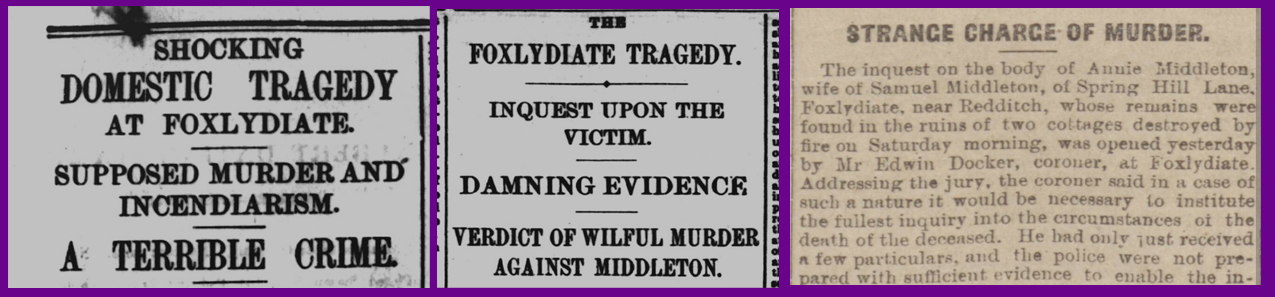
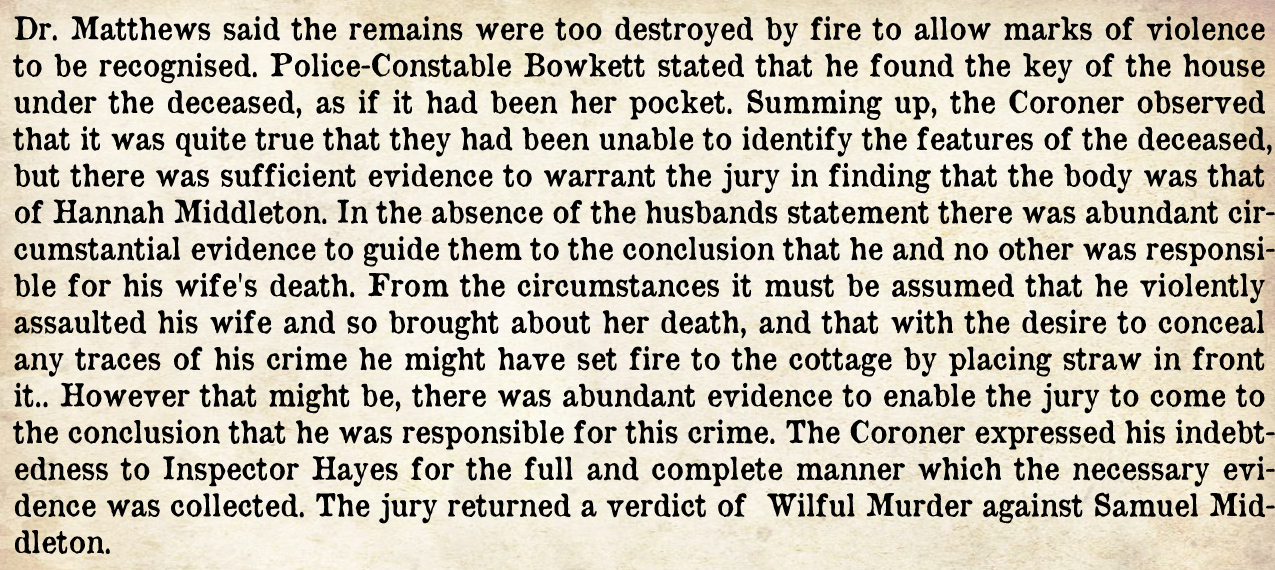
HannahSO FAR: On the evening of 10th/11th May 1902, Foxlydiate couple Samuel and Hannah Middleton had been having a protracted and violent argument. At 3.30 am the alarm was given that their cottage was on fire. When the police were eventually able to enter what was left of the cottage there was little left of Hannah Middleton (left, in a newspaper likeness) but a charred corpse. Samuel Middleton was arrested on suspicion of murdering his wife. The coroner’s inquest heard that one of the technical problems was that Hannah Middleton’s body had been so destroyed by the fire that a proper examination was impossible.
Inquest
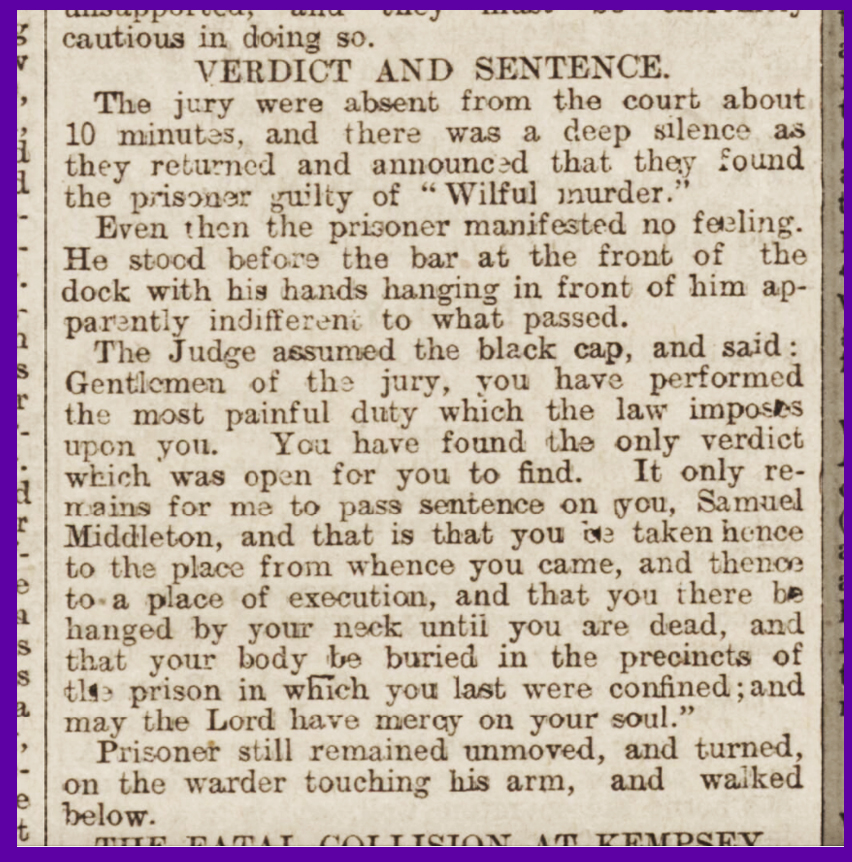
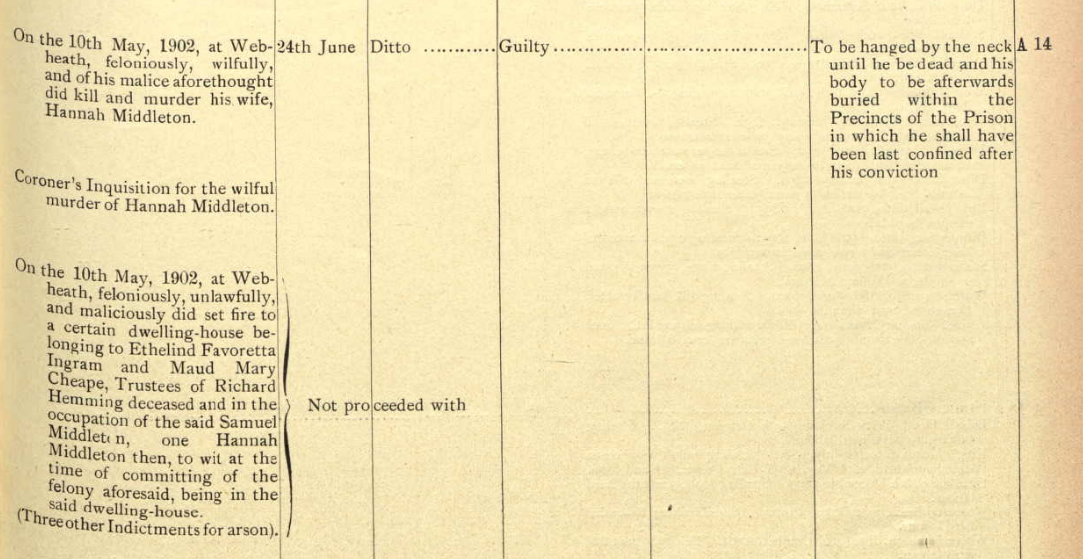
Screen Shot 2023-01-07 at 19.18.43Samuel Middleton was sent for trial at the summer assizes in Worcester. Assize courts were normally held three or four times a year in the county towns around the country, and were presided over by a senior judge. These courts were were for the more serious crimes which could not be dealt with my local magistrate courts. At the end of June, Samuel Middleton stood before Mr Justice Wright (left) and the proceedings were relatively short. The only fragile straw Middleton’s defence barristers could cling to was the lesser charge of manslaughter. Middleton had repeatedly said, in various versions, that his wife had clung to him with the intention of doing him harm – “She would have bit me to pieces, so I had to finish her.” It was clear to both judge and jury, however, that Middleton had battered his wife over the head with a poker, and then set fire to the cottage in an attempt to hide the evidence.  Mr Justice Wright delivered the inevitable verdict with due solemnity.
Verdict

On the morning of Tuesday 15th July 1902, within the walls of Worcester gaol, the wheels of British justice, with the assistance of executioner John Billington, made their final turn in the case of Samuel Middleton. Public executions ended in 1867, but newspaper reporters were granted certain levels of access, and what they couldn’t actually see, they made sure their readers had full access to their imaginative skills.

“The Press representatives had full leisure to observe all these details while they were waiting for the arrival of tbe procession. The time went slowly for the waiters, but too fast, alas, for the wretched criminal awaiting his doom in the condemned cell. The minutes went by, till at length the warder flung open the huge gates, which extend the whole length of the wall, and let in a flood of summer sunshine. The sad procession made its appearance by a door on the opposite side of the yard, descended the few steps, and slowly crossed to the place of execution. The Chaplain, the Rev. R. R. Needham, headed the cortege, and was closely followed by the condemned man, his arms pinioned behind him, and supported by a warder on either side. His face was deathly pale, and his eyes had a terrified expression, but otherwise he appeared quite calm. Others in the procession were the Governor of the Prison (Mr. H. B. Lethbridge), tbe Under-Sheriff of the County (Mr. W. P. Hughes), the surgeon (Mr. L. J. Wilding), Ald. J. Millington (one of the Visiting Justices), Chief Warder Gibson, and other warders, and the Sheriff’s officer.”

“Arriving at the death-chamber, Middleton was assisted on to the trap doors, and in a moment Billington and his assistants, two young, active men, had the noose affixed and the strap securely bound round the man’s legs. All this while Middleton made no sound or sign. The white cap was pulled down over his head, Billington sprang to the lever, gave a sharp pull, the doors flew open, and the miserable man’s body plunged down into the pit. There was a jerk, the rope vibrated for a few seconds, and then all was still. Middleton had paid the penalty of his crime.”

“As soon as the body disappeared, the Rev. R. R. Needham read a few sentences from the Burial Service, while the prison bell tolled, conveying to the waiting throng outside an intimation that the last act in the tragedy had been accomplished. The Chaplain’s voice sounded unsteady as he read the words of awful import, but he proceeded to the end. Then slowly the spectators filed out, giving one glance down the pit as they passed at the motionless, white-capped figure, the rope taut round the neck, and the head bent on to the shoulder a a horrible angle.”

In a bizarre postscript, Middleton’s official criminal record includes the  charge of destroying the cottage in which he lived, and the one occupied by Mrs Hassall.

Screen Shot 2023-01-06 at 18.50.48

FOR MORE HISTORICAL MURDER CASES, CLICK HERE

“SHE WOULD HAVE BIT ME TO PIECES, SO I HAD TO FINISH HER”. . . The murder of Hannah Middleton (1)

Middleton header

The hamlets of Foxlydiate and Webheath were, in 1902, still separate entities, but are now just part of Redditch. The word ‘lydiate’ is not uncommon in English place names, and it comes from Old English Hlid-geat, pronounced Lidyat, meaning swing-gate. The 1901 census shows that near to Springhill Farm, three adjacent cottages housed three people who were to lay significant roles in events a year later.

Screen Shot 2023-01-06 at 18.32.50

At 164 lived Samuel Middleton, his wife Hannah and their adult son William. Next door was an elderly widow, Harriet Hassall, and at 166 were Thomas and Lara Drew and their five children. Samuel Middleton was 47, and his wife 50. She was from Stow in Oxfordshire, and had married Samuel in 1879. He was born in Bentley, just a mile away from Foxlydiate. On the evening of 10th May 1902 the Middletons were in the middle of one of the violent arguments which had become all too common in recent months. Crockery was thrown and, fearing for her safety, Hannah Middleton ran the few hundred yards up the road to The Fox and Goose Inn. Landlord Herbert Chambers took Hannah back to the cottage, and later testified that the exchange was along these lines:
Middleton, “He’d better not come in here, or I’ll serve him the same.”
Chambers, “You’d better not do that, Sam.”
Middleton, “Come on then ..”
Chambers, “You’d be best governing your temper, Sam”.
Middleton, “No, I’ll do for the lot.”
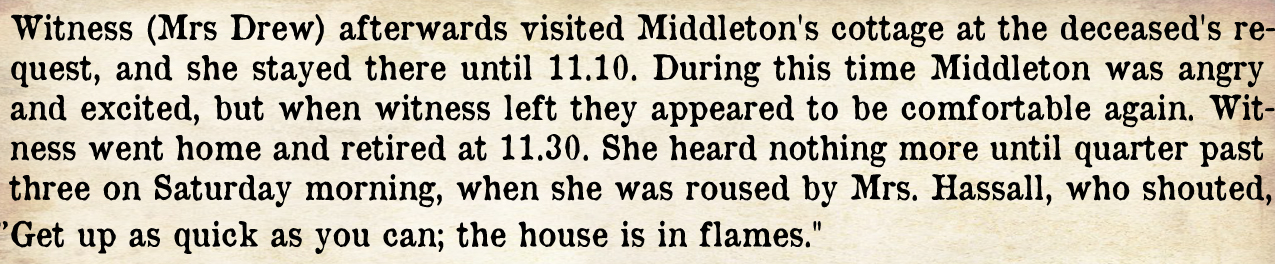
Chambers later testified that Middleton was not drunk, and that he was normally a peaceable man, but rather eccentric. Such was the proximity of the neighbouring cottages that the rows between the Middletons were something of a public event, and Laura Drew was concerned about Hannah’s safety. A newspaper reported her version of events.

Mrs Drew

Both cottages – back to back as they were – were destroyed by the fire, as was Hannah Middleton. A few days later, at the coroner’s inquest, witnesses were able to piece together the events.

Joseph Worskett, gamekeeper to Lord Windsor, said Middleton came to his house (where William Middleton was living) at Bentley at 3.30 am and called him through the window. Middleton called out, “Tell Will his mother’s nearly dead,” and went off.

William Middleton said he had heard Middleton frequently threaten his mother during the last two or three months. Inspector Hayes said the police, and fire brigade arrived at the cottages at five am on the morning of 11th May. Loose straw was littered in a continuous trail from the pig-stye to the house, and there were burnt ends around the door. Witness and two firemen discovered what they thought were human remains, on the brick floor. Portions of a woman’s clothing were buttoned at the back. Police Constable Lyes said a pair of tongs and part of a poker were lying about two feet from the body. The head of a large axe (weighing five or six pounds) was found on the floor in a room adjoining. The broken end of the poker lay close to it. A bill-hook was near the axe-head in the front room.

Later in the day, a roadman called James Tyler, was working in Trench lane, between Himbleton and Droitwich, when Middleton came and said, “Where am I going?”
Tyler said Where do you want to go?”
Middleton replied, “Anywhere, anywhere. I have killed the wife; they will soon catch me.”

Police Constable Bird found the prisoner the same evening sitting in Trench lane, and asked him what time he left Foxlydiate. He said had not left it, but when asked if his name were not Samuel Middleton he said, “I suppose it must be,” and asked where he was be taken. Police Sergeant Howard said prisoner while being taken from Bromsgrove to Redditch pointed to a scratch on the right side his cheek, and said, “That woman done this. She would not leave me and followed me downstairs. We had been rowing. She would have bit me to pieces, but I hit her on the head with the poker. They say it was all my fault.”

IN PART TWO
More details emerge
Trial and retribution


BREAKING THE CIRCLE . . . Between the covers

BTC

MJ Trow introduced us to the principle characters in this novel in the autumn of 2022 in Four Thousand Days (click to read the review) That was set in 1900, and had real-life archaeologist Margaret Murray solving a series of murders, helped by a young London copper, Constable Andrew Crawford. Now, it is May 1905, Andrew Crawford is now a Sergeant, has married into a rich family, and Margaret Murray is still lecturing at University College.

When a spiritualist medium is found dead at her dinner table, slumped face down in a bowl of mulligatawny soup, the police can find nothing to suggest criminality. It is only later, when a black feather appears, having been lodged in the woman’s throat, that Andrew Crawford suspects foul play. His boss, however is having none of it.

Two more mediums go to join the actual dead whose presence they ingeniously try to recreate for their clients, and the hunt is on for a serial killer. Crawford enlists the help of Margaret Murray, and under a pseudonym, she joins the spiritualist group to which the first murder victim has belonged. After an intervention by former Detective Inspector Edmund Reid who, amazingly, manages to convince people attending a seance that he is one of Europe’s most renowned spiritualists, we have a breathtaking finale in Margaret Murray’s dusty little office in University College.

Without giving too much away, I will tease you a little, and say that the killer is trying to find something, but isn’t sure who has it. There is a pleasing circularity here, by way of Jack the Ripper. Edmund Reid was one of the senior coppers who tried to bring the Whitechapel killer to justice, and MJ Trow has written one of the better studies of that case. One of the (many) theories about the motivation of JTR was that he was seeking revenge on the woman who gave him – or someone close to him – a fatal dose of syphilis, and he was simply working his way down a list.

Trow was for many, many years a senior history teacher at a school on the Isle of Wight, and he appeared as his thinly disguised ‘self’ in the long running series of books featuring Peter ‘Mad Max’ Maxwell. I can’t think of another writer whose encyclopaedic knowledge of the past has been the steel backbone of his books. Don’t, however, make the mistake of thinking there is an overload of fact to the detriment of entertainment. Trow is a brilliantly gifted storyteller and, as far as I am concerned, Victorian and Edwardian London belong to him. Breaking The Circle is published by Severn House, and is out now. For our mutual entertainment, I have including a graphic which shows some of the real life individuals who appear in the story.

Characters


For more on MJ Trow and his books, click on the author image below.

Screen Shot 2023-01-04 at 20.24.06


THE BROKEN AFTERNOON . . . Between the covers

Header

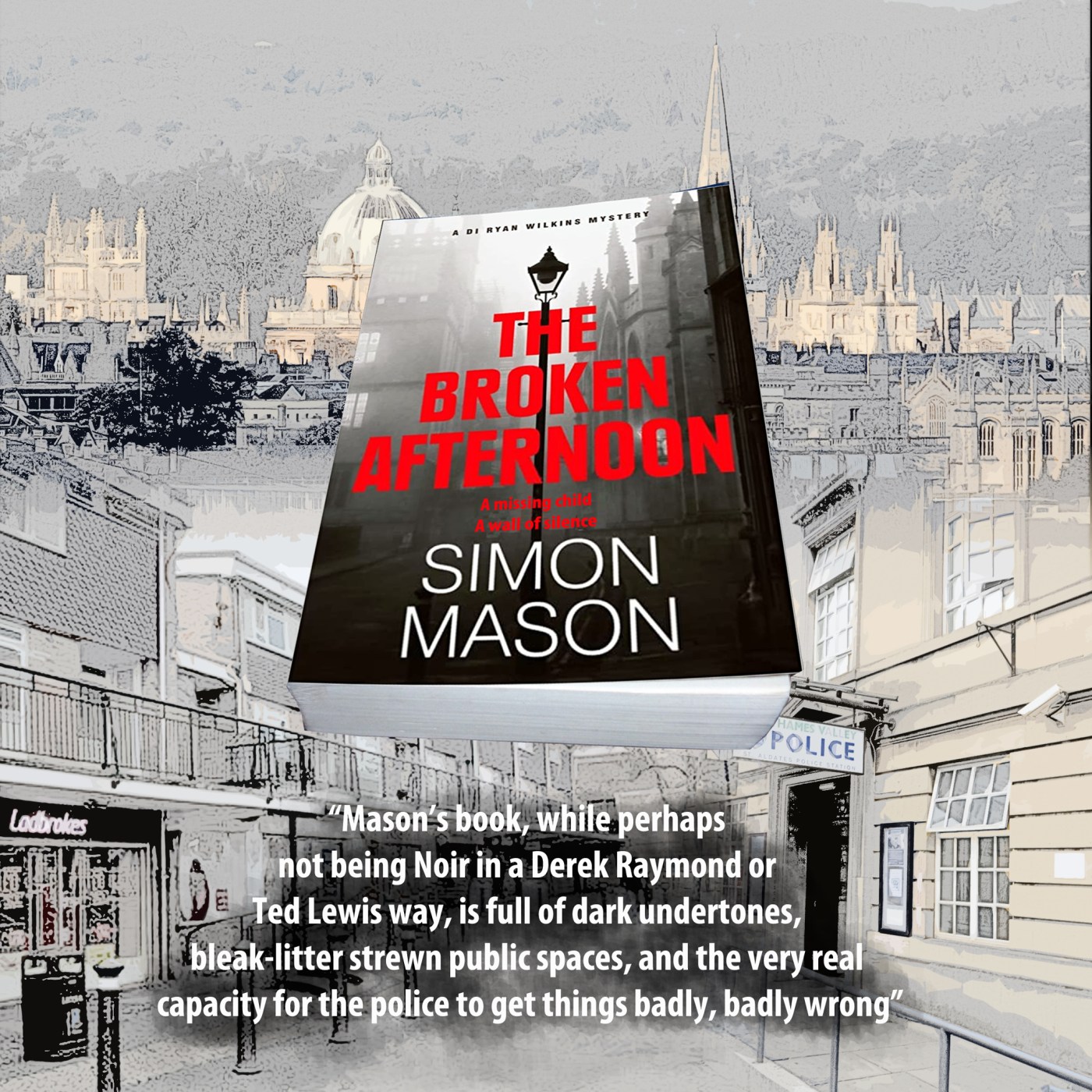
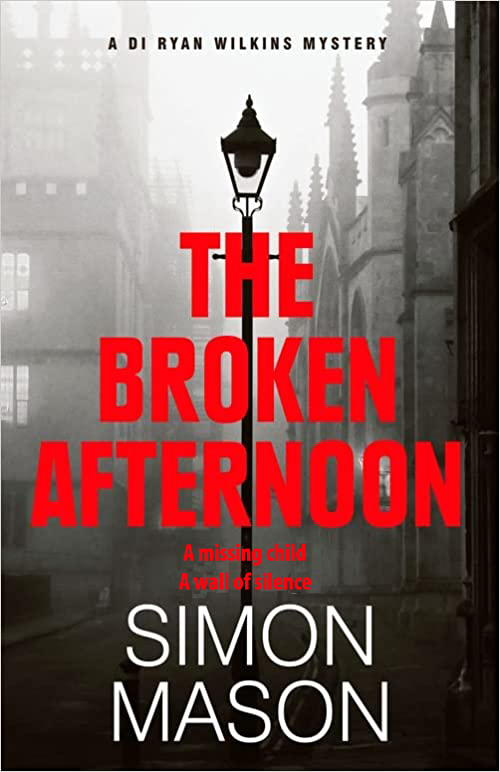
Cover copyIn Simon Mason’s A Killing In November we met Oxford DI Ryan Wilkins, and the book ended with his dismissal from the force for disciplinary reasons. In this book he is still in Oxford, but working as a security guard/general dogsbody at a van hire firm. His former partner, also named Wilkins, but Ray of that ilk, is now heading up the team that was once Ryan’s responsibility, and it is they who are tasked with investigating the abduction of a little girl from her nursery school.

Ryan and Ray are very different. Ryan is a single dad with a little boy, and somewhat rough round the edges. He was brought up on a caravan site and he is no matinee idol:

“He looked at himself in the mirror. Narrow face, grease-smear of scar tissue, big bony nose, all as familiar to him as his own smell.”

As a copper he was unorthodox, irreverent to his superiors, but with a real nose for the mean streets and those who walk them. Ray Wilkins is university educated – Balliol, no less –  a smooth dresser, good looking and at ease in press conferences; his partner Diane is pregnant with twins.

The search for four year-old Poppy Clarke is urgent, driven as much by the clamours of the media as the tearful anguish of Poppy’s mother. Ray is painfully aware of the adage about “the first forty eight hours”, but clues are scant, and he has exhausted the other convention of “close family member”

Ryan, meanwhile, has a mystery of his own to solve. Investigating a suspicious noise in the compound at Van Central, he discovers a man he had last heard of doing five years for burglary in HMP Grendon. Mick Dick is big, black, and sometimes violent, but he is down on his luck, and was trying to get into a transit van just to find somewhere to sleep out of the pouring rain. Ryan sends him on his way. The next day Ryan hears on the local news that there has been a hit and run case near North Hinksey where a body has been found at the side of the road. It is that of Michael Dick.

When the body of Poppy Clarke is found in a shallow grave in nearby woodland, the nature of the investigation changes. The urgency is replaced by a grim determination to find the killer. Time is now removed from the equation. Ryan has been doing his own nosing about into the death of Mick Dick, and finds he had been in contact with another former prison inmate called Sean Cobb. Cobb, however, is a very different kind of criminal from Mick Dick, and when Ryan tells Ray, Cobb becomes very definitely a person of interest in the hunt for Poppy Clarke’s killer. Ryan has also received a ‘phone call from his former boss, DCI Wallace, offering Ryan a carrot in the shape of a possible reinstatement.

We also meet Tom Fothergill, the millionaire boss of a company that produces high end pushchairs and prams. As part of his charitable work, he has helped ex-cons like Dick and Cobb, but how is he involved in the abduction and death of Poppy Clark?

One of the promotional blurbs for this novel declares:

“Mason has reformulated Inspector Morse for the 2020s”

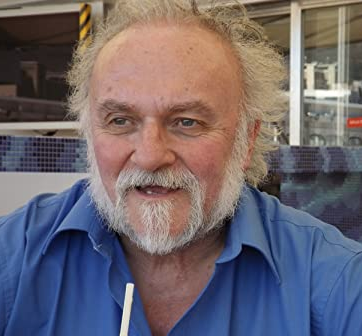
Screen Shot 2022-12-27 at 19.53.09I am sorry, but that is not how I see this book. Yes, it is set in and around Oxford, but apart from The Broken Afternoon being every bit as good a read as, say, The Silence of Nicholas Quinn or The Remorseful Day, that’s where the resemblance ends. Mason’s book, while perhaps not being Noir in a Derek Raymond or Ted Lewis way, is full of dark undertones, bleak litter strewn public spaces, and the very real capacity for the police to get things badly, badly wrong. Simon Mason (right) has created  coppers who certainly don’t spend melancholy evenings gazing into pints of real ale and then sit home alone listening to Mozart while sipping a decent single malt.

The killer of Poppy Clark is eventually ‘unmasked’, but perhaps that cliche is inappropriate, as he has been hiding in plain sight all along. The more squeamish male readers may want to skip the section towards the end set in the hospital maternity unit. It is superbly written, but graphic: I went through that experience with three of my four sons, but on the fourth occasion the ‘phone call came too late – or perhaps I drove to the hospital too slowly.

This is a very, very good book and, while Wilkins and Wilkins are chalk and cheese to Morse and Lewis, I can recommend The Broken Afternoon to anyone who enjoys a good atmospheric and convincing English police procedural. It is published by Riverrun/Quercus and will be out in all formats on 2nd February 2023.

THE POSTMAN DELIVERS . . . White Fox

White Fox Spine

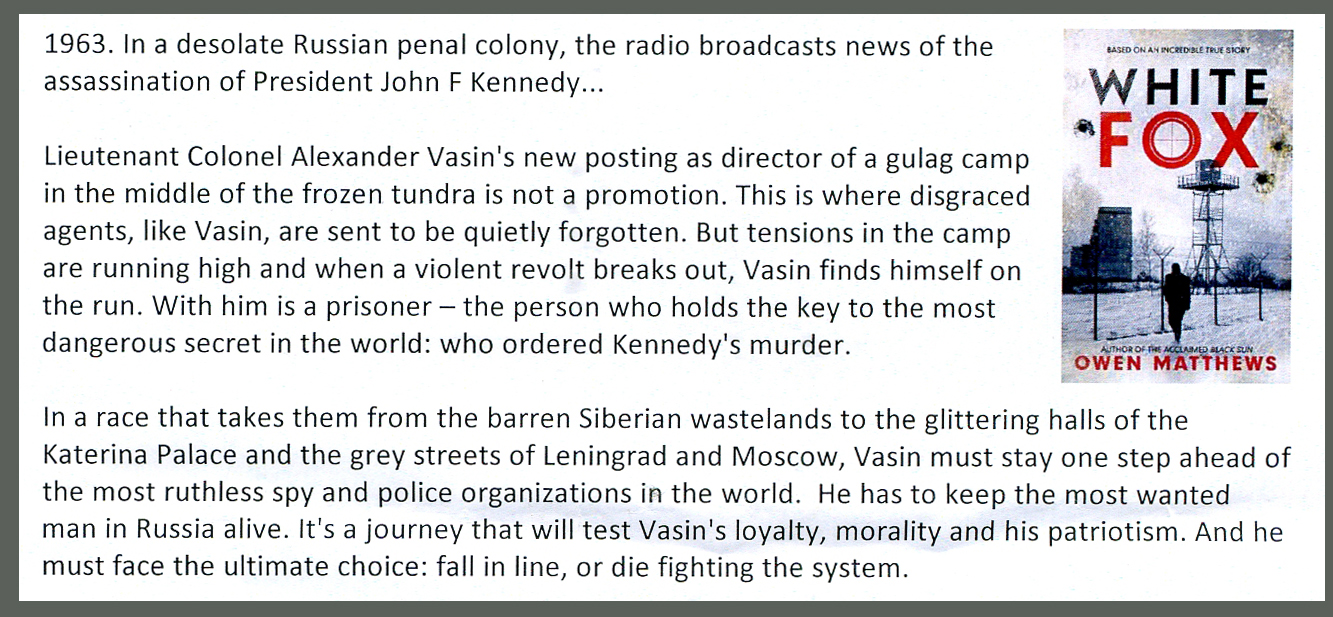
This is not due until the Spring of next year, but it looks a cracker. Owen Matthews, author of thrillers Black Sun and Red Traitor, completes the trilogy as he takes us back to 1963, and a political world struggling to come to terms with the momentous events of 22nd November.

Blurb scan

This will be published by Bantam on 9th March next year, and please keep your eyes skinned for a full review nearer the publication date. Here’s a link to Owen Matthews’ Amazon page.

THE IMPOSTER . . . Between the covers

Imposter spine010 copy

Author Leona Deakin started her career as a psychologist with the West Yorkshire Police. She is now an occupational psychologist, and this is the fourth book in her series featuring Augusta Bloom.

Imposter front008Dr Augusta Bloom is a psychologist who specialises in the criminal mind. Her business partner is Marcus Jameson, a former British intelligence agent. Bloom is often employed by the police as a consultant when  a particular case demands her particular skill-set. The killers Bloom is requested to track down have struck twice, leaving only burnt matches as a clue. I use the plural ‘killers’ advisedly, as we know they are a team, but Bloom and the police have yet to discover this.

As with the previous novels, there are two parallel plots in The Imposter. One involves Seraphine Walker who is, if you will, Moriarty to Bloom’s Holmes. Walker, despite being clinically psychopathic, is not overtly criminal, but has recruited all kinds of people who most certainly are. She heads up an organisation which, to those who enjoy a good conspiracy theory, is rather like a fictional World Economic Forum, peopled by shadowy but powerful influencers from across the globe, united by a hidden agenda The relationship between Bloom and Walker has an added piquancy because they were once doctor and patient. The backstory also involves someone we met in a previous novel – the disgraced former Foreign Secretary Gerald Porter, a ruthless man who is now happily bent on evil,  unimpeded by the constraints of being a government minister with the eyes of the world on him.

Leona_DeakinAugusta Bloom is an interesting creation. She is a loner, and not someone who finds personal relationships easy, not with Marcus Jameson nor with her notional boss, DCI Mirza, who is deeply sceptical about Bloom’s insights. When the police finally join all the dots, they realise that rather than two killings, there have probably been as many as eleven, which ramps up the pressure on Bloom and Jameson. Leona Deakin, (right) as one might expect from a professional psychologist, has constructed an complex relationship between Bloom, Walker and Jameson. As readers, we are not spoon-fed any moral certainties about the trio. Rather, we infer that their boundaries are, perhaps, elastic. As John Huston (as Noah Cross) said in Chinatown:
“You see, Mr. Gittes, most people never have to face the fact that at the right time and the right place, they’re capable of anything.”
Each of the trio – Bloom, Jameson and Walker –  has a certain dependence on the two others, but Deakin keeps it open and enigmatic, leaving all plot options open to her. This symbiotic relationship has led to Augusta Bloom taking an industry – standard test to discover if she is herself a *psychopath. To her relief, although she is marking her own paper, she doesn’t tick enough boxes.

*Psychopathy, sometimes considered synonymous with sociopathy, is characterized by persistent antisocial behavior, impaired empathy and remorse, and bold, disinhibited, and egotistical traits.

Finally, Bloom cracks the mystery, Mirza and Jameson see the light, and we readers realise that Leona Deakin has been pulling the wool over our eyes for nearly 300 pages. There is a tense and violent finale, and this clever and engaging novel ends with us looking forward to the next episode in this excellent series.

The Imposter is published by Penguin and is available in paperback and Kindle now. For reviews of the three previous novels in the series, click the links below.

GONE
LOST
HUNT

THE SIBSEY MURDER . . . A brutal killing in 1859 (2)

Sibsey header

SO FAR: March 1859. An elderly Sibsey farm labourer, William Stevenson, has been found dead in a ditch, his head destroyed by repeated blows from a blunt object. Three local men have been arrested on suspicion of his murder. One has been released without charge, but William Pickett and Henry Carey have been accused of the murder.

Their motive for killing William Stevenson? He was hardly a rich man, but on his return from Boston market he had a few shillings in his pocket and, incredible though it may seem, it was for these pieces of silver that he was repeatedly battered about the head and thrown in a ditch to die.

The sequence of events when people were suspected of murder back in the day was that there would be a coroner’s inquest where the cause of death would be established and – assuming there were suspects identified – a jury would, provided they were convinced that there was a case to answer, send the case on to magistrates. The magistrates court would normally be a repeat version, but with the case focusing on the suspect(s) rather than the victim. The final element in the trilogy was the Assize Court. This would be held four times a year, and almost always in the county town, and presided over by a senior judge. This arrangement meant that key witnesses for both prosecution and defence had to give their evidence three times, the only difference being that in the Assize Court the cross examination by barristers would be more incisive.

So it was that Carey and Pickett, having been in custody since late March finally had their day in court in late July, in front of Mr Justice Williams at Lincoln Assizes. By this time, Pickett had decided his best defence was to claim that he had been a reluctant partner in the fatal enterprise, and he feared Carey’s violence more than he feared justice. Given no other choice, Pickett was reduced to making a counter claim against his associate, but neither the judge nor the jury were convinced. Readers of The Lincolnshire Chronicle of the morning of 29th July were informed:

“Long before the Judge took his seat on the bench this morning, the Court was crowded to excess. Every avenue by which it was hoped that access to it could be gained was also besieged by an anxious crowd. The bench, as yesterday, was filled with ladies, and a hoarse murmur pervaded the court, as of parties expectant of some great exhibition. His Lordship took his seat on the bench precisely at half-past nine o’clock. The prisoners, on their appearance in the dock, presented the same appearance as on the previous day, save that their countenances seemed more anxious and worn. His lordship at once summed up. The pith of his lordship’s address to the jury was, that there could be no doubt,from the confession of both prisoners that they were present on the dreadful occasion, and, therefore, all the evidence given was superfluous. Each prisoner accused the other of striking the blow by which William Stevenson met his death.”

“The learned counsel for Picket bad endeavoured to show that Pickett was merely an accessory after the fact, and he, therefore, went into the evidence against prisoner. He pointed out that Pickett had given two different accounts of the place where he spent the night of the murder. Before proceeding to read Pickett’s statement, his lordship explained the law with respect to such confessions. The jury might believe all or any part of it they pleased. They should also read that part of the evidence which tended to show that the deed was done more than one person. With regard to Pickett’s confession, his lordship remarked that had that prisoner been a mere innocent stander-by while Stevenson was knocked down, he might have interfered, and there would have been two to one. He put it to the jury whether they could believe that he was reduced by terror to the state of inaction he describes. Tbe jury, amid the breathless silence of the crowded court, returned a verdict of GUILTY of WILFUL MURDER against both the prisoners, and the learned Judge, having assumed the black cap, proceeded to pass upon them the sentence of DEATH. The prisoners, who heard their doom with little emotion, were then removed. This concluded the criminal business of the Assizes, and the court rose.”

The hanging of Carey and Pickett on the morning of 5th August 1859, conducted by William Askern and the Horncastle cobbler William Marwood was the the last public hanging at Lincoln.

execution

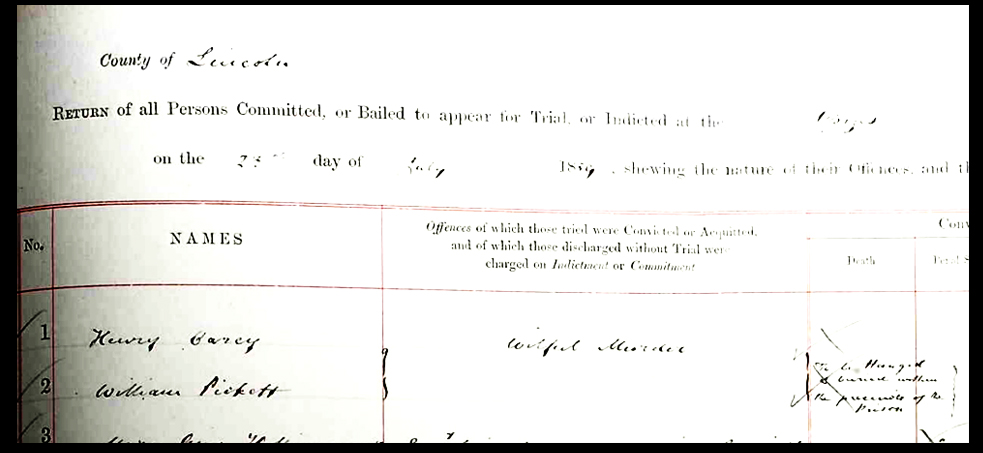
The names of Carey and Pickett remain inscribed in the judicial records while their victim, William Stevenson, was interred in the churchyard of St Margaret’s Sibsey, a few days after his brutal murder.

Criminal record

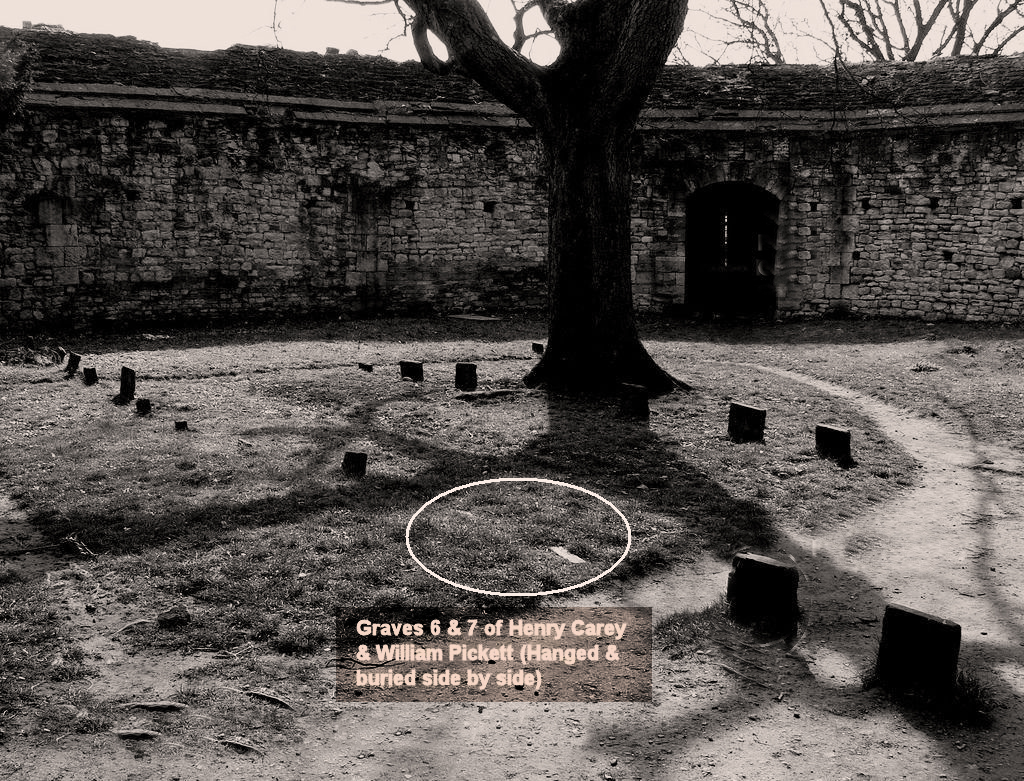
Criminals executed at Lincoln were interred with little ceremony in a tiny walled garden in the Lucy Tower. I am grateful for Alan Robinson for allowing me to use his photograph of the the last resting place of Henry Carey and William Pickett.

garavesite

As a mundane comment on the price of justice, the Stamford Mercury of 21st October 1859 reported:

Expenses

FOR MORE HISTORICAL LINCOLNSHIRE MURDERS
click on the image below

Lincolnshire Murders

Blog at WordPress.com.

Up ↑