Search

fullybooked2017

Author

fullybooked2017

A retired Assistant Head Teacher, mad keen on guitars. Four grown-up sons, two delightful grandchildren. Enjoys shooting at targets, not living things. Determined not to go gently into that good night.

THE HISTORY OF BLOOD …Between The Covers

AHOBWith a worldwide wave of support, optimism and hopes for a bright future, the African National Congress swept to power in 1994, and post-apartheid South Africa was born, blinking in the light, but healthy and vigorous. Paul Mendelson’s gripping novel of crime and corruption shows that the rainbow dream has not yet turned into a fully grown nightmare, but it reveals a country where racial and social tensions are never far from the surface.

Mendelson introduced readers to Colonel Vaughn de Vries of The Special Crimes Unit in The First Rule Of Survival (2014) and now de Vries returns to investigate the grim world of the international drug trade. The novel is set mostly in Cape Town, where Mendelson lives for part of the year, and it begins with the sad discovery of the body of a young woman in a run-down hotel. Chantal Adam is the adopted daughter of Charles Adam, a rich and influential businessman, but her blood father was Willem Fourie Adam, Charles’s brother, who was assassinated in 1994, after the elections.

Chantal lived the dream as a successful model and advertising poster girl, but a move to America brought only grief, heartbreak, and a bitter separation from her adoptive family. Now she lies dead, wrists slashed with glass, in a shabby hotel room usually used for by-the-hour sexual sexual activities. She is haggard and emaciated, but her degradation is complete when the post mortem reveals that she has ingested a large number of condoms packed with heroin.

We follow de Vries as he picks up the trail from the wretched death of Chantal Adam, to a stable of girls used by ruthless men to ferry drugs to the Far East, and then on to a man whose organised crime CV includes running a game park offering forbidden targets to American trophy hunters, and being at the very centre of political and financial corruption in South Africa and neighbouring states. Reluctantly, de Vries enlists the help of John Marantz, a former British intelligence agent, whose life has been rendered meaningless by the abduction and murder of his wife and daughter.

Like all interesting fictional coppers, de Vries is conflicted. He suffers fools with a bad grace, if at all, and his contempt for incompetence in fellow police officers is entirely colour blind. There aren’t too many of his comrades-in-print who have happy and flourishing marriages, and he is not one of them, although his fierce love for his daughters remains undiminished. He is not a man to back away from a fight, either political or physical, but neither is he a stone cold killer, as a key incident in this book reveals. He is also human enough to make dumb personal decisions which threaten to derail his career.

There are two distinct backdrops to this excellent novel; the first shows a country where the natural landscape can be harsh or almost impossibly beautiful; the second is the socio-political climate, and here Mendelson shows compassion, subtlety, but – above all – honesty. This is not a hatchet job where the white minority watch with sneers on their faces as the country’s new rulers make mistake after mistake, but a thoughtful and perceptive account of the pitfalls and temptations facing those for whom high office is, in some cases, a genuine challenge.

The complexities of the politics make for an intriguing read, but above all this a thoroughly good crime thriller, and I look forward to Vaughn de Vries returning for a new battle with the forces of evil. The History Of Blood is available online and if you want another fine novel set in contemporary South Africa, then try The Monster’s Daughter by Michelle Pretorius
IT’S MURDER IN WISBECH …podcast 2/2

IMIW

THE SECOND PART of the podcast tells the sad stories of three people who came from Easter Europe in search of employment and a better life. Instead, they found only death. Click the link below to listen to the second part of It’s Murder In Wisbech

It’s Murder In Wisbech (2)

IT’S MURDER IN WISBECH …podcast

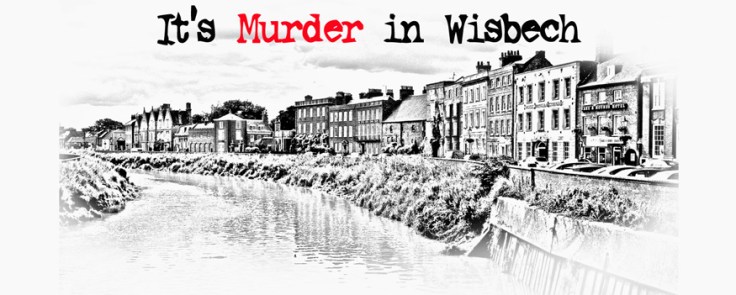
IMIWTO THE CASUAL OBSERVER Wisbech appears to be a fairly dull market town, a bit down on its luck, but otherwise unremarkable. It has, however, over the last decade or so, built for itself an unenviable record of murders. In this podcast, we take a closer look.

First up, is a pub punch up which turned distinctly nasty. Then, literally just a few yards away, a planned night of passion between two lonely middle-aged people which went tragically wrong. Just across the river a jilted lover took a terrible revenge on his former girlfriend while a short walk away, police blunders allowed a savage killer to escape – and remain at large to this day. Click the link below to listen to part one of It’s Murder In Wisbech

It’s Murder In Wisbech


THE POSTMAN DELIVERS …Charcoal Joe, The Storykiller

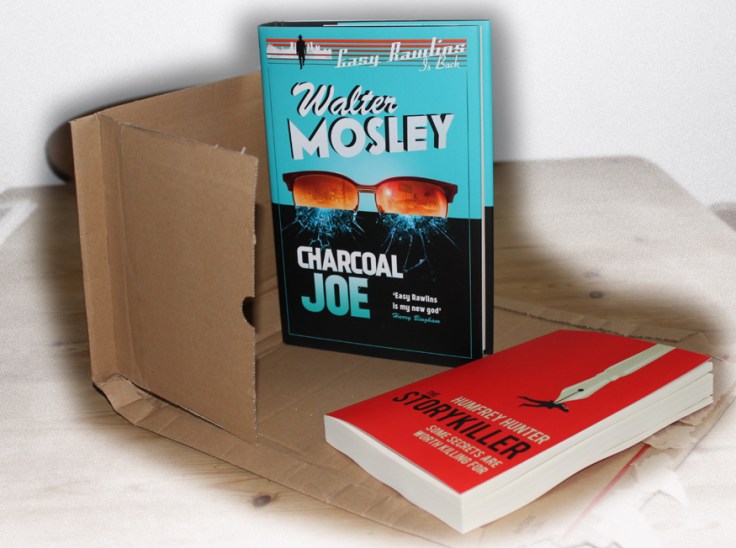
Mosley and HumfreyTODAY’S DELIVERY brought two books which in different ways could not offer more of a contrast. One is by a writer who has achieved near-legendary status in his own lifetime, is believed to be Bill Clinton’s favourite author, and who has created a handful of truly memorable characters. The other is by an author making his crime fiction debut, but who is no stranger to the world of books and people who write them, as he is a former journalist who now runs a literary agency in London.

HumfreyHumfrey Hunter certainly knows his way around the London literary scene, and his novel Storykiller is set in the English capital. We meet Jack Winter, a former hot-shot reporter who now puts his knowledge of how to make the headlines to a very different use – that of making them disappear if the client is rich enough. After unwisely accepting a new client, he finds himself in danger of becoming one of the headlines himself – as a corpse. Humfrey is known for being the only publisher in the UK willing to put out books critical of the church of Scientology, which include Going Clear by Lawrence Wright, The Church of Fear by John Sweeney and Ruthless by Ron Miscavige, the father of the church’s leader, earlier this year. A few days before its release date, the church of Scientology threatened to sue Humfrey if he went ahead with the publication of Ruthless, in a move which made headlines around the world. The book was published as planned and the church did not sue. The Storykiller will be out in September, but can be pre-ordered from Amazon.
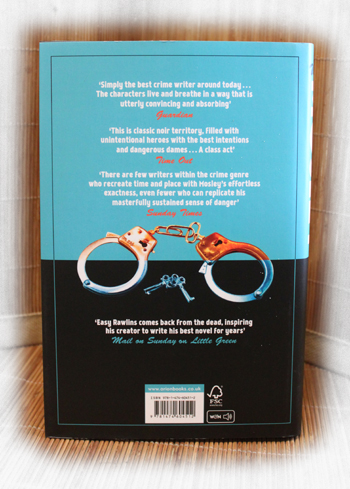
MosleyMost critics have run out of superlatives to describe the work of Walter Mosley. British crime author Harry Bingham tells us, on the cover of Mosley’s latest book, “Easy Rawlins is my new god”. Ezekiel “Easy” Rawlins is, of course, Mosley’s most celebrated creation, who first came into being in 1990 in Devil In A Blue Dress. Rawlins is a world-weary but basically honourable PI who, having seen service in World War 11, tries to earn an almost honest living in the Los Angeles of the 1950s and 60s. Readers who are familiar with Rawlins and his world will be aware of his loyal – but lethal – acquaintance, Raymond ‘Mouse’ Alexander. Alexander’s nickname may refer to his relatively unimposing stature but, make no mistake, he is the most feared hitman in town, and when he comes to ask a favour of Rawlins, the PI knows he has little choice but to agree. The favour? To investigate the case of Charcoal Joe, and underworld fixer who is languishing in jail – for a crime he didn’t commit. Charcoal Joe is available in all formats from the usual sources.

WHEN THE MUSIC’S OVER – Between The Covers

BanksThe van skids to a halt on the lonely hill top lane. Occasional distant lights from isolated farms and cottages are all that pierce the darkness. The young men inside the van giggle as they open the rear doors and throw the girl from the dirty mattress on which she has been sprawled. She hits the roadside with a body-jarring crunch.
Thus begins the 23rd episode in the career of Yorkshire copper, Alan Banks, who we first met in 1987, when he had moved from London to the Yorkshire Dales to work in the market town of Eastvale. Banks is now Detective Superintendent, but what long-time readers of the series might call The Eastvale Repertory Company are pretty much all present and correct, in the shape of fellow cops Annie Cabbot, Winsome Jackson and Ken Blackstone. We even have a guest appearance from one of Banks’s less wholesome colleagues, Richard “Dirty Dick” Burgess, who is now working for the National Crime Agency, the closest thing to the FBI within the UK.

The unfortunate girl we meet in the first few pages does not take the stage again, unless we include her appearance on the mortuary slab. She has been found by a shocked cyclist, the morning after her ride in the van ended so abruptly. She is stark naked, and has died from a severe beating. Whatever took place on Bradham Lane is not the most pressing concern for Alan Banks, however. He is called to a high level conference and brought into what will become an investigation into the life and crimes of Danny Caxton, a much loved and respected entertainer and performer on stage and TV. Caxton, like his real life counterparts Savile and Harris, was ever-present in living rooms and lounges of ordinary people up and down the land, for decades. Now in his eighties, he has been accused of historic sex crimes.

While Banks must focus on the Caxton case, by his new seniority he must also oversee the investigation into the murder of the girl on Bradham Lane. Annie Cabbot is doing most of the legwork on this, and with the help of Detective Constable Geraldine Masterson, she discovers that the dead girl is Mimosa ‘Mimsy’ Moffat. Mimsy was 15, knocking-on 25, sexually attractive and experienced, and with a home life so bad that neither ‘home’ nor ‘life’ seem to be the right words. Cabbot and Masterson begin to explore the connection between Mimsy and the Pakistani Briton who runs a kebab shop on the edge of a nearby run-down estate.

By this time, we have met Danny Claxton in his Ponderosa-style home, and a thoroughly reptilian character he seems to be – a far cry from the smiling, handsome and genial TV presence of his younger days. Banks’s chief witness – and accuser – is Linda Palmer. She is now a widow in middle age, but has become a respected and well published poet. Her accusation about Caxton dates back to what should have been a happy family holiday in Blackpool in the 1960s.

As the two cases run their parallel courses, I found the investigation into Mimsy Moffat’s death the more compelling. Robinson takes an unflinching look at the issue of vulnerable white girls being groomed and abused by men of Pakistani origin. He exposes the extremes of views held by all those involved, from the men themselves, the girls and their relatives and – most tellingly – those in positions of power, such as the police and social workers. Banks himself, probably due to his management responsibilities, keeps his own anger in check, but Robinson allows Annie Cabbot to voice her violent disgust – a feeling which I infer is shared by the author.

The book is only a whodunnit for a short period of time, as there are enough clues for CriFi buffs to work out who murdered Mimsy. Robinson’s broader message seems to be a variant on Who Killed Cock Robin? For the fly, the fish, the beetle and the owl we could probably substitute:

‘”I,” said the policeman, “with my fear of being called racist.”‘
‘” I,” said the social worker, “with my political correctness.”‘
‘”I,” said the kebab shop owner, “with my attitude towards women.”‘
‘”I,” said the mother, “with my drug addiction and neglect.”‘

There is closure, of a kind, in both cases, but Robinson, in his epilogue, offers us nothing resembling a happy ending. This book is, at its core, a brilliant police procedural. Crime fiction fans are no strangers to the police interview room, but Robinson not only uses the staple ingredient very cleverly, he gives it a lick of fresh paint, a new carpet – and maybe even a nice vase of flowers on the table. My only irritation was – as always with Banks – that we learn far more than we ever need to know about his tastes in music, but an irritation is all it was, and it didn’t spoil my enjoyment of this excellent book.

When The Music’s Over is on Amazon, as well as in all decent book shops, and you can find out more about Alan Banks and his creator by visiting Peter Robinson’s website.

THE POSTMAN DELIVERS … The Dry

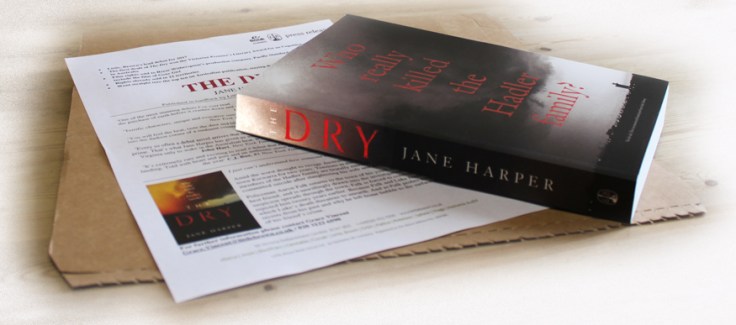
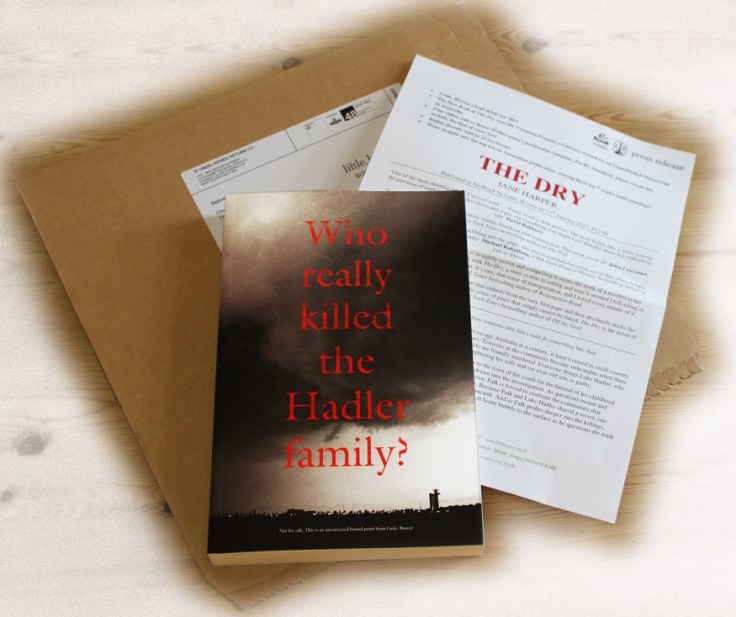
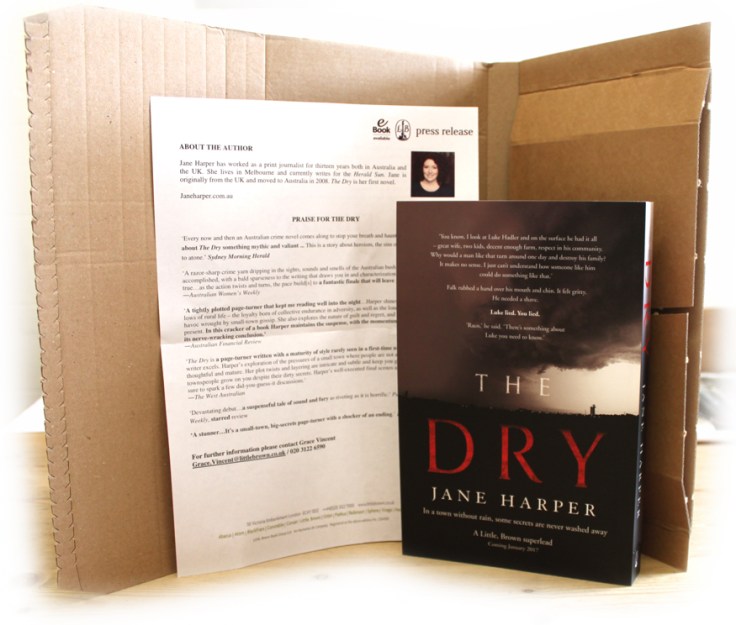
The Dry 2AUSTRALIAN CRIME FICTION doesn’t come my way anywhere near as much as I would like. I’m a massive fan of Peter Temple, but new books from him are as rare as hens’ teeth. For snappy, PI-style reads, there’s always Peter Corris and his Cliff Hardy novels. So, it was with great pleasure that I opened the packet from Little, Brown publishers, to find that I was holding a brand spanking new Australian crime story.
The Dry 3

THE DRY is the work of Melbourne journalist Jane Harper, and it tells the tale of an apparent murder-suicide involving the Hadler family in the small town of Kiewarra. Luke Hadler has committed suicide after apparently killing his wife and young son, and when city cop Aaron Falk returns to his childhood home town for the funeral, he senses that things are not as they seem. His resulting investigation turns over stones, and finds all manner of unpleasant creatures scuttling about underneath. The Dry has already been a runaway success in Australia, and is now available as a paperback and on Kindle here in the UK. It will be out in hardback in January 2017. Meanwhile, you can find out more about the book and the author from her website.

The Dry 1

THE DEAD HOUSE – Between the covers

The Dead HouseNewly promoted Detective Sergeant Fiona Griffiths, of South Wales Police, might be said to have a disability. She suffers from…..no, wait, we mustn’t use the word ‘suffers’, in case of causing offence. ‘Has’, maybe? OK, DS Griffiths has Cotard’s Syndrome. This strange condition can manifest itself in many ways, the most extreme of which convinces the person concerned that they are actually dead. Less extreme symptoms include partial disconnection between brain and body, and some of the traits of Asperger’s Syndrome, such as an inability to read or understand social gestures or convention.

So Fiona has been employed as part of some diversity box-ticking exercise, yes? Nay, and thrice nay. After the horrors of her teenage years, when she was institutionalised and in a pharmaceutical haze, she went to university, excelled, and then joined the police. This might be considered an odd career choice, given that Fiona has an the kind of electric intelligence which might not sit well within staid police procedures, but even more strange because her father was – and let’s not mince words – a notorious Cardiff gangster. Father? Well, no. Another intriguing ambiguity is that Mr Griffiths and his homely wife are not Fiona’s blood parents. Fiona came into their lives when they emerged from a social function to find an infant girl sitting in their Jaguar coupe. No message. No name. No reason.

At this point, it is best to make clear that Fiona’s search for her real ancestry and her ambivalence about her adoptive dad’s occupation are a recurrent theme in the career of Fiona Griffiths. Author Harry Bingham introduced us to this remarkable young woman in Talking To The Dead (2013). This debut was followed by Love Story With Murders (2014), The Strange Death of Fiona Griffiths (2015) and This Thing Of Darkness (2016).

In this welcome return, Fiona is called to the strangest of crime scenes. Is it a crime scene? Maybe not. A young woman is found, very dead, but dressed in white linen, remarkably peaceful, surrounded by votive lights, and lying on a table in a Dead House – an ancient form of mortuary chapel attached to a medieval church. An autopsy concludes that she died, basically, from heart disease, as young as she was. While the local police are intent on wrapping the case up as unexplained, Fiona is struck by two irreconcilable facts. Why would a woman who has had, according to the autopsy, subtle – and expensive – cosmetic surgery, have stubbly unshaven legs?

The ensuing investigation romps along at great pace, as Fiona – teamed with a grumpy, phlegmatic Camarthen Detective Inspector – uncovers a terrifying conspiracy involving, among other things, Ukranian oligarchs, wild Welshmen who eat badgers, a secret tunnel under a Brecon hillside – and a community of distinctly unsaintly monks.

Just as in This Thing Of Darkness there was a terrifying passage where Fiona was hanging on for dear life to the a boat thrashing about in a storm, there is a section here which will be very hard going for anyone who suffers from claustrophobia. Fiona and her temporary boss struggle through a tunnel system under a Welsh hillside, and I felt every second of it – the constriction, the inability to move more than a few inches, and the sheer terror of being in a virtual rock coffin.

Aside of creating a unique central character, Bingham writes like an angel. His descriptions of the Welsh countryside put you right there in the muddy field, with the smell of sheep, and the distant haze of smoke from a hard-scrabble hill farm chimney. Fans of Fiona Griffiths will know that she courts danger, gets herself into the most terrible scrapes, but will come out fighting like a five-foot-nothing whirling Dervish. Her boss says:

And well done, I suppose. I can’t think of any other officer of mine who’d have got themselves into that situation. But I can’t think of anyone who’d have got out of it either.”

I wrote, when reviewing an earlier Fiona Griffiths novel for another book site:

“In a lifetime of reading crime fiction I have never come across anyone quite like Fiona Griffiths …. Read this book. Enjoy every syllable.”

The publishers have used that quote on my edition of The Dead House, and I stand by every word. You won’t read a better book all year.

You can buy The Dead House from Harry Bingham’s Amazon page and check up on the previous adventures of Fiona Griffiths. Harry’s website is here.

JOINT JUDGMENT – A freebie!!

WEndy CartmellA FREE LUNCH? As in ‘no such thing as’? Normally, the old adage is pretty true, but it seems that you can feast your mind. if not your tummy, with a genuine free offer from author Wendy Cartmell (left). She is best known for her series of Sgt. Major Crane stories, featuring the gritty Military Policeman, but she has a more recent heroine, Emma Harrison. She is an Assistant Governor of Reading Young Offenders’ Institution, and while her charges are callow youths, they are well versed in all kinds of villainy, and the broken lives which have pitched them into the Institution have made some of them very damaged indeed.
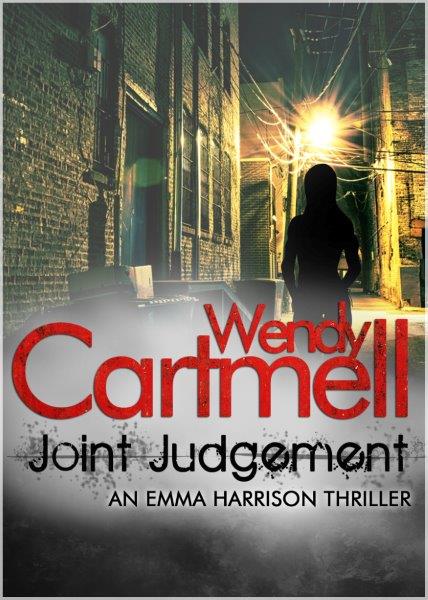

In Joint Judgment, she faces a career-defining challenge as she strives to defuse a potentially catastrophic situation, as first the Institutes doctor is attacked and badly hurt, but then the Art Teacher is brutally killed. In order to prevent further bloodshed, she enlists the help of Sgt. Billy Williams, of the Special Investigations Branch of the Royal Military Police.

Joint Judgment

As far as I can see, there is absolutely no small print here, so let’s go ahead with the all important links. Firstly, why not pay a visit to Wendy’s publisher, Endeavour Press, and see what else they have been up to.

You can follow these links to get a Kindle version, or a PDF of Joint Judgment.

Thanks to Wendy Cartmell and Endeavour Press for their generosity. In return you might like to let the wider world know what you think of the book. You can do this by following this link to the book’s Amazon page. You can also take a look at Wendy’s website to read about her other books.

THE POSTMAN DELIVERS…..Digitally

KIndleKINDLE ROUNDUP, JULY 25th 2016. It has to be said, for all that it’s a wonderful invention, and has revolutionised reading, The Kindle (other devices are available!) can provide a pitfall for the book reviewer. While a physical To Be Read pile is ever visible, and sits in the corner looking at you in an accusing fashion, the equivalent stack of books on the digital reader quietly goes away when the power is turned off. So, with apologies to the writers and publishers who have trusted me with their offspring, here is my first, but belated, look at some great titles.

Mercedes MarieMercedes Marie by Fusty Luggs
Of the five canonical victims of Jack the Ripper, the one who has intrigued writers and Ripperologists the most is Mary Jane – or Marie Jeannette – Kelly. She was the youngest of them, and despite there being no photograph of her in life, some people have imagined her as beautiful and vivacious, so unlike the poor broken down women whose deaths preceded hers. The author takes an imaginative and compelling look at how a beautiful girl from Limerick, with friends in high places, came to end her life as a butchered corpse in a Whitechapel hovel. The author? She lives in Wiltshire, England, and the name has an interesting definition in The Urban Dictionary. She has a blog, and can also be found on Twitter. You can get hold of a copy  from Amazon in the usual way.

No AccidentNo Accident by Robert Crouch
Both the author and his central character, Kent Fisher, are Environmental Health officers. You might not have put that occupation at the top of a list of those likely to become amateur sleuths, but when Fisher is called to the ironically named Tombstone Leisure Park to investigate a fatal accident, you will soon learn that his eagle eye for detail and his scientific training make him more than a match for those trying to hoodwink the police. You can read more about Robert Crouch on his website and by checking out his Twitter feed. Just for a change, here’s a link to Waterstones, who are selling Robert’s book in paperback, but the Kindle version is downloadable in the usual way.

Falling SunsFalling Suns by J.A. Corrigan
This dark tale about a mother seeking revenge for her murdered child is a police procedural with a difference. Rachel has left the police force, but when her young son goes missing, and then is found murdered, her life spirals into depression, and then shapes into white hot anger. Her cousin Michael is convicted of the little boy’s murder, but is declared insane, and is sent to a secure institution. Rachel resumes her police career, but when she learns that Michael is being considered for release, she is faced with a terrible dilemma. Should she move on with her life, or use her official know-how to exact a terrible revenge? The author was a physiotherapist before turning to writing full time, and her website is here. Falling Suns is her second novel, and  it’s currently in stock in print at Waterstone’s, and Foyles. You can get your Kindle version at Amazon.

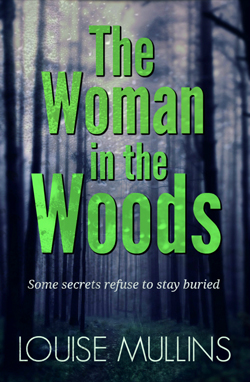
The Woman In The WoodsThe Woman In The Woods by Louise Mullins
Domestic Noir is certainly ‘the new black’, and the psychological thrills and chills that lurk behind suburban net curtains are employed with great relish here. Rachel Harper is a reporter whose career is maybe not quite on the rocks, but is certainly stuck in the low-tide mud. When a local student goes missing, and then is found dead, Rachel senses the chance to revive her journalistic CV. Her search for the truth behind the young woman’s death takes her to places where preserving her life becomes a higher priority than enhancing her Linkedin profile. Louise Mullins is based in Bristol, is a clinical psychologist who works with serious offenders. She has written seven previous novels, about which there are more details on her website. Go to Amazon to buy the Kindle version of this novel.

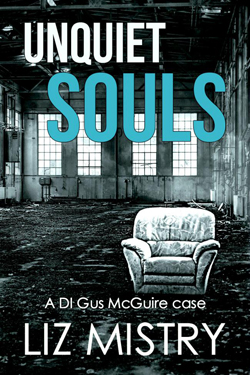
Unquiet SoulsUnquiet Souls by Liz Mistry
This police procedural introduces us to DI Gus McGuire. Central to the case is the horribly topical crime of child trafficking, and McGuire’s investigations are triggered when the dead body of a prostitute is found. When terrified children are found locked away in an attic, McGuire links the two cases, and soon finds he has to hunt a resourceful and evil criminal – nicknamed The Matchmaker. The author has written very frankly in Female First about how she suffered from depression, and thus found the completion of this novel an uphill struggle. The book is released at the end of July. Check here for further details.

Blog at WordPress.com.

Up ↑