Search

fullybooked2017

Author

fullybooked2017

A retired Assistant Head Teacher, mad keen on guitars. Four grown-up sons, two delightful grandchildren. Enjoys shooting at targets, not living things. Determined not to go gently into that good night.

TOP FIVE VILLAINS IN CRIME FICTION … by Kate Moretti

tvy

We’re delighted to be part of the Blog Tour for Kate Moretti’s The Vanishing Year. Here, she gives us her view on a subject close to her heart!

Top Five Villains in Crime Fiction

Writing a complicated layered antagonist, particularly in crime fiction, is no easy feat. They have to be sympathetic. You have to understand what they want and why and it has to run deep enough that, as a reader, you just know nothing will stand in their way. A flat villain whose desires are hidden or, worse, unrelatable produces someone cartoonish and while it maybe serves the plot, it certainly never evokes fear in a reader. There are some authors, particularly in the past fifty years, who have completely nailed the art of the complicated, and therefore sometimes terrifying, villain.

Mrs. Danvers

Mrs. Danvers is an antagonist so creepy that I paid homage to her in my new novel The Vanishing Year. She was so devoted to Rebecca, the first Mrs. de Winters, that she almost convinces the second Mrs. de Winters to jump out the second story window of Manderley. She’s described as having a “skull face”, severe, dressed in black and is often portrayed by the terrified Mrs. de Winters as lurking in dark staircases and corners. When Mrs. de Winters descends that staircase, wearing the same dress Rebecca wore the year before? Positively evil.

Annie Wilkes

Annie Wilkes is Stephen King’s worst nightmare: an avid fan turned bedside nurse turned psycho in King’s own Misery. Annie Wilkes is so terrifying, only because she’s so innocuous. Kind of homely, a little unrefined, almost pathologically cheery. In the book, she loses her mind at profanity, preferring “cockadoodie”, even as she’s severing Paul Sheldon’s thumb. It’s the off-set of these two traits: this sing-songy voice and this absolute psychosis that make her a villain with admirable depth.

Nurse Ratched

The head nurse at Salem State Hospital in One Flew Over the Cuckoo’s Nest is almost the villainous opposite of Annie Wilkes. She has no sugary coating, no false sweetness. What she does have is pure unadulterated power and she wields it to terrifying results. Anti-psychotic meds, shock therapy, even lobotomies are never off limits. Possibly the only villain in this list to get her just deserts, the end of Cuckoo shows her as impotent and powerless after Randle McMurphy is killed. The inmates no longer fear her.

Patrick Bateman

American Psycho reads like one long (run-on sentence) commentary on eighties yuppie culture. Bateman is the epitome of the eighties yuppie and his own self-hatred for it makes him a terrifyingly real villain. The sheer depth of his insanity is cause alone to fear him, regardless if his crimes actually happened or were mere fabrications, as has been interpreted. There are numerous frightening things about Bateman: his rampant hatred of women, his obviously absent moral compass, his disdain for literally every human being in his life, to the point where he interchanges them all. But what truly brings Bateman into the realm of villain is his obvious unraveling throughout the novel. He goes from self-aggrandizing to narcissistic to erratic to completely unglued. It’s this descent into madness that truly grips a reader.

Tom Ripley

In The Talented Mr. Ripley, Tom Ripley murders two men, simply to serve his needs (in the continuing series, he murders or is responsible for the death of over ten people). He wants Dickie Greenleaf’s lifestyle. He’s a con artist and a sociopath, who uses murder only as last resort. This alone, while frightening, isn’t enough to land him on any great villain list. What really gives Ripley depth is his humanness. He’s so much like a boy next door, so agreeable, so smooth. He’s well read, enjoys gardening. He’s so delightfully bland. Except when something stands in his way. He’ll beat you to death and dump your weighted body in the water, row away and feel no remorse. It’s this nuanced portrayal of Tom Ripley that really makes him truly a fantastic anti-hero. As readers, we wanted him to get away with it.

The Vanishing Year is published by Titan Books

villains

THE JOURNEY OF MICHAEL PARKER … An American Odyssey

 MICHAEL PARKER is a law enforcement officer created by the author Merle Temple. This feature takes a look at the Michael Parker trilogy, and discovers something quite remarkable.

agsopA Ghostly Shade of Pale (2013)
We are beamed down into the explosive and turbulent USA of the mid-70s, a country engulfed by the social and military repercussions of the Vietnam War. The new perceived peril which threatens to engulf Middle America does not come from the commies, however, but from the debilitating tide of cheap drugs in the hands of mobsters and crooked cops. As we absorb the atmosphere of the Deep South, where bugs the size of golf balls clatter into the kerosene lanterns and, out there on the river, vines hang from the live oaks as nameless creatures snuffle and snort in the brackish water. The King still lives in Graceland, and out there, down some back road, there’s a shotgun shack with a doped-up redneck biker sitting on the porch.

Temple introduces us to his central character, Michael Parker. He is an idealistic man who has forged a career in law enforcement. After surviving a dangerous spell as an undercover narcotics agent, he is drawn into an investigation of clubs where cheap drugs and expensive women are provided for bent politicians and minor mafia characters. Parker battles a truly Gothic horror of an opponent called Frederick who is barely human – a killer, and an albino. His pigmentation problem alone might have driven his fragile psyche into a bad place, but he is also schizophrenic. The voices he hears belong to the epic psychopaths of the 20th century, including the deranged British satanist Aleister Crowley, and Adolf Hitler.

In the end, Good just about prevails, but not before Michael has locked horns with the evil angel Frederick in a fight to the death which, as described by Temple, is as allegorical as it is actual.

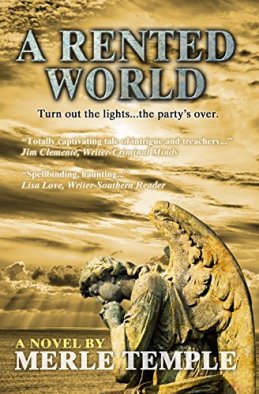
arwA Rented World (2014)
Michael Parker’s odyssey continues, but now his enemies are not the sleazeball criminal hoodlums he battled in A Ghostly Shade of Pale. His latest foes wear expensive suits, have personal assistants and, instead of the nightclub pallor of small time scammers, they have Malibu tans. Parker learns to his cost that politicians and corporate fixers have one aim, and one aim only, and that is to sell. What is on sale? You name it, they’ve got it. Bodies, buildings, allegiance, honour, integrity – all can be bought if you can meet the asking price. Temple punches home his point early on the book. He says:

“The cops counted corpses, the courtiers buried truth beneath flattery, and political grifters brokered deals in a rented world ..”

In the end, Parker comes to grief at the hands of men – and women – whose feeding at the trough of public money has been disturbed by his integrity. He has sent many men to jail and now, thanks to the over-arching powers given to law enforcement agents since 9/11, he must join them.

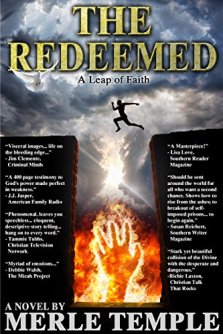
trThe Redeemed – A Leap of Faith (2016)
The book is almost entirely the tale of Parker’s journey through the American prison system and, like that of the Greek warrior, it is a journey of wandering, omens, tragedies, friendships and, ultimately, a homecoming. The home, however, is not the one that Parker bade farewell to when he fell into the pit made for him by his enemies. It is a sobering thought that Parker is sent to a Federal Correctional Institution. These establishments are at the lower end of American prisons in security terms, but Parker still has to survive terrible infestations both human – in the way of brutal and malign prison officers, and animal – such as the ever present danger from hideous Brown Recluse Spiders.

Temple’s writing is sometimes not subtle, and sometimes not silken. Instead, it often marches to the drum of anger and indignation against the incalculable human cost of criminal greed and corporate avarice. All the extreme emotions and human qualities are invoked: repentance, purity, revenge, honesty, malice, regret and redemption all cry out to us for attention. Readers also need to be aware that the books, particularly the second and third, are openly evangelical in tone. Temple is a committed Christian, and his Christianity is straight down the line: good is good, and evil is evil, but the mantra is one of redemption.

American reviewers have commented on the similarity of the characters in A Rented World to real life movers and shakers in the state of Georgia at the time in which Temple sets the novel. One critic suggests that this is almost an autobiographical novel, with Parker/Temple as a David challenging the Goliath of the American corporate world. Until I spoke to Merle Temple on-line recently, I had no idea whatsoever how prescient this judgement would be. I now understand that the whole narrative across the three books is, for the most part, a factual account of the adult life of Merle Temple. He has used some fictional devices to make sure that the books read well as novels, but other than that, they are his life story. He says, of the events in The Redeemed:

“I served five and a half years of an eight year sentence. The real psychologist in The Redeemed, who was so helpful to me, just asked me to return there to speak. They use my books now for inmates, and she told me that the movie nights are still going strong after nine years, and are now in English and Spanish. As I left each facility, I passed the baton to another inmate and asked him to do the same. I go into prisons and shelters to speak to men, as one of them, about a better way. They need lots of love, and most I’ve known are nothing like the stereotypes offered up by some in government and media in that unholy trinity of politics, crime, and business.”

If there is one section of the three books that I could read over and over again, it is the death and funeral in Memphis of Parker’s sweetheart, Dixie Lee Carter, in the first book of the trilogy. The prose is brimful of anger, passion, love and regret. Not many writers could get away with the concluding passage, but Temple does:

“On an adjacent hill in the old cemetery with weathered monuments, a solemn man in dark glasses, with black hair and sideburns, quietly watched Michael’s last farewell to Dixie. As Michael rose to leave, he saw the familiar figure point to the sky – once, and then again – to emphasise “The One”. He saluted crisply and held it, and then – framed by a pink coral sun that blistered the juncture of day and night at the skyline and branded the final resting place with sudden darkness – he turned and walked down the green hillside towards a waiting limo that would return him to Graceland.”

Check out Amazon’s author page for Merle Temple

merle


A PILGRIMAGE … In search of William Tyler and Ralph Joscelyne

In the 1830s, the problem of burying the dead had reached crisis point in London. The rapidly increasing population meant that existing graveyards and crypts were – literally, in some cases – full to bursting. One such example was the nightmarish Enon Chapel in Clement’s Lane. An unscrupulous clergyman had come up with a scheme for bargain burials. These may have been at a knock-down price, but they were not burials. The body of your loved one would simply be tipped into the crypt below the chapel, to join countless others. The enterprising minister was also of accused of recycling the wood from the coffins to sell to the poor for kindling. The crypt was only separated from the chapel above by a flimsy wooden floor, through which all kinds of noxious gases and vile insects would pass, to plague the worshipers as they sat down in the pews to praise the Lord. Even more bizarre was the conversion of the chapel to a dance hall, where customers could literally dance on the dead.

enon-chapel

Eventually, the authorities decided that enough was enough, and began the business of commissioning seven huge new cemeteries outside if the inner city boundaries. Highgate and Kensal Green are the best known of these, principally due to the numbers of famous people buried within, but it was to one of the lesser known of ‘The Magnificent Seven’ that I traveled, on a pilgrimage to visit the graves of two people who certainly made the headlines in their day, but are largely forgotten now.

403

You can read the story of The Tottenham Outrage elsewhere on the site but, briefly, on Saturday 9th January 1909, two Latvian anarchists ambushed the wages delivery for the Schnurmann Rubber Factory on Chestnut Road in Tottenham and made off with the loot, firing at their pursuers with sophisticated automatic pistols. Both criminals died as a result of their efforts, but a policeman and a young boy were killed in the chaotic chase.

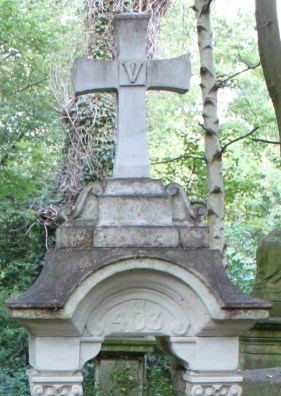
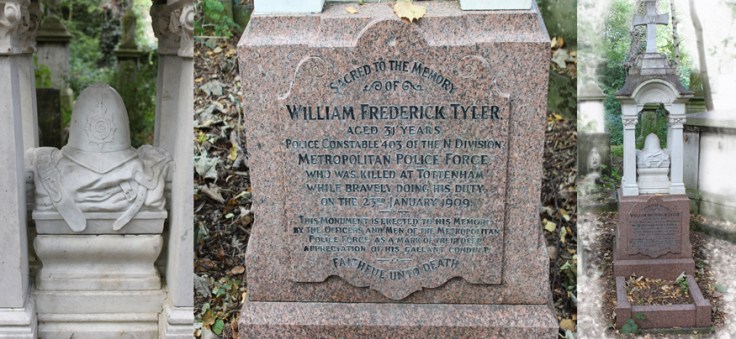
The cold blooded murder of PC William Tyler caused a national outcry, and his funeral was a public event on a grand scale. The deaths of police officers in the course of their duties have always been thought shocking in Britain and, happily, they remain rare events. PC Tyler was laid to rest in Abney Park Cemetery in Stoke Newington. Fortunately for the visiting explorer, his simple but imposing memorial is near the path, and is easily found. The number carved on the pediment is, of course, his police number.

tyler-composite

Just a few feet away from Tyler’s grave is a rather humbler cross which marks the grave of an even more tragic casualty of the madness of 9th January 1909. Like countless others before and since, young Ralph Joscelyne had a Saturday job. His was to help a local baker deliver bread to the families in that part of Tottenham. As the Latvian gunmen tried to shoot their way to safety, a stray shot hit Ralph as he tried to hide behind his employer’s cart in Mitchley Road. The ten year-old was cradled in the arms of a bystander, but was pronounced dead by the time he reached hospital.

ralph-composite

On 29th January 1909, the funeral cortège for Joscelyne and Tyler passed along a 2.5 mile route lined by 3,000 police officers and an estimated crowd of 500,000. The lengthy procession included white-plumed horses drawing Joscelyne’s coffin and black-plumed horses drawing Tyler’s coffin, draped in a Union Flag, which were escorted by hundreds of policemen, a police band, men from the local fire brigade, men from the Scots Guards and Royal Garrison Artillery, and tramway employees. A volley of guns was fired at the conclusion of the funeral.

tyler-funeral

fullsizerenderRalph Joscelyne’s mother, Louise, was to raise another seven children, but she kept the pair of boots Ralph was wearing on the day he was killed. When she died in 1952, the boots were buried with her. In more recent times, both Joscelyne and Tyler have been commemorated. WIlliam Tyler has a plaque on the wall of Tottenham police station, while Ralph Joscelyne is remembered in a memorial outside a church in Mitchley Road. There is an abiding irony that the corner of Tottenham where the robbery occurred and the resultant chase began is exactly where the catastrophic riots of 2011 started. An initially peaceful protest by relatives of Mark Duggan, a gangster shot by police, did not get the required response from officers within the police station. It then, as they say, “all kicked off.”
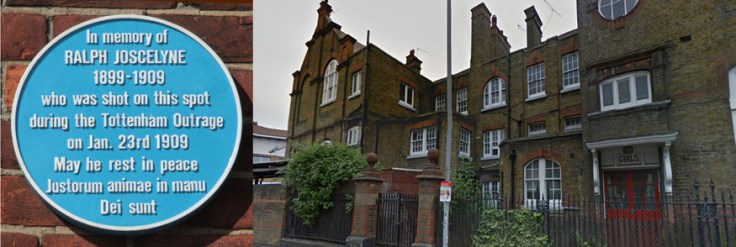
Ralph’s memorial in Abney Park was paid for by fellow scholars at his school, Earlsmead, which still stands in Broad Lane, Tottenham (below) and distant relatives of the unfortunate lad have, as mentioned earlier, ensured that his death will not be forgotten against the backdrop of more recent troubled times in London.

earlsmead

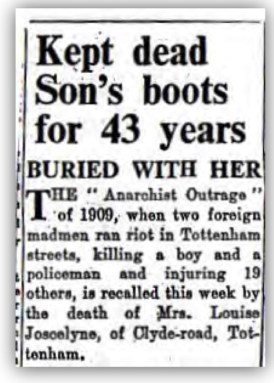
According to some Tottenham residents, however, the boy has not completely left us. This, from the pages of a local newspaper:

newspaper

COMPETITION … Win The Book of Mirrors by EO Chirovici

tbom-footer

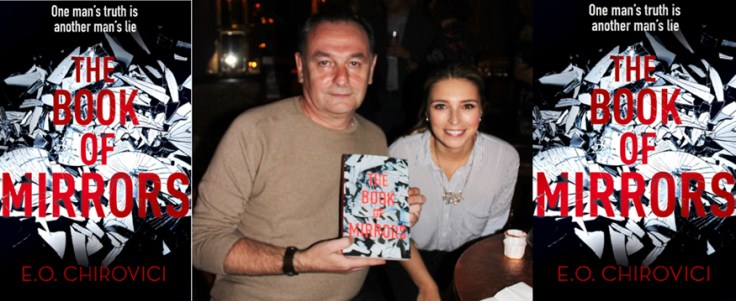
The good people from Penguin Random House made an inspired choice of the venue for last Wednesday evening’s drinks ‘do’ to introduce Romanian author Eugen O Chirovici (pictured above, with Francesca Russell from PRH) and his forthcoming crime mystery The Book of Mirrors.

tb
The Ten Bells in Spitalfields is a pub steeped in criminal – and literary – history. It takes its name from the bells in the tower of the adjacent Christ Church, which in turn featured strongly in Peter Ackroyd’s atmospheric 1985 novel, Hawksmoor. Allegedly, the pub was frequented by the victims of Jack the Ripper, and legend has it that Mary Jane Kelly, who was the subject of the final and bloodiest assault, plied her trade on the pavement outside.
eocSo, in a spookily lit upper room we met the writer, who is not only an award winning economist and has penned best-sellers in his native Romania, but also the author of a stunningly good new novel – the first he has written in English. The book is set partly in the present and partly in 1987, and it tells the story of the murder of a controversial professor of psychology at New Jersey’s Princeton University. His death is observed by different narrators, and Chirovici (left) has constructed an ingenious literary version of the old fairground attraction of distorting mirrors, so that we reach the final pages still not really sure who is giving us the correct image of events on the fateful night.
Not only is Chrirovici a very gifted writer, but he is also a very engaging person to talk to, and my colleague and I spent forty minutes or so with him, dissecting European politics and generally putting the world to rights.
Thanks to Century, we have two copies of The Book of Mirrors – which will not be generally available until January 2017 to give away. Entering couldn’t be simpler. Just email Fully Booked at:

fullybooked2016@yahoo.com

– and write The Book of Mirrors in the subject box. The competition will close at 10.00pm GMT on Sunday 9th October, when the first two names out of the proverbial hat will win the books. Due to postage costs, the competition is open to UK and Irish Republic readers only.

RULES

  1. Competition closes 10.00pm London time on Sunday 9th October 2016.
  2. One entry per competitor.
  3. All correct entries will be put in the proverbial hat, and one winner drawn.
  4. The winner will be notified by email, and a postal address requested


CLOSE YOUR EYES … Between the covers

cye

A BRUTAL DOUBLE MURDER in a remote Somerset cottage has baffled the police, and inflamed local opinion over what they see as the ineptitude of the investigating officers. In charge of the case is DCS Ronnie Cray – and yes, she has changed the first letter of her surname – and almost in desperation she enlists the help of forensic psychologist Dr Joseph O’Loughlin.

O’Loughlin is reluctantly drawn into the efforts to track down the killer who butchered Elizabeth Crowe beneath the satanist pentangle daubed on her wall, and efficiently suffocated her teenage daughter, Harper, in her bed upstairs. To say the very least, O’Laughlin has enough problems of his own. He is trying to live a normal life while battling the early symptoms of Parkinson’s Disease, and his delight at being invited to return to the cottage occupied by his daughters Charlie and Emma, and his estranged wife, is tempered when he learns that Julianne has been diagnosed with ovarian cancer.

Robotham introduces us to  a possible culprit in the opening pages of the book. This man describes his assaults on various women, while describing his awful childhood. His once-brutal father is now in a care home, and has advanced dementia, but our narrator recalls with hatred the beatings – both physical and psychological – he suffered at his father’s hands. Even more telling is the lasting legacy of his mother’s death. She was, perhaps understandably, given her husband’s predilection for violence,’playing away’, but was killed in a bizarre road traffic accident.

Elizabeth Crowe was, to use the old cliché, “no better than she should have been”. After an acrimonious divorce, she has used her new-found freedom to explore the dubious delights of dogging, and it is the participants of that strangely British open-air activity who are the obvious suspects in the investigation. There is no shortage of other suspects, however. How about the dim-witted Tommy Garrett who lives with his grandmother in the neighbouring property? Or maybe Elizabeth’s former husband, Dominic? Not only did Elizabeth cheat on him with her body, but she also ruined him financially.

Robotham leads O’Loughlin – and you, the reader – a merry dance. There are red herrings a-plenty, as O’Loughlin tries to establish the connection between the contrasting deaths of Elizabeth and Harper Crowe, and a seemingly random series of attacks on people which leaves some of them dead, but all with a crude letter ‘A’ cut into their foreheads. But of course, in detective novels, nothing is ever really random, or no fictional crime would ever be solved. Robotham is a clever enough writer to allow O’Loughlin to make the mother of all mistakes before a terrifying climax is played out on a storm blasted cliff top above the raging seas of the Bristol Channel.

Remember the famous scene in Jaws, where we are watching the Richard Dreyfuss character probing the hole in the half-sunken boat? Just as we are expecting the shark to come charging in, Spielberg gives us an even greater shock when the severed head rolls in to view. Robotham does something rather similar at the end of Close Your Eyes as he blind-sides us with a killer blow that we never see coming. This novel, which came out in hardback and digital versions last year, and is now out as a Sphere paperback, will further cement Robotham’s reputation as one of the cleverest and most effective writers of modern crime thrillers.

Click the link to check out buying option for Close Your Eyes

ABOUT THE AUTHOR
Michael Robotham
was born in Casino, New South Wales in 1960, and after serving an apprenticeship on a Sydney newspaper, moved to London, where he eventually became deputy features editor for The Daily Mail. In 1993 he began his literary career, first as a ghostwriter for several notable personalities who were writing their autobiographies. His first hit crime novel was The Suspect in 2004, and he has since won many awards for his books.  He has returned to Australia, and Close Your Eyes is the eighth novel in the Joseph O’Loughlin series.

Michael Robotham, international crime writer visiting London 26.07.2010 picture: Stefan Erhard

THE WYLIE-HOFFERT CASE … August 28th 1963

The Biggest Murder Mystery Case of the Century

by Robert K. Tanenbaum
Author of Infamy: A Butch Karp-Marlene Ciampi Thriller


If I were asked to select one case in the history of our justice system that epitomized the essentials and professionalism of a ministry of justice in terms of tempestuous drama, personal anguish, garish confrontation, and, yes, divine intervention, unhesitatingly, I would answer: the Wylie-Hoffert rape murders. Here’s why:

headline
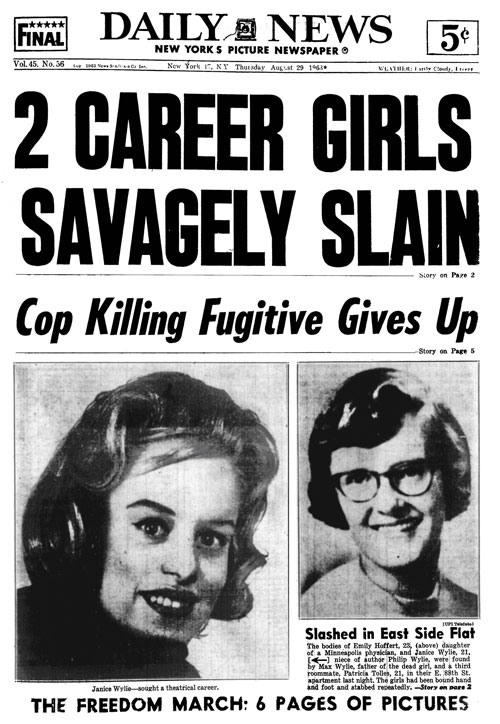
August 28, 1963, was a muggy summer day in New York City when Janice Wylie and Emily Hoffert were brutally raped and murdered in their apartment on Manhattan’s fashionable Upper East Side. Months passed as their families grieved the nightmarish unthinkable and a shaken city awaited answers. Finally, eight months later, the Brooklyn Police arrested George Whitmore, Jr., a nineteen-year-old with an I.Q. south of 70. His incarceration would ultimately entail a host of shocking law-enforcement missteps and cover-ups.

At the time of his arrest for the Wylie-Hoffert murders, the Brooklyn Police and the Kings County District Attorney’s Office (Brooklyn) also charged Whitmore with attempted rape and the murder of Minnie Edmonds, both of which occurred in Brooklyn one week apart.

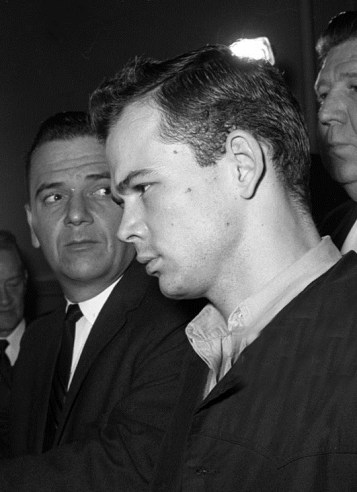
roblesYet, Mel Glass, a young Assistant District Attorney in Manhattan, not even assigned to the Homicide Bureau, was troubled by the investigation. With the blessing from legendary District Attorney, Frank Hogan, Glass tirelessly immersed himself in the case. So began an epic quest for justice, culminating in a courtroom showdown in which the Brooklyn arresting and interrogating cops refused to admit their flagrant missteps, providing a complete defense to the actual career criminal, vicious predator, murderer, Richard Robles.(pictured right)
The outcome would reach far beyond the individuals involved. Not only does the case reveal the extraordinary details of an enormously intense manhunt but it is also a classic and brilliant courtroom prosecution. The unjustly accused was exonerated and the depraved killer convicted. Ultimately, the U.S. Supreme Court memorialized this case’s significance by citing it in the noteworthy Miranda decision, a monumental Fifth Amendment due process, fundamental fairness decision designed to safeguard a suspect’s rights against self-incrimination.

I served in the Manhattan District Attorney’s Office during the tenure of District Attorney Frank Hogan, and was mentored by Mel Glass who asked me to write Echoes of My Soul which is a non-fiction account of the Wylie-Hoffert case.

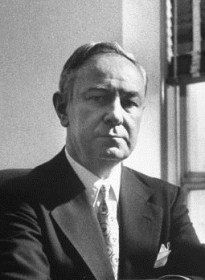
hoganImportant to note that District Attorney Hogan (left) was truly a legend long before Wylie-Hoffert occurred. Once convinced that Mel Glass’ gut-instincts and subsequent investigation was legitimate and that George Whitmore, Jr., was wrongfully indicted for the most gruesome and sensationalized double-rape murders in the media’s radar, Mr. Hogan was prepared to admit his mistake, possibly fracture his career’s reputation, and exonerate an impoverished young man with a very low I.Q. And why? Simply and manifestly because it was right, justice demanded it.

© Robert K. Tanenbaum, author of Infamy: A Butch Karp-Marlene Ciampi Thriller 

Robert K. Tanenbaum
( pictured below) is the author of Infamy: A Butch Karp-Marlene Ciampi Thriller (Gallery Books / Simon & Schuster). He has authored thirty-one books—twenty-eight novels and three nonfiction books: The Piano Teacher: The True Story of a Psychotic Killer, Badge of the Assassin, and Echoes of My Soul. He is one of the most successful prosecuting attorneys, having never lost a felony trial and convicting hundreds of violent criminals. He was a special prosecution consultant on the Hillside strangler case in Los BL_21845_07.tifAngeles and defended Amy Grossberg in her sensationalized baby death case. He was Assistant District Attorney in New York County in the office of legendary District Attorney Frank Hogan, where he ran the Homicide Bureau, served as Chief of the Criminal Courts, and was in charge of the DA’s legal staff training program. He served as Deputy Chief counsel for the Congressional Committee investigation into the assassinations of President John F. Kennedy and the Rev. Dr. Martin Luther King, Jr. He also served two terms as mayor of Beverly Hills and taught Advanced Criminal Procedure for four years at Boalt Hall School of Law, University of California, Berkeley, and has conducted continuing legal education (CLE) seminars for practicing lawyers in California, New York, and Pennsylvania. Born in Brooklyn, New York, Tanenbaum attended the University of California at Berkeley on a basketball scholarship, where he earned a B.A. He received his law degree (J.D.) from Boalt Hall School of Law at the University of California, Berkeley. For more information, please visit http://www.RobertKTanenbaumBooks.com
THE TRESPASSER …Between the covers

trespasser

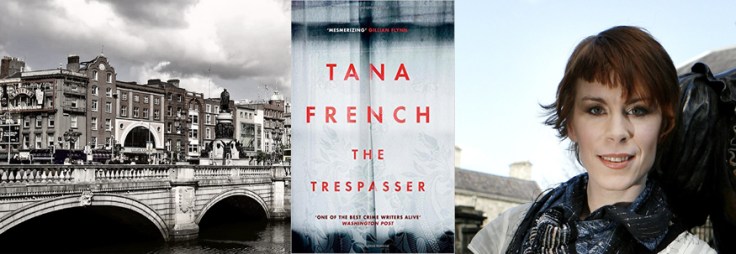
AUTHOR TANA FRENCH beams us down into an endlessly wet, chill and foggy Dublin. The old working class district of Stoneybatter has become, so we are told elsewhere, the epitome of ‘cool’ with all the trappings which that entails – craft ales, artisan bakeries and community spaces. There’s little of that on display when DI Antoinette Conway and her partner Steve Moran are called to a terrace house to view the body of a dead woman. Aislinn Murray is on the floor by her fake rustic fireplace with severe head injuries. Conway says;

“Her face is covered by blond hair, straightened and sprayed so ferociously that even murder hasn’t managed to mess it up. She looks like Dead Barbie.”

Two things puzzle Conway and Moran. Firstly, who was the man who made the ‘phone call alerting the authorities to Aislinn’s demise, and why did he call direct to Stoneybatter police station, rather than using the emergency number? Secondly who was the dead woman’s intended dinner guest that evening? The table was laid for two, with candles lit and a bottle of decent red wine quietly breathing.

As Conway puts her team of ‘D’s’ – murder detectives – together, we learn that she has a prickly relationship with her fellow officers. Yes, she is a woman and, yes, the men’s laddish behaviour – nothing new to readers of novels featuring women detectives – is nastier than simple banter, but the dystopian atmosphere in the squad room is more complex. To be blunt, Conway is something of a pain in the arse at times. She has more chips on her shoulder than a bag of McCains (other brands are available), and the endless baiting and crass pranks from her male colleagues simply stoke the fires of bitterness. Having said that, she is an absolutely pin bright and razor sharp copper, but her fragile equanimity is not helped when her boss forces her to work alongside DI Breslin, a man she loathes. Breslin is glib, sharp-suited and much admired by the other D’s. In short, he is everything that Conway is not.

The consensus among the Gardaí is that the killer of Aislinn Murray is her latest boyfriend, an apparently mild-mannered bookshop owner called Rory Fallon, and he was  the intended beneficiary of the candle-lit dinner in the Stoneybatter cottage. From the moment Conway clapped eyes on the Aislinn’s ruined face, however, she is tantalised by a feeling that she has seen the girl before. When that memory clicks into place, the investigation takes a different turn entirely, and it turns over a large rock which has many nasty creatures scuttling around underneath it.

To say that The Trespasser is a police procedural is, strictly speaking, accurate. But the description does the book justice in the same way that simply describing Luciano Pavarotti as a singer fails to illuminate the central truth. Tana French knows her Dublin, and she knows her An Garda Síochána, but those dabs of authenticity are just that – mere paint spots on a subtle, complex and magnificent canvas.

I suppose I must have drawn breath during the five or six minutes it took to read the gripping climax of this book, but I don’t remember doing so. The final pages contain no action to speak of, just four people sitting in an office, but the psychological intensity is quite terrifying. The quality of the writing is such that French does not allow Conway to luxuriate in her victory, such as it is. There is just a terrible sense of pity, of shattered lives, and human frailty. Conway walks away from the police station:

“The cobblestones feel wrong under my feet, thin skins of stone over bottomless fog. The squad I’ve spent the last two years hating, the sniggering fucktards backstabbing the solo warrior while she fought her doomed battle; that’s gone, peeled away like a smeared film that was stuck down hard over the real thing.”

This is a brilliant, savage and uncomfortable read. Don’t pick it up unless you want your emotions scoured and your sense of empathy and compassion put through the mangle.

Tana French has her own website, and you can follow the link to check buying choices for The Trespasser, which is available now.

THE POSTMAN DELIVERS … Gimenez and McQuaile

tpd-20-sept

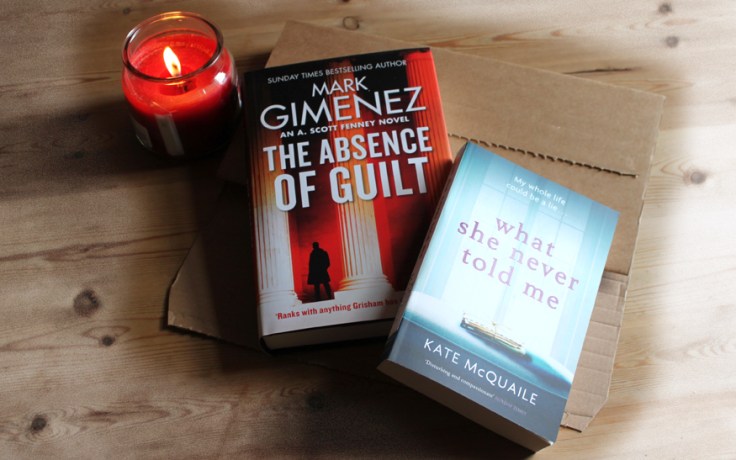
THE ABSENCE OF GUILT by Mark Gimenez
As we saw in The Colour of Law (2013) lawyer A. Scott Fenney is used to dealing with unpopular cases. Back then, it was a  heroin-addicted black prostitute, absolutely no-one’s idea of a sympathetic defendant. Now, he is a newly appointed U.S. District Judge, and before him  is a man who many consider to be the embodiment of evil on earth – Omar al Mustafa, a notorious and charismatic Muslim cleric known for his incendiary anti-American diatribes on social media. Even the POTUS has been publicly clapping his hands with glee at the prospect of Mustafa’s downfall. There’s just one tiny problem; there is no evidence to support the cleric’s conviction. With a widely expected attack on America by ISIS just weeks away, Fenney is faced with the most difficult decision of his life. The book is out in hardback on 6th October, and is published by Sphere. Check out buying options here.

WHAT SHE NEVER TOLD ME by Kate McQuaile
This domestic psychological thriller came out on Kindle earlier this year, and is now available in paperback. McQuaile is a graduate of the Faber Writing Academy, and her debut novel from Quercus tells the story of a woman, Louise Redmond, who is left feeling desolate after a failed marriage. She has never known who her father was, and when she travels home to Ireland to be at the bedside of her dying mother, her search to discover her past takes a sinister turn. Check out McQuaile’s author page on Amazon.

MURDER IN PARSON DROVE

pd-header

It is March 1861. We are in the little village of Parson Drove, Cambridgeshire. The Fens, which Samuel Pepys found so unpleasant when he visited in 1663, have all been drained. He described it as “a Heathen place”, and the events described in this podcast do not give the lie to his opinion. Click the link to listen.

MURDER IN PARSON DROVE


Blog at WordPress.com.

Up ↑