
PREVIOUSLY …
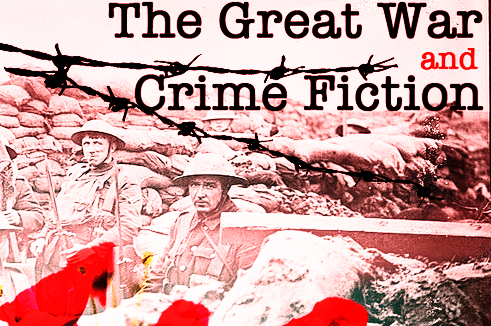
The Great War and Crime Fiction … Introduction
The Great War and Crime Fiction … Part 1
Robert Goddard and his ex-RAFC/RAF pilot and family black sheep James ‘Max’ Maxted start the ball rolling in our continuing look at crime fiction set in, or influenced by The Great War. Goddard introduced Maxted in 2013 with the first part of a trilogy, The Ways of the World. It is Spring 1919. The Great War is over. but a new war is beginning – a war of words and promises, both kept and broken and a war fought in the splendid hotels and conference halls of Paris. The victorious powers – Britain, France, the US, Italy and Japan – have sent their politicians and diplomats to the French capital to pick over the carcass of the old Europe. Amid the great and the good stands a young Englishman, James ‘Max’ Maxted. The ex-Royal Flying Corps pilot has come to Paris to investigate the mysterious death of his father, minor diplomat Sir Henry Maxted.
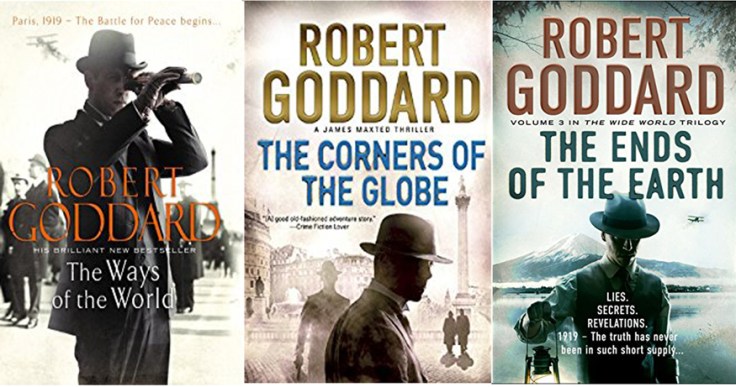
Max is used, first by an American wheeler-dealer called Ireton, then by the British Secret Service and other more shadowy organisations, to try to smoke out a German renegade called Lemmer. The story continues in The Corners of the Globe (2014). Max has still to uncover the truth about his father’s demise, and in addition to the Germans who will not accept defeat, there are some equally villainous Japanese thrown into the mix. The series concluded in 2015 with The Ends of the Earth, and it finds Max still battling the elusive Lemmer, but also locking horns with an evil Japanese aristocrat, Count Tamura. In some ways this is old-fashioned stuff, but there are hours of entertainment here for those who like their history spiced with danger and a couple of alluring femmes fatales. Max is an engaging character; a little old-school perhaps, with a nostalgic touch of Biggles and Bulldog Drummond, but equally brave and resourceful.
 Robert Ryan, also known as Tom Neale, is an English author, journalist and screenwriter. He has written a host of successful adventure novels and thrillers, but our microscope focuses on his Dr Watson novels. He is not the first writer to exploit the potential of Sherlockiana, nor will he be the last. M J Trow wrote an entertaining series of books featuring the much-maligned Inspector Lestrade, so the earnest, brave, but slightly dim companion to the great Consulting Detective must surely be worth a series of his own. Ryan takes our beloved physician and puts him down amid the carnage of The Great War. Too old to fight, Watson’s medical expertise is still valuable. In Dead Man’s Land (2013) Watson investigates a murder in the trenches which is due, not to a German bullet or shell, but to something much more sinister, and much closer to home.
The Dead Can Wait followed in 2014, and our man has returned from the trenches, mentally shattered by his experience. He has little time to recuperate however, as he is called to investigate what appears to be a mass killing – in a top secret research facility set up to develop a weapon that will be decisive in ending the war.

2015 brought A Study In Murder, and Watson has mismanaged his life to the extent that he is now in a wintry prisoner of war camp, far behind German lines. It is 1917, and the outcome of the war hangs in the balance. Murder, however, is no respecter of history, and when some poor fellow inmate is murdered, ostensibly for his Red Cross food parcel, Watson smells a sizeable and malodorous rat. January 2016 brought The Sign of Fear. The rather clumsy amalgam of two canonical Sherlock Holmes stories finds the indefatigable Watson once more at home, but a home at the mercy of a new terror – bombing raids from German aircraft. Our man is forced to untangle a mystery involving kidnap and a floating ambulance sunk by a German torpedo.
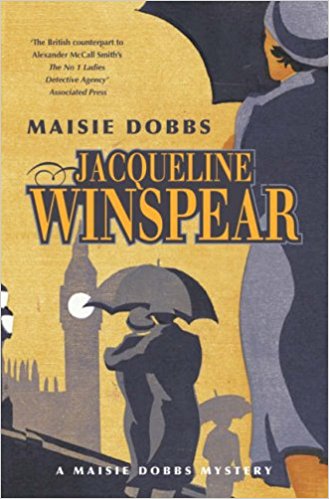 Maisie Dobbs is both the title of a novel by Jacqueline Winspear, and the name of the central character in a series which has now run to twelve novels. In the first of the series we learn that Maisie has seen the worst of The Western Front during her time as a nurse, but now she has returned to an England which is definitely not a land for heroes. She uses her acquaintance with a distinguished French investigator to set up her own agency. Although the series takes Maisie through the years between the wars, right up to the rise of Nazism, the shadow of the dreadful years of The Great War is cast over many of Maisie’s cases. The author herself says:
“The war and its aftermath provide fertile ground for a mystery. Such great social upheaval allows for the strange and unusual to emerge and a time of intense emotions can, to the writer of fiction, provide ample fodder for a compelling story, especially one concerning criminal acts and issues of guilt and innocence. After all, a generation is said to have lost its innocence in The Great War. The mystery genre provides a wonderful vehicle for exploring such a time,”
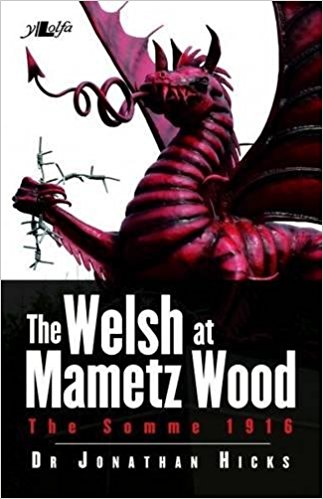 Dr Jonathan Hicks is a Welsh academic with an abiding interest in The Great War, and he has written a graphic and superbly researched history of a battle which was both one of his countrymen’s finest hours, but in terms of loss of life, arguably their darkest. A detailed look at The Welsh at Mametz Wood, The Somme 1916 is outside of our remit here, but its scholarship and interpretation of history is clearly reflected in what was his first fictional Great War novel, The Dead of Mametz (2011). His central character is Captain Thomas Oscendale of the Military Foot Police, and he has a problem to solve. An attractive French widow has been found raped and murdered in a nearby town. In her clenched fingers is a button from a British army tunic. A Welsh NCO, reputedly her lover, has just turned his Lee Enfield rifle on himself after apparently killing two of his colleagues. A mysterious British officer attends the crime scene, but then disappears. As Oscendale tries to unravel the tangle of clues, he finds a map purporting to show a site in the middle of Mametz Wood where a fortune is buried. Blind-sided by German spies and a conspiracy way above his rank, Oscendale must apply his police training to combat corrupt officials, military incompetence and the disdain – bordering on hatred – felt by front-line soldiers for ‘Red Caps’.

Oscendale returned in Demons Walk Among Us (2013) and he falls for a beautiful war widow in the process. When he finds that his most likely witness to corruption in high military places has been invalided home with neurasthenia, he has to resort to drastic measures that threaten his own life and sanity. The action takes us from the dust, heat, flies and bloated corpses of 1915 Gallipoli, through the bleak and devastated flatlands of Flanders, to small-town Wales, with its shattered and impoverished war widows, deserters at their wits’ end, and heroes who have been crippled both physically and mentally. One of the strengths of the Oscendale novels is that Hicks combines the horror of The Front Line with less dramatic but equally menacing events back home in Wales.
History. Crime Fiction. Railways. It’s as if Andrew Martin has written a series of books specifically tailored to three of my abiding interests, but within his Jim Stringer, Steam Detective series there is even more icing on the cake – a pair of novels set in The Great War. Jim Stringer is a railwayman through and through, and we first met him as a young man in an intriguing account of The Necropolis Railway, where he investigated shenanigans connected with the funeral trains that used to run from near Waterloo Station out to Brookwood Cemetery in Surrey.
 By 1916, however, Stringer has several years of crime detection under his belt, but he is sent to France where he survives the carnage of 1st July, and is picked out to supervise the running of ammunition trains carrying vital supplies up to the front line. The Somme Stations (2012) is both a chilling account of everyday life on The Western Front, but also an excellent murder mystery, with Stringer investigating a criminal death – as opposed to one of the scores of men killed daily by bullets and shells.
1917 sees Stringer invalided away from the trenches, but sent out to Mesopotamia to investigate apparent treachery within the British military establishment. In The Baghdad Railway Club (2012) Lieutenant-Colonel Shepherd is said to have accepted a bribe from the fleeing Turks.
 Stringer goes undercover as a railway advisor to investigate, but his contact Captain Boyd is discovered murdered in an abandoned station. No further help will be sent, so Stringer is on his own catching the murderer, and preventing a giant betrayal of the British effort. He has to do so whilst navigating an unfamiliar landscape, avoiding getting caught up in an Arab uprising, fighting off a case of malaria during a sweltering Baghdad summer, and treading a careful path as he investigates members of the officer class.
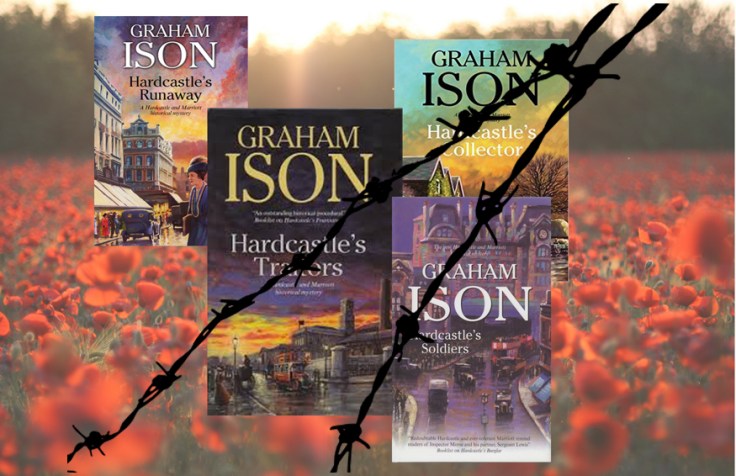
We will finish with the Inspector Hardcastle novels by Graham Ison. In one sense they are well-crafted – but otherwise unremarkable – police procedurals with a period setting, but Ison has created a sequence in the series where criminal events in London are set against successive years of the war. Hardcastle is a bluff, tough, pipe-and-slippers kind of copper, but the novels have a subtle sub-plot which reflects how the war is being fought on the home front, with the inevitable shortage of manpower in the police service, and the ruthless advantage taken by those who live outside of the law. The books have a cosy tinge to them, but are none the worse for that. Ison doesn’t flinch in his portrayal of the effect of a brutal war on hard-pressed families as well as those who are financially more comfortable. For those who like a good London novel, you will find no current writer who is better than Ison at period detail and the creation of an authentic atmosphere.

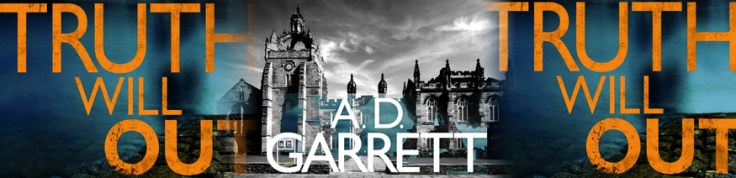
 Nick Fennimore is a forensic psychologist, and a Professor at the University of Aberdeen. His past gives him a painful and heartfelt stake in the hunt for a serial killer, as his own wife and child were snatched. Both are now lost to him; wife Rachel, because her body was found shortly after the abduction., and daughter Suzie – well, she is just lost. Neither sight nor sound of her has been sensed in the intervening years, but Fennimore clutches at the straw of her still being alive, and he feverishly scans his own personal CCTV footage of the Paris streets and boulevards in the hope of catching a glimpse of her.

 Katie Khan took the stand with something very, very different. Hold Back The Stars, which will be published on 26th January is a love story, but with a difference. It is part sci fi, part fantasy and part romance, and is the story of a young couple who are forced to prove their love in order to stay together. Katie reminded us that it was only a few years ago that making friends – and finding lovers – on social media would have been unthinkable, but her book takes us forward to a time when such liaisons will be commonplace.
 Australia 1939, and The Lucky Country is the setting for A Dangerous Crossing, the upcoming mystery thriller from Rachel Rhys. In a sense, this is a different kind of debut, as Rachel Rhys is the pen-name of an already- successful psychological suspense author. A Dangerous Crossing is her debut under this name and is inspired by a real life account of a voyage to Australia, during which two passengers die in mysterious circumstances, and war has been declared in Europe. Rachel reminded us that in a pre-digital age, a long ocean crossing was the perfect place for people to hide, and in her book everyone has a secret, or is running away from something. The novel will be published on 6th April.
 Bristol resident T A Cotterell was the final reader, with an extract from What Alice Knew. Cotterell read History of Art at Cambridge University and, significantly, the central character in his book is a portrait painter. He explained that the core theme of the book is family secrets, and told us of a real life instance when his mother name dropped someone of whom he had never heard, and when he asked who he was, he received the disconcerting reply, “Oh, he was my handler in MI6!”. The thought of his mother being a very successful intelligence operator in communist Hungary led him to explore the theme of how much we owe our children in terms of the truth. The novel asks many questions. How far would you go to protest someone you love? Would you lie to the police knowing your loved one is guilty as charged, or would you watch their life fall apart because of a terrible accident? What Alice Knew is out on 20th April.
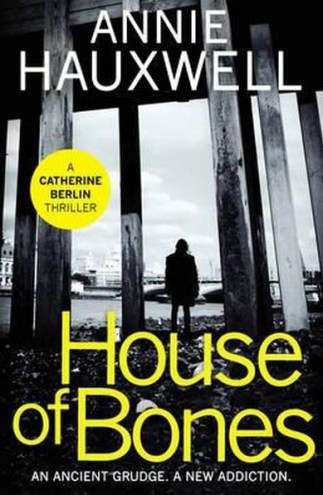 It’s always fun to come late to an established series that has many established followers, if only to see what all the fuss is about. I had covered Catherine Berlin in writing brief news grabs, but House of Bones was to be my first proper read. There is a wonderfully funereal atmosphere throughout the book. Sometimes this is literal, as at the beginning:

 Today’s delivery of two contrasting packets looked intriguing. One was large and weighty, while the other was much slimmer. When I opened the envelopes and looked at the books the differences couldn’t have been greater. One book, Blackmail, is actually written by a retired Judge, and the Nottingham Post tells us:
 If you check the graphic at the top of this feature, it shouldn’t be too difficult to spot which is the retired judge, and which is Frank Westworth, a novelist whose twin passions are powerful motorbikes and playing blues guitar. Frank wrote us an excellent feature a while back called Killing Me Softly – A Guide To Murder, and you can click the link to read it.


 and a recurring – and malign – character named The Peacemaker looms over proceedings. The books work very well as detective stories, and Perry has years of experience at blending crime with period settings. She has been careful to put each plotline in the context of the big events of each year; No Graves As Yet, for example, sets us down in the elegaic final summer of peace, in an England which was still Edwardian in spirit despite the old King being four years gone; in Shoulder The Sky Reavley searches for the killer of a war correspondent whose honesty made him a marked man, and his quest for answers takes him from one military debacle to another, in this case from Ypres to Gallipoli. Perry writes with great conviction and, as with her other books, mixes intrigue, adventure, high drama and impeccable period detail.
 The First Casualty (2005), saw stand-up comedian Ben Elton continuing a not-altogether-successful foray into the world of serious fiction. He is to be commended for placing a largely unsympathetic character at the centre of his story, but the misadventures of Douglas Kingsley, a career policeman but now a conscientious objector, tend to involve issues such as homosexuality, feminism, pacifism and the Irish Question, which were more on people’s lips at the time of Elton’s TV fame than during the period of WWI itself. Kingsley is thrown in jail because of his stance on the war, and is then abused by criminals who attribute their incarceration to his devotion to duty as a copper. The apparent murder of a rebellious soldier poet (a thinly disguised Siegfried Sassoon) and the sexual misdeeds of his wife Agnes give Kingsley plenty to think about.
 Rennie Airth has written a series of novels featuring a retired policeman and WWI veteran, John Madden. I am giving these an honorary mention, as Madden’s whole approach to life, his attitude towards detection, and his views on criminality are all profoundly influenced by his experience in the trenches, and when Manning is centre stage, his musings frequently recall his wartime experiences. The first of the series is River of Darkness (1999), and the events take place in 1921, when men were still dying of war wounds, and many of the country’s war memorials had still to be dedicated. Madden has returned from the war and is now a top detective with Scotland Yard. He is called down to investigate a savage multiple murder in rural Surrey, and he becomes convinced that the brutality of the killings is linked to events that happened during the war, and that the perpetrator, like Madden himself, has been left with scars that are both physical and mental. You might like to read the Fully Booked review of a later John Madden novel,
  Bess Crawford, who manages to combine the grim task of being a nurse tending to the appalling violence inflicted upon the bodies of young men fighting in the trenches, with a determination to get to the bottom of various mysteries which have more to do with individual human failings than with the inexorable mincing machine of the war. Her investigations are sometimes within sound of German guns, but also nearer home, such as in An Unwilling Accomplice (2014), when she has to accompany a celebrity wounded soldier to Buckingham Palace to receive a gallantry award, only to have him escape his wheelchair and commit a savage murder. The Todds have also invested time and words to bring to life the character of Detective Inspector Ian Rutledge, a man who suspended his police career to fight for King and Country. He returns to the police force after the war, but finds that the blood-soaked years have left a bitter legacy, such as in A Lonely Death (2011), when he is called to investigate a series of killings in a Sussex village, and finds that the deaths are all connected with the wartime service of the victims.
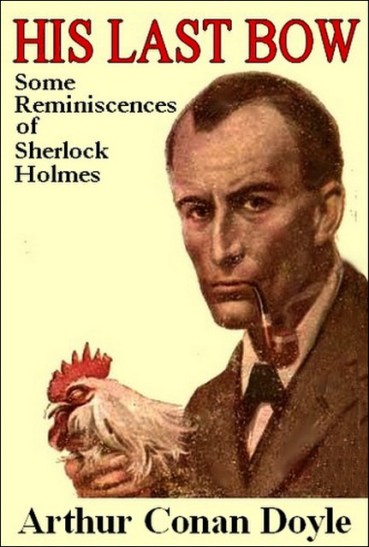 I’ll conclude this first part of the feature with a quick glimpse at a trio of curiosities, where the novel gives a fleeting but significant nod to The Great War. In 1917, Sir Arthur Conan Doyle published a collection of Holmes stories dating back across the first years of the century. In the concluding story His Last Bow: an epilogue of Sherlock Holmes, the great man disposes of a particularly dastardly German spy, and as the story finishes, he says,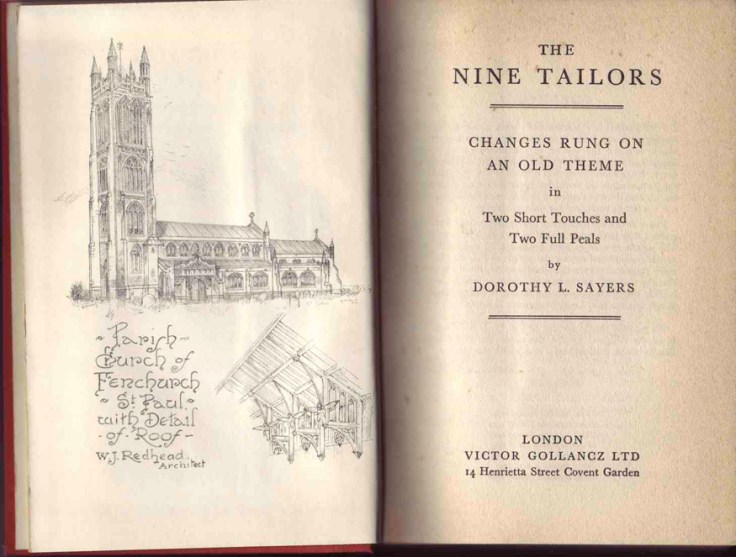
 Anthony Price has written many spy thrillers tinged with elements of military history, and in Other Paths To Glory (1974) he uses abandoned German fortifications deep beneath the French countryside as the central feature of the novel, most of which is set in the present day world of international realpolitik. As the bunkers in the novel are set in the Somme region, it is highly likely that they are modeled on the astonishing engineering of The Schwaben Redoubt, near Thiepval. The Redoubt was one of the most impregnable defences on The Western front, and it cost many thousands of lives before it was finally taken. The book is the fifth in the series featuring Dr David Audley and Colonel Jack Butler,

 and Selena’s qualifications as a psychologist made them the go-to people for corporations and wealthy families who had fallen foul of the highly lucrative business of international kidnapping. But then, on a blisteringly hot morning in Brasilia, it all went badly wrong. Selena went shopping for children’s toys prior to her addressing a meeting of fellow professionals in the afternoon. While she was selecting gifts for their little daughters, the bad guys attacked the hotel and conference centre, shooting, bombing and delivering a stark message. “You may think you are smarter than us, but look at the body count, and then tell us how clever you are.”
 One of the many delights of this excellent novel is that Finna Hale and Leah Mackay are brother and sister. Finn has leap-frogged his sister in the promotion stakes, despite her evident superiority – evident, that is, to us readers, but not the local constabulary personnel department. Kavanagh plays the relationship between the siblings with the touch of a concert violinist. There are all manner of clever nuances and deft little touches which enhance the narrative.
 Watch Her Disappear, the latest episode in the career of Zigic and Ferreira is expected to be on the shelves in January 2017, and it reminds us that hate crime can involve other issues than the colour of someone’s skin or the language they speak. A wave of sexual assaults has left Peterborough women wary and fretful, but when the next victim – a fatality – is revealed to have been a genetic man, the case becomes something different altogether.


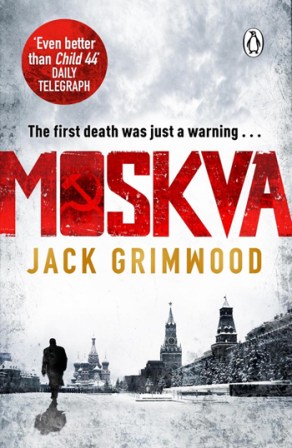 Jack Grimwood’s Moskva sets out to convince us that there is room for one more tale of conflicted lives in a modern Russia full of paradox and uncertainty. The book came out in hardback earlier this year, and is now available in paperback, from Penguin. Does Grimwood, who made his name writing science fiction and fantasy novels, hit the spot?
 The breadth of this novel in terms of time sometimes makes it hard to work out who has done what to whom. Patience – and a spot of back-tracking – will pay dividends, however, and the narrative provides a salutary reminder of the sheer magnitude of the numbers of Russian dead in WWII, and the resultant near-psychosis about The West. To top-and-tail this review and answer the earlier question as to whether Jack Grimwood (right) “hits the spot”, I can give a resounding “Yes!”. Yes, the plot is complex, and yes, you will need your wits about you, but yes, it’s a riveting read; yes, Tom Fox is a flawed but engaging central character, and yes, Grimwood has sharp-elbowed his way into the line-up of novelists who have written convincing crime novels set in the enigma that is Russia.


 fullybooked2017