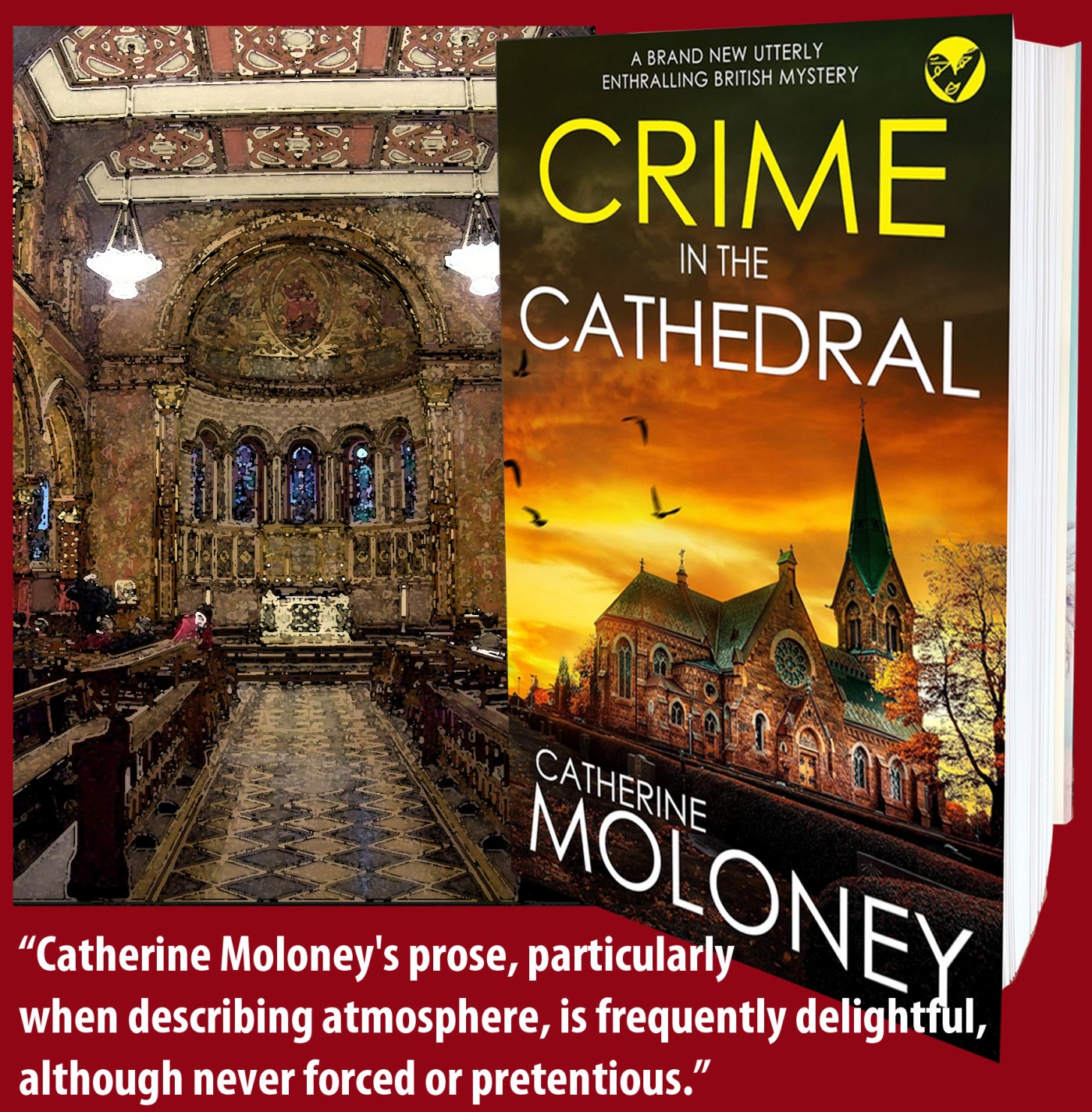

I read and reviewed Catherine Moloney’s Crime In The Gym back in July, and was struck by the sheer quality of the writing – the subtle and sympathetic portraits of the main characters, the intelligent dialogue and, above all, the sense that we were in a real police station in modern Britain. Here, we are again in the fictional town of Bromgrove. It is a place that won’t be found on any OS map, but it is, perhaps, a city, as it has a Cathedral. St Mary’s is not ancient. Think along the lines of something 19thC and Byzantine in style, rather like Westminster Cathedral.
Despite being notionally Anglican, the cathedral is very high Church, and has a centre housing supposed relics, items associated with venerated saints. The Church of England has a wide variety of worship traditions. At one end there is what used to called ‘low’ church, with very simple services and no love for elaborate symbolism. On the other extreme is the Anglo Catholic, or ‘high’ church, where Roman Catholic practices such as incense, fine robes and – in this case – an awareness of sacred relics.
It is in this centre that the body of its curator, Suzanne Haynes, is found strangled. The cathedral has a school, St Mary’s College, an elite independent school which contrasts in every way possible with the local state school, Medway High. The dead woman was a teacher of textiles at St Mary’s. Catherine Moloney’s prose, particularly when describing atmosphere, is frequently delightful, although never forced or pretentious.
“Even the larches which bordered the driveway up to St Mary’s College had a kind of clear, brave beauty, while snow diamonds spangled the two huge firs that stood on either side of the Jacobean-style arched entrance.”
Bromgrove is – as we are now – approaching Christmas and the views of Markham’s former sergeant, Noakes (now a civilian) resonate with me:
“Noakes had uncompromising views on everything from Christmas cards (robins were de rigueur, while anything PC was verboten) to carols (traditional organ music got the thumbs up, while secular ‘ Kumbaya BS and tambourines’ were out.)”
Noakes has left the force, but is employed by Markham as a consultant, much to the chagrin of his left-inclined DEI box-ticking bosses, but invariably to the advantage of his team’s crime clear-up statistics. Markham, too, has no time for the Common Purpose agenda of his superiors.
“Take no notice of me, Kate. It’s just that sometimes I get fed up of all the progressive woo-woo. The top brass always quantifying minorities and gamifying vulnerabilities, if you know what I mean.”
Frankly, the crimes – and who committed them – take second place to the wonderful writing. I would not want to deter crime fans from reading this excellent novel by suggesting it is literary fiction, but Ms Moloney is both highly literate and knows her literature, as the narrative is enriched by references to such diverse texts as Rebecca, Robert Frost,The Wisdom of Solomon and Shakespeare sonnets.
Markham’s love life is conflicted. He still has intense feelings for his former partner, but has distinctly unprofessional regard for DI Kate Burton, who is of equal rank but with less experience.Here, Moloney describes Olivia, Markham’s currently estranged partner, as a woman with Pre-Raphaelite charms:
“…the abundant red hair, translucent pallor and witchy grey-green eyes.”
Now if that isn’t the doomed Elizabeth Siddal, Dante Gabriel Rossetti’s wife, and model for Beata Beatrix, then strike me down. The other significant people in Markham’s team are his two sergeants, DS Doyle, ginger haired, lanky and affable, and DS Caruthers, a psychology graduate, with slick backed hair, a deathly pallor, and prone to sarcasm. Presiding over them is Detective Superintendent Ebury Clarke, known – with no affection- as Toadface.
Even superior crime novels, and this is one such, follow certain conventions, and the most common is to have a varied collection of people who may have murdered the victim. The list of suspects is diminished by more murders. First, Rev. Dr David Gillespie is found stabbed to death in one of the cathedral chapels, ironically in a position of prayer, kneeling on a prie dieu. Next, James Kershaw, former Head of St Mary’s, is found burned to death in a crypt of the cathedral which, with its over-exuberant decoration and the determination of its designers to make it more Catholic than Catholic, has become an almost malevolent presence in itself. Then, in an apparent murder-suicide, the bodies of art teacher Rowena Wardle and the college’s Second Master David Tucker are found, with Wardle having left a typed confession to the killings.
The confession is false, of course, and the killer is eventually unmasked in a horrifying finale. Crime In The Cathedral is published by Joffe Books, and is available now in Kindle. The paperback will be released on 24th November.


Leave a Reply