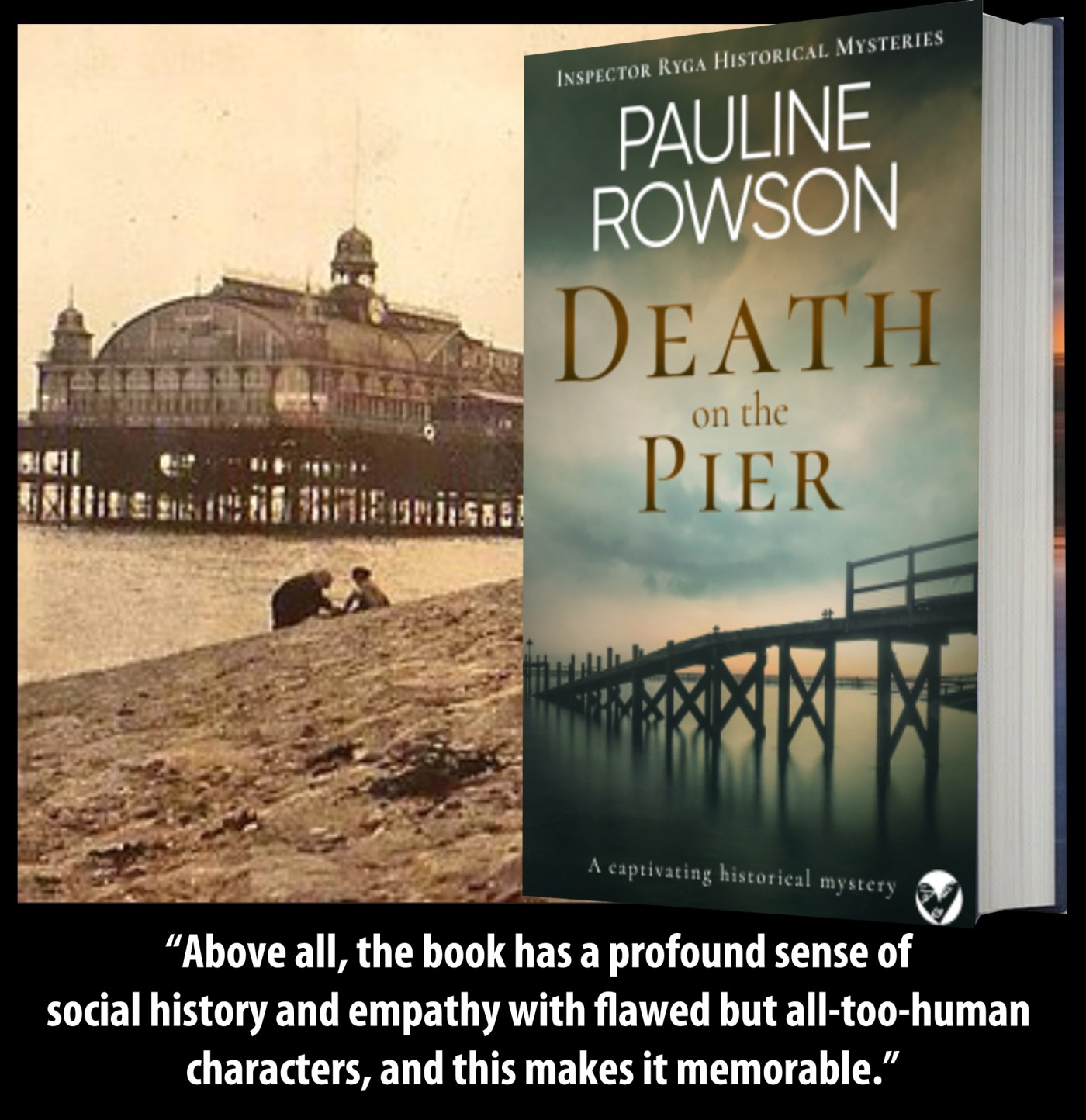

I hadn’t read a Pauline Rowson novel for years, but remembered that she is well known for her love of mysteries set in coastal locations. Here, in Death on the Pier, we are in a 1951 England with a recent war won, but with most ordinary people still struggling to support the costly yoke imposed by being, at least nominally, victors. Everyone, including the Metropolitan Police’s Detective Inspector Alun Ryga, still carries ration books. He is sent on an undercover mission to what was then ‘East End on Sea’, the brash resort of Southend.
A retired naval officer has found a bloodstained corpse in a municipal shrubbery. He goes to seek help and returns with a police constable, but there is no body, nor any sign that one was ever there. Is Clive Cottinglea a fraud, deluded, or part of some wider conspiracy? Posing as a tourist, Ryga befriends Cottinglea and senses that many things are not adding up. When Cottinglea is found dead in his deckchair on Southend’s celebrated pier, to quote our most celebrated crime writer, “the game is afoot.”
The dead man was clearly short of money, and his claims of being a veteran of the Battle of Jutland and skipper of one of Dunkirk’s heroic small boats have not convinced people at the local yacht club. When Ryga, literally over Cottinglea’s dead body, is forced to reveal that he is a London copper, Pauline Rowson has set the stage for a fascinating mystery.
The plot becomes deliciously complex. As Ryga waits for the post mortem to reveal just how Cottinglea died, the truth about the man’s real life is laid bare. As for being a Commander, the only people he ever commanded were a few housemaids and cooks. Cottinglea was a butler at a nearby stately home, and had been for some years. When, just months earlier, the Lady of The Manor had finally given up the struggle of maintaining Tyide Hall and recreating its 1920s halcyon days, Cottinglea had been paid off and given a decent reference, while the noble Lady sold the house and grounds to developers and flew off to America with the proceeds.
Cottinglea had enjoyed a brief but uncomfortable few days as a guest member of the local yacht club, but why had he been signed in by senior member Admiral Burnham? And why is Burnham now missing?
On one level, this is a standard murder mystery, albeit a very good one, but there is much more. Through the perceptive gaze of Ryga, Pauline Rowson gives us moving and compassionate portraits of ordinary people fighting an uneven battle against life’s vicissitudes.There is Miss Bard, the seemingly severe landlady of The Marigolds guest house. Once a bright and attractive woman, she is now an ageing spinster, saddled with debt but maintaining a brave face. Her carpets and furnishings are shabby, but scrupulously clean, and all that remains to her of a former better life are good manners and a sense of decency. Then there is Mrs Burnham, terminally Ill and virtually deserted by her husband who lacks the moral courage to cope with her illness face to face. Again, she remembers better times, but faces what is left of her future with quiet dignity.
We are also allowed to be observers of a very different England from the place we inhabit today. We meet men and women who, in one way or another, helped ‘win the war’. But what did they win? From individual workers, shopkeepers, pensioners and public servants right up to those who hold the government purse strings, there is a sense that, to quote Derek Raymond, the crust is on its uppers. I cannot claim to remember 1951, as I was just four years old then, but the legacy of those post-war years was a defining part of my later childhood.
Of course, Ryga gets to the bottom of the mystery, and we are presented with a very entertaining – if rather involved – solution. Above all, the book has a profound sense of social history and empathy with flawed but all-too-human characters, and this makes it memorable. Readers were introduced to Alun Ryga in Death In The Cove (2023) and this, the sixth in the series, will be published by Joffe Books on 26th August.


Leave a Reply