

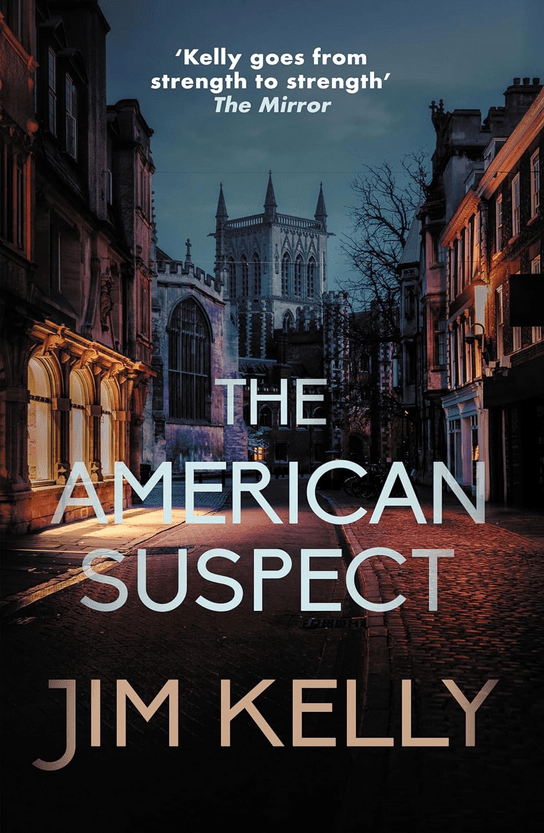
Jim Kelly’s wartime detective DI Eden Brooke returns in this elegant Cambridge mystery. It is autumn 1942, and the Americans are, once again, ‘Over There’. ‘There’, in this case, is the former British airfield of Dodswell, which is being extended to cope with a new batch of P51 Mustang fighter-bombers. The reconstruction has been briefly paused by the discovery of a human skeleton, which turns out to be that of an RFC pilot, believed to have been killed in a crash in 1917. But what were his remains doing casually buried beside the runway when he appears to have a proper grave, with headstone, in a nearby churchyard?
When an elderly woman, Ede Curtin, living in the village of Dodswell, dies in suspicious circumstances, a macabre coincidence emerges. Beside the dead woman’s bedside is a framed photograph of the pilots of RFC Dodswell, 1917. And there, fifteenth from the left, on the second row, is the man whose remains were disturbed by the excavations on the present day airfield. When Molly Curtin, daughter of the dead woman is herself found lifeless in Dodswell church, suspicion falls on Eliga, her boyfriend, a black soldier working with a US construction battalion. The evidence against him persuades a military court to sentence himself to death, and he he is sent to the prison in Shepton Mallet, to await the ministrations of Albert Pierrepoint (who enters the narrative as himself).
Brooke has other distractions. The apparently random and aimless disappearance of cats from one of Cambridge’s poorest areas triggers an investigation into a hugely lucrative smuggling operation involving crooked London dockers and corrupt US service personnel. One of the most vivid parts of the book is when Brooke, in pursuit of the catkillers, experiences a terrifying air-raid involving incendiary bombs.
Jim Kelly is a diamond of an author, and his gem has many facets, all of which sparkle. He has a deep sense of the past, and how it lives on. To quote William Faulkner, “The past is never dead. It isn’t even past.” Here, the mysterious death of the WW1 airman resonates powerfully in 1942 Cambridge. Kelly’s awareness of the power and importance of place is ever present. With Phil Rickman dead and gone, Kelly is now the unrivaled master of making suburban streets, bleak fens, misty fields and deeply flowing rivers potent elements within the overall narrative. Above all, perhaps, is his compassion for ordinary people, and his perceptive portrayal of the daily grind, the small struggles, the petty sleights and the tiny triumphs that characterise their lives.
Jim Kelly lives relatively local to me, and he once gave a talk at our town library, He revealed that his father had been a London police officer involved in the investigation into the awful events that occurred at 10 Rillington Place. In this book, Brooke is clearly no admirer of Albert Pierrepoint nor of the job he was paid to do. I wonder if this was because of the execution of Timothy Evans, for the murder of his duaghter? Some accounts say that Evans was innocent, and that his hanging is a potent argument against capital punishment. More recent books, such as Kate Summerscale’s The Peepshow, suggest that Evans was not the wide-eyed simpleton portrayed in popular media. Pierrepoint pulled the lever that sent both Evans and the undoubted killer John Reginald Halliday Christie to their deaths, but was he the heartless functionary portrayed in this book? I am not sure.
Eden Brooke has his own crosses to bear. His WW1 war wounds still cause him grief, and the young men in his family are all away ‘doing their bit’ and in imminent danger. I will not spoil your enjoyment of this superb novel by giving too much away, but once again Jim Kelly is at the top of his game with this cleverly crafted, thoughtful and immersive mystery. The novel is published by Allison and Busby, and is out now. For further details on American servicemen executed at Shepton Mallet, click this link.
My reviews of the earlier books in the series are here.


 fullybooked2017
Leave a comment