Search

fullybooked2017

Month

February 2024

LAYING OUT THE BONES . . . Between the covers

LATB header

Kate Webb introduced us to DI Matt Lockyer and DC Gemma Broad in Stay Buried, which I read, reviewed and found most impressive. Briefly, Lockyer is a single man, son of Wiltshire farmers – who would be described as ‘hard-scrabble’ in America. His younger brother, Chris, was murdered in a street brawl a few years earlier. He is involved – at a distance – with Hedy Lambert, a woman whose murder conviction he helped overturn. She still served over a decade in prison.

Because of a previous professional misjudgment, Lockyer has been sidelined into cold-case crimes. One such is the death of Holly Gilbert who fell – or was pushed – from a bridge into the path of a an HGV. Now, the remains one of the men suspected as having being involved, and who disappeared shortly after, have been discovered on Salisbury Plain. Lee Geary was a giant of a man, superficially very scary with his height, skinhead hair and tattoos, but he was simple in mind and spirit and his criminal convictions were all for minor and non violent crimes.

Three other twenty-somethings who were suspected of being involved in the death of Holly’s death have all since died in ambiguous circumstances. Lockyer has much on his mind. His mother lies dangerously ill in hospital, infected by a Covid variant, while his father struggles to keep the farm going. Lockyer lives in – and is slowly renovating – an old cottage, but he discovers that something horrific happened within its walls decades ago and, as is often the case, the past can often rear its ugly head to disrupt the relative tranquility of the present. I’ll give you a teaser – the book’s title is shared with another of the same name. If you take the trouble to Google, you will discover a rather delicate and elegant connection.

In trying to find out the truth about Lee Geary’s death, Lockyer is drawn, as if pulled by a magnet, to Old Hat Farm. It is owned by Vincent and Trish O’Neill, who lead something of an alternative life. They are are almost archetypal ‘hippies’, with lives organised around the ancient festivals such as Samhain and Beltain. Fellow seekers after truth are welcome at the farm but, unfortunately all of the key residents had lives in the real world, and it is their misdeeds in their previous lives which make up the puzzle Lockyer and Broad have to solve.

The novel is lovingly set in a part of England that the the author clearly knows well, and Lockyer’s intimate connection with the landscape – the vastness of Salisbury Plain, Wiltshire’s ancient sites and old trackways – brings a literary sense of place that was deployed so well by Thomas Hardy, but has been used by more recent writers in the crime genre such as Jim Kelly and Phil Rickson. As locals will know, the ravages caused by military training are brutal scars on the old fields and byways, but they are what they are.

Laying Out The Bones is not just a superior police procedural novel, but a powerful evocation of how historic lies and misjudgments can return to plague those involved. The empathy between  Lockyer and Broad is utterly convincing, as is the awareness of what happened to us all during the Covid outbreak. The book’s  plot is intricate, but beautifully fashioned, and although Matt Lockyer has something of a shock in the last page, I am sure he will survive to feature in a future episode of his career story. Published by Quercus, this book is available now.

THE FUTURE OF WAR CRIMES JUSTICE

WCJ header

Chris Stephen author photoThis is what used to be called a monograph, a slim volume devoted to one particular subject. It is a million miles away from Detective Inspectors, international criminals, sleepy villages with an abundance of elderly female amateur sleuths and dark deeds on the gloomy back-streets of Victorian London. However, I do try to balance my reading between novels and non-fiction, and this book repaid my interest. The author, journalist Chris Stephen (left) has reported from nine wars for publications including the Guardian and the New York Times magazine. He is the author of Judgement Day: The Trial of Slobodan Milošević (published by Atlantic Books). Ironically, the Serbian leader avoided becoming only the third former Head of State to be found guilty of war crimes, mainly because he died of a heart attack during his trial. The first was Admiral Karl  Dönitz who, for a very brief spell. was leader of Nazi Germany. The second was Charles Taylor the former Liberian leader, at whose trial Naomi Campbell made a brief but bizarre appearance as a witness. This book is part of a new series from Melville House.

Screen Shot 2024-02-18 at 18.16.58

Stephen looks at war crimes in history, and examines how contemporary justice systems defined them and dealt with them. He mentions Sherman’s ‘March To The Sea’ in 1864, where Sherman’s Union troops devastated civilian Georgia, working on the assumption that denying the enemy infrastructure, provisions and general support was just as effective as blowing them apart with shot and shell.

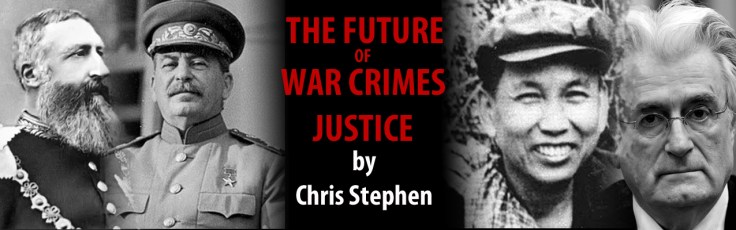
The point is well made that there are two distinctive kinds of war crimes –  those committed by military leaders and those committed on behalf of multinational companies, usually in Africa, in search of precious raw materials. Perhaps unique is the abysmal Leopold II of Belgium who, while also being head of state, was determined to strip the Congo of all its precious resources.

“Arthur Conan Doyle paused his Sherlock Holmes novels to pen an angry call to arms, “The Crime of The Congo.” He wrote:
“The crime which has been wrought in the Congo Lands by King Leopold of Belgium and his followers is the greatest which has ever been known in human animals.
More evidence of the horrors emerged in the photographs taken by British missionary Alice Seely Harris. One picture, re-printed in Europe and America, showed a farmer kneeling in front of the tiny severed hands of his five year old daughter. She had been mutilated by soldiers of the Anglo Belgian Rubber Company.”

For what it’s worth, Leopold is regularly cited in the top ten of the world’s greatest mass murderers alongside fellow luminaries such as Hitler, Stalin, and Pol Pot.

The International Criminal Court, which is central to the book,  was established as recently as 2002, and has a chequered history. It is recognised by some countries, but only in so far as its work is not prejudicial to that country’s interest. It is not part of the United Nations and has a rather nebulous authority. Its physical base is in The Hague in the Netherlands.

Because of its unique international position in terms of power and influence, America is an enigma, as  Stephen recognises.

“No country agonises over war crimes justice like the the United States. Possibly this is linked to how the USA was formed. Most countries are simply gatherings of a national group. Not America. It was founded on an ideal. Against that, American exceptionalism is the strong current across its political spectrum. The USA’s political class manages to be both internationalist and isolationist at the same time. Leader of the free world, yet also apart from it.”

Stephen’s recounting of the Pinochet affair is particularly telling. Pinochet was the former ruthless and brutal dictator of Chile. He had been deposed, but in 1998 he felt able to travel to London for medical treatment. Because of his support for Britain during the Falklands conflict it was said that Margaret Thatcher thought, “he was one of us.” Instead the criminal justice system decided to detain Pinochet and for some months it seemed to be a message sent to the wider world that no former dictator was immune from justice. Pinochet’s temporary demise was not brought about by any international action but by Spain, who issued an international arrest warrant for him, because several Spanish citizens had been murdered as a result of his purges. In the end there was a change of government, this time the New Labour vision of Tony Blair and, unwilling to upset trading partners, Britain sent Pinochet home, with the excuse that he was too ill to stand trial. Incidentally, just a few days ago he was back in the news again, as claims have been made that he was responsible for having the poet Pablo Neruda poisoned in 1973.

I imagine this book went to press before the 7th of October 2023. Although Chris Stephen does mention the conflict between Palestinian groups and Israel, it raises an interesting prospect of how the ICC will review the ongoing conflict. Who are the war criminals? The IDF? Or Hamas? Interestingly, as I write this review, South Africa has brought a case to the International Court of Justice, alleging that Israel has committed genocide. The ICJ, of course is quite different from the ICC, in that it is part of the United Nations, and can only examine cases involving countries as opposed to individuals.

The author begins his book with an account of an early atrocity by Russia in the current war in Ukraine. If anything this incident highlights both the need for-and the futility of-the International Criminal Court. Of course, Putin has been declared a war criminal by the ICC but, on the other hand, the likelihood of his ever appearing in front of an ICC court is somewhat less than zero.

Stephen concludes on an optimistic note:
The great, singular achievement of war crimes trials these thirty years has been to show that the system can work. Not always, and not always well. But it has demonstrated that vague conventions can be turned into workable laws.”

The Future of War Crimes Justice is published by Melville House and is available now.

DEADLY ANIMALS . . . Between the covers

DA spine020 copy

The district of Rubery, on the edge between Birmingham and Worcestershire. 1981. Ava Bonney is thirteen years old, She lives with her mum and sisters in a rudimentary council flat. Her dad has flown the coop, but mum Colleen has a feckless boyfriend, Trevor. Ava is an unusual girl. She is fascinated with animal physiology, and absorbs information mostly from books, but also – on the rare occasions when her fellow pupils are not being disruptive – from science lessons at school.

Ava is startlingly intelligent, but also wise enough to disguise herself as an ordinary teenager when needs must. She has an unusual hobby. She collects roadkill – mostly small mammals – and she takes them to secret sites close to her home, and installs them in little shrines. She secretly visits these special places as the remains decompose, and records her observations in a notebook. The largest specimen she has collected is a fox, but when she sneaks out one night to examine it, she has an unpleasant surprise. The smell of putrefaction is far more pungent than she would have expected, but the reason is obvious. Just a couple of yards from the dead fox is the body of a local schoolboy who went missing a couple of weeks earlier.

Not the least of Ava’s skills is a talent for mimicry, and she disguises her voice as that of a well educated middle-aged woman to make a 999 call, reporting what she has found. Another body is found, and then a third boy disappears. By this time, after interviewing local youngsters who knew the boys, Detective Sergeant Seth Delahaye has his suspicions that ‘Miss Misty’, the caller nicknamed after the anonymous woman in the 1971 Clint Eastwood film, is none other than Ava. Given the nature of the wounds inflicted on the boys the police are, despite common sense and experience, coming close to believing that they might be seeking a ‘what’ rather than a ‘who.’

Ava, with the help of her friend John, begins to put together a theory about what might be happening, and she believes that there is a connection to an elderly man – a former farmer and dog breeder – who is languishing in a care home with dementia. Delahaye, meanwhile, is receiving strange and disturbing reports of a large unidentified animal being seen at night in several places. As the police and Ava – in their different ways, close in on the killer, they realise that the truth is indeed stranger than fiction.

In Ava, Marie Tierney has created one of the most startling and original characters in modern crime fiction. I suppose she is a savant, but her gifts are not the result of her being on any kind of autism spectrum. She is super-smart, but also sensitive to the needs and natures of other people.

This is an astonishing novel on so many levels. It combines horror, compassion, dark humour, narrative verve, a deeply embedded empathy with landscape and locale and – above all – Ava Bonney, a truly memorable creation. Deadly Animals is published by Bonnier Books and is available now.

THE WINTER VISITOR . . . Between the covers

TWV header

I wasn’t sure if I should tag this review as ‘historical crime fiction.’ The novel certainly takes us back to a 1991 England of Ford Sierras, four-star petrol, Spurs being managed by Terry Venables and captained by Gary Mabbutt. Perma-press slacks from C&A and  – on the telly – the brief wonder that was BSKYB. We are in and around the town of Colchester in Essex, and we are in one of those winters where it always used to snow. I am sure that there is a doctorate waiting to be written on why Essex is perceived to Britain’s Crime Central. Perhaps it might be to do with the White House Farm murders in Tolleshunt D’Arcy, the ‘Essex Boys’ murder at Rettendon, or the exploits of double murderer James Fairweather in Colchester.

In The Winter Visitor, James Henry echoes his love of ornithology by using the term used for birds who fly to Britain during the winter – among them Redwings, Fieldfares, and both Bewick’s and Whooper Swans. I reviewed an earlier James Henry novel with an avian title, Whitethroat, back in 2020, and you can read the review here.

Two birds of very different feather are Detective Sergeants Daniel Kenton and Julian Brazier, based in Colchester. Kenton is married, bespectacled and fairly civilised:

“Daniel Kenton stared blankly into the hairdresser’s mirror. He did not care to see himself as others surely would: a a weary man, with murky red eyes, closing in on thirty five but aged beyond his years.”

Brazier, however, is frequently uncouth, ostensibly insensitive, and with the dress sense of someone preening himself in a Southend pound shop.

“Brazier was in a green bomber jacket and baggy black trousers like Charlie Chaplin, with white trainers poking out the bottom of them. Pegged trousers with turn-ups as well – on such short a leg as Brazier’s they were not at all flattering.”

As a pair, though, they are extremely effective. They need to be. James Henry has presented us with an extremely complex murder case.

Bruce Hopkins, an Essex criminal – not a major gangster, but more of a conman who dabbled in the drugs business – returns from the Spanish hideaway he shares with many other dodgy British expats, but it is a huge mistake. He is kidnapped, shoved into the boot of a Sierra (what else) which is rolled into a reservoir. When the car and body are discovered Kenton and Brazier are assigned to the case, and it is a complex one.

Hopkins did not have a criminal history likely to provoke Mafia-style revenge, so there seems to be no point in rounding up ‘the usual suspects’. Even so, Kenton is despatched to Marbella to interview former Essex bad boys, but he returns literally clueless. There is also a current investigation into an arson attack on a local church, and it is that Kenton and Brazier get the first hint of a breakthrough when they begin to suspect that Hopkins’s death may be linked to a small preparatory school called Bryde Park and some of its former staff and pupils.

James Henry is a very good writer. He captures the period perfectly, and his appreciation of the nature of Essex’s relationship with London is acute:

“Billericay, South Essex. Home of the East Ender made good. Traders, jobbers, grafters on the stock market. Leave school in May at fifteen, straight on the train into Liverpool Street towards plum jobs with brokers in the city, pulling in wedge before their smarter ‘O’ Level classmates finish in the exam hall.”

Kenton and Brazier have to visit an old fashioned mental hospital in the course of the investigation, and Henry captures its menace:

“…the institution itself had teetered on the fringe of an archaic medical world best forgotten. At the forefront of experimental medicine in the fifties, the place was synonymous with lobotomies, padded cells, terrifying screams, and all the nightmares associated with the restraint of insanity.”

We are lead this way and that as we share the detectives’ struggles to make sense of the death of Bruce Hopkins. The solution is as unexpected as it is elegant, and this is superior crime fiction. Published by Riverrun/Quercus, it is available now.

THE SHADOW NETWORK . . . Between the covers

tsn spine014 copy

Suspected war criminal Hannibal Strauss, a mercenary suspected of war crimes in Libya, Cambodia and elsewhere, is in custody near The Hague awaiting trial before the International *Criminal Court. The wheels of international war crimes justice grind extremely slowly, and as lawyers jostle for position, there is a terrorist outrage in the Netherlands capital. Gunmen open fire on a crowded square, the Grote Markt, killing not only individuals connected with the impending court case, but dozens of random civilians, too. One man involved in the Strauss case, Kon Frankowski, escapes and goes on the run.

*Factual note: the International Criminal Court (ICC) is separate and different from the International Court of Justice (ICJ). The ICJ is part of the United Nations, and investigates countries. The ICC investigates individuals, and is recognised by some – but not all – countries, a notable exception being Russia. Very few people have been convicted and jailed by the ICC, one being Charles Taylor, the former leader of Liberia. A third and unconnected organisation, the International Criminal Tribunal for the Former Yugoslavia, did convict and jail Radovan Karadžić and Ratko Mladić, while Slobodan Milošević died while his trial was in progress.

The mastermind behind the slaughter is an International terrorist known only as The Monk. His organisation has its roots in a pro-Tsarist resistance movement known as the Mladorossi. It has evolved over the decades, but remains a massive threat to international security.

Answering the call to investigate the Grote Markt massacre are Joe Dempsey, and agent with the (fictional) International Security Bureau, and his partner, criminal barrister Michael Devlin. They seem an unlikely pairing, to be honest. Dempsey is Special Forces trained, has killed many men in the course of his job, while Devlin is undoubtedly clever, but I’m not sure what his interlocutory skill brings to the table outside of the interview room. Hey ho, though, it’s a novel,  so let’s run with it.

The reason why Frankowski is at the centre of this is that he was money-launderer-in-chief to Hannibal Strauss, and the Hungarian mercenary has entrusted Frankowski with a list of all Russian  Mladorossi agents and how they are embedded across the world. This list – in the right/wrong – hands would almost certainly be the end for The Monk and his machinations. Joe Dempsey, however, has a rather delicate personal connection to Frankowski. Frankowski’s wife Maria is the former lover of Dempsey, who reluctantly ended the relationship because of the danger his work would bring to them if they became a family.

While Dempsey and Devlin are on the ground in the Netherlands, Agent Eden Grace – Dempsey’s ISB protégé, is handling things in America, and it is there that Maria Frankowski and her children have gone into hiding, as they have become an pawns in the violent chess game which seeks to find Kon Frankowski and the fatal list.

In all good spy thrillers, we must never take the author’s word that people are who we are told they are, and The Shadow Network is no exception.The Monk is hiding in plain sight, and neither we – nor Dempsey and Devlin – have a clue as to who he really is. This is a thoroughly entertaining thriller with fight scenes so real that just reading them may necessitate a visit to A & E with sympathetic wounds and trauma. It is published by Elliot and Thompson and will available on 15th February. Tony Kent, by the way, is that most unusual of pairings – a criminal barrister and heavyweight boxer. Cross him at your peril!

THE GHOST ORCHID . . . Between the covers

TGO spine018 copy

I suppose in the kingdom of detective partnerships, Holmes and Watson will never be dethroned, and quite rightly, too. I would however nominate (alongside Rizzoli and Isles, Morse and Lewis, Bryant and May, Wolfe and Goodwin) Alex Delaware and Milo Sturgis. Jonathan Kellerman’s duo of a child psychologist and LA homicide cop have for me, in dozens of novels, never failed to deliver. Yes, there’s a formula at work here, but that’s what makes all these partnerships work. Sturgis is abrasive, socially insecure and, because of his homosexuality, fighting an endless battle against his censorious LAPD colleagues, but he is a brilliant investigator: add into the mix Delaware’s social awareness, acutely attuned antennae for  people telling lies, and you have a winning mix.

A glamorous woman and a younger man are found shot dead at a Bel Air property. Her expensive jewellery has not been taken, and it looks like a professional job. Sturgis asks Delaware to take a look at the crime scene*.

*For new readers who wonder why Delaware is brought into the case, it’s simple. It’s the way the books work. Sturgis is something of a maverick, loose-cannon, lone-wolf – choose your own metaphor- and as long as he does the business, his colleagues leave him alone, so he always welcomes the extra pair of eyes and psychological insight that Delaware brings. In case you were wondering, Delaware earns a good living as a court-acknowledged expert in legal cases involving children so, thankfully for fans like me, he can afford the time to help Sturgis.

It transpires the dead woman is Meagin March, whose husband Doug is a real estate billionaire, and the corpse alongside hers belonged to, as they say, her toy-boy. Not short of a cent or three himself, Giovanni Aggiunta is the errant younger scion of a top draw Italian shoe making firm. He receives a generous allowance to amuse himself while his older brother and other family continue creating wealth with their exclusive designer footwear.  is not all she seems to have been, however, and it turns out that in a previous life she was a Vegas glamour escort. Yes, she finally snared Mr Right – and a life of luxury – but Delaware and Sturgis can find no-one who has a bad word to say about the murdered lovers, but become convinced that the woman was the intended target, and that her Italian lover was, sadly, collateral damage.

Doug March is a thoroughly unpleasant fellow. He was away on a business trip at the time, so it wasn’t his finger on the trigger of the .38 revolver, but could he have been so angry at Meagin that he hired a contract killer? Delaware is convinced that there is a message waiting to be discovered in one of the rooms of the March’s mansion. Meagin was an amateur artist and the room was her studio. All but one of her paintings are unremarkable ‘chocolate box’ scenes, but the exception seems to be a particularly severe abstract. Eventually, Delaware’s live-in romantic interest, Robin, identifies as a painting of a strange and rare flower, known as a ghost orchid*.

*Dendrophylax lindenii, the ghost orchid (a common name also used for Epipogium aphyllum) is a rare perennial epiphyte from the orchid family. It is native to Florida, the Bahamas, and Cuba. Other common names include palm polly and white frog orchid.

Robin provides more insight by suggesting that Delaware and Sturgis take a look at the unusual spelling of the dead woman’s name. I won’t say any more, but it’s not too hard an anagram to solve. These fresh clues result into a deep dive into ‘Meagin’s’ childhood which reveals horrors hitherto unsuspected. Delaware and Sturgis finally get their killer, but not quite in the way they were expecting. This is another classy and absorbing tale from the casebook of one of modern crime fiction’s most endearing partnerships. It is published by Century/Penguin Random House and will be out on 15th February.

SMOKE KINGS . . . Between the covers

sk spine010 copy

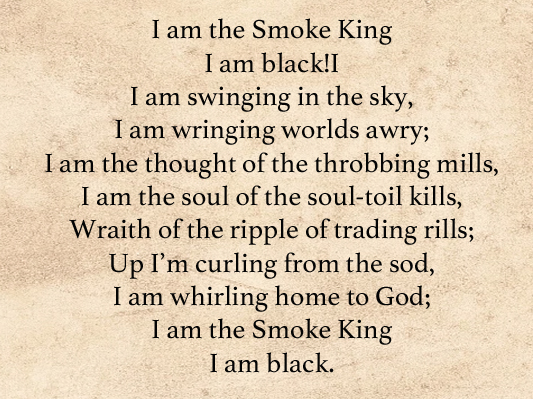
Titles of books and movies can be meaningless word pairings dreamed up by twenty-something publicists. Remember the scene in one of the Naked Gun movies at the Oscars? In the Best Picture shortlist were spoof films like Naked Attraction, Violent Lunch, Fatal Affair, Final Proposal, Basic Analysis..? So, what to make of Smoke Kings? A few moments spent on Google rewarded me with a poem written in 1905 by W.E.B. Du Bois.

Poem

The writer was an activist years ahead of his time, and by adapting his words, Jahmal Mayfield nails his colours to the mast, although his Amazon bio declares that Smoke Kings was inspired by Kimberly Jones’ passionate viral video, “How can we win?” After his cousin, Darius, has been been beaten to death by white teenagers, Nate plots his revenge. Rather than taking out the boys who killed his cousin, Nate targets the descendants of white men and women who, he argues, are responsible for lynchings, racist beatings and murders committed by their grandparents decades previously. Nate and three friends – Rachel, Isiah and Joshua – exact a kind of third party vengeance on a succession of targeted individuals. Most escape death only because they commit to paying sums of money every month to deserving causes in the black community.

Inevitably, the quartet bite off more than they can chew. One of their reprieved victims hires a former cop – Mason Farmer- on a ‘seek and destroy’ mission. He is freshly sacked from a private security firm after he fails to tick the right number of boxes on their Inclusion and Diversity check list, and he sets out to nail the quartet of avengers.

Nate  and  his buddies make another serious strategic error when they kill a random redneck called Chipper, and bury him in a remote grave. Sadly for them, Chipper’s brother Samuel is the charismatic leader of  a violently racist gang, and they are determined to avenge Chipper’s death.

Mayfield is at his most assured when describing the complex relationships between the four would-be avengers, and how they sometimes bicker about how black they actually are. Mason Farmer, too, has his preconceptions about race and identity tested when, while searching for Nate and company, he meets a mixed race woman – a campaigner for justice – called Elizabeth, and falls for her, despite her antipathy towards him. Farmer’s attitudes towards race and identity are already complicated, as his estranged daughter has a son by a black father.

The racist gang term themselves The Righteous Boys: they are deeply unpleasant, and live even worse lives:
“He drove on into the night, past fields of wild grass, old farmhouse buildings slumping like stacks of damp cardboard boxes, useless tractor equipment rusted the colour of dirty bricks. A forgotten and desolate wasteland. No wonder The Righteous Boys had chosen to call the area home.”

I read the novel pretty much back to back with re-reading a couple of Harlem Detectives novels by Chester Himes, and it left me wondering if someone had written A Rage In Harlem or The Real Cool Killers today, whether or not anyone would publish them, such is the glee with which Himes portrays the eccentricities and sometimes deeply venal nature of some of the characters. Smoke Kings is very different, as there is little ambiguity about where good and evil reside. The narrative of the book raises all kinds of very contemporary questions about ancestral guilt, both on an individual and national level. Smoke Kings is a breathless journey down the bumpy track that leads to revenge, and is published by Melville House, available now.

ARCADIA . . . Between the covers

Arcadia header

Psychopathy and comedy are not natural companions, but Guy Portman has this strange relationship down to a ‘T’ In his novels Necropolis (2014), Sepultura (2018) and Golgotha (2019) we followed the rise and fall of the elegant, analytical and ruthless killer Dyson Devereux. Then, in Emergence (2023), we learned that he had a love child. Well. let’s rephrase that. He had a child. The mother was a well-meaning but rather naive Antiguan social worker called Rakeesha Robinson and the youngster was christened Horatio.

Although Horatio never met his father he is, as they used to say, a chip off the old block. He is fascinated by trigonometry and algebra and is prone to instant acts of extreme violence, but also capable of meticulous planning to set up his deeds. An example of the latter was the way in which he disposed of mum’s loathsome boyfriend in Emergence. My review of that book described the killing in some detail, but as it caused me to be banned by Amazon, that’s all I will say here. You can find the hilarious details by clicking the link.

Seeking to give Horatio a new start, Rakeesha has taken him to Antigua, where the two of them are to stay with her extended family. Incidentally, as can sometimes happen with genetics, Horatio is as white as his father was, which makes him distinctive among the native Antiguans. He starts school, and soon establishes himself as brighter than average, but his Caribbean idyll is marred by the fact that he has to work weekends and holidays in his grandfather’s laundry centre, piling insanitary bedding from the tourist hotels into the washers, and then ironing the same hotels’ tablecloths with – as you would expect from Horatio – geometric precision.

arc filler017

As you might expect from our lad, he soon finds a way to boost his meagre wages from the laundromat. Antigua is full of low-rent tourists, many of who are anxious to score drugs, and Horatio finds that his innocent demeanour, coupled with his skin colour, enable him to establish a nice little business, buying product from a dissolute and disreputable dealer who lives in a shack just out of town, and then selling it to the European tourists (at a healthy profit).

Horatio, figuratively holding his nose when he goes to the dealer’s house, notices two things: first, a handgun badly hidden underneath a cushion and, second, a tin cash box in which the dealer keeps his cash. Putting these two observations to work allows Horatio to rid Antigua of a parasite and enrich himself to the tune of several thousand XCD (Eastern Caribbean Dollars) He also seizes an opportunity to exact revenge on a dimwitted local youth who has been harassing him.

Guy Portman is a wonderful satirist. He targets the cant, pomposity and box-ticking that have become ever-present backdrops to most people’s lives in Britain. In Horatio Robinson he has created a malevolent hero who continues to disprove Lincoln’s adage, in that – so far – he has managed to fool all of the people, and all of the time. However, like his late father, is his luck due to run out?

AN HONEST LIVING . . . Between the covers

ahl spine012

TAXONOMYThe current taxonomic system now has eight levels in its hierarchy, from lowest to highest, they are: species, genus, family, order, class, phylum, kingdom, domain.

I throw in this apparently random piece of information merely to suggest that An Honest Living does not fit easily into a genre, and many readers, especially of crime fiction, love genres and little compartments into which books can be placed.  This is the story of a New York lawyer, apparently the author himself, who becomes involved in a complex case involving arcane transcripts of historic legal cases. Sounds dull? Yes, probably, but the actual content transcends the banal description. This is, in no particular order, a love poem to a 2000s New York City that, two decades later, has all but disappeared. It is an account of a decent  man drawn into a complex conspiracy. It tells of men and women who, despite their elevated social status, can act with the  veniality and simple greed of lesser mortals.

Our man has left a well-paid corporate legal position to work for himself, trusting in his innate skills to keep the bills paid.  When he is hired by the estranged wife of a prominent bibliophile to denounce the man as a scoundrel, he accepts the case – and the bundle of high value notes – with alacrity. A few weeks later, when the man’s wife is exposed as a fraud – and Newton Reddick’s real wife appears on the scene, Murphy is in a world of trouble. As it happens, he gets away without being sued for libel, and he also gets to keep the cash. More importantly, however, he establishes a relationship with Anna Reddick, a successful author writing under the pseudonym AM Byrne.

When Newton Reddick is found hanged in a seedy hotel, matters take a distinctly sinister turn. Is there a connection with Anna Reddick’s father, a rich but not-entirely-honest businessman?

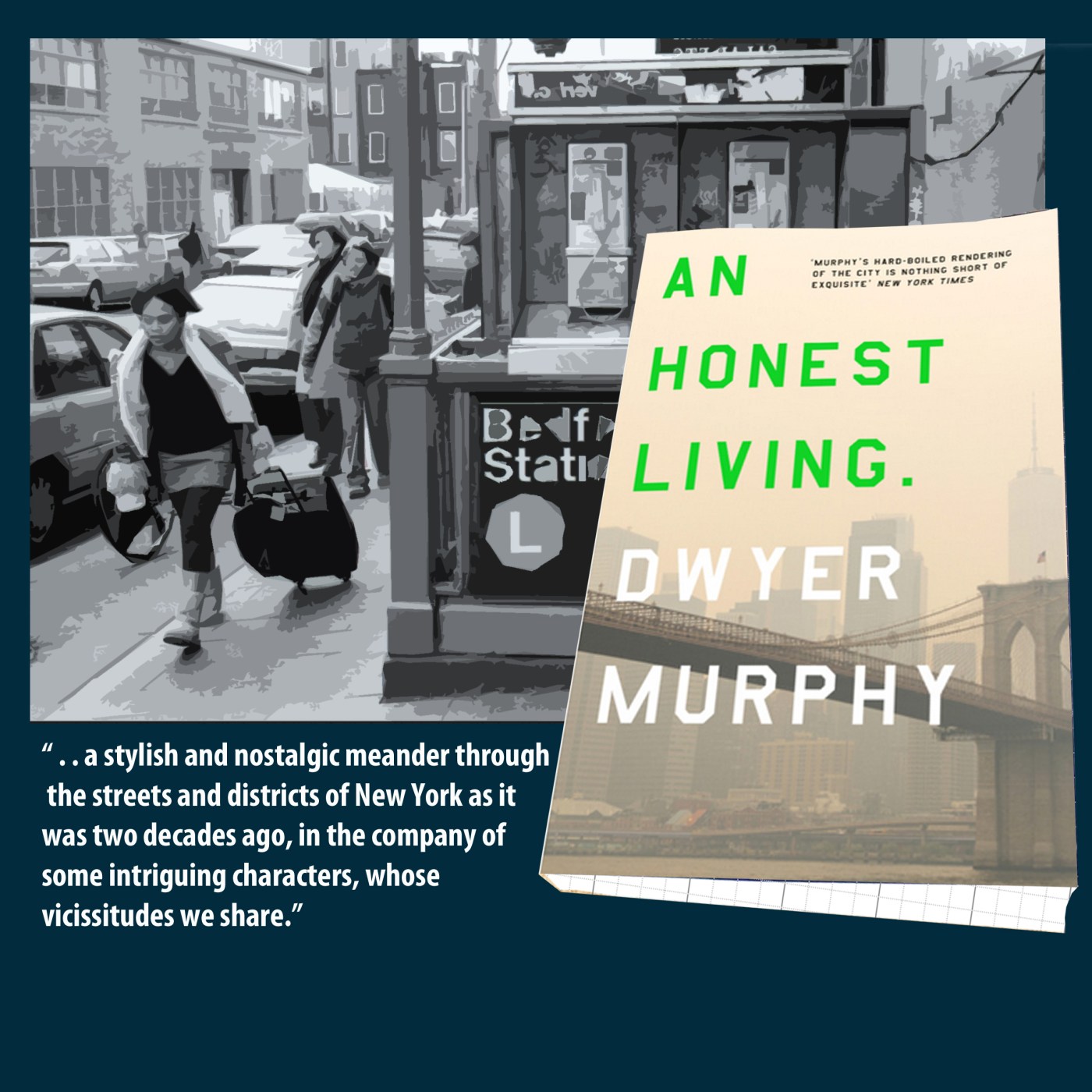
Although I enjoyed the book, I would take issue with the back cover blurb which calls the novel “hard-boiled”. If you are expecting anything resembling Noir as in, say, Jim Thompson, Ted Lewis or Derek Raymond you will not find it. This is much more delicate stuff and we are taken on a stylish and nostalgic meander through the streets and districts of New York as it was two decades ago, in the company of some intriguing characters, whose vicissitudes we share. Published by No Exit Press, this edition is available now.

Blog at WordPress.com.

Up ↑