
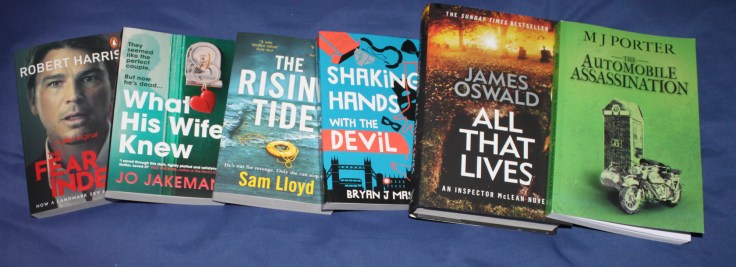

THE FEAR INDEX by Robert Harris
Harris is best-known for his best-selling historical novels such as Pompeii, Enigma, Fatherland and Munich, but here he is bang up to date with a thriller set in the cut-throat world of modern financial markets, where fortunes can be made and destroyed with a keystroke. Alex Hoffmann has developed an algorithm for playing the financial markets that generates billions of pounds – and feeds on one essential aspect of human nature – the tendency to panic. When his system is threatened by an intruder who breaches the elaborate security of his lakeside home, his life becomes a living nightmare of violence and paranoia. This is a new Penguin edition of the novel that originally came out in 2011, and is a tie-in with a forthcoming Sky mini-series.

WHAT HIS WIFE KNEW by Jo Jakeman
Domestic Noir seems to be the go-to genre these days, and this looks as though it ticks all those particular boxes. Beth’s husband Oscar has disappeared after leaving a scribbled note – which appears to be an apology for something. As she tries to unravel the mystery of his disappearance – and the mysterious apology – she becomes immersed in a nightmare of recrimination, revenge and betrayal. Jo Jakeman was bublished by Vintage, and will be available from 17th February

THE RISING TIDE by Sam Lloyd
The story centres on Lucy, one of those women crime writers love to put at the heart of their stories. She has the lot: a beautiful home high on the clifftops, a devoted husband and two beloved children. Then one morning, tit all goes pear-shaped. Their family yacht is recovered, abandoned far out at sea. Lucy’s husband is nowhere to be found and as the seconds tick by, she begins to wonder – what if he was the one who took the boat? And if so, where is he now? As a violent storm frustrates the rescue operation, Lucy pieces together what happened onboard. Then she makes a fresh discovery and it is one which makes a nightmare into a reality.
Sam Lloyd grew up in Hampshire, but now lives in Surrey with his wife, three young sons and a dog that likes to howl. His debut thriller, The Memory Wood, was published in 2020. Out on 17th February, The Rising Tide is published by Penguin.

SHAKING HANDS WITH THE DEVIL by Bryan J Mason
Set in the dying days of Margaret Thatcher’s premiership, this black – and bleakly funny – novel tells the tale of a Dennis Nilsen-like character who enjoys dismembering young men, and DCI Dave Hicks, a larger than life policeman determined to catch him. The killer – Clifton Gentle, DCI Hicks – and the next intended victim are on a collision course that Mason turns into a strange mixture of noir and slapstick.
This is from Vanguard Press and is available now

ALL THAT LIVES by James Oswald
I am a huge fan of the Inspector Tony McLean novels by James Oswald. I love the way that there is a often a subtle hint of the supernatural about these stories, and there is usually some connection with historical events, which draws me in like a magnet. In this case, an archaeological dig at the old South Leith parish kirkyard has turned up a mysterious body dating from around seven hundred years ago. Some suspect that this gruesome discovery is a sacrifice, placed there for a specific purpose. Then a second body is unearthed. This victim went missing only thirty years ago – but the similarities between her death and the ancient woman’s suggest something even more disturbing.
Drawn into the investigation, Inspector McLean finds himself torn between a worrying trend of violent drug-related deaths and uncovering what truly connects these bodies. When a third body is discovered, and too close for comfort, he begins to suspect dark purpose at play – and that whoever put them there is far from finished. Published by Wildfire, this will be out on 17th February

THE AUTOMOBILE ASSASSINATION by MJ Porter
I read, reviewed – and thoroughly enjoyed – the first book in this series, The Custard Corpses, and so I was delighted to see that Chief Inspector Mason of Birmingham’s Erdington Police is once more prevailed upon to solve a seemingly impossible case. Called to the local mortuary where a man’s body lies, shockingly bent double and lacking any form of identification, Mason and his assistant O’Rourke find themselves at Castle Bromwich aerodrome seeking answers that seem out of reach to them. The men and women of the royal air force stationed there are their prime suspects. Or are they? Was the man a spy, killed on the orders of some higher authority, or is the place his body was found irrelevant? And why do none of the men and women at the aerodrome recognise the dead man? From MJ Publishing, this is available now.


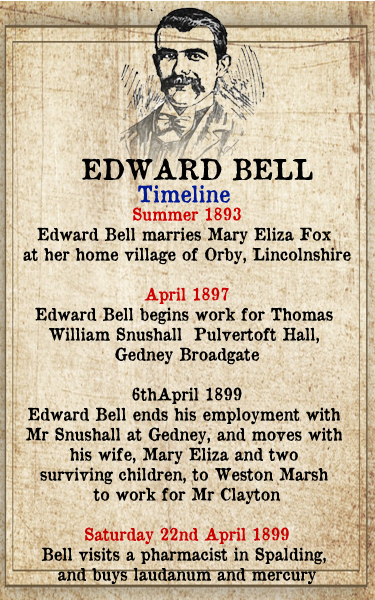
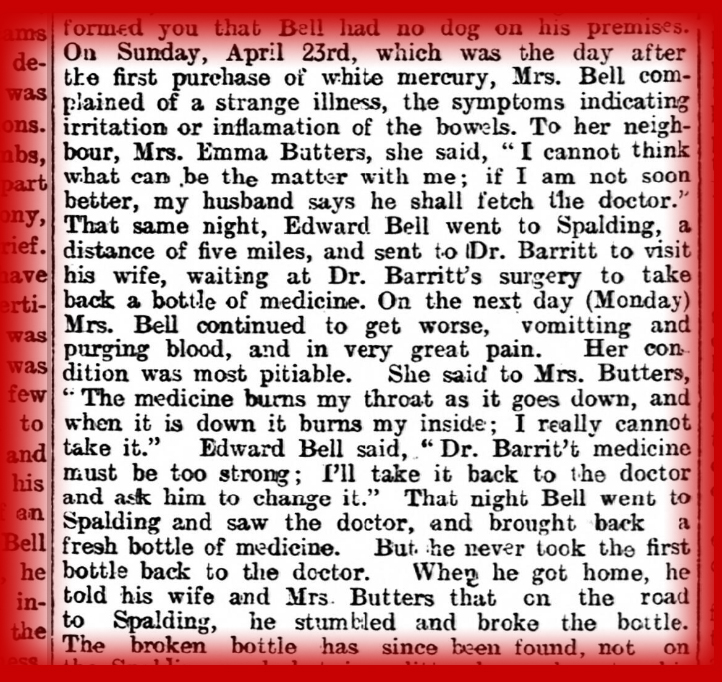

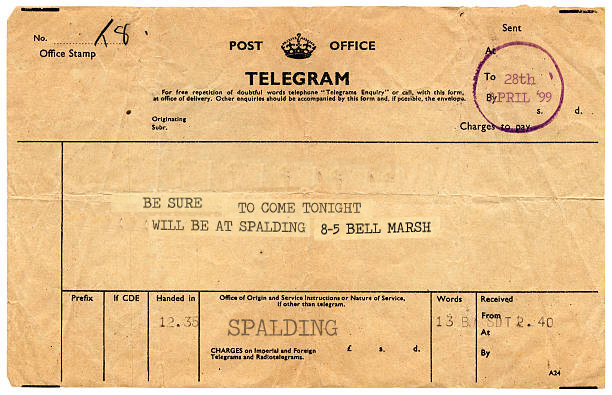

 Edward Bell clearly saw a golden future in the person of Mary Hodson, and all that stood in his way was the presence of his wife. On Saturday 22nd April, Bell walks into Spalding and visits a shop in Spalding. Its manager, Algernon Molson, represents the Talboy Herbal Remedies Company. Bell says he has two problems. Firstly, toothache, for which he buys a quantity of laudanum (a tincture of opium in wine), and a plague of rats, for which Mr Molson sells him some mercury. The following Monday, Bell returns to the shop, and buys more mercury. He says his rat problem hasn’t been solved, and so the obliging Mr Molson sells him some strychnine. Come Wednesday, Bell pays another visit to the Talboy Herbal Remedies Company and asks for some prussic acid, saying he needs to poison an ailing dog. Finally, Mr Molson says, “no”, but does sell Bell another dose of strychnine.


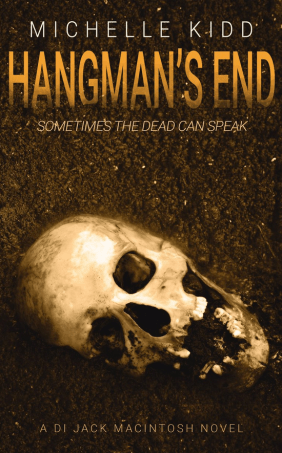 We have the advantage over the police in that we are introduced early on to the man who dropped the suitcase from the bridge into the mud. We are not sure if he is the actual slaughterman, or merely the butcher, but we do learn the whereabouts of the child’s head. The victim is soon identified as Maisie Lancaster, but a visit to her parents’ house brings MacIntosh into a collision with the metaphorical runaway car of one of his previous cases.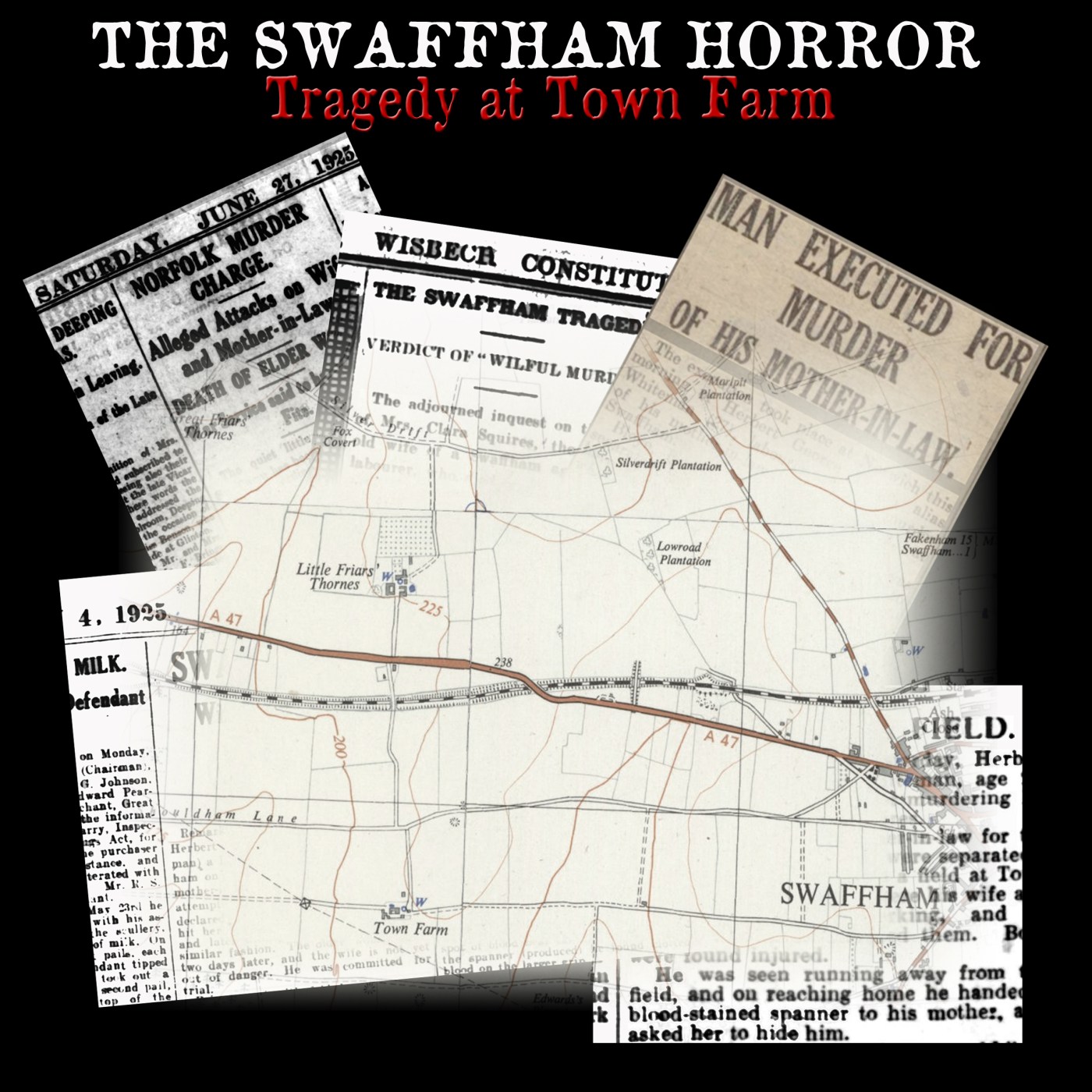
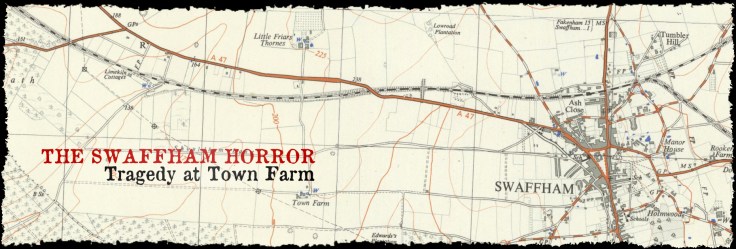


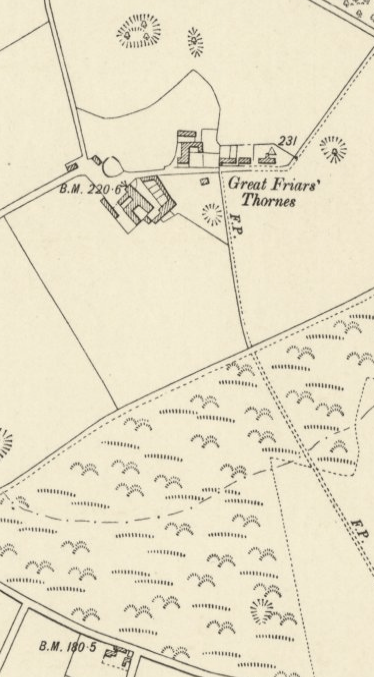 Meanwhile, what of George Whiteman? After the attack on the two women he had headed north across the railway line in the direction of his mother’s cottage near what was known as Great Friars Thornes. Mrs Whiteman was standing in the yard of the farm with another woman, Frances Turner, who later testified:
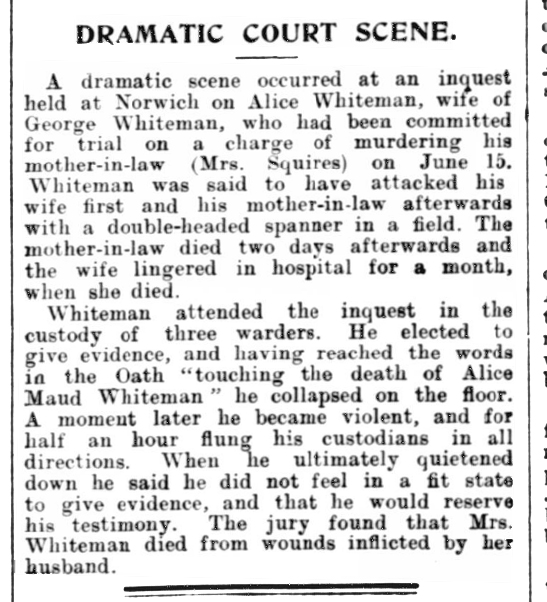


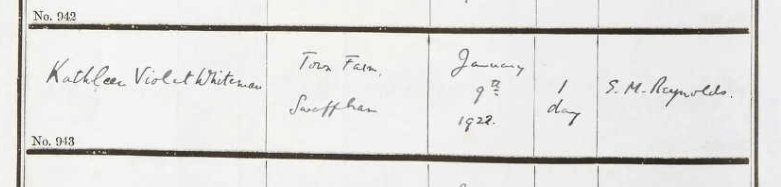
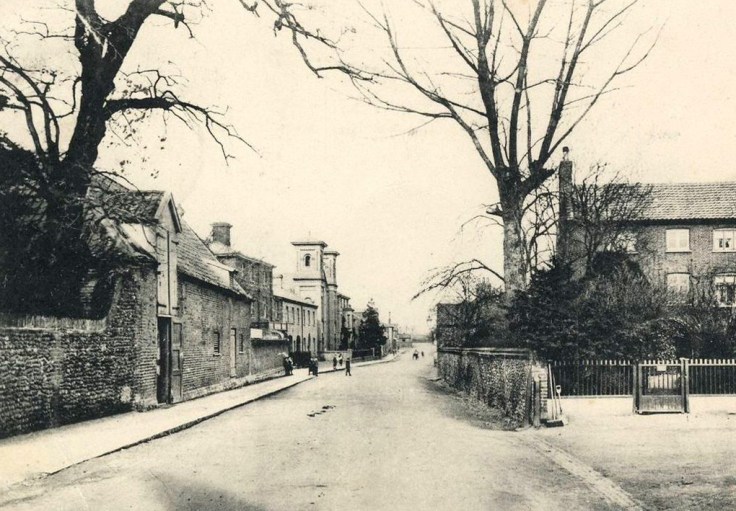
 There is more than one Town Farm near Swaffham, but I am certain that the one central to this story is the farm that sits on Shoemakers Lane. My reasons for this are that immediately after the terrible events of Monday 15th June, George Whiteman is described as making his escape across the railway line in the direction of his mother’s house at Great Thorne. Nothing else makes sense, so I am convinced that this is the correct location. In part two, I will describe the tragic events of that June day, and how justice was done in the case of George Whiteman’s mother in law, if not with regards to his young wife.


 fullybooked2017