 A FULL REVIEW of this debut novel by the Toronto writer will be coming up here before too long. In the meantime, follow this link to read extracts from the novel.
London E5 – the next ‘most desirable address in London’, or still Murder Central? For more than a decade, the streets around the outwardly unlovely Clapton Rd (Upper and Lower) have had a reputation even worse than its snaggle-toothed strip of down-at-heel takeaways, pond shops and other hard scrabble retail joints might suggest.
Of course, the borough of Hackney prides itself as being a very ‘right-on’ place to live. It has a high profile MP, and estate agents work night and day to suggest that it is full of ‘must-visit’ eateries and cafes, where slim chaps of a certain age are keen to be seen, alongside what the Hackney Post describes as “Macbook-tapping, gourmet coffee-swilling hipsters.”

The area has a lamentable history for violence. Just four of those killed in recent years are pictured below, left to right:
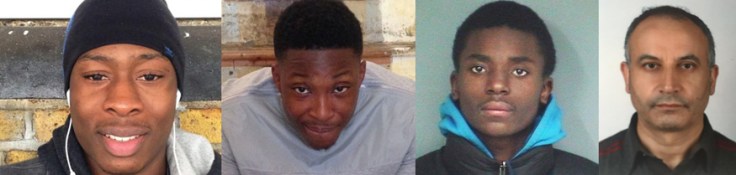
Prince Joseph Burke Monerville: On 16th February 2013, the 19 year-old was sitting in a car with his brothers, in Hindry Road, Clapton. Shots were fired into the car, and the teenager died after being taken to hospital. Scott Andrews, 27, and Roshane Reid, 20, from Hackney, were charged with the murder of Joseph Burke-Monerville and two counts of attempted murder, but later acquitted through lack of evidence.
Moses Fadairo: He was shot dead on 26th September 2015, in broad daylight, outside a butcher’s shop in Chatsworth Road. Christopher Erunse, 28, of Chalcombe Road in Greenwich, was sentenced to 18 years in prison for shooting the 25-year-old young father. His accomplice, Bradley Wynter, 28, of the Pembury Estate in Clapton, was jailed for five years for possession of a gun.
Jeremie Malenge: On 6th January 2015, the young man was lured to his death by a gang of youngsters, one of whom was just 14 years-old. He was stabbed to death in Ponsford Street. The ring-leader of the murder plot was Tariq William-Dawodu of Woodford. A young woman, Sanaa Sayed Ibrahim provided the sexual element in this killing, and she was the bait to trap Malenge. These two, plus Tre Morgan, and the 14 year-old, who was never named, were sentenced to a total sixty years in jail for the killing.
Mehmet Degirli: On Wednesday 8th June, 2016, the beaten and lifeless body of the Turkish father of two children was found in a car park. 20 year-old Mustafa Alparslan and Huseyin Akkoyun, aged 46, have been charged with Mr Degirli’s murder.
 If you are a law-abiding person who stays away from dubious places after dark, and you have a good security system in your home, Hackney is probably a safe place to live. Provided, however, you are prepared to take your chances when out shopping, or otherwise about your lawful business. If you are a writer or artist who likes the kudos of having an address in a place which is seen as rather dangerous, and ‘cutting edge’ (literally) then your aspirations will be fulfilled. If you’re an estate agent who is selling the area as a vibrant, safe and stimulating place to bring up a family, then best of luck with that one.
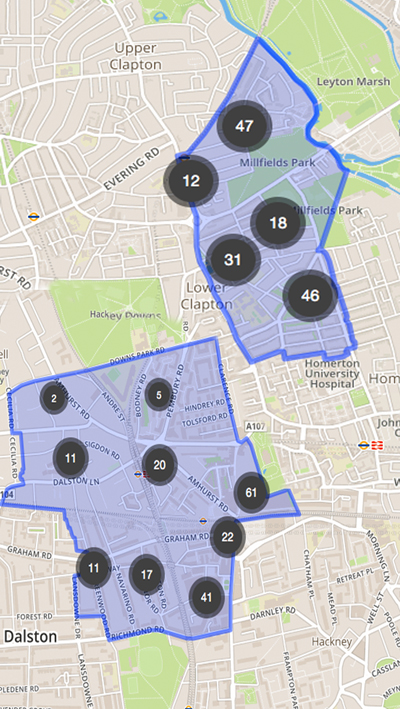
You can always type in the postcode on Police Crime Maps to see what the Metropolitan Police say is the current state of play. The live website can be accessed here, and here (left) is a graphic of what you might find. The numbers in the circles show all reported crimes for May 2016.
 WHEN YOU ARE OLD AND GREY – if not full of sleep, there will be times when images from youthful days reappear in the mind’s eye. When I was young, there was no internet, little television and, in terms of images, newspapers were King. Mostly, it is the faces of notorious criminals that I remember. Gunther Podola, long forgotten now, but at the time a notorious cop-killer; Harry Roberts, sneering out at us from the newsprint, while he evaded capture for so long; the baleful peroxide glare of Myra Hindley; the troubled but defiant ‘Jack The Lad’ face of James Hanratty. The one face, and figure, that entranced me most, however was the earliest – the sharp, brassy, night club features of Ruth Ellis.
 Ellis chose her path in adult life based on her natural vivacity and an appreciation that she could earn more from nude modelling and ‘clipping’ punters in a night club than she could by working in the typing pool or in a factory. As a child her home life had been chaotic, so she had developed the necessary survival skills to make her own way in the austere world of post-war Britain.
Ellis became manager of her own club, The Little Club, and it seems that the clientele included a number of ‘Tim-Nice-But-Dim’ gentlemen, products of minor public schools, but with aspirations way in excess of their capabilities. One such was David Blakely although, to be fair, his wealthy background meant he had attended (and failed at) one of the country’s top schools, Shrewsbury. His passion was racing cars, and although he would never come close to emulating the feats of his friend, Mike Hawthorne, his death could be viewed as equally tragic as that of Hawthorne, four years later.

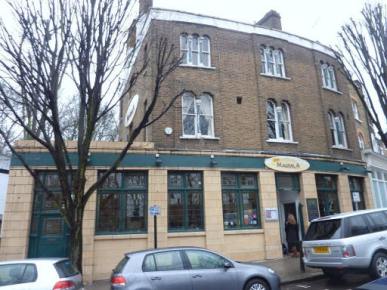 Ellis and Blakely became lovers, if not partners, but neither was faithful to the other. Blakely was physically violent; Ellis was violently jealous. On 10th April, 1955 – Easter Sunday – Ellis waylaid Blakely as he left a Hampstead pub, the Magdala. She shot him dead with a .38 Smith and Wesson revolver. Despite the day, there was to be no resurrection.
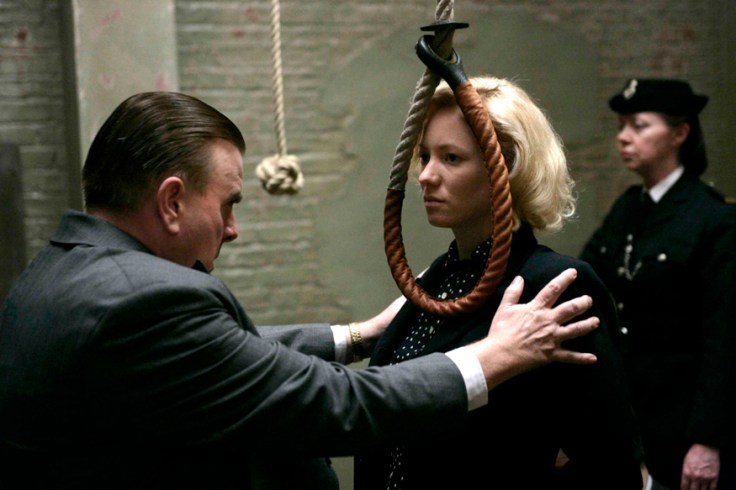
Ellis was arrested at the scene and made no attempt to deny her crime. The trial was something of a formality, and in 1955, the death sentence was mandatory for premeditated murder. Despite various attempts to have the sentence revoked, Ruth Ellis was hanged on Wednesday 13th July, 1955. The hangman was Albert Pierrepoint. (below, a scene from the film Pierrepoint: The Last Hangman, with Timothy Spall and Mary Stockley)
THERE ARE SOME MALEFACTORS down the years whose names only make us shudder because we know the deeds with which they have become associated. In themselves, they are just ordinary names, commonplace even. West, Brady, Hindley, Sutcliffe, Shipman, Haigh – take a look in your local telephone directory, and you will find them by the dozen, all, we assume, leading blameless lives. But our man here is something of an exception – Crippen. It has a nasty little bite to it, consonants crunching into vowels. Say it over. It sounds sinister, doesn’t it?
 Hawley Harvey Crippen was never a doctor, in the accepted sense. He was at best, a purveyor of quack medicines and homepathic cures to the gullible. He may even have been a backstreet abortionist, but that has never been proved. He was born in Michigan in 1862, but emigrated to England in 1897 with his second wife Cora. Cora was a second rate music hall entertainer and Crippen, tired of her charms, took up with a young typist named Ethel Le Neve.
In 1910, Cora disappeared. Crippen claimed that she had left him and returned to America. Ethel Le Neve was duly installed in her place at 39 Hilldrop Crescent, Hollway (sketch, right). A friend of Cora 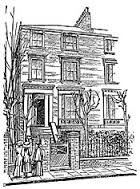 Crippen eventually raised the alarm, as she suspected foul play. The house was searched, and nothing was found. Crippen and Le Neve, however, were spooked, and fled to the continent, where they bought a passage on a steamer bound for Canada.
The guilty couple’s disappearance triggered more exhaustive searches of the house and , eventually, the remains of a woman were found under the basement floor. The discovery filled newspapers around the English speaking world. Meanwhile, on board the SS Montrose, Le Neve had cropped her hair and disguised herself as a boy, but the Captain had his doubts and sent a radio telegram to Britain. With great alacrity Chief Inspector Walter Dew, no doubt smarting that he had accepted Crippen’s earlier story at face value, took an express boat to Canada, and arrived in Quebec before the SS Montrose.
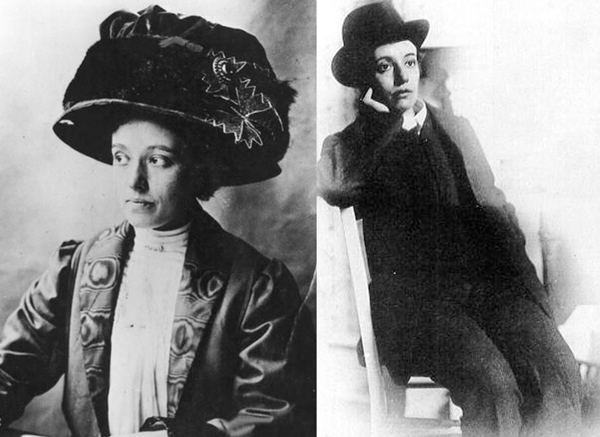
Crippen and his ‘boy’ were duly arrested, brought back to England, and were duly tried. Crippen was found guilty and was hanged at Pentonville Prison on 23rd November 1910. Le Neve? She escaped with a minor conviction and left for Canada on the morning of her lover’s execution. The mundane is never far away in these dramas, however, and Le Neve returned to England, changed her name, and died in relative obscurity in 1967, in Croydon of all places. Below is a composite of Ethel Le Neve contrasting her feminine and boyish modes.
Further reading:
Dr Crippen by Katherine Watson
The Mild Murderer: The True Story of the Dr. Crippen Case by Tom Cullen

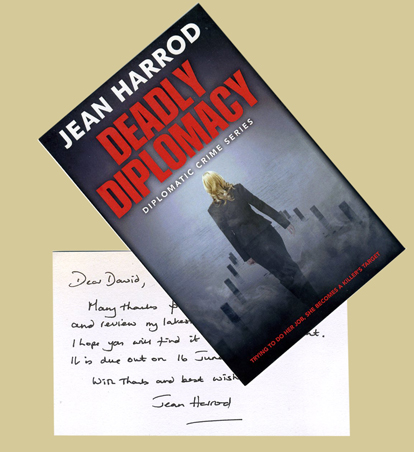
In a former life Jean Harrod was a British diplomat who served all over the world. One hopes that she gave the lie to Sir Henry Wotton’s famous assertion that a diplomat was “an honest gentleman sent to lie abroad for the good of his country.” Now she has retired from that demanding role, and is free to give full reign to her vivid imagination.
She has settled in Yorkshire, and in addition to writing plays, she has embarked on a series of crime thrillers featuring British career diplomat Jess Turner. The second of these is Deadly Deceit, and opens with Turner being sent to the seemingly exotic British Overseas Territory of the Turks and Caicos Islands, TCI for short.
She is on a troubleshooting mission, as the Governor has been involved in a mysterious near-fatal car accident, and someone with the proverbial ‘safe pair of hands’ is required to step into the breach.
Crime fiction has a much used trope – that of ‘The Odd Couple’. Nothing to do with Neil Simon’s immortal characters, of course, but think of Holmes and Watson, Wolfe and Goodwin, Dalziel and Pascoe, Morse and Lewis. They tolerate, irritate, admire and, occasionally, infuriate each other, but the device allows writers to have great fun with the law of opposites. Readers were introduced to Jess Turner’s ‘other half’ in the first book in the series, Deadly Diplomacy. He is Queensland cop DI Tom Sangster. As you might expect, in order to be a foil for the urbane and sleek Turner, he has to be a bit of a rough diamond. Sangster is no fool, however, as his crime clear-up rate testifies.
Given the fact that Turner and Sangster live worlds apart, Jean Harrod will have to continue coming up with convincing reasons for them to meet up. In this case, it is TCI’s proximity to the stricken island republic of Haiti. Boatloads of Haitian migrants are arriving on TCI, and the patience and compassion of the locals has been wearing pretty thin. Sangster’s homeland has its own problems with ‘illegals’ of course, and he has been attending a conference in Miami – a short flight from TCI – with US Immigration officials.
Turner and Sangster uncover a nasty racket in people smuggling, which involves not just shady villains down at the waterfront, but some very eminent people. Although there are a couple of grisly killings, and a very convincing description of a tropical hurricane, I would class this novel as a romantic thriller. It’s none the worse for that, however, and it makes a refreshing change to have central characters who are neither near-alcoholics, black-humoured nor self destructive. I have not had the pleasure of meeting the author, but I suspect that there is a little something autobiographical about Jess Turner. Deadly Deceit is out now. Buy now on Amazon.
WRITERS OF GORY CRIME NOVELS need a fertile – if not downright disturbing – imagination, but it is difficult to think of anyone who could have invented Dennis Nilsen. Between 1978 and 1983 he murdered – and then butchered – a series of young men who had been lured into his houses, 195 Melrose Avenue and 23 Cranley Gardens. On the face of it, the two properties (below) couldn’t look less sinister if they tried.

Both houses are harmless suburbia writ large. They might be the subject of a gently mocking John Betjeman poem, but Houses of Horror – surely not? Think again!
 Nilsen (left) preyed on young men who were often lost and alone in London. He murdered them, so he claims, so that they would not leave him. To ensure their continuing post-mortem presence, he would wrap their bodies in polythene and conceal them beneath the floorboards, regularly spraying with with deodorant as the corpses putrified. When he tired of this game, he would dismember what was left of his young victims, and then try to dispose of the body parts via the toilet. Sometimes, when this was too difficult, the limbs were boiled to remove the flesh, thus making disposal more straightforward. When he had access to a garden space, at Melrose Avenue, many of the victims were eventually consumed by that most normal of activities – the garden bonfire.
Nilsen’s catalogue of horror closed in 1983 when an employee of Dyno Rod discovered the cause of the smell and the drain blockages near the house in Cranley Gardens. Nilsen was duly arrested, and confessed to the murders. At his trial, the only major dispute was the question of his sanity, and his fitness to stand trial. He was found guilty of six counts of murder and one of attempted murder.He was sentenced to life imprisonment with a minimum stipulation of twenty five years. It would be a brave – or suicidal – Home Secretary who would ever agree to his release.
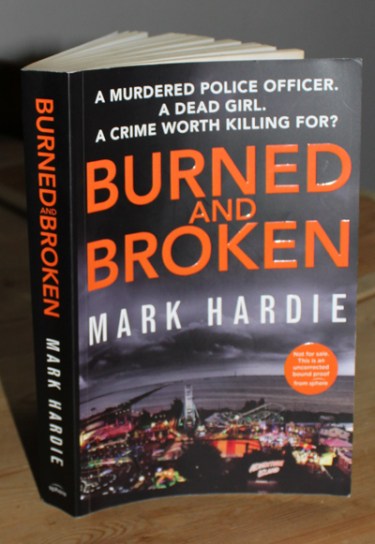
Burned And Broken, by Mark Hardie. UK readers will be yawningly familiar with jokes about Essex. They usually involve insults about dim women, taste in clothes, and a prediliction for gaudy jewellery. For the uninitiated, Essex is a county north of the River Thames and east of London. This debut novel from Mark Hardie is set in the Essex seaside town of Southend, for generations the closest and most accessible chance for millions of Londoners to sample sea air, have a ride on the donkeys, and paddle in the sea. If we are being pernickerty we could say the waters lapping around the paddlers’ ankles are actually those of the Thames Estuary, rather than the North Sea, but hey-ho, let’s move on.
DC Cat Russell and her senior partner DS Frank Pearson are caught up in several investigations which seem to be connected. Most headline-worthy is the apparent immolation, in his car, of another copper – DI Sean Carragher. Russell has worked with him, and when Professional Standards come calling, she is in the hot seat. Another case which appears to be linked is the earlier death of a troubled teenage girl, alumnus of a since-closed children’s home. When the erstwhile director of that home is found swinging gently from a rope, on the scaffolding outside a sleazy nightclub, alarm bells ought to start ringing, but they are muted.
Donna Freeman was a friend of Alicia Goode, the dead girl, and a fellow graduate of the Abigail Burnett Children’s Home. She is convinced that Alicia was murdered, and in the rare moments when her head is clear of drugs, she is determined to find Justice for Alicia.
Of the two principal coppers, Frank Pearson is, by a long chalk, the most convincingly drawn. We sweat with him as he waits for the results of his latest biopsy. He is sure he has some awful cancer of the urinary tract, and struggles to conceal from his colleagues his frequent trips to the police station loo. We know he mourns a suicidal wife, and that he has pretensions to be a saxophonist, but these ambitions are restricted to the equivalent of his own private karaoke.
This book is, at its heart, a police procedural, so we are presented with the standard set of questions. Was Sean Carragher murdered? Was he the worst sort of bent copper? Does Donna have a serious point to prove about her dead friend? What dark secrets lay behind the closure of the children’s home? Hardie answers all of these questions eventually, and although the chronologically disjointed narrative takes a while to bed in, it is, eventually, successful.
This is a fine debut, and it often bounces above the safety net of the standard murder mystery. Hardie adds a dash of noir to the proceedings, and although he has many a mile to travel in the footsteps of The Master, there are touches of the nihilism of Derek Raymond in Hardie’s prose.
Burned And Broken was published on 23 June, and is available from all good booksellers, and from Amazon via this link.
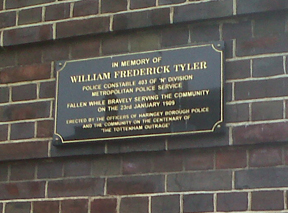
ON 23rd JANUARY 1909 two Eastern European anarchists robbed a car containing the weekly wages for a Tottenham factory. The robbery took place within sight and sound of Tottenham police station, and an old fashioned hue and cry followed. The two robbers, Paul Helfeld and Jacob Lepidus, were armed with modern repeating handguns, but the pursuers – a random collection of policemen and members of the public – had no comparable firepower. What might have been high comedy turned into tragedy as first a ten year-old boy, Ralph Joscelyne, and then police Constable Tyler, were shot dead. After a chase extending miles across nearby streets and open ground, both robbers came to a violent end. First Helfeld was mortally wounded, and died later in hospital, and then Lepidus died, probably by his own hand, in the bedroom of a tiny cottage in Hale End, Walthamstow.
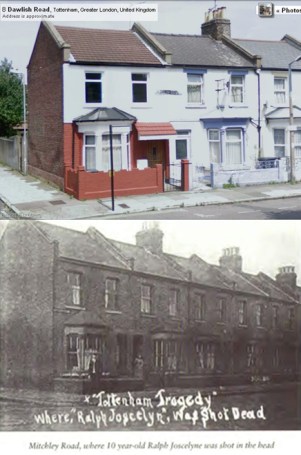 (Left) The spot where Ralph Jocelyne was killed, then and now.
(Below) The plaque commemorating the death of PC William Tyler. It can seen on the wall of Tottenham police station, just yards away from where the initial robbery took place.
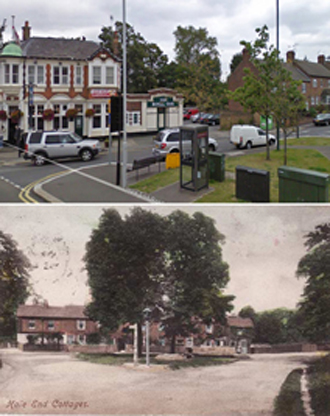 Oak Cottage, where the Tottenham Outrage ended, has long gone, but a ‘a then and now’ picture reminds us of what it looked like. It would have stood to the right of the existing pub, which is called The Royal Oak.

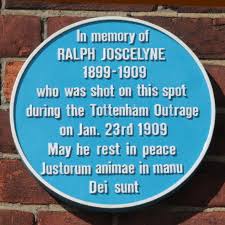
Poor Ralph Joscelyne shared the huge public funeral accorded to the murdered policeman, and a plaque to his memory was unveiled recently. It is on the wall of a little church in the street where the unfortunate child met his untimely end.
The activities of politically motivated refugees from Eastern Europe were to be brought even more fully into the public spotlight two years later, when another gang of desperados committed a botched raid on a jeweller’s shop in Houndsditch. Again, there were fatalities, but the consequence of the raid were even more dramatic, as they culminated in The Siege of Sidney Street.
Further reading:
The Houndsditch Murders by Donald Rumbelow
Edwardian Gun Crime and The Tottenham Outrage by Claire Eastwood
Outrage! An Edwardian Tragedy by Janet Harris
The map and annotations below are taken from Janet Harris’s excellent little book on that desperate day in Tottenham’s history.


WELCOME TO FULLY BOOKED! If you are a fan of crime writing – old, new, true or fiction – you should find something to entertain you here. Among the regular features will be a focus on real life crimes, both in the UK and further afield, the classic fiction of The Golden Age, and the latest new releases from top authors and publishers. You can also find us on Twitter and Facebook by clicking the buttons.


CHECK OUT A SELECTION of our best graphics – covers, descriptions and images relating to crime novels. A click on the Pinterest icon will take you straight there!

We’re also on Tumblr …

To hell with raindrops on roses and whiskers on kittens –
these are a few of MY favourite things –


 fullybooked2017