
Search

fullybooked2017

Tag

WW2

THE BARRAGE BODY . . . Between the covers

It is December, 1944, and we are in the Birmingham suburb of Erdington. Further afield, and quite unknown to both the residents of Erdington and the American soldiers shivering in their foxholes in the Ardennes Forest, Hitler is about to launch his last desperate gamble in what would come to be known as the Battle of The Bulge. In Erdington, war-wise, things are relatively quiet, but a barrage balloon unit, staffed by young women of that WAAF, is parked up at the Dunlop rubber factory, commonly known as Fort Dunlop.

It is here that Detective Chief Inspector Sam Mason is summoned, initially to investigate what appears to be a case of malicious communications, but things escalate rapidly. First it seems that someone has stolen vital blueprints for new and improved tyres for Lancaster bombers, and then, a body is discovered tethered to a barrage balloon which has unaccountably broken free.

Mason has a veritable 2000 piece jigsaw to put together. So many questions. Who was the man found dead in the barrage balloon cables? Why was jack-the-lad teenager Simon Samuels found in a similar position? What is the connection to Samuels’ father, a guard at a Staffordshire POW camp. Painstakingly, Mason and his redoubtable Sergeant O’Rourke have to move the pieces one by one until they begin to make a recognisable picture.

Sam Mason is quite unlike most British coppers in contemporary CriFi, partly because of the era in which was working. Because it is the 1940s we are quite content for him to rather stolid, happily married, prone to the aches and pains of late middle age. His deceptively gentle and slow-moving approach masks a sharp mind and a critical eye for detail. Here, he patiently absorbs the facts of a strange case, and delivers the goods.

This is the fourth Erdington Mystery. I enjoyed and reviewed the first of them, The Custard Corpses. The series couldn’t be more different from the books for which Porter is, perhaps, better known – dramatic swords, shields and helmets dramas from Saxon and Norman times. The books have one thing in common, however, and that is the setting – Mercia, the ancient kingdom we would now call The Midlands where, incidentally, Porter was born and brought up. The Barrage Body is original, inventive, nostalgic, absorbing, and I loved it. Published by MJ Publishing, it is available now.

MURDER IN PARIS . . . Between the covers

It is April 1945, and we are in Paris. The fighting has long since moved east, but the consequences of the previous four years are very evident. Charles de Gaulle has marched at the head of his victory parade, convincing some (but not all) that he had liberated France entirely on his own. Across the country, collaborators are being executed, and the women who consorted too freely with Germans are being roughly dealt with. In the gaol at Fresnes are several women who have been liberated from Ravensbruck. They all claim to be victims of the Nazis, but are some of them not who they say they are?

Frederick Rowlands has been brought to Paris by Iris Barnes, an MI6 officer, to confirm – or refute – the identity of a woman he once knew in the days before he lost his sight. He meets Clara Metzner. She is skin and bone, after her incarceration in Ravensbruck, and he is uncertain. The next day, she is found dead in her cell, apparently haven taken her own life.

Fictional detectives seem to be perfectly able to do their jobs despite various physical and mental conditions which might be regarded as disabilities. Nero Wolfe was too obese to leave his apartment, Lincoln Rhyme is quadriplegic, Fiona Griffiths has Cotard’s syndrome, while George Cross is autistic. Christina Koning’s Frederick Rowlands isn’t the first blind detective, of course, as Ernest Bramah’s Max Carrados stories entranced readers over a century ago.

The febrile atmosphere and often uneasy ‘peace’ in Paris is vividly described, and we even have some thinly disguised real life characters with walk-on parts, such as Ernest Hemingway, Martha Gellhorn, Pablo Picasso, Edith Piaf, Samuel Beckett, Gertrude Stein and Wyndham Lewis.

As Rowlands and Barnes seem to be clutching at straws as they try to identify the girl who was murdered – a shock induced heart failure, according to the autopsy – the plot spins off at a tangent. Lady Celia, a member of the Irish aristocracy, asks Rowlands to trace a young man, Sebastian Gogarty, a former employee, who was last heard of as a POW in Silesia. He agrees, and as he and Major Cochrane, one of Lady Celia’s admirers head off on their search, they drive through a very different France. Paris, largely untouched by street fighting or bombs, is in stark contrast to the countryside further east, devastated by the retreating Germans. Gogarty has been living with a group of Maquis, but he returns to Paris after telling Rowlands and Cochrane about the execution of four female resistance members in his camp.

There is an interlude, tenderly described when, after failing to resolve issues in France, Rowlands returns to England. During the elation of VE Day, he recalls a more sombre occasion.

“He remembered standing in a crowd in Trafalgar Square as large as this one. It had been on Armistice Day, 1919. That had been a silent crowd, all the more impressive because of its silence. There had been no cheers, no flag waving as there was now. When the maroon sounded, the transformation was immediate. The roar of traffic died. All the men removed their hats. Men and women stood with heads bowed, unmoving. For fully two minutes the silence was maintained then and across the country. Everyone and everything stopped. Buses, trains, trams, and horse-drawn vehicles halted. Factories ceased working, as did offices, shops, hospitals and banks. Schools became silent. Court proceedings came to a standstill. Prisoners stood to attention in their cells. Only the sound of a muffled bell tolling the hour of eleven broke the silence.”

Rowlands and his family reconcile themselves to leaving their temporary home in Brighton for their bomb damaged home in London, but there is much work to be done. When not involved in investigations, Rowlands has worked with St Dunstan’s, the charity set up to employ blind veterans. Now, with tens of thousands of able-bodied military people being demobbed, will there still be work for them?

The action reverts to Paris, wth Rowlands returning, accompanied by young Jewish man, Clara Meltzner’s brother. It becomes increasingly obvious that some organisation is determined to prevent the true identity of the young woman murdered in Fresnes gaol being revealed. Rowland’s problem is that, despite the Germans no longer being physically present, everyone is at each other’s throats – the rival Résistance groups, Gaullists, communists, Nazi sympathisers – each has much to lose, and violence has become a way of life.

Christina Koning’s spirited account of a Paris springtime takes in so many evocative locations – Le cimetière du Père-Lachaise, the sinister depths of the Catacombs, the newly bustling shops fragrant with fresh baked bread and ripe fromage – that we are transported into another world. Murder in Paris will be published by Allison & Busby on 20th November.


APPOINTMENT IN PARIS . . . Between the covers

London, spring 1940. The ailing Neville Chamberlain is still Prime Minister, Hitler has rampaged through Poland and Czechoslovakia, and Winston Churchill is First Lord of The Admiralty, licking his wounds after his attempt to thwart the Nazi occupation of Norway.

Former intelligence agent Stella Fry is working in a quiet backwater of the war effort, a documentary film unit. She is headhunted by MI5 after a German  prisoner of war named Fassbinder is murdered in a high security interrogation unit. Why Stella? The main suspect in the killing is Robert Handel,  Stella’s erstwhile colleague at Oxford. Also working “off the books” for MI5 is a rumpled but effective former colleague of Stella’s, Harry Fox, now scratching a living as a private investigator. He and Stella’s earlier encounter can be found in Midnight in Vienna (2024).

The powers that be believe that Handel has fled to Paris, where his sister runs a bookshop. Stella is despatched to find him, and this allows Jane Thynne to pen a few evocative pages describing the French capital on the brink of a national disaster, but still behaving with its customary panache and insouciance. After a brief meeting with a certain Noel Coward, secretly working for British Intelligence, Stella, rather than finding Handel, is found by him, as he is now deeply embedded with the fledgling French resistance movement, already organising itself for the inevitable arrival of the Nazis. He denies any responsibility for Fassbinder’s murder and, after a passionate evening in Handel’s room, the couple awake to the news that Hitler has invaded Belgium, Luxemburg and Holland. Handel bundles Stella onto a crowded train bound for the Channel, and amid crowds of terrified refugees, she eventually arrives in Dover.

Meanwhile, Harry Fox has become entangled with a classic femme fatale who calls herself Lisselotte Edelman. It could be said that Harry is not a perfect gentleman for, while Lisselotte is gently snoring in his bed after a passionate encounter, he investigates her handbag, where, beneath the usual feminine fripperies, he finds a handgun, an Enfield No.3 MK1 .38 calibre, the same gun that shot Harry is also a veteran of The Great War, and sometimes his dreams are shot through with the horrors that his eighteen-year-old self endured at Mametz Wood.

I must declare an interest here. I am a sucker for novels set during WW2 and, all the more so if they are grounded in London. I ‘missed’ the war by a considerable distance, being born in 1947, but my childhood was shot through with reminders. I recall playing with old ration books and remember my father being laid low with occasional bouts of the malaria he had contracted in North Africa. In my teens I admired the old soldiers who had survived the Great War. They are all long since gone, as are all but a few of the men of my father’s generation. Jane Thynne captures the uncertain times of the early 1940s with uncanny accuracy, and she can stand shoulder to shoulder with fellow contemporary writers like John Lawton who have brought those troubled times so vividly to life.

Jane Thynne weaves a complex web of assumed identities, the dark arts of espionage and complex international politics, in particular the ambiguous relationship between Britain and the United States. She still finds space for some Brief Encounter-style romance, and some delightful cultural references, my favourite being the reference to a quiet Cotswold railway station (think a poet who died at Arras in 1917) Appointment in Paris is a delightful and complex journey into a fascinating period of our history. It was published by Quercus on 4th September.

CLASSICS REVISITED . . . Journey Into Fear

Eric Ambler (1909 – 1998) was one of the finest story-tellers of the middle years of the 20thC, and he had a profound influence on later writers of the espionage thriller, such as Le Carré, Fleming and Deighton. When I revisited The Mask of Dimitrios (1939) I remarked that in those days, Istanbul still carried the aura of the exotic but dangerous place where east-meets-west. Central character Mr Graham is an engineer who works for a British armaments corporation, and has been sent to Istanbul on a business deal. The trip has been successful, but on the evening before his return to England his host insists on taking him to a nightclub. You could pick virtually any paragraph from the book as an example of Ambler’s skill, but I liked this particular description of a suspicious customer at the club:

“He was a short, thin man with a stupid face, very bony with large nostrils, prominent cheekbones and full lips pressed together as if he had sore gums or were trying to keep his temper. He was intensely pale and his small deep-set eyes and thinning curly hair seemed in consequence darker than they were. The hair was plastered in streaks across his skull. He wore a crumpled brown suit with lumpy padded shoulders, a soft shirt with an almost invisible collar and a new grey tie.”

Returning to his hotel in the small hours, Graham unlocks his room. Mayhem ensues. Three shots ring out, one of which takes a chunk out of his hand. The gunman escapes, and in the fallout from the incident, Graham is taken to meet the sinister chief of Istanbul’s secret police. He is told that this wasn’t a robbery gone wrong, but an attempt on his life. Why is he so important? As an expert in the ballistics of naval guns, he has information that Germany would prefer not to be spread further, and so if his knowledge dies with him, then so be it. Historical note: despite its alliance with Germany in the Great War, Turkey remained resolutely neutral in WW2, despite a token declaration of war against the Axis in February 1945.

Graham’s planned return journey by rail is aborted, and he is put on an Italian cargo ship bound for Genoa, on the grounds that he will be safe there. After a brief stop in Athens, Graham is appalled to see the the Sestri Levante has a new passenger – the man from the Istanbul nightclub and, presumably, the person who tried to kill him.

The real threat to Graham comes not from the nightclub man but from an elderly archaeologist called Haller, whose long winded monologues about Sumerian funerary rites have made meal times such a bore for the other passengers. Haller is, in fact, a Nazi agent called Moeller, who has been trying – to use chess metaphor – to wipe Graham’s knight off the board for several weeks. This is one of those novels, all too easily parodied, where no-one is who they claim to be. It is from what was, in some ways, a simpler age, where storytellers just told the story, with no ‘special effects’ like multiple time frames and constant changes of narrator.

The book is quintessentially English. We are left pretty much to our own devices to decide what Graham even looked like. We don’t even know his Christian name, but neither do we need to. The novel was filmed in 1943, but Americanised. It had a decent cast, with Joseph Cotton as Graham, but by then, America had been at war for two years, and the whole political and diplomatic background had shifted. It may – or may not – be a decent film but, looking at the plot online, I probably will not bother. Back to the book. Graham, until the last few pages ponders his fate and, like a twentieth century Hamlet, he ‘suffers the slings and arrows of outrageous fortune.’ When he does take decisive action it is violent, and he certainly does ‘take arms against a sea of troubles.’ This Penguin edition was published in 2023.

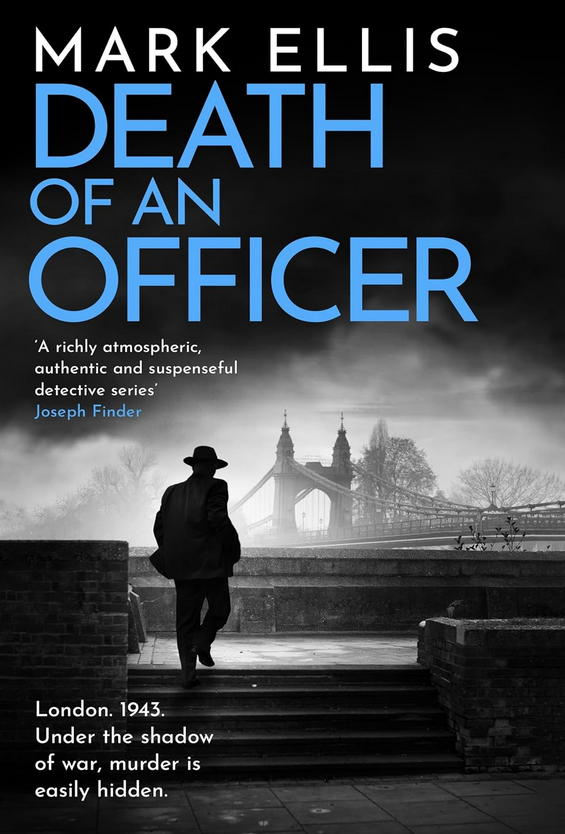
DEATH OF AN OFFICER . . . Between the covers

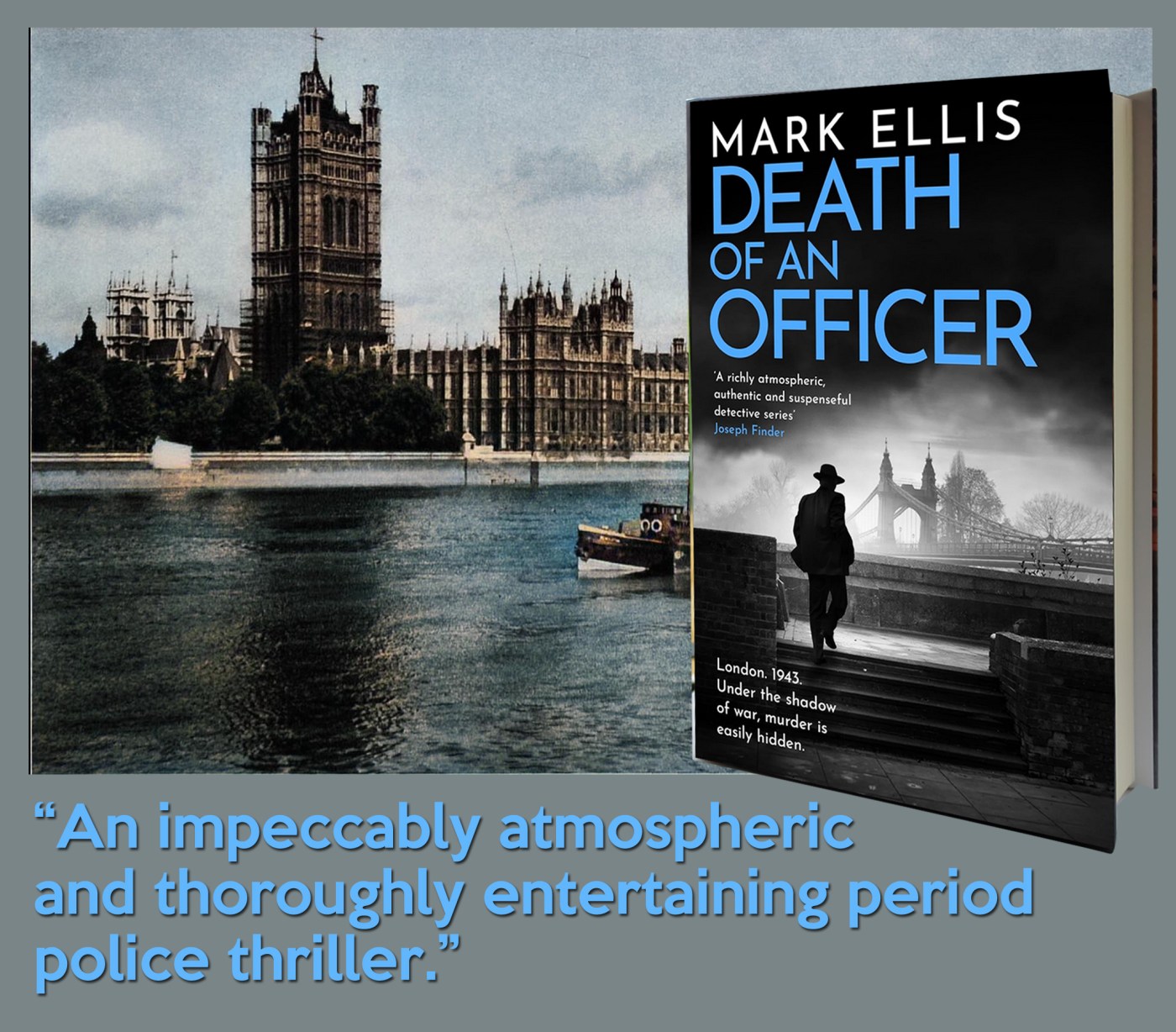
Detective Chief Inspector Frank (christened Francisco) Merlin is a thoroughly likeable and convincing central character in this murder mystery, set in 1943 London. As in all good police novels, there is more than one murder. The first we are privy to is that of a seemingly inoffensive consultant surgeon, Mr Dev Sinha, found dead in his bedroom, apparently bludgeoned with a hefty statue of Ganesha, the Hindu elephant god. Sinha’s wife has been diagnosed with a serious mental illness, and has been packed off to an institution near Coventry ( no jokes please) but when she is interviewed she is more lucid than those around her have been led to believe.

Added to Merlin’s list of corpses is that of south London scrap dealer called  Reg Mayhew, apparently victim of the delayed detonation of a German bomb. Unfortunately for the investigators, the word ‘corpse’, suggesting an intact body, is misleading. Mayhew’s proximity to the blast has given the lie to the old adage about someone’s inability to be in two places at once.

Clumsily concealed beneath bomb site rubble in the East End is the well-dressed (evening attire and dress shirt) remains of Andrew Corrigan, a Major in the US army. It seems he was a ‘friend’ of a rich and influential MP, Malcolm Trenton. 

Merlin’s investigations take him towards the contentious issue of Indian independence, and it seems that the murdered consultant was a member of a committee comprising prominent British Indians who support Subhas Chandra Bose, a firebrand nationalist who is seeking support from Nazi Germany and Japan, in the belief that they would win the war, and then look favourably on an independent India.

Like all good historical novelists, Mark Ellis has done his homework to make sure we feel we are in the London of spring 1943. We are aware of the recent Bethnal Green Tube disaster, that Mr Attlee is a key member of Churchill’s coalition government, and that a Dulwich College alumni has just had his latest novel, The Lady in the Lake, published. We also know that the Americans are in town. As Caruso sang in 1917, the boys are definitely ‘Over There!‘Among the 1943 intake is Bernie Goldberg, a grizzled American cop, now attached to Eisenhower’s London staff.

I am old, but not so ancient that I can remember WW2 London. Many fine writers, including Evelyn Waugh in his Sword of Honour trilogy, and John Lawton with his Fred Troy novels, have set the scene and established the atmosphere of those times, and Mark Ellis treads in very worthy footsteps. There is the dismal food, the ever present danger of air raids, the sheer density of the evening darkness and the constant reminder of sons, brothers and husbands risking their lives hundreds of miles away. Ellis also reminds us that for most decent people, the war was a time to pull together, tighten the belt, shrug the shoulders and get on with things. Others, the petty and not so petty criminals, saw the chance to exploit the situation, and get rich quickly.

Central to the plot is ‘the love that dare not speak its name‘ in the shape of an exclusive club organised by Maltese gangsters. Mark Ellis reminds us that there were no rainbow pedestrian crossings or Pride flags flying over public buildings in 1943, and that there was an ever-present danger that men in public life were susceptible to blackmail on account of their sexual preferences. With a mixture of good detective work and a bit of Lady Luck, Merlin and his team solve the murders. The book’s title is ambiguous, in that Major Andrew Corrigan certainly fits the bill, but there is one other officer casualty – I will leave you to find out for yourself his identity by reading this impeccably atmospheric and thoroughly entertaining period police thriller. It will be published by Headline Accent on 29th May.

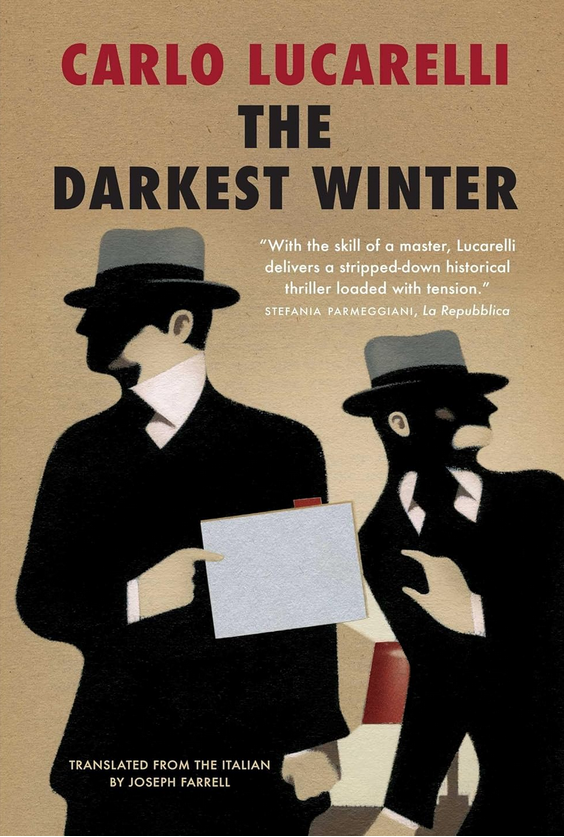
THE DARKEST WINTER . . . Between the covers

Bologna, northern Italy, November 1944. The introduction to this excellent novel explains the political situation in more detail but, in a nutshell, Italy is divided. The provisional ‘free’ government has surrendered to the Allies who are, painfully, fighting their way north up the spine of the country. Most of Italy – including Bologna – is still under German control. The city, with its ancient churches, porticos and squares, now resembles a giant farmyard. Rural villages around the city have now moved in, bringing livestock and farm carts full of straw and root vegetables.

Bolognese copper Comandante De Luca has three murders to investigate. The three dead men giving De Luca a headache are: Francesco Tagliaferri, in life an engineer, in death just a corpse with a shattered head, slumped against the column of a portico in Via Senzanome; Professor Franco Maria Brullo, of the city’s Faculty of Medicine, shot dead through the eye; most problematic, given the Germans’ penchant for violent retribution, is the corrupted body of a minor SS functionary, Rottenführer Weber, found floating in a flooded cellar. The latter is key, as if De Luca doesn’t solve the killing of the SS corporal the Nazi authorities will execute ten random Italian prisoners pour encourager les autres {or its equivalent in Italian.

As Caliban said, “The isle is full of noises,” and among the ‘noises’ to disrupt the lives of Bologna’s citizens are The Black Brigades (ultra violent fascist volunteers), the Bodogliani (left wing partisans loyal to the the King) and activists with all manners of allegiances in between. Rather like Philip Kerr’s immortal Bernie Gunther, De Luca tries to be a decent copper with his left hand tied behind his back and the fingers of his right holding his nose against the stench of corruption.

Parts of Bologna resemble a nightmare visualised in a Bosch painting. A young man in a derelict theatre – where shattered families are trying to rebuild their lives in the boxes once patronised by wealthy theatre-goers,  faces Deluca. When challenged for his identity, he says,

“What do you want to see? My military rank? My exemption from labor?” He beat his hand on his shoulder and grimaced because he must have hurt himself. “Here are my documents. This,” he shook the empty sleeve, “I left in Russia. And what I am wearing,” he held the flap of his coat, “is all I have left.”

The Bologna winter is certainly dark, but Lucarelli’s prose renders the shattered city with the inky blackness of a genuine Noir novel.

“There was in the air the scent of old smoke, ashes and wet filth which Bologna always had during that year and a half of war. Damp and sticky in summer, dry and biting in winter. The stench of boiled cabbage and burnt oil, of urine and excrement, sweat and dust, cold and coarse like rusted iron.”

While reading this, my mind strayed to Joseph Heller’s Catch 22. Not only was Bologna the target for Yossarian’s squadron but, towards the end of the book, a cold wind blows away the buffoonery, and we are left with the blacked out streets, and the grim murder of the maid Michaela, by the psychopathic navigator, ‘Aarfy’ Aardvark.

Lucarelli gives us a labyrinthine plot and a reassuringly fallible central character, who makes many mistakes and wrong calls as he searches for the truth. Reassuringly, there is also a full glossary explaining the multitude of different factions and splinter groups which made up the Italian political landscape in 1944. Bizarre though it sounds given their brutality, the Wehrmacht and the SS give a sense of relative unity to what was, otherwise, chaos.

This novel follows on from three earlier books, known as the De Luca trilogy, consistg of  Carte Blanche (it: Carta bianca, 1990), The Damned Season (it: L’estate torbida, 1991), and Goose Street (it: Via Delle Oche, 1996). The Darkest Winter, translated by Joseph Farrell, is published by Open Borders Press/Orenda Books, and will be available on 22nd May. For an Englishman’s view of a very different Italy, a few months earlier than Lucarelli’s story, you should read There’s No Home by Alexander Baron, where we join a British unit in the south of the peninsula, not long after the Germans had retreated to their defence lines further north.

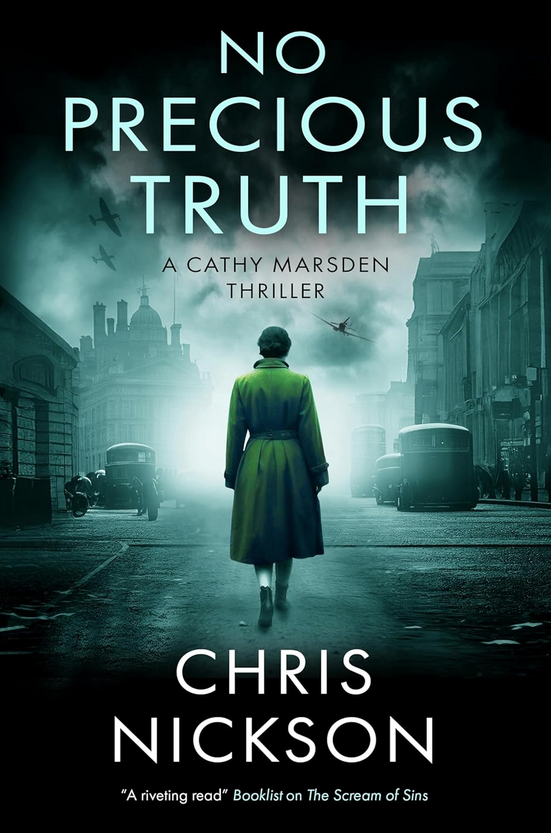
NO PRECIOUS TRUTH . . . Between the covers

In my reading experience, there is no living writer so closely associated with one place than Chris Nickson. Phil Rickson had his Welsh Marches, Robert B Parker had his Boston, Colin Dexter had his Oxford and Christopher Fowler had his (peculiar) London. Sadly, Time has borne those four sons away, but Nickson’s Leeds is now rediscovered in the first of a new series.

It is February 1941. Cathy Marsden is a Sergeant in the Leeds police, but has been seconded to the Special Investigations Bureau, a unit recently set up to investigate black marketeers and other criminals looking to make money out of the war. She is astonished when her older brother, Daniel, turns up at the office. As far as she was aware he was humdrum civil servant in London, pushing pens and folders of documents from one desk to another. Like her, however, he has been seconded, but to another top secret intelligence service, and he is in Leeds to track down a dangerous Dutch double agent called Jan Minuit.

Although I have read and enjoyed them all, Nickson’s Leeds novels tend to have a similar plot, which is basically a manhunt. This enables the author’s creations from Simon Westow to Tom Harper (who gets a brief mention here) to pound the streets of the city in search of a villain. The technical aspect of this is not complicated, as it enables Nickson to put his unparalleled knowledge of the topography to good use. He is clearly in tune with a kind of of geopsychology, which enables readers to follow the footsteps of his characters across the decades, so that thoroughfares like Briggate, The Headrow and Kirkgate become as familiar as our own back yards.

If Minuit is bent on sabotage, Leeds has two prime targets for an agent of The Third Reich. One is pretty much in the open. The Kirkstall iron foundry has been producing components for military vehicles since WW1 and is hard to disguise. The Avro factory at Yeadon, however has been covered in camouflage and disguised – from the air – as open country. This ‘shadow factory’ is working day and night to produce Lancaster bombers, as well as the less celebrated (but equally vital) Anson.

Nickson has a well-established style. It is propulsive. Short sentences. A sense of urgency. Genuine narrative drive.

“Cathy turned off the ring road and started up Wheatwood Lane.The daylight was lasting longer, barely a stretch of dusk on the horizon. Ahead of her, the hill rose steeply, fields on either side, farmland.No chance to go more than a few yards.The road was filled with police cars, a pair of ambulances and the black coroner’s van.,”

“Monday dawned sour with threatening clouds, the colour of old bruises. The air was thick and damp. Yesterday’s promise of spring had vanished like a magician’s illusion. Instead, the rain felt that it like might begin at any time. At least it would deter the Luftwaffe.”

There is a thrilling conclusion to the team’s pursuit of Jan Minuit, and it is Cathy’s resilience and strength which eventually brings the spy/saboteur to his knees. Chris Nickson’s skill lies in his ability to convince us that we are standing beside his characters and sharing their world. In this case, it is Cathy Marsden’s wartime Leeds, with its rationing and privation, its fear that clear nighttime skies will be a gift to the Luftwaffe, and the ever present fear in the hearts of local women that their father, husband, brother, son or boyfriend will be the next name on the mounting list of casualties.

Nickson also reminds us that the horrors of WW1 cast a long shadow. Cathy’s father, once a strapping Yorkshire lad, was gassed in the trenches, and over thirty years later is a wreckage of a man, struggling with the essentials of existence – such as breathing. No Precious Truth will be published by Severn House on 1st April.

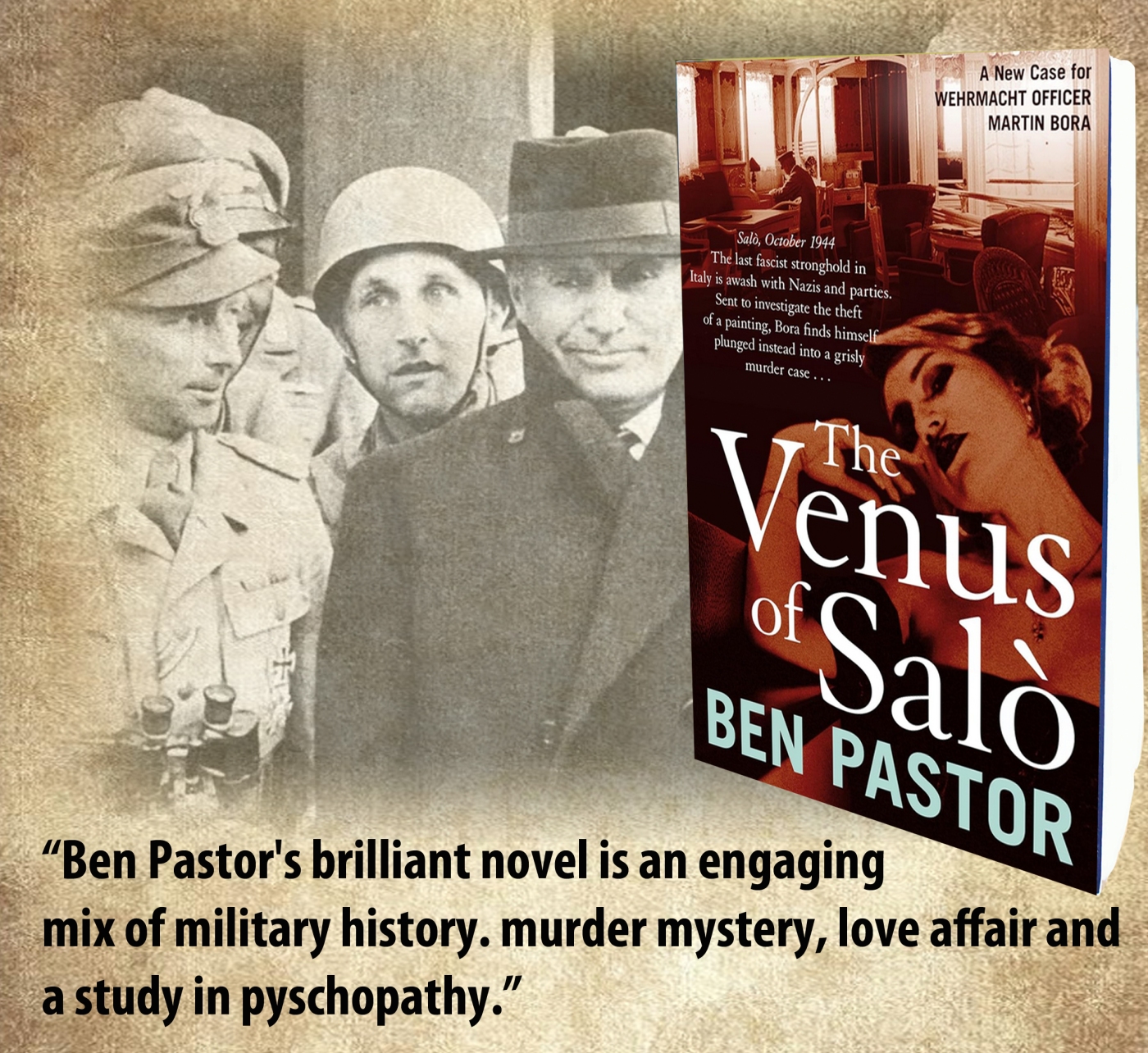
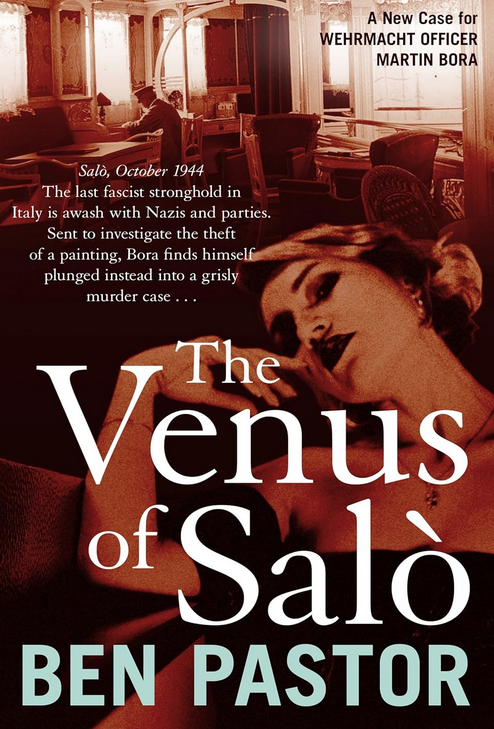
THE VENUS OF SALO . . . Between the covers

tvos spine052 copy

Not for the first time, I am a late arrival at the party. This is the eighth book in a series featuring Wehrmacht soldier, Colonel Martin Bora. We find him in the north of Italy, in October 1944. It is a strange time in Italian  history. The Allies have, at huge cost, breached the various German defensive lines, even the formidable Gothic Line. But winter, with its rain and snow, is not far away, and the  fighting in late 1943/early 1944 was a brutal and sapping experience the Allies are unwilling to repeat. In the far north, there is a last pocket of Fascism. This time line of that eventful period may provide a useful backdrop.

25th July 1943, Mussolini dismissed by KIng Victor Emmanuel III and arrested.
12th September  1943, Mussolini rescued from imprisonment by German special forces.
23rd September 1943, Italian Social Republic created, with its capital at Salò.
29th September 1943, the rest of Italy surrenders to the Allies.
28th October 1943, National Republican Army (Esercito Nazionale Repubblicano) created, loyal to Mussolini.
8th December 1943, Republican National Guard created, loyal to Mussolini.
4th June 1944, Allies enter Rome.
20th July 1944, Hitler survives the von Stauffenberg assassination attempt.
14th October 1944, Rommel commits suicide. Announced as death from complications from an earlier road accident.

Most of the action takes place in and around Salò, a town on the shores of Lake Garda. In the mountains and valleys around, German forces and Italian troops loyal to Mussolini are fighting a savage war against Italian partisan groups. Martin Bora, a veteran of campaigns including a spell on the Eastern Front, has been driven by Gestapo agent Jacob Mengs to Salò, where he is told to investigate the theft of a priceless Titian painting, known as The Venus of Salò. It had been ‘borrowed’ from its owner – Giovanni Pozzi –  a rich Italian textile magnate, and was hanging in the HQ of the local German army commander when thieves created a diversion, and cut it from its canvas.

In the novel, everyone is at each other’s throats. The ENR can’t stand the RNG (see the timeline), the SS and the Gestapo loathe the regular German army, and the German high command have scant respect for their Italian allies. Even the Italian partisans – divided into communist and royalist bands –  are at daggers drawn with each other; both however are contemptuous of local farmers and peasants, especially those they suspect of being collaborators.

As Bora investigates the theft of the painting, there are three deaths which puzzle him. First, a music teacher hangs herself. Then, the maid of a renowned soprano apparently shoots herself with a pistol given to her by an RNG captain, and a seamstress is butchered with a razor-sharp blade. While trying to work out how the three deaths are connected, Bora is entranced by his own flesh and blood ‘Venus’ in the shape of Annie Tedesco, widowed daughter of Giovanni Pozzi. What Bora doesn’t know (but we do, of course) is that all the while he is being set up by the Gestapo and SS. Orchestrated by Jacob Mengs, a dossier of Bora’s apparent disloyalty to the Third Reich is being prepared and, in the wake of the July plot.

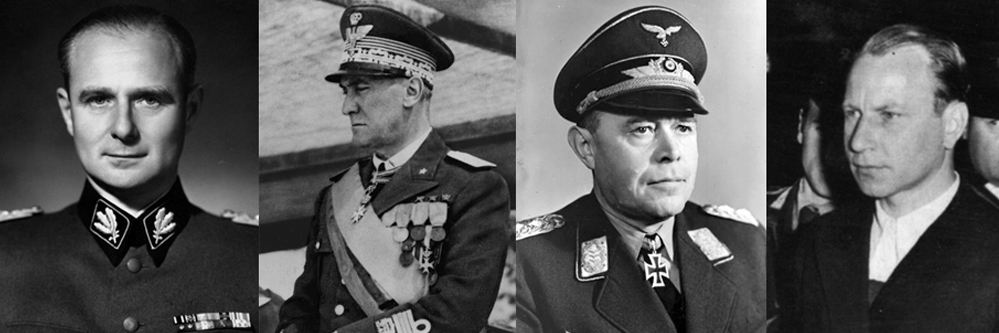
Most of the book’s characters are fictional, with the exception of a few more exalted figures (left to right, below), such as SS Obergruppenführer Karl Wolff (Himmler’s adjutant), Marshal Rodolfo Graziani, head of Italian troops loyal to Mussolini, Generalfeldmarschall Albert Kesselring, and top SS man Herbert Kappler.

Fourmen

The notion, in WW2 fiction, of ‘the good German’ as a central character, is certainly not new. Perhaps the best known of these characters is the late Philip Kerr’s Bernie Gunther, but there is also a good series by Luke McCallin featuring Hauptmann Gregor Reinhardt. The ‘good German’ as a concept in real history is much more complex; at a senior level, Rommel was forced to commit suicide over his alleged involvement in the von Stauffenberg plot, and Admiral Wilhelm Canaris, chief of the Abwehr (German Military Intelligence), was hanged for treason by the SS just weeks before Hitler committed suicide. Shamefully, Albert Speer, after his release from prison in 1966, made a decent career – lasting almost twenty years – as a media personality and TV ‘talking head’ on the Nazi era.

Ben Pastor’s brilliant novel is an engaging mix of military history. murder mystery, love affair and a study in pyschopathy. Beyond the fiction, however, she reminds us that, for the Allies, the fighting continued almost to the proverbial eleventh hour – the surrender of German forces was formally accepted on 2nd May 1945. The carnage in Italy cost the German army between 30K – 40K dead. The allies suffered more grievously, with deaths estimated as 60K – 70K. The Venus of Salò is published by Bitter Lemon Press and is out now.

Screen Shot 2024-05-08 at 19.53.52

THE HUMAN KIND . . . Between the covers

thk spine045 copy

This is the third novel in Alexander Baron’s WW2 trilogy, and it is rather different to the previous books, although there are obvious links. From The City, From The Plough tells the story of a group of soldiers preparing for, and then taking part in, the invasion of Normandy in 1944, while in There’s No Home the focus is on just a few weeks where an army company takes up residence in the Sicilian town of Catania in 1943. The titles are hyperlinked to my reviews of the novels.

The Human Kind is a sequence of short stories or vignettes, presented as being mainly autobiographical, and they reflect a wide variety of incidents and experiences involving men at arms. I use that phrase intentionally. I an surely not the first person to compare Baron’s trilogy with Evelyn Waugh’s magisterial Sword of Honour trilogy, which comprised Men at Arms, Officers and Gentlemen and Unconditional Surrender. There are stark differences, obviously, in that Waugh’s novels saw soldiering through the eyes of middle class officers. The central character, Guy Crouchback, is from a minor-aristocratic Roman Catholic family, while Baron was a Jewish man from London’s East End. What connects the two trilogies, however, is keen social observation, repeated ironies of circumstance and – most importantly – the fact that for many men the war and military life became central to their very being, despite the obvious hazards and unpleasantness. Baron – a communist in his youth –  himself probably despised Waugh’s upper-middle-class reactionary views but he admired his writing, saying it was, “a magnificent illumination of a whole complex of human problems.”

Each of the stories except one, which I will return to, references the military campaigns – Italy, Normandy and Belgium – described in the earlier books. The one that affected me most was Mrs Grocott’s Boy. Raymond Grocott comes from The Potteries, where he lives with his widowed mother. He is, to use an old word, gormless. Nowadays, I suppose, he would have been long since diagnosed with ‘special needs’, and he has failed the basic intelligence test required to be admitted to the army. Having persuaded those in authority to let him join, he takes part in the invasion of Sicily. Contracting malaria, he is invalided out, but is desperate to rejoin his unit which, with some degree of innate cunning, he does. In a stroke of irony that Thomas Hardy would have loved, his company is selected to be shipped home to prepare for the Normandy landings. Out of a misplaced sense of kindness, Raymond’s fellow soldiers cover for him and try to keep him on the straight and narrow paths but, as the landing craft approaches the French beach it finally dawns on him that he could be killed, and he pleads to be sent to the rear for medical attention. It is too late. Somehow, he survives, having been driven on by an NCO. But when what remains of the platoon finally bivouacs in a relatively safe place, he is handed a written order transferring him away from danger and into the care of the medics. As he trudges away, he has a solitary flash of self awareness and he curses the well-meaning men who have delivered him to a place of shame. His parting words to his colleagues are, “I hope you die. I hope you all die.”

Screen Shot 2024-04-17 at 21.05.26There is black humour in some of the stories, as well as a dark awareness of sexuality. In Chicolino, the soldiers in Baron’s platoon ‘adopt’ a homeless Sicilian boy, just into his teens. They share rations with him and treat him kindly, but are shocked to the core when he assumes that they will want to have sex with him in return for their kindness. He would have been quite happy to oblige, and is hurt and humiliated by their rejection. In The Indian, Baron retells the story from There’s No Home of how Sergeant Craddock comes to sleep with the beautiful Graziela. It is the appearance of a drunk but harmless Indian soldier that brings them into each other’s arms. Readers who, like me, are long in the tooth, will remember watching a 1963 movie called The Victors, directed by Carl Foreman. Alexander Baron was the screenwriter, and the story Everybody Loves a Dog, which relates the unfortunate consequences of a friendless and inarticulate Yorkshire soldier befriending a stray dog, was one of many memorable scenes in the film.

One of Baron’s colleagues is an intelligent and educated man called Frank Chase. In The Venus Bar, we read of his liaison with a beautiful but ruthless Ostend brothel owner.  but in Victory Night, the war has taken its toll and Chase is shipped home, psychologically broken. He is hospitalised, but can make no sense of his situation.

“He was too bewildered to fight against his loneliness. He did not visit London. It was only to the immediate past, to us, that his memory was able to reach. Peace time had passed out of his life. He was afraid to go to London in search of the ends of long-broken threads. He wondered about in a days, hardly aware of anything that happened except the arrival of letters from his old comrades. He hugged these to him, for they were the raw material of dreams, daydreams that burst inside him like magnesium flares, illuminating with brief, ghostly intensity the supreme experiences he had to live through.”

When victory in Europe is finally declared, Chase is horrified by the drunken celebrations in an English village.

“The faces streamed past him, faces for a Bruegel, red and ugly with drink, the fat faces of alewives glistening with the distant firelight, the suet- lump faces of men who had not been judged young or intelligent enough to die, the vacuous whore-faces, pathetically greedy for pleasure, of little village girls. They squealed and shrieked, filled the night with graceless laughter, bawled idiot songs, coughed, screamed, yelled and belched.”

There are twenty five stories in all in The Human Kind, and all but two are reflections on Baron’s war service. The last one, An Epilogue, is a brief story of something that happened in the Korean War, by which time Baron had been in ‘civvy street’ for some time, but Strangers To Death, the first tale in the book, recounts an incident from Baron’s childhood. He says he was sixteen at the time, so this would place the events in the summer of 1933. He is the proud owner of a new sports bicycle, and he joins a group of local youngsters who cycle out from their East End homes to nearby countryside to camp on the banks of the River Lea. Here, they swim, smoke, cook meals and relish the fresh air, but when one of their number is trapped in the silk-weed growing from the river bed, and drowns, the atmosphere becomes sombre. It was probably Baron’s first intimate encounter with death, but with the insouciance of youth, he and his mates are soon back in the river, daring each other to play tug-of-war with the silk-weed and trying to get as close to the treacherous currents of a weir as they dare. On the way home, Baron comes even closer to death when, his spectacles blurred by rain, he collides with a tram. Miraculously, he is thrown clear, unharmed apart from a graze, and even his precious ‘Silver Wing’ bicycle is undamaged. He would of course, come to stare death in the face all too frequently just ten years later.

It would be inaccurate to say that Baron is a ‘forgotten’ writer, but his name would not be included in most people’s list of great English writers of the final decades of the twentieth century. Many of his other novels, often set in the Jewish London of his youth, are still in print, but his take on what war does to men, women and children is astonishing. His compassion, empathy and simple understanding of humanity should put his books up there with the best contemporary accounts of a disastrous – but necessary – conflict. The Human Kind is republished by The Imperial War Museums,and is available now.

Blog at WordPress.com.

Up ↑