Search

fullybooked2017

Tag

WW1

THE WILD DATE PALM . . . Between the covers

In 1882, a group of Romanian Jews, fleeing religious persecution, bought land in Palestine and, with later help from the Rothschild family, founded the town of Zikhron Ya’akov. It is here in the years just before The Great War that we meet Shoshana Adelstein, elder daughter of a farmer whose vineyards contribute to the local wine making industry. After a love affair that ends unhappily, she marries a wealthy Turkish businessman, and moves to Constantinople.

1915 finds her bored, restless and stifled in a loveless marriage, but with her adopted country at war with Britain, France and Russia, she is anxious about her people in Palestine and, deceiving her husband, boards a train to Haifa. What she sees – displaced Armenian Christians being harried and beaten by Turkish soldiers –  as the train trundles over the Anatolian plateau, shapes the rest of her life. On her return to Zikhron Ya’akov and appalled by what she has witnessed from the train window, Shoshana envisages that after the Armenians, the Jews living across the Ottoman empire will be next, and she vows to take action.

Together with her brother Nathan and her lover, Eli, Shoshana creates an intelligence network to gather information on Turkish troop movements, defensive works, logistics and troop morale. Eventually, contact is made with the British administration in Cairo, but as Shoshana’s network expands, its vulnerability to betrayal increases exponentially. I can take or leave some of the more frothy romantic sections of this book, but when Shoshana reconnects (they had met briefly before the war) with a certain young army officer called Thomas Edward Lawrence, the spark (for me) was lit.

Lawrence is in Cairo with his colleague, archaeologist – and intelligence agent – Leonard Woolley, and they are determined to disrupt the Turks in every way possible. History hands us so many ironies: Lawrence and the Jewish intelligence agents have a common enemy in the Turks, of course, but look for totally incompatible outcomes. Lawrence has promised an Arab homeland to the tribesmen he leads, while Shoshana and Nathan want a land where Jews can prosper.

The best fiction closely shadows real life and, in both reality and imagination, the worst betrayals come from within. Not from a snarling enemy, but from those once thought to be friends. The Wild Date Palm is a chastening example of how easily loyalty can be corrupted. The title of the book is deeply significant as, in the last chapter, Diane Armstrong slows us that life can truly spring from death, and that despair can be the mother of hope.

The slaughter of Armenian Christians before and during The Great War is a matter of historical record,  Two decades later, another horrific act of genocide occurred and Danuta Julia Boguslawski, born in 1939 in Kraków, Poland, is well qualified to write about such things. She and her family survived the war and, in 1948, they emigrated to Australia. Now, writing as Diane Armstrong, with a long and successful career as a writer behind her, she has written a novel of great power and compassion, set in a time of turmoil and unimaginable cruelty. Published by HQ fiction, The Wild Date Palm is available now.

BASED ON THE BOOK BY . . . Paths of Glory (Part One)

Header

Stanley Kubrick’s 1957 film The Paths of Glory was a limited success at the time – it just about broke even at the box office – and was initially highly controversial. It was banned in France for twenty years, and several other European countries refused to show it as a gesture of solidarity with France. It was also banned in all American military establishments. So, why the fuss?

George-macready-trailer

The film, based on a book by American writer Humphrey Cobb, focuses on a section of The Western Front in 1916 held by the French. Although it is never mentioned in the film, we assume that the action takes place around Verdun, the most costly single engagement in a war that chewed up men’s lives like a meat grinder. The 701st Regiment are ordered to attack an impregnable German position known as ‘The Anthill’. General Miraud, (George Macready, above) after initially protesting to his superior that the attack would be suicidal, changes his mind after being offered promotion.

38-kirk-douglas-theredlist

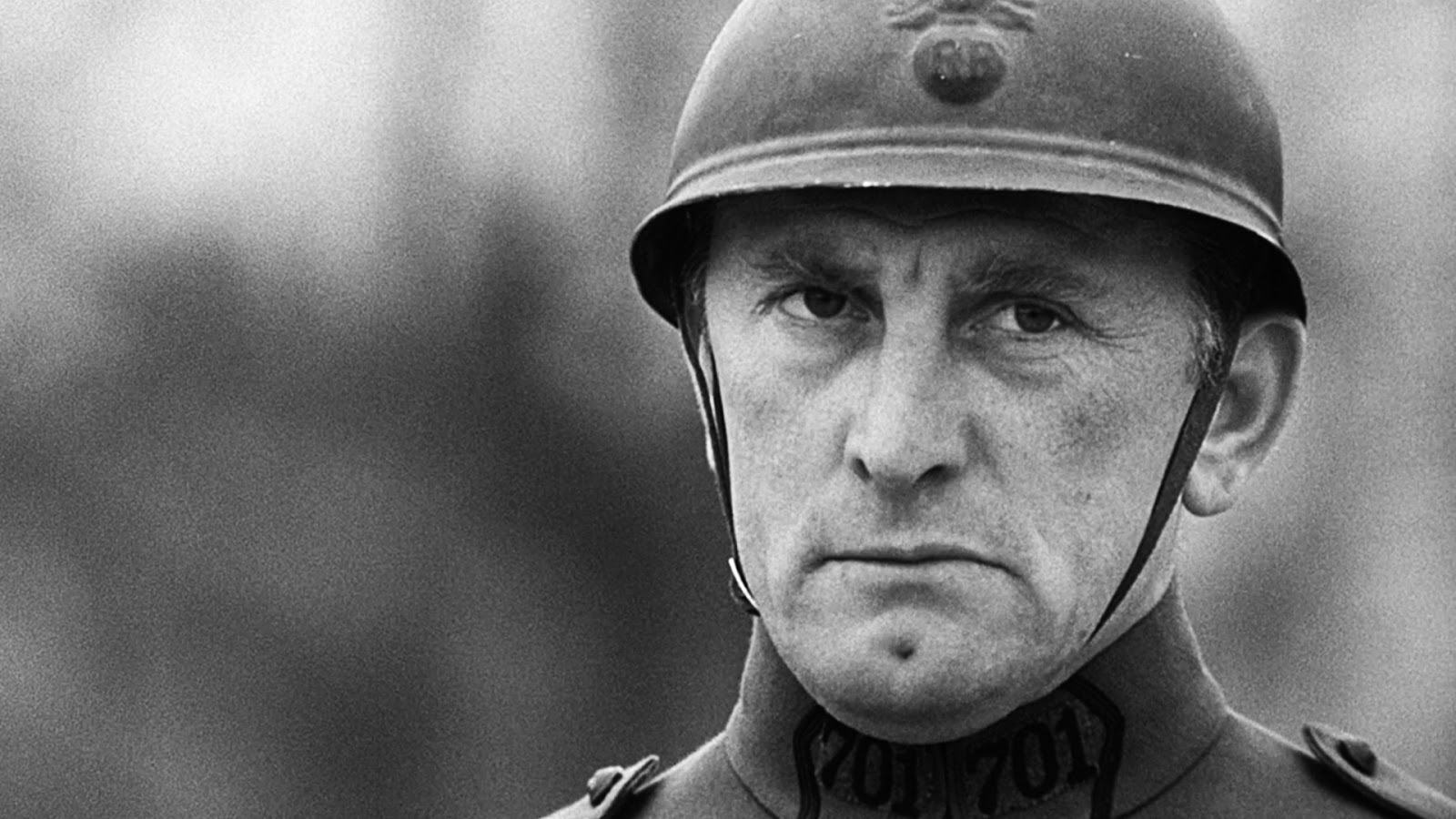
Colonel Dax (Kirk Douglas, above) is the officer who will lead the attack. He is dubious about the prospects, but obeys the order. The attack is an unmitigated disaster. German shellfire halts progress in No Man’s Land, while one company is unable even to leave the trench, such is the ferocity of the bombardment. In a rage, Miraud orders his artillery to fire on his own lines in order to force the men to attack.

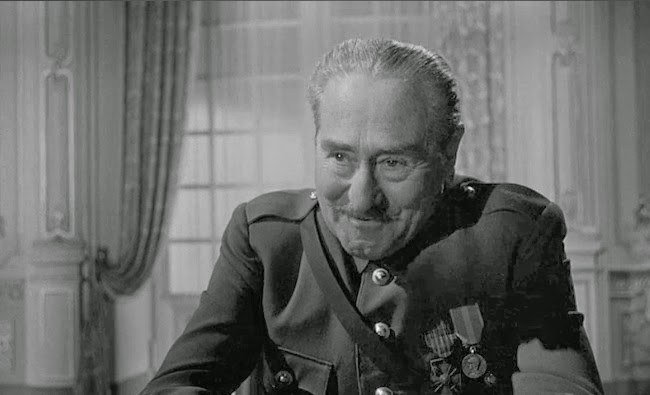
Miraud feels that his own honour has been impugned, and, after removing the regiment out of the line to a chateau some miles away, orders that 100 of the surviving men be arrested and charged with cowardice. The scheming General Broulard ( Adolphe Menjou, below) suggests that just three men will be enough pour encourager les autres, and Dax is forced to ask three of his company commanders to select three sacrificial victims.

adolphe menjou


Three men are chosen: Corporal Paris (Ralph Meeker) is selected because his superior officer, Lieutenant Roget, needs to silence him in case he exposes Roget’s cowardice. Private Arnaud’s name is simply drawn out of a hat, while Private Ferol (Timothy Carey) is a deeply unpleasant individual who, it seems, ‘has it coming’.

The three men are tried
in a mockery of a judicial process, despite an impassioned defence by Dax, who was a lawyer in civilian life. They are sentenced to death. Dax has one last card to play. He has a written testimony that Miraud has ordered gunfire down on his own men, but it is dismissed by Broulard. The men are duly executed, with one of them, Arnaud, strapped to a stretcher after being seriously injured in a fight with his guards.

Broulard and Miraud are enjoying a leisurely breakfast in luxurious surroundings, when Dax is invited to join them. He shares his information about Miraud’s order to shell his own trenches. Miraud is told that he will face and enquiry, and then storms out voicing a sense of betrayal. Broulard congratulates Dax on a very clever plan to secure his own promotion. Dax finally loses his temper at this interpretation of his motives and rages at his superior officer.

Back at the chateau, the surviving members of the 701st Regiment are in an estaminet, drunk and reckless. The proprietor pushes a young German girl onto the makeshift stage and forces her to sing. She hesitantly sings an old song. “Der treue Husar” (The Faithful Hussar). The men’s mockery turns to empathy and then grief, as they join in with the song. Outside, Dax has just been given the order that the 701st are to return to the front line with immediate effect.

In Part two of this feature, I will explore the differences between the book and the film, and attempt to understand what Cobb and Kubrick were trying to say about this tragic episode in European history.

Blog at WordPress.com.

Up ↑